<!doctype html>
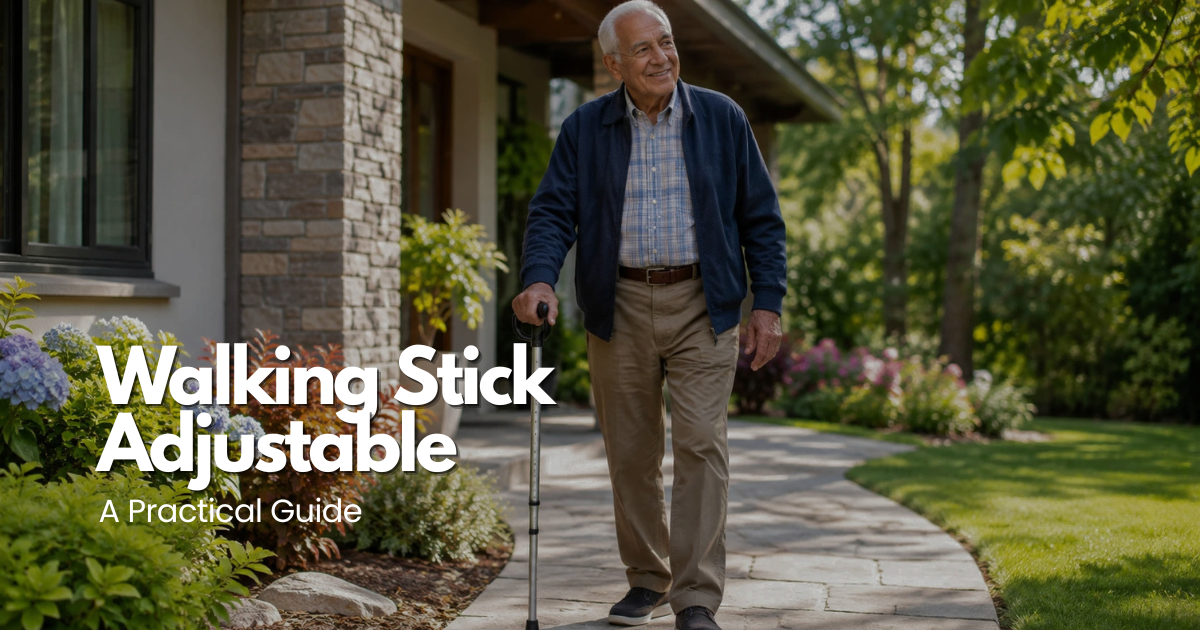
For seniors experiencing mild balance difficulties or reduced walking confidence, an adjustable walking stick may provide a useful additional point of ground contact. Its effectiveness depends on the person’s physical abilities, the equipment’s construction, and the environments where it will be used. Proper fitting, a secure locking mechanism, and a compatible rubber tip are essential considerations.
A walking stick adjustable should also be evaluated according to the user’s long-term mobility needs. Some people require occasional support during short walks, while others depend on a medical cane or walker for more consistent assistance. Understanding these differences helps older adults and caregivers make informed decisions without relying exclusively on product advertisements or customer ratings.
This guide explains how to choose, adjust, inspect, and maintain an adjustable walking stick. It also explores walking techniques, outdoor conditions, home safety, Medicare considerations, caregiver responsibilities, and situations where professional mobility assessment may be necessary.
Safety note: A walking stick does not eliminate the risk of falling and should not replace medical evaluation when walking ability changes. Sudden weakness, severe dizziness, new difficulty walking, or injuries following a fall require appropriate medical attention. If a person is uncertain whether a walking stick provides sufficient support, consult a qualified healthcare professional before using it independently.
Quick answer: how to evaluate walking stick adjustable
The most suitable walking stick adjustable is one that fits the user’s body dimensions, provides comfortable hand support, maintains reliable contact with the walking surface, and has a secure adjustment mechanism. Its design should match the person’s balance needs, walking habits, and everyday environment rather than simply offering the greatest number of features.
An adjustable walking stick is often chosen for its customizable height and convenient handling. Nevertheless, these features offer meaningful benefits only when the device is correctly fitted, regularly inspected, and appropriate for the amount of support the person requires.
Before selecting an adjustable walking stick, examine the following:
- Adjustable height range: Confirm that the available settings accommodate the user’s natural standing position and arm length.
- Handle design: Choose a grip that feels secure and comfortable without requiring excessive hand pressure.
- Locking mechanism: Verify that the adjustment pin, collar, or other securing system engages properly.
- Rubber tip: Inspect its construction, ground contact, wear resistance, and compatibility with the walking stick.
- Material and construction: Consider durability, weight, shaft stability, and the manufacturer’s stated limitations.
- Walking environment: Evaluate indoor flooring, outdoor surfaces, stairs, thresholds, and frequently used routes.
- User mobility: Consider balance, coordination, hand strength, endurance, and the amount of weight-bearing assistance needed.
- Professional fitting: Seek individual assessment when the walking stick will be used to compensate for a medical mobility limitation.
The right walking stick adjustable should support a comfortable walking posture without encouraging excessive leaning, shoulder elevation, or unstable movements. A short trial in a store may help assess comfort, but it cannot fully establish whether the equipment will perform appropriately during ordinary daily activities.
For a more reliable decision, compare the device’s specifications with the individual’s needs and arrange supervised practice when necessary. If the walking stick does not provide adequate stability, a medical cane, quad cane, or walker may be a more appropriate option.

Adjustable walking stick — What “walking stick adjustable” means
The term walking stick adjustable describes a walking aid whose shaft can be lengthened or shortened using a built-in mechanism. This design allows users to select a height within the product’s specified adjustment range without permanently cutting or modifying the shaft.
Many adjustable walking sticks feature telescoping sections that slide into one another. Common mechanisms include spring-loaded buttons, multiple adjustment holes, tightening collars, and other manufacturer-specific locking systems. Each design has advantages and limitations related to convenience, stability, maintenance, and ease of adjustment.
A walking stick adjustable may be manufactured from aluminum, wood combined with adjustable components, composite materials, or other engineered structures. Aluminum models are common because they can offer a useful balance of low weight and durability, although the actual performance depends on product construction and intended use.
Some adjustable walking sticks are designed primarily for recreational walking or hiking. Others are marketed as mobility aids for older adults or individuals requiring additional support. These categories are not interchangeable, and a product should not be considered medically suitable simply because its height can be adjusted.
When comparing models, check the manufacturer’s intended purpose, available height settings, handle dimensions, maximum specified load, and replacement-part availability. Pay particular attention to whether the device is designed for occasional balance assistance or more consistent everyday use.
The advantage of adjustability is flexibility, but it also introduces components that require routine inspection. An adjustable walking stick with a damaged locking pin or unstable telescoping shaft may be less dependable than a properly fitted fixed-length model in good condition.
For seniors and caregivers, the most useful definition of a walking stick adjustable is therefore not simply a stick that changes height. It is a walking aid whose fit, mechanical security, and level of support must be considered together.
Cane, walking stick, and quad cane: practical mobility and caregiver questions
Walking sticks, standard canes, and quad canes may look similar, but their designs can provide different kinds of support. Understanding these distinctions is especially important for older adults whose walking difficulties involve weakness, pain, impaired coordination, or reduced balance.
A traditional walking stick is frequently used for light assistance, outdoor walking, or an additional point of contact with the ground. It may be appropriate for certain users who remain generally stable but appreciate occasional support. However, a decorative or recreational walking stick is not automatically suitable for medical mobility needs.
A standard medical cane is designed for walking assistance and may help some individuals redistribute part of the load associated with a painful or weaker leg. Proper selection, height adjustment, and walking technique are important because incorrect use can create additional strain or instability.
Quad canes have a broader base featuring four contact points. This design may offer additional stability for selected users, although the base must be positioned correctly and the device may be less convenient in narrow spaces or on uneven surfaces.
Walkers generally provide a wider support structure and may be appropriate when a person requires more consistent assistance. However, different walker designs, including standard walkers and rollators, also have distinct requirements and limitations.
| Mobility aid | Typical design | Important consideration |
|---|---|---|
| Adjustable walking stick | Height-adjustable shaft, usually with one tip | Convenient for certain light-support needs |
| Standard medical cane | Single-tip cane intended for mobility assistance | Requires proper fitting and coordinated use |
| Quad cane | Cane with four ground-contact points | May offer additional stability for selected users |
| Standard walker | Wider frame with multiple contact points | May be appropriate when greater support is needed |
| Rollator | Wheeled walking aid, often with brakes | Requires sufficient control and appropriate instruction |
A walking stick adjustable should be selected according to the person’s mobility requirements rather than appearance or convenience alone. Someone experiencing repeated balance losses may need a more supportive device, even if a lightweight walking stick is easier to carry.
Caregivers should also consider whether the user can grip the handle comfortably, control the equipment during turns, and navigate the home without creating new obstacles. A physical therapist can help determine which mobility aid offers the most appropriate support.
Walking stick adjustable: Why height adjustment matters
Proper height adjustment is one of the most important factors affecting the comfort and usability of a walking stick adjustable. A device positioned too high may encourage the user to raise the shoulder or hold the arm awkwardly, while one positioned too low may contribute to excessive leaning or an uncomfortable wrist angle.
An appropriately fitted walking stick generally allows the person to stand upright with a natural arm position. A common starting point involves wearing usual walking shoes, relaxing the arms at the sides, and checking whether the handle reaches approximately the wrist crease.
When the handle is held, the elbow should normally remain slightly bent rather than fully straight or sharply flexed. However, this is a general fitting guideline, and the correct position may differ according to the person’s mobility condition, posture, arm length, and professional recommendations.
The height-adjustment mechanism should also be easy enough for the intended user or caregiver to operate correctly. Some models require pressing a spring-loaded button, while others use additional tightening components that must be secured before walking.
After adjusting a walking stick adjustable, confirm that all relevant locking parts are fully engaged. A setting that appears correct while the stick is stationary may still be unsafe if the shaft shifts or the mechanism does not lock consistently.
Height should be reviewed when the user’s posture changes, different footwear substantially affects standing position, or the walking stick feels uncomfortable during ordinary use. Persistent discomfort should prompt reassessment rather than repeated trial-and-error adjustments.
The goal of height adjustment is not simply to make the equipment reach the ground. It is to support a comfortable, controlled walking position while remaining within the device’s intended specifications.
Adjustable walking stick — Handle comfort and grip
The handle of an adjustable walking stick determines how the user’s hand interacts with the device. A well-designed grip should feel stable, allow comfortable positioning of the wrist, and accommodate the individual’s hand size and strength.
Common handle styles include curved or crook handles, ergonomic palm grips, T-shaped handles, and softer cushioned designs. Each distributes pressure differently, so a handle that feels comfortable to one user may be unsuitable for another.
Older adults with arthritis, reduced grip strength, hand sensitivity, or limited finger movement may need particular attention to handle shape. A grip that requires excessive squeezing can contribute to fatigue, while a narrow or poorly positioned handle may feel uncomfortable during longer periods of use.
A walking stick adjustable with a soft grip may initially seem more comfortable, but the material should also provide secure control. Smooth, worn, loose, or slippery surfaces can interfere with handling, especially when hands are damp.
When comparing handle designs, evaluate how the walking stick feels while standing and during professionally recommended walking movements. The wrist should not need to twist excessively, and the handle should not rotate unexpectedly under normal intended use.
Caregivers should observe whether the person can place the hand on the grip without difficulty and maintain control when stopping or changing direction. Uncomfortable pressure, numbness, or repeated slipping suggests that a different design or professional assessment may be needed.
A comfortable handle is an important feature of a walking stick adjustable, but it does not replace the need for a secure shaft, appropriate height, and suitable ground contact.

Locking pins and adjustment holes: practical mobility and caregiver questions
The adjustment mechanism is a critical component of a walking stick adjustable because it determines whether the selected height remains secure during use. Many telescoping models use a spring-loaded pin that fits into one of several holes along the shaft.
Some walking sticks also include a tightening collar or compression mechanism intended to reduce unwanted movement. These components should be operated exactly as described in the manufacturer’s instructions rather than assuming all adjustable models work the same way.
Before using the walking stick, inspect the selected adjustment hole and confirm that the locking pin is fully engaged. If the manufacturer specifies an additional collar or securing step, complete that step before walking.
Unusual clicking, visible shaft movement, a pin that does not remain seated, or a collar that cannot tighten properly may indicate a mechanical problem. A walking stick adjustable should not be used when its locking system behaves unpredictably.
Adjustment holes can also become damaged through wear, impact, or improper handling. Inspect the surrounding material for cracks, distortion, or other changes that may affect the connection between the shaft sections.
Avoid drilling new adjustment holes, adding improvised fasteners, or modifying the locking mechanism. Such alterations can change the structural characteristics of the walking stick and may create hazards not addressed by the original product design.
If a locking component becomes damaged, contact the manufacturer or supplier regarding approved repairs or replacement. When reliable repair is not possible, replacing the device may be the most appropriate option.
A secure adjustment system is essential because even a well-fitted walking stick adjustable cannot provide dependable assistance when its height changes unexpectedly.
Walking stick adjustable: Rubber tip and ground contact
The rubber tip is the part of a single-tip walking stick adjustable that contacts the walking surface. Its condition influences how effectively the device maintains contact with the ground and how predictably it behaves during normal use.
Tips vary in shape, diameter, material, tread pattern, and flexibility. Some have a conventional rounded or flat base, while others use specialized designs intended for particular surfaces or movement patterns.
The appropriate tip depends on the walking stick’s construction and the user’s environment. A larger or differently shaped tip should not be assumed safer without confirming compatibility and considering the individual’s walking needs.
Over time, rubber tips can wear unevenly, lose tread, harden, crack, or become loose. These changes may reduce traction and create instability, particularly on smooth indoor floors or damp surfaces.
Inspect the tip for visible damage, embedded stones, dirt, and signs of separation from the shaft. If replacement is required, select the correct size and approved design specified for the walking stick adjustable.
Cleaning the tip may help remove debris that interferes with ground contact, but cleaning cannot restore worn material or correct structural damage. Replacement is necessary when the tip no longer meets the manufacturer’s condition requirements.
Even an undamaged rubber tip does not guarantee safety on wet tiles, ice, loose gravel, or other challenging surfaces. Environmental conditions and the user’s balance remain important factors.
Maintaining a suitable tip is a simple but valuable part of keeping an adjustable walking stick functional during everyday mobility.
Adjustable walking stick — Which hand should hold it
One of the most common questions about using a walking stick adjustable concerns which hand should hold the device. The answer depends on why the person needs assistance and whether the stick is being used for general balance support or a specific medical walking limitation.
For many individuals using a medical cane because one leg is weaker or painful, the cane is commonly held in the hand opposite the affected leg. This arrangement may support a coordinated walking pattern when taught and used correctly.
However, some people have different needs because of neurological conditions, reduced hand function, problems affecting both legs, or other mobility limitations. An individualized assessment may lead to different recommendations.
A walking stick adjustable used for light recreational balance support should not automatically be treated the same way as a prescribed medical cane. The device’s purpose, load capacity, and appropriate walking technique must be considered.
Caregivers should avoid changing the person’s established walking pattern without professional guidance, especially when the individual has previously received rehabilitation instruction. An unfamiliar technique may require additional coordination and can increase uncertainty.
A physical therapist can evaluate which hand provides appropriate control and demonstrate how to coordinate the walking stick with foot movement, turning, and changes in direction.
Correct hand placement is only one part of safe use. The person’s grip strength, shoulder comfort, posture, and ability to control the walking stick adjustable should also be considered before independent use.
IMAGE HERE
Neutral walking stick adjustable decision table
| Decision area | What can go wrong | Evidence to verify |
|---|---|---|
| Person or rider | Wrong fit, control, posture, or participation assumption | Measurements and supervised assessment |
| Environment or route | Clearance, surface, slope, parking, or transfer failure | Complete route test and measurements |
| Provider or seller | Missing service, repair, documentation, or return support | Written terms and named contact |
| Fallback | Delay, malfunction, fatigue, weather, or coverage denial | Backup route and escalation plan |
Official sources and limitations
These sources were consulted for the walking stick adjustable research map. They establish general U.S. safety, access, equipment, or coverage boundaries; they do not endorse a product, converter, seller, provider, ranking, or individual outcome.
- MedlinePlus — Using a cane — Fit, hand position, walking, stairs, and maintenance guidance; follow the user’s clinician or therapist.
- MedlinePlus — Mobility aids — Explains why fit and professional assessment matter for canes and walkers.
- NIA — Six tips to help prevent falls — Fall-prevention context including using a cane or walker when more stability is needed.
- NIA — Preventing falls at home — Route and home-environment risk reduction.
- Medicare.gov — Canes — Medicare coverage boundary; confirm current eligibility and supplier requirements.
- ADA — Mobility devices — Access context; does not determine individual fit or safe technique.