
Safety note: A GPS device is a location aid, not a medical alert service, fall detector, professional monitoring contract, or guarantee that an older adult will be found. It can be delayed, approximate, offline, uncharged, removed, or left behind. Do not use a GPS tracker for an older adult in Ireland to secretly monitor, restrain, or replace human care. If a person is missing or in immediate danger in Ireland, follow the response plan and contact An Garda Síochána or emergency services; do not wait for an app to refresh.
Quick answer: what should you check in a GPS tracker for an older adult in Ireland?
The first decision is the safety event you are trying to manage. Is the concern a familiar walk, getting lost after leaving home, a missed arrival, living alone, a rural route, or the need to summon medical help? A GPS tracker for an older adult in Ireland may provide a location clue or an alert after movement, but it will not prevent departure and it may not identify the room, field, lane, or building where a person is located.
Keep the GPS tracker for an older adult in Ireland within a documented response plan rather than treating the map as the whole solution.
The same GPS tracker for an older adult in Ireland should be tested again whenever the route, network, or caregiver changes.
For this reason, a family can evaluate the GPS tracker for an older adult in Ireland as one layer within the wider safety plan.
For an Ireland-focused choice, check six connected questions: what stays with the person; which positioning and mobile technologies it uses; whether the service works on the actual Irish route; what hardware, activation, cellular, replacement, and subscription costs apply; who can see the location; and who responds when an alert arrives. Check the device at home, outdoors, in a vehicle, in a familiar destination, and in the places where coverage or battery loss is most likely.
Choose the simplest arrangement that the older adult accepts and the caregiver can maintain. A phone-sharing app may suit a person who always carries and charges a phone. A wearable may suit someone who forgets a phone but accepts a pendant or watch. A door sensor, identification card, check-in call, or telecare service may be more important than a map. The best outcome is a tested care plan, not the highest product rating.
When an Ireland GPS tracker for an older adult in Ireland can add useful information
A location device can help a caregiver understand where a person was recently seen, whether a planned route was followed, or whether an agreed zone was crossed. It can support a calm call, a destination check, or a faster handoff to people searching. Its value depends on freshness, coverage, battery, attachment, and an available responder. Treat the displayed point as evidence to interpret, not as a promise of continuous supervision.
When an Irish care plan needs another safety layer
If the primary risk is a fall, chest pain, confusion, wandering at night, inability to press a button, or a need for professional response, a GPS tracker for an older adult in Ireland alone may be the wrong tool. Discuss medical alert, telecare, home safety, or care-service options with an appropriate professional. A location service and an emergency response service are different products even when both use a phone application.
What a location pin cannot prove in Ireland
A pin cannot prove that the person is still there, that the device is on their body, that a road or building is safe, or that a caregiver can reach them. Signal reflections, walls, trees, topography, weather conditions, network gaps, and update intervals can all affect the result. A map also cannot assess pain, injury, distress, or whether the person understands a call.

Define the Ireland care situation before choosing a GPS tracker for an older adult in Ireland
The phrase “GPS tracker for an older adult in Ireland” can describe several different systems. Naming the event first prevents a family from buying a device for a problem it cannot observe. Write down who may be at risk, where the event occurs, how quickly someone needs to know, and what the caregiver can realistically do after receiving information.
Familiar walks and local errands in Ireland
For a person who walks to a shop, church, community center, or neighbor, the useful question may be whether the person arrived and whether they can find the way home. A GPS tracker for an older adult in Ireland may support a last-known-point check, but a destination contact and a predictable routine may be equally important. Test the route in ordinary clothing, including the roads, lanes, bus stop, shop, and indoor destination.
Wandering from an Irish home
Wandering can happen after a change in routine, a move, a desire to go somewhere familiar, or difficulty recognizing surroundings. A device may help after the person has left, while a door alarm, identification, neighbor awareness, lighting, and a written response plan may provide earlier or more useful support. Do not frame a GPS tracker for an older adult in Ireland as a way to lock a person in or remove their freedom.
Rural roads, farms, and coastal routes
Rural Ireland introduces route-specific questions: mobile signal can vary by valley, hill, building, operator, and weather; a displayed point may be broad; and a caregiver may be far away. Test the actual road, not just the house. Include gates, sheds, wooded areas, shoreline paths, public transport, and destinations where the person may go. Plan how a responder reaches the location safely.
Living alone or spending long periods alone
A GPS tracker for an older adult in Ireland can show a recent location, but it may not tell a remote caregiver that someone has fallen inside the home. Write the call schedule, the person who can visit, the backup if the first caregiver is unavailable, and the service that handles urgent medical needs. If the person cannot reliably call or respond, a different type of support may be more appropriate.
Day services, transport, and care handoffs
Handoffs create a common failure point. A person may leave home with one caregiver, travel with a driver, attend a day service, and return with another person. Decide who owns the device, who checks the battery, who receives alerts, and who may access location history. A tracker should not be passed between services without a clear responsibility agreement.
Medical, fall, or emergency concerns
Location and medical response are separate questions. Some devices have an SOS button or voice function, but that does not prove that a trained monitoring center, clinician, or emergency service will respond. Confirm the actual response model. If a fall or illness is the main concern, compare a medical alert or telecare pathway with the location option rather than assuming a GPS map solves the problem.
Understand types of GPS tracker for an older adult in Ireland available to older adults in Ireland
Before comparing features, identify the system’s moving parts. One product may depend on a smartphone, another on a cellular subscription, another on nearby Bluetooth phones, and another on a base station. The name on the box is less important than what the device carries, how it communicates, and who receives the result.
Phone-based location sharing for an older adult
A phone arrangement can work when the older adult already uses a smartphone, accepts location sharing, keeps it charged, and carries it outside the home. It may avoid a new wearable and provide familiar calling. It can fail when the phone is left on a charger, put in a bag, muted, switched off, restricted by battery settings, or separated from the person during a fall.
Test the locked phone in its ordinary case and pocket. Check location permissions, background activity, notifications, mobile data, battery saver, and the caregiver’s ability to distinguish a current point from an old one. If the phone is the only location source, include a routine for checking that it leaves the home with the person.
Standalone cellular GPS devices in Ireland
A standalone unit may communicate without a nearby smartphone, but it usually needs a compatible mobile network, a SIM or embedded service, battery power, an account, and an app or web portal. Ask which network or networks support the unit in Ireland, whether roaming is involved, what happens when service is suspended, and whether a UK plan remains suitable after travel or a change in provider.
Do not infer Irish coverage from a generic claim such as “works worldwide.” A device can use a roaming arrangement with different terms, data limits, or support boundaries. Verify the exact model, service plan, home address, usual routes, and destination countries before buying.
Bluetooth item finders versus person GPS trackers for elderly people in Ireland
A Bluetooth finder can help locate keys, a wallet, or a bag near a compatible phone. It may not provide independent outdoor GPS, a cellular connection, or a reliable person location. If the older adult leaves the tagged object behind, the map follows the object. This distinction matters when a family is concerned about wandering rather than misplaced property.
Watches, pendants, clips, and wearable GPS trackers for elderly people in Ireland
A watch, pendant, belt attachment, or clip may stay with the person more consistently than a phone in a handbag. It may also be removed for bathing, sleep, skin comfort, clothing, or privacy. Try the shape on the actual person. Check the clasp, weight, charging contacts, visibility, button size, voice quality, and whether the person can recognize the alert.
Vehicle GPS devices and the person-location boundary
A vehicle device reports the vehicle. It cannot prove which passenger is inside or where a person went after leaving the car. It may help with a transport plan, but it should not be described as a personal tracker unless the person also carries a separate location device. Keep this distinction visible in the caregiver worksheet.
Medical alarm devices with location features
Some medical alert products add GPS, two-way voice, or an emergency button. Verify the recipient of the button press: a family member, a monitoring center, a provider, or an emergency service. Check response hours, language, contract, battery, water limits, and what happens when the person cannot speak. Do not treat the word “SOS” as proof of professional response.
Check Irish mobile coverage and location behavior before purchase
In Ireland, a GPS device still depends on more than satellites. It may need mobile data to send a location to the caregiver, and the result can be affected by the building, route, terrain, carrier, network congestion, device design, and update schedule. The Commission for Communications Regulation provides a coverage map that lets consumers inspect predicted outdoor coverage by area, provider, and technology. Use it as a starting point, not as a guarantee for an individual device or indoor room.
Use an Eircode and the actual route for coverage checks
Check the home Eircode, the route, the destination, and the places where the older adult may stop. A coverage map can help compare predicted outdoor service, but it does not test a particular tracker’s modem, SIM arrangement, battery state, or indoor performance. A device using a virtual operator or roaming profile may not behave exactly like a phone on the network you normally use.
Test rural, urban, and indoor transitions
Run a safe route through the environments that matter: a housing estate, town center, rural lane, bus or taxi journey, shop, community venue, apartment entrance, garage, and home. Record the time displayed by the app, the age of the point, battery, signal status, and whether an alert arrived. Include a sheltered or indoor location because a strong outdoor map result does not establish room-level coverage.

Ask what “real time” means on an Ireland tracker
Ask how often the unit attempts a fix, what triggers an update, how long the mobile network can delay it, and whether the app displays the timestamp clearly. An alert may be triggered by movement, a zone crossing, a scheduled interval, a caregiver request, or a button press. These are materially different behaviors even when a listing uses the same “live” wording.
Separate location accuracy from location freshness
A recent point can be approximate, and a precise-looking point can be old. Teach caregivers to read the timestamp, battery, connection state, and confidence or radius display together. If the screen makes the age of the point hard to see, record that as a usability limitation. Never assume that the person remained at the last displayed point.
Check cross-border travel and roaming
Travel between the Republic of Ireland and Northern Ireland can change network and service conditions. Ask whether the device’s plan supports the intended travel, which country supplies support, how roaming is billed, and whether the caregiver can still access the same app. A family should test the travel route if cross-border movement is part of the ordinary routine.
Document coverage uncertainty honestly
Record where the device did not update, how long the gap lasted, and what the person was carrying. A failed test is useful information. It may lead to a different device, a second network, a phone call, a door alert, a destination check, or a decision not to rely on GPS in that location.
When reviewing service terms, keep the GPS tracker for an older adult in Ireland tied to the actual route, responder, and maintenance routine.
Compare the total cost and service terms of an Irish GPS tracker for an older adult in Ireland
A price in a search result is not the full cost of a working safety arrangement. Add the device, charger, strap or clip, activation, SIM or cellular service, recurring plan, taxes, data, replacement, support, return shipping, and caregiver time. Do not insert current prices into a general guide because availability and plans change; verify the exact model and Irish seller or provider.
One-time hardware and recurring location service
Ask what remains available if the recurring plan ends. Does the device stop communicating, lose history, stop sending zones, or retain only a local function? Check trial periods, automatic renewal, cancellation, pause options, and the date on which a plan begins. Keep confirmation of cancellation separate from the hardware return.
Irish VAT, currency, and imported-device questions
For a device bought from outside Ireland, verify the final delivered cost, VAT treatment, import or delivery charges, warranty jurisdiction, plug and charger, app region, and who handles returns. A lower displayed price can become more expensive after shipping, a replacement, or support delays. The practical question is what the family will pay to keep the exact service working in the person’s location.
Network, SIM, and account ownership costs
Find out whether the provider supplies the SIM, whether the account is tied to the seller, and whether a caregiver can transfer ownership. Ask what happens when a phone is replaced, a card expires, or the older adult’s service changes. A device that cannot be transferred cleanly may create a gap when the primary caregiver changes.
Replacement, repair, and return conditions
Read the return window, restocking rule, water or physical damage exclusions, warranty length, repair address, and service cancellation steps. Activate and test promptly. If the device does not fit, will not stay charged, or cannot cover the actual route, document the problem while the return option is still open.
Support in the caregiver’s real time zone
Check how support is reached, when it is staffed, whether help is available in Ireland, and whether a second caregiver can speak to the provider. Ask one practical question before purchase about offline status or coverage. Save the answer with the model number and date. Support that exists only during a distant business window may be a meaningful limitation.
Read GPS tracker for an older adult in Ireland reviews without turning them into an Ireland ranking
Reviews can reveal recurring setup problems, but they are not controlled tests and do not establish that a product is suitable for an older adult in Ireland. A reviewer may use a different network, country, phone, route, building, expectation, or product revision. Read reviews to generate questions, then verify the answer in current documentation and on the actual route.
Separate delivery and packaging from tracker performance
A comment about late delivery does not test positioning, battery, alerts, or support. Tag review evidence as delivery, setup, hardware, battery, comfort, coverage, app, subscription, privacy, or response. Technical comments are more useful when they identify the model, route, phone, network, timestamp, and failure state.
Look for repeated battery and attachment problems
Short battery life, loose clips, confusing chargers, and a band that is regularly removed can all undermine a care plan. Do not average these comments into a star score. Ask whether the problem would be likely in this person’s routine and test it before the return period ends.
Watch for subscription and region confusion
A report that a GPS tracker for an older adult in Ireland “stopped working” may involve an expired plan, a network change, a regional restriction, a forgotten account, or a failed payment. Verify whether the exact model is supported in Ireland and whether the review describes the same service terms. Do not assume a United Kingdom or United States review applies to an Irish purchase.
Use recent reviews as prompts, not evidence of a guarantee
Recent comments may reflect the current app, but they are still individual experiences. If several reviewers mention the same route, provider, or account issue, ask the seller or manufacturer for a clear answer. Record that answer and test it. A review cannot substitute for a current manual, service agreement, or route check.
Do not copy another family’s care plan
Another family’s older adult may have different memory, hearing, mobility, consent, clothing, home, network, and caregiver availability. Use the review to identify a concern, not to import a decision. The most helpful question is whether the device works for this person’s ordinary day and the responder’s actual capacity.
Choose a wearable GPS tracker for an older adult in Ireland that an older adult in Ireland will use
Reliability starts before a signal reaches a map. The older adult has to accept the object, remember or tolerate its routine, and keep it on the person often enough to answer the care question. A device that is technically capable but regularly removed is not a dependable person-location system.
Wrist, pendant, and clip comfort for Irish routines
Check weight, pressure, heat, skin contact, sleeves, coat changes, clasp strength, and whether the device catches on furniture. Ask the older adult what feels uncomfortable. Try it during a full day that includes meals, a walk, transport, rest, and the bathroom. Never tighten a device to prevent removal or use it as a substitute for respectful supervision.
Water, bathing, sleep, and removal gaps
Confirm the manufacturer’s water rating and the difference between splash resistance and immersion. A device may be removed for a shower, bath, swimming, skin care, or sleep even when it is water resistant. Record those gaps and add a check-in, door alert, or other layer if the gap overlaps the risk period. Keep the charging base dry unless its instructions say otherwise.
Buttons, voice, hearing, and vision
Test whether the person can find and press a button, understand an indicator, hear a reply, and speak comfortably. Test with background noise and the person’s glasses or hearing aids. A two-way voice function may be valuable, but only if the recipient answers and the older adult understands the conversation. Write a backup if nobody responds.
Charging and dexterity for an Irish household
Choose one visible charging place near an ordinary routine. Test the cable, contacts, indicator, plug, and the person’s hand strength. Ask who checks the battery during weekends, travel, illness, and a change of caregiver. A charger that is difficult to align or easy to misplace can create a silent failure.
Dignity, consent, and the social meaning of GPS tracker for an older adult in Ireland
A medical-looking watch or pendant may feel reassuring to one person and stigmatizing to another. Explain the purpose, what is shared, who can see the location, and what happens when the device is offline. Invite the person into the decision as far as possible. If the person resists, understand the reason and consider a less intrusive layer rather than escalating physical control.
Protect location privacy and consent under Irish data protection rules
Location information can reveal a person’s home, routines, appointments, relationships, and movement. The Data Protection Commission explains that location data can be personal data when it relates to an identified or identifiable person, and that a lawful basis and transparency matter. This guide is not legal advice; families, organizations, and care providers should obtain appropriate advice for their roles and circumstances.
Explain the purpose of an Ireland location device
State the specific reason for tracking: supporting a familiar walk, identifying a last known point, receiving a zone alert, or enabling a call for help. Explain what the device does not do. Avoid vague claims such as “we will always know where you are.” A narrow purpose makes it easier to decide what data, access, and history are genuinely needed.
Discuss consent and decision-making capacity
Consent is not a shortcut for every legal question, and a diagnosis does not automatically answer whether a person can decide about a device. Include the older adult in the discussion whenever possible. If capacity, guardianship, service-provider authority, or family disagreement is involved, seek appropriate professional advice. Do not hide GPS tracker for an older adult in Ireland or use secrecy as a substitute for a lawful and ethical care arrangement.
Limit caregiver accounts and location history
Give access only to people with a defined response role. Use separate accounts if the service offers them, remove former caregivers promptly, and avoid posting live maps in group chats. Ask how long history is stored, whether it can be deleted, and where data is processed. Review shared phones, tablets, browser sessions, notification previews, and saved passwords.
Review app permissions on the caregiver phone
Check location, notifications, Bluetooth, microphone, contacts, photos, and background activity. Some functions may need background location or notifications, but every permission should have a clear reason. Turn off what is unnecessary and revisit permissions after an app or phone update. Protect the caregiver account with a unique password, screen lock, and multifactor authentication where available.
Be careful with care homes, day services, and transport providers
If an organization may carry, store, or view the device, agree who is responsible for the data and the hardware. Clarify whether GPS tracker for an older adult in Ireland is worn during transport, who receives alerts, who may view history, and when the device is handed back. A family should not assume that a care provider accepts tracking or can respond to a consumer app without a separate agreement.
Build an Ireland caregiver response after a GPS tracker for an older adult in Ireland alert
An alert is information, not a diagnosis and not a command to search alone. Create a response card before relying on the device. Include the person’s current photograph, clothing, communication needs, medical information that responders genuinely need, likely destinations, key contacts, device number, last test, and the point at which Gardaí or emergency services are contacted.
Prepare an Irish missing-person information pack
An Garda Síochána’s Herbert Protocol is designed to help families prepare information about a person living with dementia, including a description, recent photograph, medicines, important contacts, and familiar places. Review the current Garda guidance and keep the completed information in the format and place recommended. A tracker can add a location clue, but it does not replace this preparation.
Respond to a missed arrival in Ireland
Read the displayed time, battery, connection state, and last known point. Call the person if it is safe and appropriate, contact the destination, and compare the point with the expected route. Do not refresh the app repeatedly instead of acting. If the circumstances create a risk of harm, use the written escalation plan and contact the appropriate Irish service.
Respond to an unexpected zone exit
Check whether the boundary was crossed by a normal walk, a vehicle, a caregiver, or an inaccurate or delayed update. Use familiar language and avoid accusations. If the person cannot be reached, the battery is low, the point is stale, or the route includes hazards, treat the uncertainty as part of the risk rather than as reassurance.
Respond when the device is left behind
Compare the device’s point with the person’s clothing, bag, vehicle, and likely destinations. Call the person and ask what they are carrying. Search for the person, not only the hardware. If the person may be in danger, do not let a stable device point delay escalation.
Know when to contact An Garda Síochána
Garda guidance says you do not have to wait 24 hours to report someone missing when there is concern for their safety and welfare. In an emergency in Ireland, call 999 or 112. Provide the person’s name, age, description, last known whereabouts, clothing, recent photograph, relevant details, and GPS tracker for an older adult in Ireland’s last known point and timestamp. Follow the current Garda instructions rather than relying on a consumer app’s support script.
Do not let the map delay emergency help
A reassuring-looking map can be stale, approximate, or attached to a bag or vehicle. If there is immediate danger, serious injury, exposure, traffic risk, water risk, or an inability to locate the person, use emergency services. The purpose of GPS tracker for an older adult in Ireland is to provide another useful signal for a human response, not to set a higher threshold for seeking help.
Test an Ireland GPS tracker for an older adult in Ireland on the real person and route
Testing should be transparent, safe, and repeatable. Do not stage a disappearance, drain a dependent device, take a person into danger, or create a surprise that causes distress. Start with setup, then test ordinary carrying, outdoor travel, indoor transitions, alerts, low battery, offline behavior, and caregiver handoff.
Test model, account, and service activation
Record the exact model, serial number, app, account owner, service plan, SIM or network, support contact, charger, and renewal date. Confirm that the caregiver can log in and that a backup has the access appropriate to their role. Save the current manual and terms. Test cancellation and account-transfer instructions before a problem occurs.
Test the ordinary carrying position
Use the pocket, band, pendant, clip, or bag the person will actually use. Observe sitting, walking, stairs, vehicle travel, a coat change, a transfer, and a normal indoor entry. Check whether the device moves, detaches, is forgotten, or is removed. A test carried by a caregiver in a different position does not answer the person’s question.
Test an Irish outdoor route
Choose a safe route that represents the real concern. Record departure, destination, return, timestamps, update age, battery, displayed accuracy, mobile state, and alert delivery. Repeat on a second day if possible. Include a rural, suburban, or urban environment as relevant rather than extrapolating from a single walk.
Test indoor transitions and transport
Test the home, entrance, lift, garage, shop, clinic, community center, bus or taxi handoff, and destination. Teach caregivers that an outdoor point may be the last known point rather than a room location. If indoor knowledge is essential, add an indoor safety measure instead of assuming a GPS device will become an indoor positioning system.
Test zone alerts and caregiver acknowledgment
Cross an agreed boundary with permission. Record the crossing time, notification time, acknowledgment, displayed point, and action. Repeat after a phone or app update. Test what happens if the first caregiver does not respond and whether the backup receives a meaningful alert rather than a silent failure.
Test low battery and offline messages
Learn the exact message, warning time, and recovery process without putting the person at risk. Check whether caregivers receive a low-battery alert and whether the last known location remains visible. Keep a paper or offline response card in case the app or network is unavailable.
Compare approaches using a GPS tracker for an older adult in Ireland by care task
The most useful comparison is between the problem, the information a device may provide, the failure to test, and the companion layer that fills the gap. This is not a product ranking. It is a decision aid for a family deciding whether a location device belongs in the wider safety plan.
| Care situation | Possible role | Limit to test | Companion layer |
|---|---|---|---|
| Familiar walk or local errand | Last-known point, arrival clue, or agreed-zone alert | Route coverage, update age, battery | Check-in and destination contact |
| Rural lane, farm, or coastal path | Location signal when the network and sky view cooperate | Gaps, terrain, safe search access | Route plan, identification, human response |
| Phone is always carried | Existing phone location sharing | Phone left behind, settings, charge | Charging routine and backup call |
| Phone is often forgotten | Wearable personal location device | Comfort, removal, water, cellular plan | Consent review and caregiver handoff |
| Fall or medical emergency | Possible location supplement | No clinical response assumed | Medical alert, telecare, or care plan |
| Unexpected exit from home | Alert after movement or boundary crossing | Door-to-map delay and indoor gap | Door alarm, Herbert Protocol preparation, response plan |
Use the table to choose what to verify, not to promise that a device performs each role. The same form factor may use different service plans and networks. Read the exact terms, test the actual person and route, and decide what happens when the device is removed or unavailable.
Maintain an Ireland GPS tracker for an older adult in Ireland after the purchase
Maintenance keeps a location arrangement connected to real life. It includes battery, attachment, service, app permissions, network support, consent, caregiver availability, and the emergency information pack. Set recurring reminders and write down the last successful test instead of assuming that a device that worked at delivery will work indefinitely.
Run a monthly personal tracker check
Inspect the band, clip, pendant, charging contact, casing, button, speaker, and signs of damage. Check battery, service, app login, caregiver accounts, zones, and the last route test. Use a short, safe route with the person’s permission. Record what happened and the action if a check fails.
Repeat checks after phone or app updates
Review notifications, background location, battery optimization, Bluetooth, login, permissions, and account access after an update. Do not grant a new permission automatically. Run a brief test while the phone is locked and GPS tracker for an older adult in Ireland is in its normal position.
Repeat checks after a network or plan change
Ask whether the exact model remains supported, whether the SIM or roaming arrangement changed, and whether the plan price or features changed. Confirm the renewal date and cancellation path. A device that worked on one service arrangement may behave differently after a carrier, account, or software change.
Repeat checks after a move or routine change
Recheck an Eircode, home boundary, day service, transport route, workplace, care home, holiday destination, or seasonal clothing change. Remove old zones and add only useful ones. A notification that fires constantly may be ignored; an obsolete zone can also confuse a responder.
Retire GPS tracker for an older adult in Ireland with privacy and a replacement layer
When a device no longer fits, do not simply place it in a drawer. Agree on the replacement layer, remove caregivers, cancel service, delete history where possible, sign out of app and web sessions, reset the hardware, and document the new test date. If the person has stopped accepting the device, record the reason and the safer alternative.
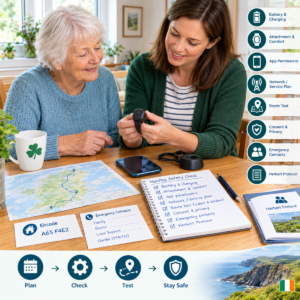
Use an Ireland GPS tracker for an older adult in Ireland with identification and backup safety layers
A tracker works best when it sits inside a wider plan. Irish dementia and assistive-technology guidance presents location devices, telecare, routines, environmental changes, identification, and human support as connected parts of safer independence. A family can use more than one layer without making every layer intrusive.
Identification for an older adult who may get lost
Keep current information available in a form the person will carry and responders can understand. Depending on the person’s wishes and advice, this may include name, trusted contact, communication needs, medical information, or a card that says whom to call. Update the photograph, clothing description, medication information, and familiar places in the Herbert Protocol preparation.
Door, home, and routine supports
A door alert can notify a caregiver near the point of departure, while GPS tracker for an older adult in Ireland may help later outdoors. Lighting, clear signs, predictable routines, neighbor awareness, and a check-in can reduce confusion without treating the person as a problem to control. Ask what support preserves independence and dignity.
Medical alert and telecare alternatives
If the main need is to summon help after a fall, illness, or distress, compare medical alert and telecare pathways. Ask who answers, whether monitoring is available 24 hours, what happens if the person cannot speak, how water and power are handled, and whether the service covers the home and intended travel. A GPS map may be a useful supplement but is not a substitute.
Caregiver check-ins and destination agreements
A scheduled call or message can be more dependable than an alert that depends on a charged device. Agree who calls, what “no answer” means, and which destination is contacted first. Keep a backup if a caregiver is working, traveling, ill, or asleep. The person should know how to ask for help without needing to explain a complex app.
Practical Ireland GPS tracker for an older adult in Ireland readiness checklist
Use this checklist before a family decides to rely on a location device. Mark each item with a date and owner. A blank answer is not a reason to panic; it is a reason to test, clarify, or add another layer.
Before buying an Irish GPS tracker for an older adult in Ireland
- The specific safety event and route are written down.
- The device follows the person rather than only a vehicle, bag, or key.
- The model’s network, SIM, service area, and Irish support are clear.
- The home Eircode and usual destinations have been checked against current coverage information.
- Hardware, plan, activation, delivery, VAT, return, warranty, and cancellation terms are recorded.
- The older adult has been included in the decision and the form is acceptable.
Before relying on a personal GPS tracker for an older adult in Ireland
- The device is activated, charged, attached, and comfortable during the ordinary routine.
- The app shows a timestamp, battery, connection state, and location behavior the caregiver understands.
- The route has been tested outdoors and indoors, including the meaningful destination.
- A zone alert and caregiver handoff have been tested.
- Low battery, offline, removed, lost, and stale-location responses are written down.
- The privacy purpose, viewers, permissions, history, and account deletion process have been reviewed.
- A current photograph, clothing information, likely destinations, and Garda response details are ready.
Monthly Ireland tracker review
- Battery, attachment, charger, service, and account still work.
- The phone and app have not changed a permission or notification.
- The network and plan remain suitable for the route.
- The older adult still accepts the device and understands its purpose.
- The responder list, Eircode, destinations, zones, and emergency information are current.
- A short route test has been completed and recorded.
Frequently asked questions about a GPS tracker for an older adult in Ireland
These questions address Ireland-specific decisions without naming a current winner, quoting unstable prices, or turning the guide into a brand review.
Does a GPS tracker for an older adult work everywhere in Ireland?
No device should be assumed to work everywhere. Coverage, buildings, terrain, network, SIM, battery, device design, update interval, and indoor conditions matter. Check current ComReg coverage information, then test the exact model on the person’s actual route.
Should an Ireland GPS tracker for an older adult in Ireland use a phone or a separate device?
Use the option the person will carry and the caregiver can maintain. A phone may be familiar but can be left behind. A separate wearable may follow the person better but adds charging, service, comfort, and consent questions.
Do GPS trackers for elderly people in Ireland need a monthly fee?
Some need recurring cellular or monitoring service and some use a phone or another arrangement. Check the exact model’s service terms, what stops when payment ends, renewal, cancellation, data, and support. Do not rely on the hardware price alone.
Can an Ireland GPS tracker for an older adult in Ireland replace a medical alert device?
Not automatically. A tracker may provide location, while a medical alert service may provide a button, two-way communication, monitoring, or escalation. Confirm who responds and whether fall or medical needs are addressed before substituting one system for another.
Can a GPS tracker for an older adult in Ireland prevent an older adult from wandering?
No. It may generate information after movement or a zone crossing. It cannot stop a person leaving, guarantee an alert, or replace supervision, identification, a door layer, or prompt human response.
Is consent required to use a GPS tracker for an older adult in Ireland?
The answer depends on the people, roles, service, and processing involved; do not treat this article as legal advice. Discuss the purpose with the older adult, review the provider’s privacy information, and obtain appropriate professional advice when capacity, authority, a care organization, or disagreement is involved.
What should a caregiver do if an Ireland tracker shows an old location?
Read the timestamp, battery, connection, and device status. Call the person if safe, contact the destination, and follow the response plan. Treat the point as last known information. If there is concern for safety or welfare, contact the appropriate service rather than repeatedly refreshing the app.
Can a GPS tracker for an older adult in Ireland work indoors in an Irish home or care setting?
It may show a broad area, a last outdoor point, a delayed update, or no useful location. Test the actual building. If room-level or immediate indoor response matters, add an appropriate home, telecare, or human support layer.
What is the Herbert Protocol and how does it relate to a GPS tracker for an older adult in Ireland?
The Herbert Protocol is Garda-supported preparation for information that can help locate a missing person with dementia, including a photograph, description, medicines, contacts, and familiar places. It complements GPS tracker for an older adult in Ireland. It does not depend on the device working and should be prepared according to current Garda guidance.
Can a GPS tracker for an older adult in Ireland bought for Ireland work in Northern Ireland or abroad?
Maybe, but verify the service, roaming, network, support, data, and emergency arrangements for the exact plan. Test the ordinary travel route if it matters. A device’s claim of broad coverage is not proof of continuous service across a border.
Official Ireland sources for GPS tracker safety and privacy
The sources below support the guide’s claims about Irish coverage, dementia safety, location data, emergency preparation, and GPS limitations. They do not endorse a product, retailer, seller, subscription, or current price.
- Commission for Communications Regulation — Service Coverage Map: supports checking predicted outdoor mobile coverage by area, provider, and technology. It is not a guarantee for a particular tracker, building, or indoor room.
- Alzheimer Society of Ireland — Suppliers of Products and Devices: supports the use of assistive technology, personal alarms, telecare, and local technology resources as part of a wider support plan. It is a supplier-information resource, not a product endorsement.
- An Garda Síochána — The Herbert Protocol: supports preparation of photographs, descriptions, medicines, contacts, and familiar places for a missing person with dementia.
- An Garda Síochána — Missing Persons: supports reporting concerns promptly, information to provide, and the 999/112 emergency boundary.
- Data Protection Commission — What are personal data and when are they processed?: supports the treatment of identifiable location information as personal data and the need to consider processing responsibilities.
- Data Protection Commission — Lawful processing: supports considering the lawful basis for processing rather than assuming consent is the only or universal answer.
- Data Protection Commission — Guidance on Cookies and Other Tracking Technologies: supports clear information, affirmative consent where relevant, and the sensitivity of tracking technologies; device-specific legal analysis remains necessary.
- GPS.gov — GPS Accuracy: supports the limits created by blockage, reflections, satellite geometry, atmosphere, and receiver design. It is general GPS information, not an Irish service specification.
Final GPS tracker for elderly Ireland readiness check
Before relying on a device, answer these questions in writing: What event does it support? Does the device stay with the person? Does the exact model communicate on the Irish route? What happens indoors, in a rural gap, across a border, or when the battery is low? Who receives the information, who can respond, and when are Gardaí or emergency services contacted? What are the privacy, consent, return, service, and account-closure terms?
After delivery, test the exact model on the actual person, route, phone, network, building, and caregiver chain. Keep the result with the current photograph, likely destinations, Eircode, service details, and Herbert Protocol preparation. If the device fails a meaningful test, return or replace it according to the terms instead of quietly treating the failure as acceptable.
An Ireland GPS tracker can be a helpful part of a respectful safety plan when it is chosen for a defined need, accepted by the older adult, supported by a workable network and service, tested in ordinary conditions, protected with sensible privacy controls, and paired with human response. It is a tool for better information, not a promise that uncertainty has disappeared.