
<!doctype html>
For older adults and caregivers, identifying the right equipment is essential before comparing prices or manufacturers. A Lift Chair for Steps intended for staircase travel requires an assessment of the stairs, boarding locations, user positioning, and installation conditions. A conventional lift recliner requires a different assessment focused on seat measurements, standing ability, reclining clearance, and electrical requirements.
This practical guide explains how to distinguish these products, evaluate mobility needs, measure the home, compare purchase and rental options, and plan for safe everyday use. It also covers maintenance, power backup, caregiver assistance, Medicare coverage, and alternatives when a chair is not appropriate.
Safety note: A power lift recliner cannot carry someone up or down stairs. A stairlift is not a full-body patient lift and is only appropriate when the person can use its seat and boarding arrangements safely. Significant balance or transfer limitations should be evaluated by a qualified professional before equipment is selected.
Quick Answer: What to Verify Before Choosing a Lift Chair for Steps
The first question is whether the person needs help standing from a chair or traveling between floors. The answer determines which equipment category should be considered.
If the primary challenge is using a staircase, a properly selected stairlift may be an option. If the difficulty is rising from a seated position in a living room or bedroom, a power lift recliner may be more relevant.
Before purchasing a Lift Chair for Steps, verify:
- The exact mobility problem the equipment must address.
- Whether the product is a stairlift or a power lift recliner.
- The user’s sitting, standing, balance, and transfer abilities.
- Appropriate seating dimensions and weight capacity.
- Staircase geometry or room clearance requirements.
- Safe access to the equipment and its stopping positions.
- Control accessibility and ease of operation.
- Electrical requirements and battery backup limitations.
- Installation, assembly, and delivery arrangements.
- Manufacturer instructions and operating restrictions.
- Warranty, maintenance, and repair services.
- Total purchase or rental costs.
- Potential insurance or financial assistance.
- Caregiver involvement and a realistic backup plan.
A useful Lift Chair for Steps comparison should focus on the task, user, and environment rather than treating every product with the word lift as interchangeable.
Clarify What “Lift Chair for Steps” Means
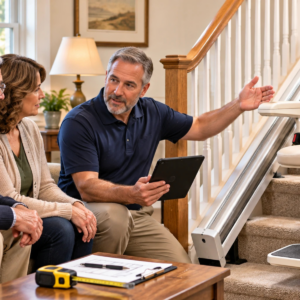
A Lift Chair for Steps search can reflect several needs. Someone may want help getting up from a favorite armchair, moving between two levels, or accessing a home entrance with several steps.
These situations are different and should be evaluated separately. A product appropriate for one task may provide no useful assistance for another.
Lift Recliner for Assisted Standing
A power lift recliner uses a motorized mechanism to raise and tilt its seat. The motion can assist certain people when transitioning from sitting toward standing.
The chair remains in place and cannot transport someone up a staircase.
Stair Lift Chair for Staircase Travel
A stairlift is a motorized seat connected to a rail fitted to the staircase. It transports an appropriately seated user between designated positions.
Its suitability depends on staircase dimensions, user abilities, and installation requirements.
Exterior Steps and Home Entrances
Outdoor stairlifts may be available for some exterior staircases. In other settings, a ramp, platform lift, or another accessibility modification may be more suitable.
The correct solution depends on the entrance design and the person’s needs.
Identify the Actual Goal
Before requesting a quotation, describe the specific obstacle. For example, determine whether the person needs to reach an upstairs bedroom, enter the house from outside, or rise from a low chair.
That information is more useful than the search term alone.
Lift Chair Versus Stair Lift
A lift recliner and a stairlift have different purposes, mechanisms, and installation requirements.
| Feature | Power lift recliner | Stair lift chair |
|---|---|---|
| Primary purpose | Assist certain seated-to-standing movements | Transport a seated user along stairs |
| Location | Living room, bedroom, or seating area | Staircase |
| Movement | Raises and tilts the seat | Travels along an installed rail |
| Installation | Furniture setup and electrical connection | Professional staircase-specific installation |
| Main measurements | User size and reclining clearance | Stair geometry, landing space, user size |
| Helps travel between floors | No | Yes |
| Provides full-body patient transfers | No | No |
A stairlift does not replace a suitable transfer plan at the upper and lower landings. Likewise, a power lift recliner does not eliminate difficulties with stairs once the person has stood up.
Lift Chair for Steps: Person-Centered Assessment
The most useful Lift Chair for Steps assessment begins with the person’s daily activities and mobility limitations.
Height, seating dimensions, balance, hand strength, posture, and the ability to use equipment controls all matter. The appropriate considerations differ depending on whether the product is a stairlift or a reclining lift chair.
Standing Ability
For a power lift recliner, assess whether the individual can safely participate in standing after the seat rises. A motorized mechanism cannot guarantee stability or walking ability.
Stairlift Boarding and Exiting
A stairlift user must be able to access the seat and use the boarding arrangements appropriately at both ends of the staircase.
Posture and Sitting Balance
The person should be able to maintain the position required by the selected equipment and use its safety features correctly.
Hand Controls
Evaluate whether the individual can see, reach, understand, and operate the controls.
Professional Guidance
An occupational therapist or another qualified mobility professional may help identify the right equipment when physical abilities make transfers or stair access complicated.
Lift Chair for Steps: Seat Width and Depth
Seat dimensions matter whether the selected equipment is a power lift recliner or a stairlift.
A chair with adequate weight capacity may still be uncomfortable or difficult to access if its dimensions are inappropriate.
Seat Width
The seat should accommodate the person comfortably without creating unnecessary difficulty reaching the armrests.
Seat Depth
Appropriate depth supports comfortable positioning against the backrest.
Seat Height
For lift recliners, seat height can affect leg positioning and standing comfort. For stairlifts, boarding arrangements and seat height must match the individual’s abilities.
Backrest and Armrests
Review the backrest and available arm support according to the equipment’s intended use.
Weight Capacity
Follow the manufacturer-defined capacity for the exact model and configuration.
Trial and Fit Confirmation
Whenever practical, the intended user should evaluate the chair with appropriate supervision before the purchase is finalized.
Rise Motion and Transfer Technique
A power lift recliner assists certain seated-to-standing movements, but it does not perform every part of the transfer.
The person must still have the physical abilities required for the movement. The manufacturer’s operating instructions and any individualized clinical guidance should determine the appropriate procedure.
Understand the Lifting Movement
Different power lift recliners have different seat-tilting paths and operating ranges. Buyers should verify the movement of the exact model.
Consider Balance
The chair’s lifting function does not prevent loss of balance after standing.
Maintain Appropriate Surroundings
Nearby furniture and objects should not obstruct the chair’s approved movement.
Avoid Improvised Physical Assistance
Caregivers should not force the mechanism or attempt unassessed transfers.
Recognize When a Lift Recliner Is Insufficient
A person who requires extensive physical support may need equipment designed for assisted transfers rather than ordinary reclining furniture.
Lift Chair for Steps: Controls and Dexterity
The controls are a central part of any Lift Chair for Steps purchase.
A power recliner may use a handheld controller with directional buttons. Stairlifts commonly have controls for travel and may include additional functions for positioning or calling the chair to a landing.
Button Visibility
Controls should be understandable to the intended user.
Hand Function
The person must be able to activate the necessary controls reliably or have an appropriate assistance arrangement.
Control Location
The operating controls should remain accessible in the approved seated position.
Understanding Movement
The user and regular caregivers should understand how the specific equipment starts, moves, and stops.
Supervised Demonstration
A demonstration with the exact model can reveal difficulties that product photographs or marketing descriptions do not show.
Lift Chair for Steps: Wall Clearance and Footrest Space
Clearance requirements depend on the equipment being considered.
For a power lift recliner, the room must accommodate the seat’s forward lifting movement and the backrest and footrest when reclining.
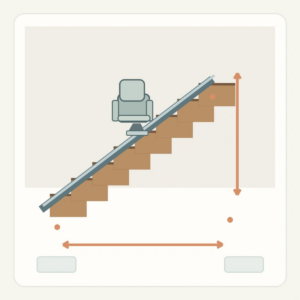
For a stairlift, available staircase width, rail placement, landings, and the seat’s parked position determine practical clearance.
Power Recliner Wall Clearance
Check the manufacturer’s minimum distance from the wall for the exact recliner.
Footrest Extension
The footrest should move without contacting nearby furniture or obstructing household routes.
Staircase Width
The staircase survey should assess how much usable space remains after the rail and chair are installed.
Landing Access
Both ends of a stairlift route need suitable boarding and exiting locations.
Other Household Members
Consider how the installation or furniture placement affects everyone who uses the space.
Doorways and Delivery Route
Delivery requirements are particularly important when purchasing a large power lift recliner.
A chair may fit the intended room but be too large for the home’s entrance, hallway, or narrow turns.
Measure the Entire Route
Review doorways, thresholds, corridors, elevators, and corners.
Confirm Package Dimensions
Some furniture arrives partially assembled and may have different shipping dimensions from the completed chair.
Ask About Assembly
Verify whether professional setup, room placement, and packaging removal are included.
Stairlift Installation Access
A stairlift installer must be able to access the staircase and carry out the approved installation procedure.
Final Placement
Whether the product is a recliner or stairlift, its final location should meet the manufacturer’s clearance and operational requirements.
Lift Chair for Steps: Power, Battery, and Emergency Operation
A Lift Chair for Steps generally relies on powered components, but electrical arrangements differ between products.
Power recliners usually need an appropriate electrical outlet for normal operation. Many stairlifts use rechargeable batteries, although the charging system and available operation vary by model.
Electrical Requirements
Review the exact manufacturer’s power supply and installation instructions.
Battery Backup
Some lift recliners include limited battery backup. Stairlifts may have rechargeable battery systems that support operation during certain power interruptions.
Do Not Assume Unlimited Operation
Battery capacity, charging status, and model-specific requirements determine what remains available.
Emergency Procedures
Ask the manufacturer or installer to explain the approved response to a malfunction or power interruption.
Manual Procedures Are Model-Specific
Do not attempt to force a chair, move a loaded carriage, or improvise manual operation. Any emergency movement must follow the manufacturer’s instructions and appropriate professional guidance.
Prepare Alternative Assistance
If the person depends on powered equipment, an alternative plan should be established before an outage or malfunction occurs.
Lift Chair for Steps: Lift Chair Maintenance
Both stairlifts and power lift recliners contain components that may eventually require servicing.
However, the appropriate maintenance procedures differ considerably.
Power Recliner Components
Motors, actuators, handsets, power supplies, and lifting frames may require professional inspection when abnormal symptoms occur.
Stairlift Components
Rails, carriages, seats, controls, batteries, and charging systems should be maintained according to the stairlift manufacturer’s service requirements.
Upholstery Cleaning
Use the recommended cleaning methods for the relevant seating materials.
Signs of Equipment Problems
Unexpected noise, jerking, irregular movement, damaged wiring, or unreliable controls should prompt appropriate service.
Use Approved Components
Replacement parts should be compatible with the exact model.
Keep Service Records
Maintain a dated record of the equipment model, serial number, inspections, and repairs.
Stairs and the Lift Chair Decision
When the main problem involves stairs, a lift recliner should not be presented as the solution.
An older adult may find it easier to stand from a recliner and still be unable to access an upstairs bedroom or bathroom.
Straight Staircases
A straight stairlift may be suitable for some homes after a professional staircase and user assessment.
Curved Staircases
Staircases with turns or changes in direction require a compatible rail arrangement and installation evaluation.
Outdoor Steps
A weather-appropriate stairlift or another outdoor accessibility solution may be considered when compatible with the home’s layout.
Single-Level Living
Some households can reduce the need to use stairs by moving essential activities to an accessible floor.
Other Home Modifications
Depending on the environment, ramps, platform lifts, or other accessibility changes may be more suitable.
The best Lift Chair for Steps decision should address the actual accessibility problem rather than the product name.
Lift Chair for Steps: Caregiver Assistance
Caregiver responsibilities differ between helping someone use a reclining lift chair and supporting access to a stairlift.
The person should participate in decisions about assistance, comfort, privacy, and independence whenever possible.
Establish Appropriate Roles
Clarify who prepares the equipment, provides approved supervision, and arranges service when necessary.
Explain the Controls
Regular caregivers should understand the correct functions and limitations.
Respect Consent
The intended user should understand the assistance being offered and be able to communicate discomfort or concern.
Avoid Unsupported Transfers
A caregiver should not attempt to carry someone on stairs or use equipment beyond its intended purpose.
Review Changes in Ability
If the person needs more support than before, a new assessment may be necessary.
Lift Chair for Steps: Renting Versus Buying
Both rental and purchase arrangements may be worth exploring, depending on the type of equipment, duration of need, and available services.
Buying a Power Lift Recliner
Purchasing may be practical for longer-term seating needs when the model fits the user and reliable service is available.
Renting a Lift Recliner
Some suppliers may offer temporary arrangements, although availability varies.
Purchasing a Stairlift
Stairlift purchases commonly involve a home survey, installation, and ongoing service arrangements.
Renting a Stairlift
Rental availability and terms depend on the supplier and installation type. Some configurations may be less suitable for temporary arrangements.
Compare Complete Costs
Ask about delivery, installation, deposits, maintenance, removal, repairs, and contract conditions.
Consider Changing Needs
The anticipated duration of use and possible changes in mobility should influence the decision.
Used Lift Chairs and Hygiene
A used power lift recliner may offer savings, but its mechanical and electrical condition should be carefully evaluated.
Used stairlifts require an additional consideration: the rail and installation must be appropriate for the new staircase.
Model Identification
Confirm the exact manufacturer, model, and available documentation.
Mechanical Condition
Unexpected movement, worn components, and structural damage require qualified assessment.
Electrical Condition
Verify that approved controls, power equipment, and other necessary components are included.
Upholstery and Cleaning
Consider fabric condition and the manufacturer’s cleaning recommendations.
Stairlift Rail Compatibility
Do not assume that a rail removed from one staircase will fit another home.
Professional Inspection
Qualified evaluation is particularly important when the equipment’s history or condition is unknown.
Lift Chair for Steps: Medicare and Lift-Chair Coverage
Medicare coverage depends on the type of equipment being considered.
An ordinary stairlift and a power lift recliner fall into different categories and should not be treated as though they share the same insurance rules.
Original Medicare and Seat-Lift Mechanisms
Original Medicare Part B may cover certain medically necessary seat-lift mechanisms when the beneficiary meets specific clinical, functional, and documentation requirements.
Qualifying Conditions
The applicable seat-lift mechanism policy includes severe arthritis of the hip or knee or severe neuromuscular disease, along with other criteria.
Standing and Walking Requirements
The beneficiary must meet Medicare’s requirements involving inability to rise from an ordinary chair and the ability to walk once standing.
The Recliner Is Generally Not Covered
Coverage for an eligible mechanism does not mean Medicare pays for the full upholstered chair.
Stairlift Coverage
Original Medicare generally does not cover ordinary residential stairlifts as home accessibility installations. Other funding arrangements may be available, depending on the person’s circumstances and location.
Medicare Advantage
Some Medicare Advantage plans may have different supplemental benefits, networks, and authorization rules. Coverage must be verified with the exact plan.
Confirm Before Purchasing
Request information from the insurer, treating practitioner, and appropriate supplier before relying on reimbursement.
Lift Chair for Steps: Emergency and Fall Backup
No chair or lift system eliminates every mobility risk.
Households should have a realistic backup plan when the equipment becomes unavailable or the person’s needs change.
Power Interruption
Understand the exact battery and emergency procedures for the selected model.
Mechanical Failure
Know whom to contact for qualified service and what assistance is available while the equipment is not operating.
Changes in Balance
New dizziness, weakness, or instability may require medical assessment.
Stair Access Problems
If staircase travel becomes unsafe, avoid improvising physical transfers. Seek an appropriate alternative arrangement.
Emergency Contact Information
Keep relevant caregiver, service, and emergency contacts accessible.
Room Layout and Daily Routine
The best equipment location should support everyday activities rather than simply look attractive.
Access to Essential Rooms
Consider how the person reaches bedrooms, bathrooms, kitchens, and common areas.
Lighting
Adequate lighting can make controls, steps, and nearby pathways easier to see.
Household Movement
Furniture and stairlift installations should not create unnecessary obstructions.
Caregiver Access
When supervision or assistance is required, the surrounding environment should accommodate the approved arrangement.
Review Regularly
Changes to furniture, flooring, mobility equipment, or the person’s routine may affect suitability.
Lift Chair for Steps: When a Lift Chair Is Not Enough
A Lift Chair for Steps solution may become inadequate if the person’s abilities change or the selected equipment cannot address the actual task.
Significant Transfer Assistance
Someone who cannot safely participate in standing may need a different type of transfer equipment.
Difficulty Accessing the Stairlift Seat
When boarding or exiting becomes unsafe, a professional should reassess the stairlift arrangement.
Complex Mobility Needs
People who require wheelchair access between floors may need another accessibility system.
Repeated Falls or New Symptoms
Changes in health or balance should prompt appropriate clinical assessment rather than reliance on stronger equipment alone.
Reevaluate the Entire Environment
Sometimes changes to the home or daily routine provide a more useful solution than adding features to an existing chair.
Lift Chair for Steps: Questions for a Supplier
Before purchasing, ask the supplier:
- Is this product a stairlift or a power lift recliner?
- What is the exact manufacturer and model?
- What mobility task is it designed to support?
- What user dimensions and weight limits apply?
- What home or staircase measurements are required?
- Can the intended user evaluate the equipment?
- What controls and safety features are included?
- What are the electrical and battery requirements?
- What happens during a power outage?
- Are professional installation or assembly included?
- What maintenance schedule is recommended?
- Who handles warranty claims and repairs?
- Are compatible replacement parts available?
- What are the written return or cancellation conditions?
- What is the full price after installation and additional services?
- Does any insurance or assistance program apply?
- What alternative arrangement is recommended if the equipment becomes unusable?
Keeping written answers makes it easier to compare suppliers and evaluate the complete purchase.
Final Lift Chair for Steps Checklist
Before purchasing or using a Lift Chair for Steps, confirm:
-
The actual mobility task is identified.
-
The correct equipment category has been selected.
-
The user’s abilities have been appropriately assessed.
-
Seat dimensions and weight capacity are suitable.
-
Staircase or room measurements are complete.
-
Boarding and exiting arrangements are appropriate.
-
Controls are accessible.
-
Electrical requirements are understood.
-
Battery limitations and backup procedures are documented.
-
Installation or assembly is arranged.
-
The correct manufacturer’s instructions are available.
-
Warranty and repair responsibilities are clear.
-
Total costs have been reviewed.
-
Coverage expectations have been verified separately.
-
Caregiver responsibilities are understood.
-
A realistic backup plan exists.
Make the Lift Chair for Steps Plan Usable Every Day
A practical plan should remain understandable after the equipment has been installed or delivered.
Keep operating instructions, model identification, support contacts, and relevant measurements together. The intended user and regular caregivers should know which activities the equipment supports and what to do when operation becomes unreliable.
For a stairlift, daily routines include appropriate access at both landings and keeping the travel route clear. For a power lift recliner, the routine involves comfortable seating, accessible controls, suitable electrical access, and enough clearance for powered movement.
The household should reassess the arrangement when the user’s physical abilities or home environment changes.
Reassess Lift Chair for Steps After a Change
A chair or accessibility system that works well today may become unsuitable following a change in health, mobility, or household conditions.
Following a Fall
Reevaluate the person’s abilities and any new concerns about safe equipment use.
After Hospitalization
New physical limitations or movement restrictions may require professional guidance.
Changes in the Home
Furniture placement, flooring, or staircase modifications can change access requirements.
After Equipment Repairs
Confirm that the equipment has received appropriate service before routine use resumes.
When Caregiver Support Changes
Review whether the existing arrangement still provides the assistance the person needs.
Compare Lift Chair for Steps Options Without Overpromising
A reliable comparison should examine what each option actually accomplishes.
| Decision factor | Power lift recliner | Stair lift chair |
|---|---|---|
| Main goal | Assisted movement toward standing | Travel along stairs |
| User assessment | Standing, balance, and seating fit | Sitting, boarding, exiting, and controls |
| Environment | Room and reclining clearance | Stair geometry and landings |
| Setup | Furniture assembly and power | Professional rail installation |
| Electrical needs | Model-specific power supply | Model-specific battery and charging system |
| Maintenance | Mechanism, controls, upholstery | Rail, carriage, controls, batteries |
| Medicare | Possible qualifying seat-lift mechanism coverage | Generally not covered by Original Medicare |
| Backup plan | Alternative seating or assistance | Alternative access and assistance |
The appropriate option is the one that addresses the person’s actual need, not necessarily the product with the longest feature list.
Before Finalizing a Lift Chair for Steps
Before signing a purchase agreement, verify the exact model, dimensions, installation requirements, and written financial terms.
If the product is a stairlift, obtain an appropriate staircase survey and confirm user access at both landings. If it is a power lift recliner, verify seat fit, full movement clearance, and the person’s ability to participate in the intended standing movement.
Ask how repairs are handled, whether replacement parts are available, and what happens when equipment is unusable. A suitable backup arrangement is part of the decision, not an optional detail to consider after installation.
Applied Situations for Lift Chair for Steps
Lift Chair for Steps During Rising From a Chair
An older adult needs assistance rising from a living-room chair. A suitably selected power lift recliner may be considered, but it does not provide transportation along stairs.
Lift Chair for Steps During Bathroom Access
A person can stand from a recliner but struggles to reach an upstairs bathroom. The household should assess staircase accessibility or consider a different room arrangement.
Lift Chair for Steps When a Staircase Is the Main Barrier
An older adult can sit and use appropriate controls but has difficulty negotiating stairs. A professionally assessed stairlift may offer a relevant option if the home and user’s abilities are suitable.
Lift Chair for Steps in a Tight Living Room
A large power lift recliner blocks the main walkway when its footrest extends. The chair’s full movement dimensions should be checked before purchase.
Lift Chair for Steps During a Power Interruption
The household loses power, affecting the normal operation of mobility equipment. The exact manufacturer’s backup capabilities and established assistance plan determine the appropriate response.
Lift Chair for Steps During a Short-Term Rental
Someone requires temporary assistance after a change in mobility. A suitable rental arrangement may be considered, with written terms covering setup, removal, maintenance, and support.
Lift Chair for Steps During a Used-Equipment Purchase
A used recliner or stairlift appears affordable, but its service history is uncertain. Qualified assessment and compatibility checks should precede reliance on the equipment.
Lift Chair for Steps During Caregiver Assistance
A caregiver assists an older adult who needs help with controls or positioning. The assistance should follow an appropriate assessment and agreed plan.
Lift Chair for Steps During Delivery
A large recliner cannot pass through a narrow entrance. Measuring the full delivery route before purchase can prevent an unsuitable order.
Lift Chair for Steps After a Fall
A person’s balance changes after a fall. Equipment suitability should be reassessed instead of assuming the previous arrangement remains appropriate.
Lift Chair for Steps During a Repair Appointment
A technician needs the equipment’s model number and service history. Accessible documentation can help identify approved replacement components and appropriate work.
Lift Chair for Steps During an Insurance Conversation
A family assumes all mobility equipment described as a lift chair qualifies for Medicare reimbursement. They should verify the specific equipment category and applicable coverage rules before purchasing.
Frequently Asked Questions About Lift Chair for Steps
Is a Lift Chair the Same as a Stair Lift?
No. A lift recliner assists certain people when moving from sitting toward standing. A stairlift transports an appropriately seated user along a staircase.
What Does Lift Chair for Steps Usually Mean?
The phrase may refer to a stairlift for navigating stairs or a lift recliner used for standing assistance. The intended task should be clarified before selecting equipment.
Can a Power Lift Recliner Go Up Stairs?
No. A conventional power lift recliner is stationary furniture and cannot carry someone between floors.
Is There a Lift Chair for Outdoor Steps?
Some manufacturers offer outdoor stairlifts for compatible exterior staircases. Other access solutions may be more appropriate depending on the entrance.
What Is the Difference Between a Straight and Curved Stairlift?
A straight stairlift is intended for a compatible straight staircase. A curved stairlift uses a rail configuration designed for turns or changes in direction.
Does Medicare Cover a Lift Chair?
Original Medicare may cover certain medically necessary seat-lift mechanisms under strict requirements. The complete upholstered recliner is generally not covered.
Does Medicare Cover Stairlifts?
Original Medicare generally does not cover residential stairlifts. Other financial assistance may be available depending on the circumstances.
How Much Does a Lift Chair for Steps Cost?
Costs depend on the equipment category, manufacturer, model, installation requirements, and included services. A staircase survey or exact recliner quotation is necessary for a reliable estimate.
Are Stairlifts Safe for Older Adults?
They may be appropriate when professionally selected and installed for a person who can use the seat, controls, and boarding arrangements safely.
Do Stairlifts Work During Power Outages?
Many stairlifts use rechargeable batteries and may continue operating during certain outages. Available operation depends on the model, charging status, and battery condition.
Can I Purchase a Used Stairlift?
Used equipment may be available, but the rail and other components must be suitable for the new staircase. Professional assessment and installation are important.
What Should I Measure Before Buying?
For a stairlift, measure and evaluate the staircase and landings through an appropriate installation survey. For a lift recliner, review user fit, room clearance, and the delivery route.
When Should Another Mobility Solution Be Considered?
If the person cannot safely use the equipment or needs wheelchair access, full-body transfer assistance, or a different type of home modification, professional assessment may identify a more appropriate option.
Conclusion: Choosing a Lift Chair for Steps With Confidence
Finding the right Lift Chair for Steps begins with understanding the mobility challenge rather than selecting a product based on its name. Stairlifts and power lift recliners perform different functions and require different assessments, installation arrangements, and safety considerations.
If the goal is traveling between floors, evaluate staircase geometry, user positioning, landing access, controls, and installation requirements. If the goal is assisted standing from furniture, focus on seat measurements, lifting movement, balance, room clearance, and power requirements.
A well-informed Lift Chair for Steps decision also includes warranty protection, reliable maintenance, transparent costs, and an appropriate backup plan. By matching equipment to the actual task and the person’s abilities, families can make more practical choices about home accessibility and daily mobility.
Neutral mobility decision table
| Question | Why it matters | What to verify |
|---|---|---|
| Does it fit the person? | Posture, control, comfort, and transfer safety | Measurements and supervised trial |
| Does it fit the setting? | Doorways, turning, surfaces, stairs, and storage | Complete route and clearance |
| Who supports it? | Training, repairs, cleaning, and follow-up | Named provider and written terms |
| What happens if the plan fails? | Delay, injury, lost mobility, or unexpected cost | Backup route and escalation contact |
Official sources and verification notes
These sources establish general U.S. coverage, access, or safety boundaries. They do not endorse a product, provider, brand, price, or ranking. Confirm current rules for the exact person and item.
- Medicare.gov — Durable medical equipment coverage — DME definition, eligibility, supplier participation, rent-or-buy rules, and cost boundaries.
- ADA.gov — Mobility devices — General public-access and mobility-device context; not a product or clinical endorsement.
- Medicare.gov — Medicare coverage search — Current coverage lookup boundary; exact seat-lift coverage must be confirmed for the person and item.