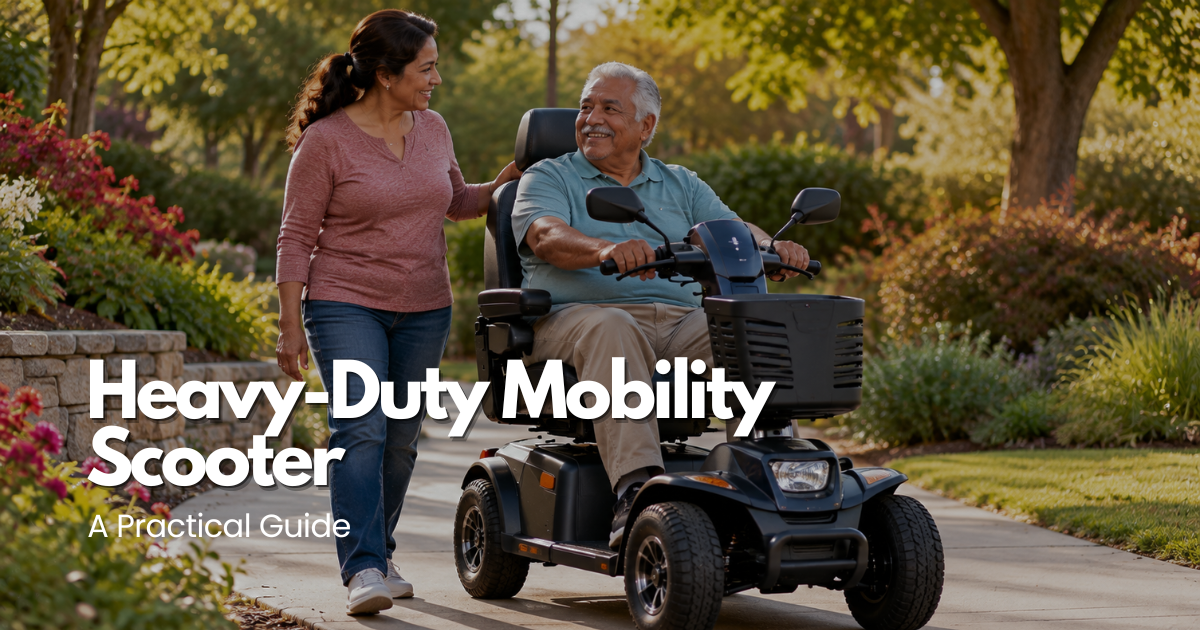
Choosing a heavy-duty mobility scooter requires more than comparing maximum speed, battery range, or advertised weight capacity. Seat dimensions, steering control, turning radius, ground clearance, suspension, transport weight, and available storage space all influence whether a particular model is appropriate. A scooter that performs well on an open outdoor path may be difficult to maneuver inside a smaller home.
This comprehensive guide explains how to evaluate heavy-duty mobility scooter features, compare three-wheel and four-wheel models, understand battery performance, assess safe operating conditions, and plan for transportation and maintenance. It also covers used scooters, caregiver support, purchasing costs, Medicare coverage, and situations in which a smaller scooter or power wheelchair may be more suitable.
Safety note: Mobility scooters are powered vehicles that require appropriate steering, braking, judgment, and postural control. Always follow the manufacturer’s operating instructions and stated limits for weight, slopes, surfaces, and weather. Seek professional assessment when mobility, balance, vision, cognition, or physical control is uncertain. Stop using equipment that behaves unexpectedly, and do not attempt unfamiliar slopes, obstacles, or loading procedures.
Quick Answer: How to Evaluate a Heavy-Duty Mobility Scooter
The best heavy-duty mobility scooter is the one that fits the intended rider, works along the actual travel routes, and can be operated, transported, charged, and maintained reliably.
Heavy-duty construction does not automatically make a scooter more comfortable, stable, or suitable for every environment. Increased dimensions may provide useful features while creating additional challenges with doorways, tight turns, and vehicle transportation.
Before purchasing a heavy-duty mobility scooter, verify:
- The rider’s functional mobility and ability to operate powered controls.
- The exact model’s maximum weight capacity and approved accessories.
- Seat width, depth, height, cushioning, and armrest fit.
- Three-wheel or four-wheel configuration.
- Turning radius and overall scooter dimensions.
- Battery type, charging requirements, and realistic travel range.
- Tire design, suspension, and ground clearance.
- Manufacturer-approved slope and surface limits.
- Tiller position, steering controls, and braking behavior.
- Safe mounting, dismounting, and transfer requirements.
- Home doorway, hallway, elevator, and storage measurements.
- Vehicle-loading and transportation compatibility.
- Repair availability, replacement parts, and warranty terms.
- Total purchase, maintenance, and transportation costs.
- Medicare or other insurance eligibility.
- A practical plan for mechanical failure or depleted batteries.
A suitable heavy-duty mobility scooter should support the rider’s actual daily needs without introducing avoidable control, access, or transportation problems.
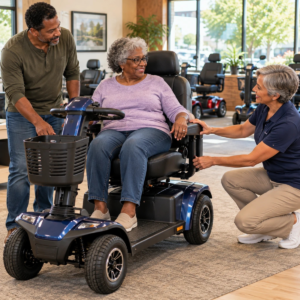
What Does Heavy-Duty Mobility Scooter Mean?
A heavy-duty mobility scooter generally refers to a scooter designed with a higher weight capacity or more substantial construction than some standard mobility models.
However, the term heavy-duty is not a universal guarantee of outdoor performance, comfort, or specific capabilities. Manufacturers may use the description differently, making exact model specifications essential.
Heavy-Duty Mobility Scooter Weight Capacity
Weight capacity is one of the main characteristics associated with heavy-duty scooters.
Different scooters have different manufacturer-defined limits, and additional accessories or carried items may affect the permitted configuration.
A higher maximum capacity should never be interpreted as permission to exceed the manufacturer’s requirements.
Frame and Construction
Some heavy-duty mobility scooter models include larger frames, reinforced structures, or more substantial wheel assemblies.
These features may support a particular equipment design, but they can also increase overall dimensions and transportation weight.
Check actual specifications rather than relying on the appearance of a strong frame.
Larger Seating Options
Some models offer wider seating, deeper cushions, adjustable armrests, or additional support features.
However, a larger seat is not automatically a better fit for every rider.
Proper seating should allow comfortable posture and reliable access to the scooter’s controls.
Heavy-Duty Versus All-Terrain Scooters
Heavy-duty and all-terrain are different product descriptions.
A scooter with a higher capacity may not be approved for rough trails, loose gravel, steep inclines, or wet conditions.
Outdoor suitability must be verified using the exact manufacturer’s operating instructions.
Rider Fit and Clinical Mobility Needs
The first consideration when selecting a heavy-duty mobility scooter should be the intended rider.
A scooter may have adequate weight capacity but remain unsuitable because of limited steering ability, poor postural support, difficulties transferring, or insufficient control.
Mobility and Endurance
A qualified healthcare professional can help evaluate whether a powered scooter is appropriate for someone experiencing limited walking endurance.
The assessment should consider the person’s everyday activities and mobility goals.
Sitting Balance and Postural Control
Mobility scooters generally require the rider to maintain a suitable seated posture during movement.
A person with significant postural instability may require a different seating or mobility system.
Hand Strength and Coordination
Most mobility scooters use a steering tiller that requires sufficient reach, coordination, and control.
Some individuals may find this design difficult because of hand weakness, pain, or limited movement.
Vision and Cognitive Abilities
Operating a powered scooter requires recognizing obstacles, judging distances, and responding appropriately to the environment.
Changes in vision, attention, or judgment should be addressed before relying on powered mobility.
Supervised Scooter Evaluation
When suitability is uncertain, arrange an assessment with an occupational therapist or other qualified mobility professional.
The assessment should use a representative scooter configuration and include actual seating, controls, and environmental needs.
Heavy-Duty Mobility Scooter Weight Capacity Versus Comfort
A higher weight rating does not automatically mean that a heavy-duty mobility scooter provides better seating comfort.
The rider’s dimensions, posture, arm support, and ability to reach the steering controls may be more important than the maximum published capacity.
Seat Width and Depth
The seat should provide appropriate support without interfering with posture or control.
A seat that is excessively wide or deep may create difficulties reaching armrests or operating the scooter comfortably.
Seat Height
Seat height influences how the rider gets onto and off the scooter.
It may also affect available legroom and the relationship between the body and steering tiller.
Armrests and Back Support
Armrests should provide suitable support while allowing the rider to use controls and complete approved transfers.
Backrest design and cushioning may affect comfort during longer periods of sitting.
Pressure and Skin Considerations
People with reduced sensation, persistent discomfort, or existing skin concerns may require individualized seating assessment.
A standard scooter cushion is not necessarily a substitute for specialized pressure-management seating.
Three-Wheel Versus Four-Wheel Heavy-Duty Mobility Scooters
Heavy-duty mobility scooter models are available in different wheel configurations.
Three-wheel and four-wheel designs may differ in turning radius, footprint, maneuverability, and performance characteristics, but their suitability depends on the exact model and route.
Three-Wheel Heavy-Duty Scooters
Some three-wheel scooters offer turning characteristics that may be useful in certain indoor environments.
However, the number of wheels does not establish suitability for every slope, surface, or rider.
Four-Wheel Heavy-Duty Scooters
Four-wheel models may offer different stability characteristics and larger footprints.
They can also require more room for maneuvering, depending on the design.
Compare Turning Radius
Turning radius indicates how much space a scooter needs for certain turns.
A model with a larger turning radius may be difficult to use in narrow hallways or small rooms.
Compare the Actual Environment
A scooter should be evaluated on the intended routes with qualified supervision when necessary.
An outdoor demonstration does not establish that the same model will fit inside a home.
Three-Wheel and Four-Wheel Comparison
| Feature | Three-wheel scooter | Four-wheel scooter |
|---|---|---|
| Wheel layout | One front wheel in a typical design | Two front and two rear wheels in a typical design |
| Turning space | May offer a tighter turn on some models | May require more room on some models |
| Stability characteristics | Model- and condition-dependent | Model- and condition-dependent |
| Indoor suitability | Requires route and fit assessment | Requires route and fit assessment |
| Outdoor suitability | Depends on manufacturer limits | Depends on manufacturer limits |
| Best choice | Based on rider and actual environment | Based on rider and actual environment |
The safest decision is based on verified specifications and rider control rather than a general assumption about wheel count.
Battery Range and Travel Planning
Battery performance is a central consideration when comparing heavy-duty mobility scooter options.
Manufacturers may publish estimated ranges, but actual performance can vary significantly with conditions.
Understanding Advertised Range
A published range is generally based on specific testing assumptions.
The actual distance available to a rider may differ because of battery condition, equipment configuration, terrain, and environmental factors.
Rider Weight and Equipment Load
The combined load carried by a scooter may affect energy consumption.
The rider should follow all applicable load and accessory limits.
Terrain and Surface Resistance
Inclines, uneven surfaces, and high rolling resistance may reduce available range.
Do not assume an advertised maximum distance applies to every route.
Battery Age and Temperature
Battery performance can change with age, storage conditions, and temperature.
Follow the manufacturer’s charging, maintenance, and replacement recommendations.
Planning a Battery Reserve
A practical travel plan should leave a reasonable battery reserve rather than depend on reaching the advertised maximum range.
The rider should also know how to access assistance if the battery becomes depleted.
Tires, Suspension, and Ground Clearance
The wheel and suspension system influences how a heavy-duty mobility scooter behaves on approved surfaces.
However, larger tires and higher ground clearance do not eliminate stability or traction risks.
Pneumatic and Solid Tires
Scooters may use air-filled, solid, or other manufacturer-specified tire designs.
Different tires involve different maintenance requirements and riding characteristics.
Suspension Systems
Some heavy-duty mobility scooter models include suspension intended to improve comfort over permitted surfaces.
The effectiveness of these systems varies by model and operating conditions.
Ground Clearance
Ground clearance indicates the space between relevant underside components and the ground.
It can be important when evaluating thresholds and obstacles, but it should not be used to justify exceeding manufacturer limits.
Suitable Outdoor Surfaces
Paved paths, sidewalks, and other surfaces may have different operating challenges.
Review the manufacturer’s recommendations for traction, slopes, obstacles, and weather.
Steering Controls and Tiller Reach
A heavy-duty mobility scooter should allow the rider to control steering, acceleration, braking, and direction comfortably.
A scooter that feels difficult to control during a supervised trial may not be suitable for independent use.
Tiller Adjustment
Some models offer adjustable steering columns or tillers.
The adjustment range should accommodate the rider’s reach and posture.
Hand Control Accessibility
Controls should be accessible without uncomfortable stretching or excessive hand effort.
A professional assessment may be useful when dexterity or coordination is limited.
Braking and Stopping
Scooters may use automatic or electronically controlled braking arrangements.
The rider must understand the exact model’s stopping behavior and manufacturer’s instructions.
Practicing With the Exact Model
Familiarity with one scooter does not guarantee safe control of another.
Initial training should address the specific model and approved operating conditions.
Seat Height and Getting On or Off the Scooter
Mounting and dismounting a scooter can be more challenging when the device has a large frame or elevated seat.
The correct approach depends on the rider’s mobility, balance, and the manufacturer’s design.
Seat Height Assessment
Check whether the seat height suits the rider’s abilities.
A professional may need to evaluate transfers when balance, pain, or physical limitations create concerns.
Swivel Seats and Adjustable Features
Some scooters offer swivel seats or other features intended to assist access.
These features should be used only according to the model’s instructions.
Armrest Clearance
Armrests can influence ease of access and body positioning.
The correct arrangement should provide appropriate support without interfering with safe movement.
When Another Mobility Device May Be Better
A person who cannot safely get onto or off a scooter may require a different powered mobility solution.
A power wheelchair may offer more suitable controls or seating arrangements for some individuals.
Indoor Doorways and Storage Fit
Heavy-duty mobility scooters may be wider, longer, or harder to maneuver than smaller models.
Before purchasing, compare actual equipment dimensions with the home’s usable spaces.
Doorway Width
Measure the narrowest doorway the scooter needs to pass through.
Account for handles, armrests, mirrors, baskets, and other accessories that may affect overall dimensions.
Hallway and Turning Space
A scooter may fit through a doorway but lack enough room to turn.
Review the entire intended route, including corners and furniture.
Elevators and Shared Buildings
Elevator dimensions and building access may affect suitability.
Confirm that the scooter can enter, maneuver, and exit according to the building’s requirements.
Storage and Charging Location
Select an accessible location that follows manufacturer recommendations and does not obstruct exits.
Charging arrangements should also account for cable placement and electrical safety.
Transporting and Loading a Heavy-Duty Mobility Scooter
Transportation can be one of the largest practical challenges of owning a heavy-duty mobility scooter.
Many larger models weigh considerably more than compact travel scooters, and not all are designed for easy disassembly.
Scooter Transport Weight
Check the manufacturer’s stated scooter weight, including the relevant configuration and battery.
Do not assume a large mobility scooter can be lifted safely by a caregiver.
Vehicle Lift Compatibility
A vehicle-mounted scooter lift must be rated for the exact scooter and permitted installation.
The vehicle’s capacities and mounting requirements also matter.
Ramps and Loading Systems
Loading ramps have their own weight, slope, length, traction, and compatibility limits.
Do not improvise loading methods or exceed stated specifications.
Securement During Transportation
Follow manufacturer and vehicle-equipment instructions for approved transportation and securement.
A mobility scooter is not automatically an approved occupied vehicle seat.
Professional Vehicle Assessment
When loading or transporting the scooter is part of regular use, consult a qualified mobility equipment supplier or vehicle modification professional.
Verify the complete arrangement before buying.
Buying a Used Heavy-Duty Mobility Scooter
A used heavy-duty mobility scooter may offer a lower purchase price, but its condition can significantly influence reliability and future costs.
Battery age, previous repairs, water exposure, and replacement-part availability deserve careful attention.
Battery Condition
Batteries may lose performance over time.
Ask about their age, charging history, and replacement requirements.
Frame and Structural Inspection
Check for visible damage, corrosion, alterations, or unusual movement.
Have questionable equipment evaluated by a qualified technician.
Tire and Brake Condition
Tires, wheels, and braking components can wear.
The scooter should be assessed before anyone depends on it for routine mobility.
Charger and Accessories
Verify that the correct manufacturer-approved charger is included.
Missing or incompatible accessories can create additional costs.
Service History
Request maintenance records and confirm that authorized service remains available.
A used scooter that runs during a short demonstration may still require significant repairs.
Heavy-Duty Mobility Scooter Service and Replacement Parts
Long-term scooter ownership includes servicing, replacement parts, and technical support.
A scooter that cannot be repaired locally may become difficult to rely on.
Battery and Charger Availability
Confirm that approved replacement batteries and chargers can be obtained.
Tires and Brakes
Ask whether local technicians can inspect and service the model’s wheels and braking system.
Motors and Electronic Controls
Powered components may require specialized troubleshooting.
Avoid unauthorized modifications or substitute parts.
Warranty and Repair Arrangements
Review warranty coverage, service charges, transportation requirements, and expected support options before purchasing.
Planning for Service Interruptions
Maintain an alternative mobility arrangement if the scooter becomes unavailable.
Medicare Coverage and Medical Necessity
Medicare Part B may cover qualifying power-operated vehicles, including mobility scooters, when the applicable medical necessity and documentation requirements are met.
However, a heavy-duty mobility scooter is not automatically covered because of its higher capacity or outdoor capabilities.
Medicare Requirements for Mobility Scooters
Medicare evaluates whether the person’s mobility limitation significantly affects mobility-related activities of daily living within the home.
The individual must meet the relevant requirements for powered mobility equipment, including appropriate control, transfer, and seating abilities for a scooter.
Face-to-Face Evaluation and Written Order
Medicare generally requires a face-to-face examination and appropriate written order from the treating practitioner.
The supplier must also satisfy applicable Medicare requirements.
Heavy-Duty Scooter Weight Categories
Medicare uses specific equipment classifications and billing codes.
A higher-capacity scooter must meet the requirements for its applicable category rather than simply carry a heavy-duty marketing label.
Medicare Part B Costs
For covered equipment under Original Medicare, the beneficiary generally pays 20% of the Medicare-approved amount after meeting the Part B deductible when the supplier accepts assignment and the applicable requirements are satisfied.
Actual costs depend on the specific equipment and coverage circumstances.
Medicare Advantage and Other Insurance
Medicare Advantage, Medicaid, and private insurance programs may apply different requirements.
Ask the insurer and equipment supplier to confirm the exact model and anticipated costs before purchase.
Outdoor Recreation Versus Household Mobility
A scooter purchased primarily for outdoor convenience does not automatically meet Medicare’s medical necessity criteria.
Coverage assessments focus on qualifying mobility limitations and appropriate use within the home.
Weather Protection and Scooter Storage
Weather exposure can affect the reliability and appearance of mobility scooters.
A heavy-duty frame does not automatically make electronic controls, batteries, seating, or connectors waterproof.
Rain and Moisture
Follow the manufacturer’s stated weather restrictions.
Avoid operating or storing equipment in conditions that exceed its approved limits.
Heat and Sun Exposure
Excessive heat can affect some materials and battery systems.
Use manufacturer-approved storage methods.
Charging Safety
Charge the scooter according to its battery and charger instructions.
Do not use damaged electrical components or improvised charging equipment.
Long-Term Storage
Some scooters require particular battery maintenance during storage.
Review the model-specific guidance before leaving the device unused for extended periods.
Caregiver Support and Emergency Backup
Some scooter users operate independently but need assistance with charging, storage, transportation, or maintenance.
An appropriate support plan should reflect the rider’s preferences and practical needs.
Assistance With Charging
Identify who is responsible for checking the charging arrangement when help is needed.
Transportation Support
Caregivers should not attempt loading procedures beyond their training or physical capabilities.
Use approved equipment and professional guidance.
Responding to Equipment Problems
Unexpected braking behavior, abnormal sounds, power failures, or damaged controls require attention.
Stop using malfunctioning equipment and contact qualified support.
Backup Mobility Arrangements
Plan how the person can maintain access to essential activities when the scooter is unavailable.
A backup may involve another suitable mobility device or appropriate caregiver transportation support.
Evaluating Heavy-Duty Mobility Scooter Reviews
Online reviews can be useful for identifying potential questions about reliability, comfort, service, and range.
However, reviews should not replace actual specifications or a professional mobility assessment.
Compare the Exact Model
Product characteristics may change between versions.
Confirm that a review refers to the same model and configuration.
Consider the Reviewer’s Environment
A scooter used on wide outdoor paths may perform differently in a narrow apartment.
The rider’s travel conditions matter.
Distinguish Opinions From Specifications
Comments about comfort and convenience are subjective.
Verify measurable claims through manufacturer documentation.
Review Repair Experiences
Feedback about replacement parts and service support may help identify issues worth investigating.
Total Cost of Heavy-Duty Mobility Scooter Ownership
The full cost of a heavy-duty mobility scooter includes more than the purchase price.
Maintenance, accessories, transportation, and replacement batteries can create meaningful additional expenses.
Initial Purchase Price
Compare actual equipment specifications and included features.
Do not choose solely by the lowest price.
Battery Replacement
Battery life and replacement costs depend on the technology, use, and manufacturer.
Confirm the approved replacement process.
Transportation Equipment
Vehicle lifts, ramps, approved securement equipment, and installation may add substantial costs.
Repair and Service
Ask about labor charges, transport to a repair facility, warranty exclusions, and replacement parts.
Storage and Charging
A suitable storage area and charging arrangement may require planning or modifications.
Heavy-Duty Mobility Scooter Cost Comparison
| Cost category | Questions to ask |
|---|---|
| Scooter purchase | What exact model and accessories are included? |
| Battery | What battery type is required, and what does replacement involve? |
| Charging | Is the approved charger included? |
| Transport | Is a compatible vehicle lift or loading system necessary? |
| Maintenance | Which parts require routine service? |
| Repairs | Is authorized local support available? |
| Insurance | Does the exact model qualify under the applicable plan? |
| Backup | What alternative mobility support is available during repairs? |
A lower purchase price may not produce lower long-term costs.
Safety on Slopes and Different Surfaces
A heavy-duty mobility scooter may be designed for a variety of permitted environments, but every model has operating limits.
A reinforced frame and larger tires do not eliminate the possibility of losing traction or control.
Manufacturer Slope Limits
Follow the manufacturer’s maximum incline and operating conditions.
Do not treat general outdoor marketing claims as permission to use steep hills.
Uneven Ground
Uneven surfaces may affect steering and stability.
A route should remain within the device’s approved operating conditions and rider capabilities.
Sidewalks and Ramps
Accessibility ramps vary in design, slope, and surface condition.
Check whether the intended route is suitable for the exact scooter.
Braking and Control
The rider must understand how the scooter responds when stopping or changing direction.
Unexpected behavior requires professional inspection.
When Conditions Are Unsafe
Avoid routes that exceed the scooter’s approved limits or the rider’s assessed abilities.
Use an appropriate alternative rather than forcing the scooter through difficult terrain.
When a Heavy-Duty Mobility Scooter Is Not the Best Choice
A heavy-duty mobility scooter is not automatically preferable to a compact scooter, standard model, or power wheelchair.
The correct equipment should match the rider’s actual functional needs and environment.
Small Homes and Narrow Doorways
A large scooter may create significant maneuvering difficulties indoors.
A smaller device may be more practical when appropriate.
Limited Tiller Control
Someone who cannot comfortably operate a tiller may need a different control system.
A power wheelchair may be considered through professional assessment.
Difficult Transfers
High seating, substantial frame dimensions, or limited access may make getting onto and off a scooter difficult.
Individualized mobility assessment can help identify appropriate alternatives.
Transportation Constraints
A heavy scooter may exceed vehicle-loading capabilities.
Transport compatibility should be verified before purchase.
When Additional Seating Support Is Required
People who need specialized posture or pressure-management systems may require equipment other than a conventional scooter.
Final Heavy-Duty Mobility Scooter Checklist
Before choosing a heavy-duty mobility scooter, confirm:
-
The rider’s mobility and operating abilities have been assessed.
-
Weight capacity and accessory limits are appropriate.
-
Seat width, depth, height, and support are suitable.
-
The steering tiller and controls are accessible.
-
Braking and stopping behavior are understood.
-
Three-wheel or four-wheel configuration matches the route.
-
Turning radius has been compared with actual spaces.
-
Battery range is suitable for expected travel with reserve.
-
Charging and battery maintenance requirements are clear.
-
Tire, suspension, and ground-clearance limits are understood.
-
The manufacturer permits the intended surfaces and slopes.
-
Home doorways, hallways, and storage have been measured.
-
Mounting and dismounting suitability has been evaluated.
-
Vehicle transport and loading requirements are verified.
-
Local repairs and replacement parts are available.
-
Warranty, maintenance, and ownership costs are understood.
-
Medicare or insurance coverage has been checked.
-
An appropriate backup mobility plan exists.
A complete evaluation considers the rider, environment, equipment, transportation, service, and long-term usability together.
Important Research Findings About Heavy-Duty Mobility Scooters
Weight Capacity Is Only One Specification
A scooter with a higher weight rating may still be inappropriate because of its seating, controls, dimensions, or transfer requirements.
Advertised Battery Range Is Not Guaranteed
Real-world range varies with load, surfaces, weather, battery condition, and operating patterns.
Home Suitability Matters for Medicare
Medicare’s powered mobility criteria focus on qualifying mobility-related needs within the home, not simply outdoor convenience.
Larger Scooters Can Be Harder to Transport
Additional capacity and construction may increase weight and dimensions.
Vehicle-loading compatibility should be checked before buying.
Professional Trials Can Reveal Fit Problems
A supervised trial using the intended rider may reveal difficulties with steering reach, sitting posture, stopping, or entering and exiting the scooter.
Practical Heavy-Duty Mobility Scooter Situations
During the First Mobility Assessment
A professional evaluates the rider’s physical abilities, seating requirements, and suitability for powered mobility.
During a Scooter Supplier Visit
Compare exact dimensions, capacity, controls, batteries, accessories, warranty, and available service.
During Home Route Evaluation
Measure doorway access, turning areas, flooring, storage, and the charging location.
During a Supervised Scooter Trial
Assess whether the rider can comfortably manage the exact controls and permitted movements.
During a Brake or Control Check
Unexpected control behavior should lead to equipment inspection rather than continued use.
During a Caregiver Handoff
Document charging, maintenance, transport, and emergency responsibilities.
During Vehicle Transport Planning
Have a qualified provider evaluate loading equipment, vehicle compatibility, and securement requirements.
During a Repair Request
Record the exact model, observed problem, and relevant service information.
During a Medicare Coverage Inquiry
Verify medical necessity, the applicable equipment classification, supplier participation, and documentation.
During an Outdoor Route Review
Compare the route’s surfaces and slopes with the manufacturer’s limits.
During a Return or Exchange Decision
Review whether unresolved problems involve fit, controls, home accessibility, transportation, or product defects.
During the Final Comparison
Consider the complete cost and daily burden of the equipment rather than relying on a single advertised feature.
Frequently Asked Questions About Heavy-Duty Mobility Scooters
What Is a Heavy-Duty Mobility Scooter?
A heavy-duty mobility scooter is a powered scooter designed with features such as increased weight capacity or larger construction.
Exact dimensions, seating, performance, and operating limits vary by model.
What Is the Difference Between a Standard and Heavy-Duty Mobility Scooter?
Heavy-duty models may offer higher capacities or different construction and seating options.
However, the exact differences depend on the manufacturer.
Are Heavy-Duty Mobility Scooters Good for Seniors?
They may be appropriate for some older adults when the scooter fits their physical abilities, home environment, and mobility goals.
A professional assessment may be helpful.
Are Four-Wheel Heavy-Duty Scooters Better Than Three-Wheel Models?
Not universally. Each design has different dimensions and operating characteristics.
The appropriate choice depends on the rider and intended routes.
How Far Can a Heavy-Duty Mobility Scooter Travel?
Travel range depends on the exact scooter, battery, rider load, terrain, and operating conditions.
Manufacturer estimates should not be treated as guaranteed distances.
Can Heavy-Duty Mobility Scooters Be Used on Hills?
Only within the manufacturer’s permitted slope and surface limits and the rider’s assessed abilities.
A heavy-duty label does not remove stability or traction risks.
Can I Use a Heavy-Duty Mobility Scooter Indoors?
Possibly, if the scooter fits the home’s doorways, turning areas, flooring, and access requirements.
Large models may be difficult to maneuver in small rooms.
Are Heavy-Duty Mobility Scooters Portable?
Some models offer transport-related features, but larger scooters may be heavy or difficult to disassemble.
Verify the actual scooter weight and transport requirements.
Can a Heavy-Duty Mobility Scooter Be Carried in a Car?
Transportation depends on the vehicle, scooter dimensions, approved loading equipment, and securement requirements.
A qualified equipment provider can assess compatibility.
Are Used Heavy-Duty Mobility Scooters Reliable?
Reliability depends on condition, maintenance history, battery health, and access to replacement parts.
A qualified inspection is advisable.
Does Medicare Cover a Heavy-Duty Mobility Scooter?
Medicare Part B may cover qualifying powered mobility scooters when specific medical necessity and documentation criteria are satisfied.
A heavy-duty label does not automatically establish eligibility.
Does Medicare Cover Scooters for Outdoor Use?
Medicare primarily evaluates qualifying mobility-related needs within the home.
Outdoor recreation alone does not establish medical necessity for coverage.
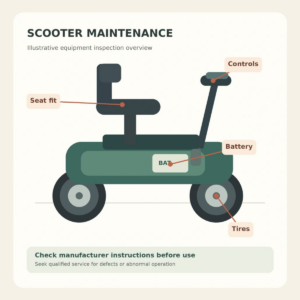
What Maintenance Does a Heavy-Duty Mobility Scooter Need?
Maintenance may include battery care, tire checks, brake inspection, electrical controls, and manufacturer-specified servicing.
Follow the exact model’s instructions.
Is a Heavy-Duty Scooter Better Than a Power Wheelchair?
Not necessarily. Some people need specialized seating, different steering controls, or assistance with transfers that a scooter cannot provide.
A professional mobility assessment can help identify the appropriate category.
What Should I Do if the Scooter Stops Working?
Stop using the malfunctioning equipment, follow the manufacturer’s instructions, and contact an authorized service provider.
Use the established alternative mobility arrangement.
Conclusion: Choosing a Heavy-Duty Mobility Scooter With Confidence
A heavy-duty mobility scooter can support mobility for certain individuals when its design matches the rider’s abilities, seating needs, and intended environments. Higher weight capacity, larger tires, and substantial construction may provide useful features, but they do not guarantee better comfort, safety, or suitability.
Before purchasing a heavy-duty mobility scooter, evaluate seating, steering controls, turning radius, realistic battery performance, terrain limits, storage, transportation, and maintenance support. A supervised trial and professional assessment can help identify problems that are not obvious in product listings.
The best heavy-duty mobility scooter is one the rider can operate comfortably within the manufacturer’s requirements and maintain over time. Careful planning, verified specifications, suitable transportation, and a dependable backup can help families make informed mobility decisions.
Neutral heavy duty mobility scooter decision table
| Decision area | What can go wrong | Evidence to verify |
|---|---|---|
| Person or rider | Wrong fit, control, posture, or participation assumption | Measurements and supervised assessment |
| Environment or route | Clearance, surface, slope, parking, or transfer failure | Complete route test and measurements |
| Provider or seller | Missing service, repair, documentation, or return support | Written terms and named contact |
| Fallback | Delay, malfunction, fatigue, weather, or coverage denial | Backup route and escalation plan |
Official sources and limitations
These sources were consulted for the heavy duty mobility scooter research map. They establish general U.S. safety, access, equipment, or coverage boundaries; they do not endorse a product, converter, seller, provider, ranking, or individual outcome.
- Medicare.gov — Wheelchairs and scooters — Medical necessity, supplier, order, and prior-authorization boundaries.
- Medicare.gov — DME coverage — General DME framework.
- MedlinePlus — Mobility aids — Fit and professional assessment.
- ADA — Mobility devices — Access context.
- NHTSA — Adapted vehicles — Transport and loading questions.
- FAA — Wheelchairs and mobility devices — Battery and air-travel planning.