
Start with the right kind of support, not the most complicated device. A well-fitted walker should make everyday movement steadier without forcing the user to hunch, rush, or fight the equipment.
Mobility walkers for elderly adults can improve stability, conserve energy, and make daily activities more manageable when the walker matches the person, the home, and the way it will be used. The best choice is not automatically the model with four wheels, a seat, or the most accessories. It is the walker that provides enough support, can be controlled safely, fits through the user’s normal routes, and is adjusted by someone who understands gait and balance.
This guide explains the practical differences among standard walkers, two-wheel walkers, rollators, and transport-oriented designs. It also covers fit, brakes, seats, baskets, thresholds, maintenance, Medicare basics, and the warning signs that a professional assessment is needed. The goal is to help families compare options thoughtfully without treating age alone as a reason to buy a particular device.
Quick answer: which mobility walker is best for an older adult?
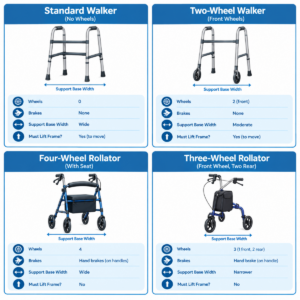
A standard pick-up walker usually provides the most stable base but requires the user to lift it. A two-wheel walker reduces that lifting effort while still offering substantial support. A four-wheel rollator moves more easily and often includes a seat, yet it demands reliable brake use and enough balance to control a rolling frame. A three-wheel rollator turns easily in tight spaces but generally offers a narrower support base.
The safest starting point is a mobility assessment by a physical therapist or other qualified clinician. The clinician can observe walking, strength, balance, cognition, hand function, fatigue, and the surfaces encountered at home. A medical-supply professional can help with product dimensions and adjustments, but product fitting should not replace a clinical recommendation when falls, weakness, surgery, dizziness, or a neurologic condition are involved.
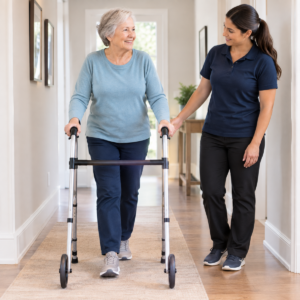
What mobility walkers for the elderly are designed to do
A Mobility Walkers increases the user’s base of support. In plain language, it gives the person a larger, more stable area within which to control the body while standing and stepping. Depending on the design, it may also reduce the load placed on one or both legs, provide a place to pause, or carry small items so both hands remain available for support.
A walker does not cure the cause of unsteadiness. Weakness, pain, medication effects, vision changes, low blood pressure, numbness, and balance disorders may still need medical attention. A new walker should therefore be part of a broader plan that can include exercise, medication review, vision care, safer footwear, and changes to the home.
MedlinePlus notes that mobility aids may help people with disabilities, injuries, certain health conditions, or age-related movement difficulties become more independent. It also emphasizes that some devices require upper-body strength and balance and that walkers should be properly fitted. That distinction matters: more equipment is not always more safety.
Types of mobility walkers for elderly adults
The names used by retailers are inconsistent, so compare the frame and function rather than relying on a label. A product described simply as an “elderly walker” may be a standard frame, a two-wheel walker, a rollator, or even a transport chair hybrid. Those devices behave very differently.
Standard walkers without wheels
A standard walker has four rubber tips. The user lifts or partially lifts the frame, sets it ahead, confirms all four tips are stable, and then steps into the frame. This design resists rolling and may suit someone who needs a high level of steady support and has enough arm strength and coordination to reposition it.
The tradeoff is effort. Repeatedly lifting the frame can be tiring, and a user who cannot clear the rear tips may catch them on the floor. Tennis balls are sometimes added informally to help the rear legs slide, but improvised modifications can change traction and wear unpredictably. Use accessories intended for that walker and follow the manufacturer’s instructions.
Two-wheel walkers
A two-wheel walker has wheels at the front and tips or glides at the rear. The user can push the frame forward rather than lifting it completely. The rear contact points add resistance, which may feel more controlled than a rollator. This can be a useful middle ground for a person who needs substantial support but tires when lifting a standard frame.
Wheel size, rear glide material, flooring, and outdoor cracks affect how easily the walker moves. Small wheels that behave well on smooth indoor floors may stop abruptly at a threshold or broken sidewalk. Test the exact routes the person needs to travel.
Four-wheel rollators
A four-wheel rollator rolls continuously and normally has hand brakes, a seat, and a storage bag or basket. It may suit someone who walks reasonably well but needs balance support and scheduled rest breaks. It is often easier to steer outdoors than a standard walker.
A rollator is not the best choice for everyone. The user must understand and operate the brakes, keep the device close, and resist letting it run ahead. Someone who pushes heavily downward or needs the frame to bear substantial body weight may require a different device. The seat is for resting only when the brakes are locked and the manufacturer permits seated use; it is not normally a transport seat for another person to push.
Three-wheel walkers and compact rollators
Three-wheel designs are narrow and maneuverable. They can turn in kitchens, bathrooms, and crowded rooms more easily than many four-wheel models. However, their triangular footprint is smaller and they usually do not provide the same stable resting seat. A compact frame should be chosen because it fits a specific environment and user, not merely because it looks easier to store.
Specialty walkers
Upright walkers, platform attachments, reverse walkers, bariatric frames, and neurologic designs address specific needs. An upright walker changes where the arms are supported. A platform attachment may help when gripping a handle is painful or restricted. A bariatric frame offers a higher listed capacity and often a wider frame, but it must still fit doorways and the user. Specialty features should be selected with clinical guidance because they change posture, steering, and how weight moves through the device.
Mobility Walkers comparison table
| Mobility Walkers type | Main advantage | Main limitation | Often considered when |
|---|---|---|---|
| Standard, no wheels | Stable frame that does not roll freely | Must be lifted or advanced carefully | The user needs substantial support and can manage the lifting motion |
| Two-wheel | Less lifting effort with controlled rear contact | Can catch on thresholds or rough ground | The user needs support but has difficulty lifting a standard frame |
| Four-wheel rollator | Easy forward movement, brakes, and a rest seat | Requires brake control and may roll away | The user has adequate control but needs balance support and rest breaks |
| Three-wheel | Narrow turning radius | Smaller support base and usually no true seat | Tight indoor routes are the dominant concern |
| Specialty or platform | Addresses posture, grip, weight, or neurologic needs | Fit and technique are more specialized | A clinician identifies a need that a standard design does not meet |
How to choose the best Mobility Walkers for the elderly person in your care
The phrase “best walker” is incomplete until it includes a person and a route. A device that works in a rehabilitation hallway may be frustrating in a small apartment. A rollator that feels smooth in a showroom may be difficult to stop on a sloped driveway. Use the following decision sequence to narrow the options.
Start with the amount of support needed
Observe whether the person needs light balance assistance, regular weight support, or help during nearly every step. Ask whether one side is weaker, whether the knees buckle, and whether fatigue changes performance later in the day. A clinician can identify gait patterns that are not obvious to a family member.
If the person has fallen recently, nearly fallen, developed sudden weakness, or started walking differently, do not treat the walker purchase as the complete response. Seek medical advice to investigate the change. A device selected before the underlying problem is understood may be poorly matched.
Check hand function and brake ability
Hand pain, arthritis, reduced sensation, tremor, or weakness can make small brake levers difficult to use. The user should be able to apply and release the brakes deliberately without changing grip in an unsafe way. Parking brakes should be understandable and easy to confirm visually or by feel.
For a standard or two-wheel walker, grip still matters because the handles transmit support. Platform attachments may be appropriate in some cases, but they change the mechanics and should be fitted correctly.
Measure the user’s everyday routes
Record the narrowest doorway, bathroom approach, bedside clearance, turning space, elevator opening, car cargo opening, and common outdoor surfaces. Measure the walker at its widest fixed point, not just between the handles. Remember that hands and elbows can add practical width.
Test thresholds and transitions. A small raised strip between rooms can stop a wheel and shift the user’s weight forward. Thick carpet, gravel, grass, wet pavement, and cracked sidewalks also change rolling resistance.
Decide whether a seat is genuinely needed
Mobility Walkers for the elderly with seats are useful when fatigue or shortness of breath makes planned rest stops important. The seat height should allow controlled sitting and standing, and the user must be able to lock the brakes before sitting. A seat that is too low can make standing difficult; one that is too high may leave the feet unsupported.
A seat adds weight and bulk. If the walker will be lifted into a trunk several times a day, the caregiver should test the folding sequence and the actual lifting weight. “Lightweight” is a marketing description, not a universal standard.
Evaluate storage without sacrificing control
A mobility walker with seat and basket can keep a phone, water bottle, medication list, and small personal items within reach. Storage should not block the feet, interfere with folding, or encourage overloading. Heavy bags on one side can change steering and stability.
Keep both hands available while walking. Carrying a cup, plate, laundry basket, or oxygen equipment by hand can undermine the support the walker is meant to provide. Use only compatible accessories, and route any tubing so it cannot catch on wheels or furniture.
How a mobility walker should fit
General fitting guidance often places the handgrips near the crease of the wrist when the user stands upright with arms relaxed, producing a slight bend at the elbows when the handles are held. MedlinePlus similarly advises that handles should be around hip level and the elbows slightly bent. This is a starting point, not a substitute for individual fitting.
A Mobility Walkers that is too low encourages bending and can move the user’s body outside the safest part of the frame. A walker that is too high may elevate the shoulders, reduce the ability to bear weight through the arms, and make steering awkward. Shoes matter: fit the device while the person wears the footwear normally used for walking.
After adjustment, observe several tasks: walking straight, turning, approaching a chair, sitting, standing, and crossing a doorway. The user’s toes should remain within a controlled position relative to the frame rather than trailing far behind it. The shoulders should not be shrugged, and the walker should not repeatedly get too far ahead.
Using Mobility Walkers safely during everyday movement
A clinician should teach the sequence that matches the person’s condition. General guidance for a common pattern is to advance the walker a short distance, make sure all tips or wheels are stable, step with the weaker or recovering leg, and then bring the stronger leg through. The exact sequence may differ after surgery or when weight-bearing restrictions apply.
Look ahead rather than staring continuously at the feet. Keep the frame close enough to support an upright posture. Turn using several small steps instead of twisting the body while the feet remain planted. Slow down before rugs, thresholds, pets, cords, and wet surfaces.
Sitting down and standing up
Back up until the chair touches the backs of the legs. Reach for stable armrests one hand at a time and lower with control. Do not drop into the seat. To stand, push from the chair’s armrests or another approved stable surface; do not pull backward on a walker that can tip toward the user.
With a rollator seat, apply the parking brakes fully, position the device on level ground, turn carefully, and confirm stability before sitting. Follow the manufacturer’s instructions. Never sit on a rollator on a slope, and do not use the seat as a wheelchair unless the product is specifically designed and labeled for transport.
Curbs, single steps, stairs, and escalators
Curbs and steps require individualized training because wheel size, leg strength, weight-bearing restrictions, and balance affect the safe sequence. MedlinePlus specifically warns not to use stairs or escalators with a walker unless a physical therapist has provided training. If the route routinely includes stairs, solve the route problem rather than improvising while carrying the walker.
Outdoor walking
Outdoor use adds slopes, cracks, drainage grates, leaves, snow, and changing light. Larger wheels may roll over irregular surfaces more easily, but they do not eliminate fall risk. On a rollator, descend slopes slowly with controlled braking; never rely on parking brakes as speed brakes unless the instructions describe that use.
Plan where to rest before fatigue becomes severe. If the user becomes dizzy, unusually short of breath, confused, weak, or develops chest discomfort, stop and seek appropriate medical help rather than trying to complete the route.
Home setup for Mobility Walkers for elderly adults
A walker cannot compensate for a route filled with hazards. Remove loose rugs or secure them appropriately, keep electrical cords out of walking paths, improve lighting, clean spills promptly, and arrange furniture so the user does not have to turn sideways through narrow gaps.
Choose chairs with firm seats and armrests. Very low, soft furniture can make transfers difficult. In the bathroom, consider professional advice about grab bars, toilet height, and shower access. A walker should not be used as a substitute for a permanently installed grab bar.
Keep frequently used items between comfortable waist and shoulder height. The user should not climb, overreach, or abandon the walker to reach a cabinet. A small compatible bag can help carry light items while both hands stay on the handles.
Maintenance checklist for elderly walkers
Inspect the walker on a schedule and after any fall, impact, or unusual movement. Check that height-adjustment buttons are fully engaged at matching positions, fasteners are tight, folding locks work, and the frame is not bent or cracked.
- Daily: look at tips, glides, wheels, brakes, and the path for debris or moisture.
- Weekly: test brake response, parking-brake engagement, seat stability, folding latches, and accessory attachment.
- Periodically: compare wear against the manual, clean bearings and frame as directed, and arrange professional service when parts loosen or steering changes.
Replace worn tips and damaged wheels with parts specified for the model. A tip can look intact from the side while the tread underneath is smooth. Brake cables that stretch, fray, or rub should be serviced rather than improvised.
Medicare, insurance, and the cost of a walker
Medicare lists walkers among examples of durable medical equipment. Part B may cover medically necessary DME ordered for home use when eligibility and supplier requirements are met. Coverage method can vary: an item may be rented, purchased, or handled under another payment arrangement.
Do not assume a retail Mobility Walkers for Elderly will be reimbursed after purchase. Before ordering, ask the treating clinician what documentation is required and confirm that the supplier is enrolled in Medicare and accepts assignment. Medicare Advantage plans may use network and authorization rules that differ from Original Medicare.
For private insurance, Medicaid, Veterans benefits, or community lending programs, verify the current rules directly. The lowest purchase price is not always the lowest total cost if the device needs replacement parts, a professional fitting, delivery, or a return because it does not fit the home.
Common mistakes when choosing a Mobility Walkers
- Choosing by age rather than function. Two people of the same age may need entirely different levels of support.
- Buying a rollator because it has a seat. The user may not have the hand control or balance needed for a freely rolling frame.
- Ignoring width and turning space. A device that cannot reach the bathroom or bedside will not support the most important routines.
- Leaving the factory height unchanged. Proper adjustment is part of safe use.
- Pulling on the walker to stand. The frame may tip toward the user.
- Adding incompatible trays, bags, or glides. Accessories can change balance, braking, folding, and clearance.
- Waiting after a fall. A fall or sudden gait change deserves prompt assessment, not just a sturdier device.
How to test a walker before making it the everyday device
A short trial should reproduce real tasks, not just a straight walk across a showroom. Begin on a level, uncluttered surface with a qualified professional present. Confirm the height, grip, frame locks, brakes, and footwear. Then test starting, stopping, turning both directions, backing toward a chair, sitting, standing, and carrying a light item in an approved bag.
Move to the routes that matter. The device should pass through the bathroom door, turn near the toilet, reach the preferred side of the bed, and move around the kitchen without forcing the user to abandon it. If the person lives in an apartment, include the elevator and building entrance. If outings matter, include the driveway, curb cut, parking lot, and car-loading sequence.
Record what happens rather than asking only whether the walker “feels good.” Note whether the user drifts to one side, catches a foot on the frame, walks too far behind it, forgets the brakes, becomes short of breath, or needs repeated cues. These observations help a therapist distinguish a setup problem from a device-category problem.
Confidence is important, but confidence without control is not safety. A person may prefer the faster feel of a rollator even when the frame repeatedly moves beyond a controlled position. Conversely, someone may reject a standard walker because it feels slow even though it provides the support needed during recovery. A trial should balance preference with observed performance.
Testing a folding walker and car transport
The caregiver who will load the walker should perform the complete sequence. Fold it, secure loose parts, lift it into the actual vehicle, and restore it to a locked operating position. Check whether the seat, bag, tray, or cup holder must be removed. A device that is technically foldable may still be too heavy, awkward, or large for routine use.
Never let the walker move freely inside a vehicle. Secure it so it cannot strike passengers during a sudden stop. Keep the manual and any small removable parts together. After transport, confirm both sides are fully opened and locked before the user takes hold.
Decision examples: matching the Mobility Walkers for Elderly to the routine
An older adult recovering from surgery
A two-wheel walker may reduce lifting effort while providing more resistance than a four-wheel rollator, but the correct choice depends on weight-bearing instructions and gait. The surgeon or therapist should teach the sequence and determine when support can be reduced. A seat may be unnecessary for a short indoor rehabilitation route and could add bulk.
A person who tires during community outings
A rollator with a seat may help if the person can control the brakes and sit safely. Wheel size, parking-brake operation, seat height, and folded weight become important. The route should include planned rest locations, accessible entrances, and a way to transport the device.
A person with arthritis in the hands
Brake levers and folding releases may be the deciding features. Test grip force, finger reach, and the ability to set the parking brake. A device that is easy to roll but impossible to lock is not a workable solution. A therapist may explore alternative handles or support options.
A person with memory or judgment changes
The safest design may be the one with the simplest reliable sequence, but supervision needs must also be assessed. Repeatedly forgetting brakes, standing before the frame is positioned, or using the seat on a slope are not problems that a label can solve. Caregiver cueing, environmental changes, and another mobility approach may be necessary.
A small home with narrow doors
Measure first. A narrow frame that passes the door may still require more turning space than available. Removing bathroom doors, changing hinge direction, rearranging furniture, or creating a clearer route may be safer than choosing a device solely for its narrow width. Any building change should preserve privacy, fire safety, and an unobstructed exit.
Monitoring whether the Mobility Walkers for Elderly is still the right choice
Needs change. Set a review point after the first few days and again after several weeks. Ask whether the person is walking more safely, reaching important rooms, and experiencing less fatigue. Also ask about hand pain, shoulder discomfort, fear, near-falls, and tasks that are being avoided.
Watch for the walker moving farther ahead, the body bending more, uneven wear on tips, increased reliance on furniture, new brake errors, or difficulty standing. These can indicate a fit issue, maintenance problem, or change in health. Reassessment is especially important after hospitalization, a fall, medication change, infection, or new pain.
Keep a simple log when several caregivers are involved. Record falls and near-falls, circumstances, footwear, time of day, surface, and whether the device was in use. The purpose is not to blame the user; it is to find patterns that can be changed.
Questions to take to a walker fitting appointment
- What support problem is this walker intended to solve?
- Why is this category preferable to a cane, standard walker, two-wheel walker, or rollator?
- What walking and transfer sequence should the user follow?
- How should the handles be adjusted with the user’s normal shoes?
- Can the user safely operate every brake, latch, and folding control?
- Which accessories are approved, and what load can the storage area carry?
- What surfaces or routes should be avoided?
- How will the device be transported and rechecked after unfolding?
- Which parts wear out, and where can compatible replacements be obtained?
- What changes should trigger a new clinical assessment?
When to ask a physical therapist or clinician for help
Arrange professional evaluation when the user has repeated falls or near-falls, new weakness, dizziness, fainting, pain that changes walking, difficulty using brakes, cognitive changes, recent surgery, a new weight-bearing restriction, or a progressive neurologic condition. Help is also appropriate when the device seems to increase fear or when the person avoids using it.
A therapist can assess whether the walker is the correct category, fit it, teach transfers and turning, and recommend exercises or environmental changes. The recommendation may change over time. Recovery can reduce support needs, while progression of a condition may require a different device.
Frequently asked questions about mobility walkers for elderly adults
What is the best walker for the elderly?
There is no single best model. A standard walker provides more resistance to rolling, a two-wheel walker reduces lifting effort, and a rollator offers easy movement and a seat but requires brake control. The best choice follows an assessment of balance, strength, cognition, hand function, fatigue, and the home route.
Are walkers with a seat safe for older adults?
They can be safe for a user who can control the brakes, turn, and sit with the device locked on level ground. A seat is not automatically appropriate for someone who leans heavily on the frame or cannot remember the parking-brake sequence.
How do I know whether the walker is too low?
Warning signs include pronounced bending, shrugged or uncomfortable shoulders, the frame getting too far ahead, and difficulty standing within the support area. A professional fitting is the best way to confirm height and technique.
Can someone be pushed while sitting on a rollator?
Not unless the manufacturer specifically labels the product for that purpose. Most rollator seats are designed for stationary rest with brakes locked, not for transport.
Should a walker be used on stairs?
Do not attempt stairs or escalators without individualized training from a physical therapist. Many routes require an alternative plan, a second device kept on another level, or an accessibility modification.
How often should walker tips and brakes be checked?
Look at contact points and brake function frequently, especially before longer outings. Replace worn parts promptly and follow the manufacturer’s maintenance schedule.
Does Medicare cover walkers?
Medicare Part B may cover a medically necessary walker as DME when it is ordered for home use and coverage requirements are satisfied. Confirm documentation, supplier enrollment, assignment, and any plan-specific authorization before purchasing.
Can a basket make a walker unstable?
It can if it is overloaded, mounted incorrectly, or carries weight unevenly. Use a compatible accessory, keep loads light, and make sure it does not interfere with feet, wheels, brakes, or folding.
Official sources and further reading
- MedlinePlus: Using a walker
- MedlinePlus: Mobility aids
- Medicare.gov: Durable medical equipment coverage
- MedlinePlus: Fall risk assessment
Choose support that works in the real home
The most useful walker is one the older adult can control confidently on the routes that matter every day. Bring the user’s measurements, normal shoes, medication and fall history, doorway dimensions, and transportation needs to a clinical or supplier appointment. Test fit and technique before relying on the device at home.
SeniorTechLife will connect this guide to the broader Walkers Hub and related home-safety resources as those planned pages are published. Until then, use the official resources listed in the source record and ask a qualified clinician for individualized guidance.
1 comentario en «Mobility Walkers for Elderly: A Practical Guide»