
Caregiver job duties should describe the work a paid caregiver is hired, trained, and authorized to do, including the client’s needs, the setting, supervision, documentation, safety limits, schedule, and the process for asking for help when a task falls outside the role.
Quick answer: what caregiver job duties should cover
A caregiver job is not a generic promise to “help seniors.” The duties should identify the client population, location, shift pattern, daily support, reporting relationship, training requirements, recordkeeping, and tasks that require a supervisor or clinician. The same title can mean different work in a private home, agency, adult day program, assisted living community, or hospice-related setting. A usable job-duty list is specific enough for a candidate to understand the work and for an employer to train and supervise it safely.
Common caregiver work can include help with meals, shopping, transportation, personal routines, household organization, appointments, companionship, and observations that need to be reported. CDC identifies similar activities among the support caregivers provide. The employer must still define the level of assistance, the client’s care plan, and what the worker cannot do. No job title authorizes a worker to perform clinical, legal, financial, or emergency tasks beyond training, policy, and applicable law.
| Job-duty area | What a clear description says | Risk if it stays vague |
|---|---|---|
| Client support | Specific daily tasks, level of help, and care-plan boundaries. | Worker and client may expect different levels of personal care. |
| Schedule | Shift hours, weekends, travel, on-call expectations, and break process. | Unpaid or unsafe around-the-clock expectations can develop. |
| Supervision | Who gives instructions, receives reports, and handles changes. | Staff improvise during a health or safety concern. |
| Documentation | What is recorded, when, where, and how privacy is protected. | Important observations and services may be lost or mishandled. |
| Limits | Tasks requiring training, a clinician, another worker, or an emergency response. | Worker is pressured into unsafe or unauthorized care. |
Caregiver job duties begin with the work setting
Before listing tasks, define where the work happens. An in-home caregiver may navigate household routines, family communication, pets, stairs, transportation, and privacy in someone else’s home. A community-based caregiver may work with several residents, follow facility policies, and coordinate with a nurse or manager. The setting shapes workload, supplies, emergency procedures, and how the worker receives instructions.
Caregiver job duties in a private home need household boundaries
State whether the caregiver may prepare meals, do laundry, provide light housekeeping related to the client, run errands, drive, assist with a routine, or accompany the client to appointments. Do not use a caregiver role to absorb general family housekeeping, heavy cleaning, yard work, child care, or work for people who are not the client unless that is explicitly agreed and lawful. A client’s home is also a workplace; access, pets, smoke, visitors, and safety hazards should be addressed before the first shift.
Caregiver job duties in a community need role coordination
In a residence or program, describe the worker’s assigned residents, shift handoff, reporting chain, meal and activity role, emergency procedure, and documentation system. The job should identify which team member handles a medication question, a change in condition, a family concern, a fall, a supply shortage, or a behavioral escalation. Workers should not be left to guess which policy applies during a busy shift.
Caregiver job duties should state the employment relationship
A worker may be employed by an agency, a facility, or directly by a household. This affects who provides training, payroll, insurance, supervision, scheduling, records, and replacement coverage. Job candidates should ask who the employer is and which policies apply. A family hiring directly should obtain current legal and employment guidance rather than copying an agency job description without the systems that support it.

Caregiver job duties for daily client support
Daily duties should use action words and describe the allowed level of help. “Assist with dressing” may mean laying out clothes, offering cues, fastening a button, or providing hands-on assistance. Those are different tasks. The job description should say how the care plan defines assistance and when a worker must ask for a supervisor, clinician, or another trained person.
Caregiver job duties for personal routines
Personal support may include bathing, dressing, grooming, toileting, eating, repositioning, or mobility assistance when the worker is trained and the care plan permits it. Describe privacy expectations, equipment, two-person-assist requirements, and the rule for declining an unsafe task. A caregiver should explain before helping, offer choices, protect dignity, and report a meaningful change rather than forcing a routine to happen on schedule.
Caregiver job duties for meals and household tasks
Specify whether the worker plans meals, prepares food, cleans up, shops, does client-related laundry, changes linens, or organizes supplies. Include diet and food-safety instructions from the care plan, but do not require a caregiver to prescribe a diet or diagnose a nutrition problem. If a client needs feeding support, swallowing precautions, or a therapeutic diet, the employer should explain the training, care-plan direction, and reporting process.
Caregiver job duties for transportation and errands
If driving is part of the role, state whether the worker uses an agency vehicle, client vehicle, or personal vehicle; what insurance and license requirements apply; how trips are documented; and how mobility devices are handled. If transportation is not part of the job, say so. A caregiver who accompanies a client to an appointment can take notes and report questions, but should not make medical decisions or sign documents without authority.
Caregiver job duties for companionship and engagement
Companionship can include conversation, walks, games, music, reading, community activities, and support for a preferred routine. It should be person-centered, not a requirement that every client socialize in the same way. The job description can name an expectation to notice isolation, withdrawal, or distress and report it through the proper channel. It should not make a caregiver the client’s sole emotional support or crisis counselor.
Caregiver job duties, care plans, and documentation
A care plan tells a worker what support is expected for a particular client. The job description tells the worker how to perform the role across shifts and clients. Both are needed. CDC’s care-plan guidance includes health conditions, medicines, providers, insurance information, and emergency contacts; the caregiver should know where authorized information is kept and how to use it without overstepping privacy.
Caregiver job documentation should be factual
Document the service provided, relevant observation, time, and required follow-up according to employer policy. Use neutral wording. “Client declined lunch and asked for tea” is more useful than a judgment about attitude. Do not write diagnoses, assume motives, or copy private information into personal messages. A record should help the next worker or supervisor understand what happened and whether someone needs to act.
Caregiver job duties should include reporting changes
Workers should know what must be reported immediately, what goes in the shift note, and what can wait for a scheduled meeting. Examples may include a fall, sudden confusion, new pain, breathing concern, missed medicine, skin change, food or fluid concern, equipment problem, or change in mobility. The worker does not diagnose the cause; they follow the reporting and emergency process set by the employer and care team.
Caregiver job privacy duties protect the client and worker
Do not discuss a client in public spaces, share photos or messages without authorization, use a client’s account or card for personal purposes, or leave records visible in a car. Follow the employer’s policy for phones, electronic records, family communication, and secure disposal. If a family member asks for information, the worker should follow the approved contact and privacy process rather than assume a relationship gives access.
Caregiver job duties and training requirements
Training should match the duties, client population, and setting. Orientation may cover confidentiality, infection prevention, emergency response, falls, safe lifting, documentation, client rights, communication, abuse reporting, and employer policies. A worker may also need client-specific instruction for mobility equipment, a meal plan, dementia communication, a health maintenance activity, or a particular care routine. Training is an ongoing process, not a checklist completed before the first shift.
Caregiver job duties should identify required competencies
For each higher-risk task, the employer should state what training, demonstration, observation, certification, or supervisor approval is needed. Medicare notes that caregiver training may be covered under Part B in certain situations when a provider determines it is appropriate for a patient’s treatment plan. That coverage information is not a job qualification standard; it illustrates why a caregiver needs task-specific instruction rather than a generic online video.
Caregiver job duties need a safe-lifting rule
State when a worker must use equipment, request a second person, or stop and seek help. The client’s condition, weight, balance, and environment can change. A job that requires a caregiver to “assist with transfers” without equipment, policy, or training is incomplete. Reporting an unsafe assignment is part of professional care, not a failure to cooperate.
Caregiver job duties for medication support need exact limits
Medication work may range from reminder and pickup to assistance under a defined plan. The description should state whether the worker may handle labeled containers, document a reminder, contact a pharmacy, observe a self-administered medicine, or provide a service permitted by the care plan and local rules. Never use a job description to authorize a worker to decide a dose, substitute a medicine, or ignore a side effect.
Caregiver job duties during a shift handoff
Handoffs are a safety task. The incoming caregiver needs enough information to continue the client’s routine without receiving an unnecessary personal history. The outgoing caregiver needs a clear time to end the shift. A predictable handoff reduces missed appointments, duplicate services, medication confusion, and family conflict.
Caregiver shift notes should name unresolved items
Record what was completed, what changed, and what the next worker or supervisor needs to know. Include time-sensitive tasks, refill requests, a pending call, equipment issue, new symptom reported through the required channel, or a client preference that mattered that day. Do not use the handoff to criticize another worker. If performance is a concern, follow the employer’s supervision process.
Caregiver job duties after a missed shift need a backup process
A worker should know whom to call before a late arrival or absence, how much notice is expected, and whether they may contact the client directly. The employer or household should have a backup plan rather than expecting a caregiver to work while ill or arrange an unauthorized replacement. Continuity of care is an employer and system responsibility as well as a worker responsibility.
Caregiver job duties after an incident require timely reporting
If there is a fall, injury, missing client, allegation, suspected abuse, medication issue, equipment failure, or emergency transfer, follow the written policy immediately. Preserve factual details, notify the correct supervisor or emergency service, and complete documentation as required. Do not hide an incident, edit a record after the fact without the proper process, or promise a family outcome you cannot control.
Caregiver job duties and client rights
A professional caregiver supports the client’s choice, dignity, privacy, culture, language, beliefs, and daily preferences within the care plan and safety requirements. The worker should not treat an older adult as a child, use their own preferences as the default, or discuss the client’s condition casually. Respect is a job duty that appears in ordinary actions: knock before entering, explain a task, offer choices, preserve modesty, and allow enough time.
Caregiver duties should support client choice
Offer options when possible: which shirt, meal, activity, bath time, or route feels better. If a choice conflicts with a safety concern, follow the employer’s process and involve the appropriate supervisor or clinician. The caregiver should not make a unilateral legal, medical, or financial decision because it seems convenient.
Caregiver job boundaries prevent exploitation
Do not borrow money, accept inappropriate gifts, use the client’s car or property for personal reasons, ask the client to keep secrets, or take on tasks outside the contract in exchange for an informal payment. Report a boundary concern to the supervisor or employer. Clear boundaries protect both the client and the caregiver from misunderstanding and exploitation.
Caregiver job duty performance review and growth
Performance review should connect the job description to observable work: punctuality, care-plan follow-through, communication, documentation, safety, respect, training completion, and ability to ask for help. It should not reward a caregiver for quietly taking unsafe extra work or punish them for reporting a realistic concern.
Caregiver job feedback should identify the next skill
Use a specific example, explain the expected standard, provide coaching or training, and set a review point. For example, if shift notes are incomplete, clarify which fields matter and review an appropriate example. If transfers feel unsafe, arrange training or change the assignment. General criticism without a plan does not improve client care.
Caregiver job duties can change with client needs
Update the assignment after a hospital stay, new diagnosis, mobility change, change in family support, move, or recurring incident. The employee should receive the new care-plan direction, time to learn the change, and an opportunity to ask questions. A job may need additional staffing, a different skill mix, equipment, or a referral to another service rather than simply adding more tasks to the same shift.
Caregiver job duties with families and other professionals
Caregivers often work alongside family members, nurses, therapists, social workers, physicians, managers, coordinators, and other direct-care staff. The job description should explain how the caregiver participates without taking over another professional’s role. Good coordination means bringing useful observations, following the current plan, asking questions, and documenting the agreed next step.
Caregiver job duties with family members require approved communication
Families may know the client well and may offer helpful information about routines, preferences, and changes. They may also make requests that conflict with the care plan, employer policy, client wishes, or the worker’s scope. The caregiver should listen respectfully, explain that they will follow the approved process, and bring the request to the supervisor when needed. Avoid debating care decisions during a shift or sharing protected information with an unauthorized relative.
Caregiver job duties with clinicians require concise observations
A caregiver can report what they saw, heard, measured if authorized, or were told by the client. A useful report includes time, pattern, change from baseline, and immediate safety action. It does not diagnose. For example, “client reported new dizziness when standing at 8 a.m.; sat safely; supervisor notified” is clearer than “client has an infection.” Clear observations help clinicians and supervisors decide what should happen next.
Caregiver job duties with a supervisor include escalation
Workers should know when a supervisor must be contacted and which communication method applies. Include urgent clinical or safety changes, an allegation or boundary issue, an unsafe assignment, a missed critical service, a client refusal that changes the plan, a medication concern, or a family conflict that cannot be resolved within the caregiver’s role. Escalation is a professional action; it gives the right person a chance to respond before a problem becomes larger.
Caregiver job duties in difficult but common situations
Not every difficult moment is an emergency, but every difficult moment needs a safe response. A job-duty guide should give workers a structure: pause, protect immediate safety, use the care plan and de-escalation approach, report the change, and ask for qualified help. It should never encourage a worker to hide a problem because a shift is busy.
Caregiver job duties when a client refuses support
Clients may refuse a shower, meal, activity, medicine reminder, transfer, or appointment. Respectful caregivers ask what is wrong, offer choices within the plan, allow time when safe, and report a meaningful refusal according to policy. Forcing care can harm dignity and safety. If refusal creates an immediate concern, follow the employer’s escalation process and the client’s care-plan instructions.
Caregiver job duties when a client is upset or confused
Use a calm voice, simple language, familiar routines, and enough personal space. Avoid arguing about a mistaken belief or making promises that cannot be kept. Look for practical triggers such as pain, noise, fatigue, hunger, a need for the bathroom, a change in routine, or an unfamiliar person. Report the event and the approach that helped. A pattern may require a care-plan review or clinical assessment.
Caregiver job duties when supplies or equipment fail
State how to report a missing supply, broken walker, empty gloves, nonworking call device, transportation cancellation, or inaccessible bathroom. Do not use damaged equipment or substitute supplies in a way that creates risk. The worker should protect the client, notify the correct person, document the issue if required, and wait for an appropriate solution. A job description should name the after-hours process so staff are not stranded with a predictable problem.
Caregiver job duties when a client’s needs exceed the assignment
Sometimes the correct response is to say that the assignment needs review. A worker may notice that a client now needs two-person transfers, more personal care, frequent overnight support, clinical monitoring, or a different service. The caregiver should document and report the concern, not quietly add untrained work or let the client go without support. Employers should treat this information as a staffing and care-planning issue.
Caregiver job duties, attendance, and professional reliability
Reliable attendance matters because missed support can affect meals, transportation, medication routines, personal care, and client trust. Reliability also includes telling the employer early when a worker cannot complete a shift safely, arrives late, needs a schedule adjustment, or cannot perform a task because of injury or missing training. A professional caregiver does not conceal a limitation to protect a schedule.
Caregiver job duties and breaks should be explicit
Describe meal and rest breaks, coverage during breaks, travel time, overtime rules, and what happens when a shift runs late because of an emergency. A worker cannot provide safe care indefinitely without rest. Employers should provide a workable coverage process rather than expecting a caregiver to skip breaks, stay after every shift, or arrange unpaid relief without authority.
Caregiver job duties include dependable preparation
Preparation may include reviewing the current care plan, checking the schedule, bringing required identification or supplies, confirming transportation, and knowing whom to call. It does not mean accessing records that are not needed or arriving far outside paid time without instruction. The employer should state what preparation is part of the shift and what is expected before arrival.
Caregiver job duties template for a safe assignment
| Assignment field | Required detail | Who resolves a change |
|---|---|---|
| Client and setting | Client needs relevant to the job, location, access, schedule, and emergency procedure. | Supervisor or care coordinator. |
| Allowed duties | Specific personal, household, transportation, companionship, and documentation tasks. | Supervisor and care plan. |
| Excluded duties | Clinical, financial, legal, unsafe-lifting, or untrained tasks. | Clinician, manager, or authorized representative. |
| Training | Orientation, task-specific competency, equipment, privacy, and incident requirements. | Employer or qualified trainer. |
| Communication | Shift note, family contact limit, incident chain, and after-hours number. | Direct supervisor. |
Review this assignment at regular intervals and after any meaningful change. The written job duties should stay aligned with the care plan, staffing level, client preferences, and legal or employer requirements. A document that is never updated can create as much confusion as no document at all.
Caregiver job duties before ending an assignment
When a caregiver leaves a position, changes clients, or transfers to another shift, the employer should provide a defined offboarding process. Return keys, badges, equipment, records, and client property; remove system access; complete required notes; and identify the person who will take over. The caregiver should not keep client contact information, photographs, documents, or account access after the work relationship ends unless a lawful, authorized arrangement requires it.
Caregiver job duties during a transition should avoid gaps
Use the final handoff to identify time-sensitive appointments, care-plan changes, supply needs, client preferences, unresolved concerns, and any safety issue already reported. Do not transfer private information through an insecure personal channel. A clear transition protects the incoming worker and the client, and it allows the departing worker to leave with professional boundaries intact.
The employer should review whether the incoming assignment needs a new assessment or extra orientation. A transition can reveal that the existing schedule, documentation, or staffing model is no longer adequate. Resolving that issue before the first shift is safer than asking a new caregiver to discover it alone.
Caregivers should also receive clear confirmation of the final shift, payroll or timekeeping procedure, and who may answer a future employment verification request. These steps are administrative, but they prevent unfinished obligations from being confused with ongoing responsibility for a former client.
A respectful close also gives the client and family a chance to understand the next point of contact. Continuity should be planned, documented, and supervised rather than left to informal personal messages after the job ends.
Before the final day, the supervisor and caregiver can compare the written assignment with the work actually performed. If recurring tasks were never documented, if a family request became routine without approval, or if the client’s abilities changed, the record should be corrected through the employer’s process. This review is not a performance argument. It is a last opportunity to make the next worker’s scope clear and to identify whether the client needs a reassessment, another service, or a different staffing plan.
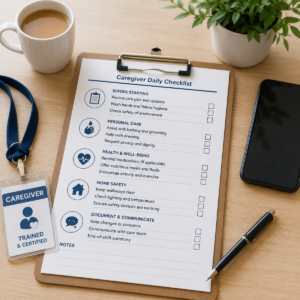
Caregiver job duties checklist before accepting a position
- Who is the employer and who is the direct supervisor?
- Which clients, setting, shifts, travel, and on-call expectations apply?
- Which tasks are expected, and which are specifically excluded?
- What training, credentials, background checks, or demonstrations are required?
- How are medication, transfers, emergencies, incidents, and documentation handled?
- What is the break, overtime, absence, and backup policy?
- How are privacy, client rights, family communication, and complaints managed?
- How will the job change if the client’s needs change?
Frequently asked questions about caregiver job duties
What are caregiver job duties?
They are the specific work tasks, boundaries, training, documentation, reporting, and supervision expectations assigned to a paid caregiver in a particular setting.
Can caregiver job duties include medication assistance?
They may include defined medication support when the care plan, employer policy, training, and applicable rules allow it. A job description should not authorize dose changes or untrained clinical work.
What should a caregiver do if a task feels unsafe?
Stop, protect the client from immediate danger, and follow the employer’s escalation process. Request a supervisor, another trained worker, equipment, or clinical guidance as appropriate. Do not improvise an unsafe transfer or procedure.
How are caregiver job duties different from caregiver responsibilities?
Job duties are the assigned tasks and work processes for a position. A separate caregiver duties responsibilities guide can address broader accountability and role ownership. This article focuses on the employment scope and day-to-day execution of a job.
Official sources for caregiver job-duty planning
- CDC: Dementia caregiving as a public health strategy — used for common caregiver support categories.
- CDC: Steps for creating and maintaining a care plan — used for care-plan information and planning context.
- Medicare: Caregiver training services — used for conditional training context.
- ACL: National Family Caregiver Support Program — used for high-level training and respite context.