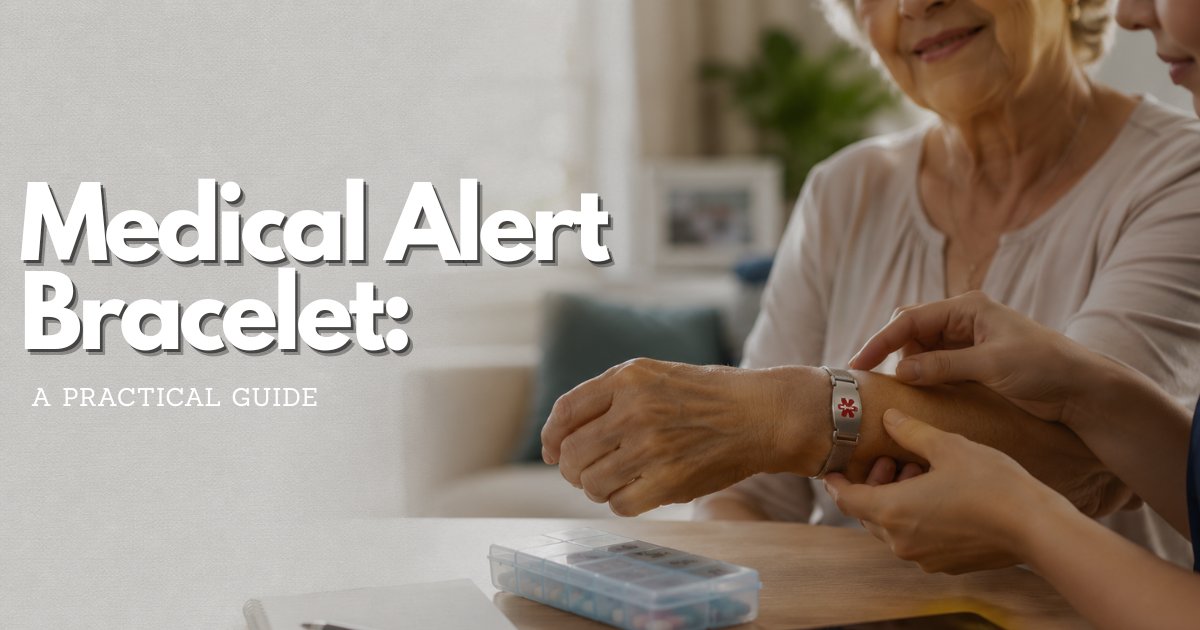
A medical alert bracelet can mean either a wrist-worn emergency button or a medical identification bracelet. Knowing which one you need—and whether the wearer can comfortably use it every day—matters more than choosing by style, advertising claims, or a generic “best” list.
Quick answer: what does a medical alert bracelet do?
An emergency-button bracelet is a wearable way to request help. Pressing its button may connect the wearer with a monitoring service, a base station, a phone, or chosen contacts, depending on the service. A medical ID bracelet is different: it displays or links to health and contact information for someone who is already receiving help. One can summon assistance; the other can help responders understand relevant information. Some people need one, some need both, and neither replaces calling 911 in an immediate emergency when a person can do so.
For an older adult, the right bracelet is the one they can put on, keep on, reach after a fall, and explain without confusion. It should fit a real routine: bathing, sleeping, getting dressed, using a walker, gardening, traveling, and charging devices. The National Institute on Aging notes that emergency response systems can help lower risk for people who live alone, but they must be correctly set up, worn, and maintained; they do not replace regular contact from family, friends, or caregivers.
| Type of bracelet | Main job | What to verify |
|---|---|---|
| Emergency-button bracelet | Starts a help request | Connection, response order, coverage, charging, and fit |
| Medical ID bracelet | Communicates critical information | Readable information, accurate contacts, comfort, and update process |
| Both together | Requests help and supports identification | Whether wearing two items is realistic and information remains current |
Tell an emergency medical alert bracelet from a medical ID bracelet
The words are often used interchangeably online, which can lead to a costly or unsafe mismatch. Before shopping or enrolling, write down the problem you are trying to solve. “I need someone to know I take a blood thinner” points toward an ID and a discussion with a clinician about what information to carry. “I need a simple way to call for help in the bathroom” points toward an emergency response device. “My parent may become lost” may require an ID, agreed safety planning, and professional advice—not a bracelet alone.
An emergency-button bracelet creates a communication path
Most button bracelets are part of a broader personal emergency response system. The bracelet sends a signal to a home base, a mobile device, or a connected service. What happens next depends on the provider’s terms: an operator may attempt to speak to the wearer, contacts may be called, or emergency services may be requested. Ask for the exact sequence in writing. A bracelet cannot promise a particular emergency response time, diagnose a medical problem, or solve a situation where it is uncharged, out of range, or not worn.
A medical ID bracelet communicates information after help arrives
An ID bracelet generally carries engraved information, a medical-symbol identifier, or a reference to a record. It may be useful for severe allergies, diabetes, anticoagulants, seizure disorders, implanted devices, or other information a clinician advises the person to carry. Keep the content brief, legible, and current. Do not crowd it with a full medical history, private account numbers, or details that a first responder cannot use quickly. Ask a clinician what information is appropriate if you are unsure.
Do not assume one bracelet does the other job
A button bracelet may contain no medical information. An engraved bracelet may contain no electronic button, location feature, speaker, or monitoring service. A smartwatch may include a help feature, but its interface, charging habit, and emergency configuration can be different again. If a seller uses phrases such as “medical alert,” inspect the actual function: can it contact anyone, does it display information, and what must be purchased or configured before it works?
Choose a bracelet for medical alert use by wearability first
Features do not matter if the bracelet is removed. Let the intended wearer handle a sample or the actual device before committing. They should try fastening it while seated, using their usual glasses and mobility aids. They should be able to identify the button by touch, avoid accidental presses during ordinary movement, and remove it safely if instructed. A caregiver’s preference for a discreet design should not outweigh the wearer’s comfort or consent.
Check the clasp, band, and skin contact
Arthritis, tremor, one-sided weakness, swelling, fragile skin, and sensory sensitivity can change what is tolerable. A clasp that is secure may also be impossible to fasten alone. A tight band can be uncomfortable or trap moisture; a loose band can rotate the button out of reach. Ask about adjustment, replacement bands, cleaning instructions, and whether the device must be removed for bathing. Stop using any bracelet that causes skin injury and seek appropriate medical guidance for persistent irritation.
Test the button from positions where help may be needed
Reach is more important than appearance. With the provider’s approved test process, have the wearer press the button while sitting in a chair, lying in bed, and on the bathroom floor only if that can be done safely as a simulation. Can they find it with one hand? Can they press it with limited grip? Does the device respond clearly? For a home system, test from the bedroom, bathroom, kitchen, porch, and other everyday locations. Walls, distance, closed doors, and household noise may change the experience.
Consider shower, sleep, and charging routines
Never infer water resistance from a wristband’s appearance. Confirm the device’s current water instructions directly with the provider. A bracelet that is approved for shower use still may have restrictions, while its charger and base should remain dry. Decide where the wearer will place the bracelet during charging and what backup is available then. If it comes off overnight, keep a charged phone or another reachable alert method close by. A plan that depends on remembering a complicated daily routine is more likely to fail.
How a bracelet medical alert button connects to help
Home bracelets commonly communicate with a base unit. Mobile bracelets or watch-style devices may use cellular service and include a speaker, or they may rely on a paired phone. These are not interchangeable. Ask whether the bracelet itself has two-way voice, whether the home base can be heard from common rooms, and what connection is required. Confirm coverage at the actual address and places the wearer regularly visits rather than treating a coverage map as a guarantee.
Understand the response order before enrollment
Write down what happens after a button press. Does someone call the wearer through a speaker? Are emergency contacts called before emergency services? What if the wearer cannot speak? Can contacts be changed immediately after a move or family change? A response plan should name people who have agreed to be called and who understand their limits. A nearby neighbor may be able to unlock a door but may not be able to lift someone after a fall. A distant relative may organize information but cannot arrive quickly.
Treat fall detection as an added layer, not a promise
Some systems offer automatic fall detection, but it can miss falls and can create false alerts. NIA-supported wearable research identifies both false alarms and undetected falls as real challenges. A wearer who can press the button should do so. Before adding the feature, ask how an alert is cancelled, whether the person can hear the service’s callback, and whether false alerts will discourage use. A discussion with a clinician is appropriate after a fall or a new concern about balance.
Use location features with realistic expectations
Location may help a mobile device’s response plan, but it depends on power, network connection, device carriage, permissions, and environment. Indoor, rural, or enclosed locations may be less precise. Location sharing should be explained to the wearer: who sees it, whether it is continuous or event-based, and how it can be turned off or changed. Never present a bracelet map as a substitute for a person telling 911 where they are when able.
Set up a medical alert bracelet before relying on it
Set up the bracelet with the wearer present and unhurried. Read the provider’s instructions, register the device, charge it as directed, and create a simple written record of the model, support number, response order, and test date. Do not leave the base unit hidden behind furniture or place a charger where it is difficult to reach. Make sure the person knows which bracelet is the emergency button and which is identification if they wear both.
Build contacts around consent and actual availability
Each listed contact should agree to participate. Confirm their number, time zone, ability to answer, and what they can do if called. Review information after changes to phones, addresses, caregivers, access instructions, or relationships. The wearer should understand who is listed and should retain control when capable. An alert service account is not a reason to share a person’s health details with every relative.
Practice without causing a false emergency
Use the exact test procedure provided by the service. Explain that accidental alerts can happen and should be reported honestly; fear of “getting in trouble” can make someone delay a real call. During a test, check button reach, sound quality, the contact sequence, and the person’s ability to state their name and location. Record any failure and contact support rather than assuming it will work next time. Repeat after a move, a service change, or a period when the bracelet was not used.
Match a medical alert bracelet to daily situations
Describe the person’s normal week instead of choosing from a feature chart. Do they live alone, share a home, use stairs, shower independently, take walks, drive, visit a senior center, or spend afternoons with a neighbor?
Where is their phone when they are cooking, gardening, or using the bathroom? A wrist button can be a strong fit for someone who already wears a watch and wants a reachable control. It can be a poor fit for someone who routinely removes everything from their wrists, has severe skin sensitivity, or cannot reliably fasten the band.
Use a home-based bracelet for at-home reach, not assumed mobility
A bracelet connected to a home base may be a sensible option for a person whose needs are concentrated in the home. The benefit is simplicity: the wrist button can be easier to find than a phone. The limitation is that the system only works within the provider’s stated range and connection conditions. Test the places that matter, including the bathroom and the route to the mailbox. Do not describe a home-based bracelet as mobile protection unless the service explicitly provides and verifies that capability.
Use a mobile bracelet only when carrying and charging are realistic
A mobile system can extend a help request beyond the home, but it adds responsibilities. The wearer must take it along, keep it charged, and remain within supported service coverage. A bracelet that depends on a paired phone may be ineffective when that phone is left in another room, switched off, or out of power. Ask what the device does when cellular service is weak, whether the speaker is on the wrist or elsewhere, and how an address change is handled. Test ordinary destinations before relying on it during a long outing.
Plan for a person who uses a walker or wheelchair
Mobility equipment changes the practical test. A wrist button should remain easy to reach while both hands are on a walker, while transferring to a chair, and after a person sits or lies on the floor. Check whether straps catch on handles, clothing, or transfer aids. If the person wears gloves in cold weather, try the button with gloves on. These details are not cosmetic: a device that cannot be pressed in the positions where a fall is likely cannot meet its intended purpose.
Check service terms and costs without turning the guide into a review
Emergency-button bracelets are often part of a paid service, even when the wrist unit looks like a simple piece of hardware. Request the current, written terms before giving payment information. Separate the one-time equipment or activation charge from recurring service, optional fall detection, shipping, cancellation, replacement, and return terms. The NIA notes that emergency medical alert systems typically have a startup fee and monthly service fee that vary by company, features, and coverage area. Do not use a promotional rate as if it were a long-term cost.
Verify coverage instead of relying on a sales promise
The NIA states that Medicare does not pay for emergency medical alert systems. Medicaid, private health insurance, long-term-care insurance, and local programs may provide assistance in particular circumstances. That does not establish eligibility for an individual. Call the plan or program directly, identify the exact service being considered, and ask whether any authorization, supplier rule, documentation, or reimbursement process applies. Save the answer with its date and the representative’s name. Never delay an urgent safety decision solely while waiting for a possible benefit.
Ask what happens at cancellation, loss, or death
This is uncomfortable but practical planning. Ask how to return equipment, stop charges, update an authorized account contact, and replace a lost bracelet. If a caregiver manages payment, make sure the wearer’s wishes and account access are documented appropriately. A family should not discover a cancellation rule only after a hospitalization or death. Keep contract information with other household records, while avoiding broad sharing of passwords or personal information.
Build a backup plan when the bracelet cannot be used
Any electronic alert can be off the wrist, out of charge, out of range, damaged, or simply inaccessible after a fall. The backup plan should be written in plain language and practiced. Keep a charged phone reachable where practical, teach the person how to call 911, identify a trusted nearby contact, and set check-in routines that match the person’s wishes. If someone cannot get up after a fall, they should avoid trying to stand abruptly when that could cause additional injury; follow emergency instructions and seek medical evaluation as appropriate.
Decide who checks in and what missed contact means
Check-ins are not surveillance when they are agreed on, predictable, and respectful. Decide who calls, when, and what happens if there is no answer. A missed call may mean a nap, a noisy shower, a dead phone, or a real problem; the plan should allow for proportionate follow-up. Write down which neighbor, family member, building contact, or emergency service is appropriate at each step. Revisit the plan after a move, health change, or conflict between the person’s preferences and a caregiver’s worries.
Use professional help when a bracelet is not enough
New confusion, repeated falls, worsening weakness, missed medicines, wandering, or inability to manage daily tasks are not problems a bracelet alone can solve. The NIA advises discussing alert systems and safety devices with a doctor or social worker in relevant situations. A clinician, occupational therapist, care manager, or local aging-services organization can help assess the home, mobility, and support needs. The purpose is not to remove independence automatically; it is to make a realistic plan before a crisis forces one.
Keep medical ID bracelet information useful and private
An ID bracelet needs different maintenance. Re-read the engraving or linked record at least twice a year and after medication, diagnosis, or contact changes. The goal is clarity under pressure, not completeness. A clinician can help decide which conditions, allergies, medicines, implants, emergency contacts, or communication needs are appropriate to include. If information is outdated or unreadable, replace or update it promptly.
Use concise information a responder can act on
Clear, durable information may be more useful than a stylish but unreadable inscription. Include only details that help in an emergency, based on professional advice and the wearer’s preferences. Avoid placing a Social Security number, insurance number, full medical record, account password, or home access code on the bracelet. If a digital record is used, understand how responders can identify and access it and what personal data the service stores.
Respect privacy and autonomy in bracelet decisions
Safety and privacy note: A bracelet is one layer of an emergency plan, not a diagnosis, fall-prevention program, or guarantee of response. Use it with a reachable phone, routine check-ins, home-safety changes, and professional guidance for new falls, confusion, or health changes. Obtain the wearer’s informed agreement before sharing location, contacts, or medical information whenever they can make that decision.
Consumer device services are not automatically covered by HIPAA merely because they use health-related language. Read the privacy policy and service agreement. Ask what information is collected, who can see it, how long it is retained, and how a user changes or closes the account. The U.S. Department of Health and Human Services explains safeguards for covered entities’ mobile technology use, but that guidance is not a blanket privacy promise for every consumer product.
Maintain the bracelet and the emergency backup plan
Set a monthly reminder to inspect the band, clasp, button, charge indicator, and comfort. Run the approved test. Confirm that contacts, address, unit number, and entry directions are current. A device that is lost, broken, uncharged, or no longer worn should be treated as unavailable until resolved. Keep the provider’s support number in a separate place and use ordinary alternatives—a charged phone, nearby contacts, and 911 for an immediate emergency—while service is interrupted.
Pair the bracelet with fall-prevention basics
A button responds after a problem; it does not remove hazards. NIA home-safety guidance emphasizes measures such as better lighting, secured rugs, and grab bars where appropriate. Review new dizziness, repeated falls, medication changes, vision changes, or difficulty getting up with a health professional. Keep smoke and carbon-monoxide alarms working, maintain clear walking paths, and decide who will check in if the bracelet cannot be used.
Revisit fit after health or routine changes
A bracelet that fit before a hospitalization, weight change, new mobility aid, or move may no longer be practical. Re-test button reach and connection after any meaningful change. Ask the wearer why they have stopped wearing it instead of simply insisting on compliance. Their answer may reveal a solvable issue—skin irritation, confusing prompts, fear of false alarms, a difficult clasp, or an inadequate response plan.
Use a simple monthly medical alert bracelet checklist
A short routine is more likely to happen than a complicated log. On the same day each month, look at the bracelet with the wearer and ask: Is it still comfortable? Is it being worn at the times it is meant to protect? Is the band clean and intact? Is the battery or charging status correct? Has the person’s address, phone number, health information, or emergency contact changed? Then complete the service’s approved test. Write down the date and any concern in a place both the wearer and a trusted helper can find.
Review the decision after an alert, not only after a problem
Every alert is a chance to improve the plan. After a real or accidental button press, ask whether the response was understandable, whether contacts were reached in the expected order, and whether the person felt respected. If the device was not worn, find out why without blame. If the person was unable to use it, consider whether a different format, home modification, check-in plan, or professional assessment is needed. A bracelet is useful only when it continues to match the person’s circumstances.
Frequently asked questions about medical alert bracelets
What is a medical alert bracelet?
It may be a wrist-worn emergency button, a medical identification bracelet, or a term used loosely for either. Check whether the item can summon help, communicate medical information, or both before buying or enrolling.
Can a medical alert bracelet call 911?
Some services can request emergency help as part of their stated response process, but the details vary. Confirm the provider’s current procedure. If someone has an immediate emergency and can call 911 directly, they should do so.
Can a medical alert bracelet be worn in the shower?
Only if the specific device’s instructions permit it. Confirm the current water-use limits directly with the provider, and keep chargers and base equipment dry.
Does a medical alert bracelet detect falls?
Some systems offer optional fall detection, but it can miss events and create false alerts. Press the button whenever possible and maintain a backup plan.
What should be engraved on an ID medical alert bracelet?
Use concise, emergency-relevant information based on the wearer’s needs and clinician guidance. Avoid sensitive account numbers and update the bracelet when vital information changes.
Does Medicare pay for a medical alert bracelet?
The NIA says Medicare does not pay for emergency medical alert systems. Medicaid, private insurance, long-term-care insurance, or local programs may offer help in some cases; verify directly with the specific plan or program.
Final medical alert bracelet readiness check
Before relying on a bracelet, confirm its actual function, fit, connection, response order, and maintenance routine. The wearer should know when to press the button, what information the ID displays, who will be contacted, and what happens if the bracelet is off, lost, or out of power. If those answers are unclear, pause and resolve them with the service, clinician, or local aging-support professional. A comfortable bracelet with a practiced plan is more useful than a feature-heavy one that no one understands.
Make this check a conversation rather than a purchase decision. Ask the wearer to demonstrate the button, describe the contact plan, and say where the backup phone is kept. A trusted person can then confirm the provider’s current instructions, update contacts, and schedule the next test. That shared understanding is especially valuable when the household changes, a caregiver travels, or a person begins using a new mobility aid.
Keep the plan easy to revisit. Put the next test date on a calendar, save the service number in the phone and on paper, and revisit privacy settings whenever a contact changes. If the wearer expresses discomfort, confusion, or a wish to stop using the bracelet, listen first. The right adjustment may be a different band, a clearer routine, more support at home, or a different safety tool. Continuing to wear a device that does not fit the person’s life is not a meaningful safety strategy.
Official sources and verification
- National Institute on Aging: Services for Older Adults Living at Home — alert-system function, limits, and payment context.
- National Institute on Aging: Falls and Fractures in Older Adults — bracelets and necklaces as emergency-response options plus fall-prevention context.
- National Institute on Aging: Tips for Living Alone With Early-Stage Dementia — alert systems and medical ID context.
- National Institute on Aging: Wearable Technology Supports Aging in Place — false alarms and missed-event limits of automated fall detection.
- HHS: HIPAA and mobile technologies — privacy safeguards context and its limits.
2 comentarios en «Medical Alert Bracelet: A Practical Guide»