
An elderly wandering alarm can notify a caregiver when a door opens, a person crosses a monitored area, a pressure mat is stepped on, or a wearable moves beyond a safe boundary. It is a warning layer, not a lock, restraint, GPS guarantee, or substitute for human supervision. The right setup depends on the person’s routine, the home layout, the alarm’s range and delay, who receives the alert, and what the caregiver does next.
Quick answer: what should an elderly wandering alarm do?
An elderly wandering alarm should provide a timely, understandable signal when a defined event occurs, such as an exterior door opening at night or a person stepping onto a pressure mat near an exit. It should also make clear who receives the alert, how the alert arrives, what happens during power or network failure, and how the person’s dignity and privacy are protected.
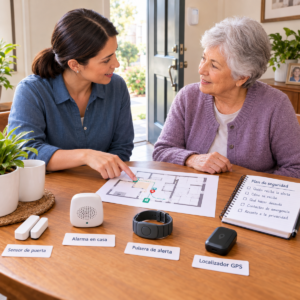
Begin with the event you need to notice. A door chime may be enough when a caregiver is awake and nearby. A bed or floor mat may help detect nighttime movement. A motion sensor may cover a hallway without requiring the person to wear anything. A wearable alarm may help outside the home but introduces charging, fit, and removal problems. A GPS tracker can add location information after someone leaves, but it does not replace an in-home warning.
Use an alarm to support a broader plan. The Alzheimer’s Association says home measures may help reduce wandering risk but cannot guarantee that someone with dementia will not wander. The National Institute on Aging recommends layered safeguards such as identification, recent photos or video, local awareness, home changes, and GPS as one possible aid. An alarm is most useful when it triggers a practiced human response rather than panic or false reassurance.
When a senior wandering alarm may help at home
A home alarm may help when the person tends to leave through a predictable door, gets up at night, explores a hallway, or needs a caregiver to know when a monitored area has been entered. It can reduce the need for a caregiver to watch a doorway continuously. It may also support independence inside a familiar area when the alert is used discreetly and respectfully.
When a wandering alarm for elderly care is not enough
An alarm is not enough when the person leaves through an unmonitored route, the caregiver cannot hear or receive alerts, the device is repeatedly disabled, the person is outdoors, or the risk requires professional supervision. A door alarm cannot tell you where someone went after leaving. Add identification, a recent photo, a list of likely destinations, trusted neighbors, a phone or GPS option when appropriate, and a response ladder.
How consent and dignity shape an elderly wandering alarm
Explain what the alarm detects, who receives the signal, and what happens after it sounds. Avoid presenting the device as punishment or surveillance. A person may accept a familiar door chime but resist a hidden camera or a wearable that feels restrictive. Revisit the arrangement after a move, a change in cognition, a new caregiver, a privacy concern, or a change in wandering pattern.
Understand elderly wandering alarm types before choosing one
“Wandering alarm” can mean several different technologies. Match the detection method to the person’s behavior and the home’s layout rather than choosing the loudest alert.
Elderly wandering door alarm and door chime options
A door sensor can send a chime, local alarm, phone notification, or pager signal when a door opens. It may work well for a predictable exit and a caregiver who is awake or nearby. Check whether it detects opening, closing, repeated movement, or only a contact separation. Test the door with the person’s usual force, clothing, mobility aid, and lighting.
Place the sensor where it cannot be easily knocked loose, but do not create a trip hazard or block the person’s safe passage. A visible chime may be more understandable than a hidden sensor. If the person is frightened by alarms, use a calmer signal and teach caregivers how to silence it without disabling the safety plan.
Pressure mats and floor sensors for an elderly wandering alarm
A pressure mat can alert when someone steps out of bed or crosses a monitored threshold. It may help with nighttime movement when a caregiver is nearby. The mat must lie flat, remain visible enough to avoid becoming a trip hazard, and be checked after cleaning, furniture movement, or a change in flooring.
Test footwear, bare feet, walkers, canes, wheelchairs, pets, visitors, and the caregiver’s own movement. A mat that triggers constantly may be ignored. A mat that misses a light step or is placed in the wrong path may create false reassurance. Consider whether a bed sensor, motion sensor, night light, or scheduled check-in is safer for the routine.
Motion sensors for senior wandering alarm coverage
A motion sensor can monitor a hallway, kitchen, stair area, or entry zone without requiring the person to wear anything. It may be useful when wandering follows a repeated path. Confirm the detection range, angle, height, pet tolerance, lighting, and alert delay. A sensor aimed at a doorway may miss a side route or activate when a caregiver walks past.
Bed and chair sensors for elderly wandering care
Bed or chair sensors can alert when a person leaves a monitored place. Use them to support a known care routine, not to prevent movement. A person may sit elsewhere, remove the sensor, or become confused by a loud alarm. Combine the alert with lighting, a clear path, comfortable footwear, and a caregiver who knows how to check in calmly.
Wearable wandering alarms for seniors
A wearable may use a button, proximity signal, geofence, or connection to a caregiver’s phone. It can extend awareness beyond one doorway, but it must be worn, charged, attached, and connected. A person may remove it for bathing, sleep, dressing, or privacy. Test the wearable in real clothing and during the activities that matter.
GPS tracker alarms for elderly wandering outside the home
A GPS tracker can provide a location or boundary alert after a person leaves, subject to signal, battery, network, update interval, and account limits. It does not replace a door alarm, because the first location update may arrive after departure. It also does not guarantee a precise indoor position or prevent wandering. Use it as a complementary layer when the person and family can support it.
| Alarm type | Best-matched event | What to test | Main limitation |
|---|---|---|---|
| Door contact or chime | Exterior door opens | All exit doors, alert volume, battery, night use, caregiver hearing, and side routes | Does not show where the person went after exit |
| Pressure mat | Person steps out of bed or across a threshold | Flat placement, mobility aids, pets, footwear, cleaning, and trip safety | Can be moved, missed, or triggered too often |
| Motion sensor | Movement through a hallway or monitored zone | Range, angle, pets, lighting, caregiver movement, and notification delay | May miss routes or create false alerts |
| Bed or chair sensor | Person leaves a monitored rest area | Placement, timing, comfort, false alarms, and nighttime response | Does not monitor the whole home or outdoor movement |
| Wearable or GPS alarm | Button press, boundary event, or outdoor location | Fit, charging, removal, cellular connection, timestamp, and responder access | Can be left behind, uncharged, offline, or inaccurate |
The table is a matching tool, not a product ranking. Many families need two layers: a local home alert to notice departure and a personal or identification layer to support response after departure. Choose only the components caregivers can maintain and respond to.
Map the home before installing an elderly wandering alarm
Walk through the home at the times wandering is most likely. Note exterior doors, garage doors, patio doors, stairs, elevators, windows, balconies, bathrooms, kitchens, driveways, water, roads, and places where a person may become confused. The alarm should fit the home’s actual paths instead of focusing on the most obvious front door.
List every exit for an elderly wandering door alarm
Record the front door, back door, side door, garage, patio, basement, fire exit, and any route through a shared hallway. Test each one. A door alarm on the main entrance is not a complete home plan if another door opens directly to a driveway or street.
Identify nighttime routes for senior wandering alarm placement
Observe where the person goes after waking. A bathroom route may need lighting and a clear floor more than a loud alarm. A kitchen route may need a local notification. A stairway may need a sensor, handrail, lighting, and a professional home-safety review. Do not place wires, mats, or devices where they create a new fall hazard.
Check outdoor hazards around an elderly wandering alarm
Note water, traffic, steep ground, open stairwells, dense foliage, tunnels, transit stops, and neighboring yards. The Alzheimer’s Association recommends knowing dangerous areas near the home and likely places a person may go. An alarm should prompt a response plan that considers these hazards, not merely produce noise inside the home.
Keep safe movement paths open around wandering alarms
Safety devices should not make the person climb over a mat, squeeze past furniture, or search in darkness. Keep floors clear, improve lighting, and consider how walkers, canes, wheelchairs, slippers, pets, and visitors interact with the alarm. The CDC’s fall-prevention guidance emphasizes removing trip hazards, improving lighting, and making home paths safer for older adults.
Set alerts and caregiver response for an elderly wandering alarm
An alert is only useful if the caregiver understands it and can act. Decide in advance whether a signal means “check the door,” “call the person,” “look at the camera if appropriate,” “check the last known location,” or “begin a missing-person response.” Keep the sequence short enough to use under stress.
Choose the right alert for a senior wandering alarm
Compare a local chime, loud siren, vibrating pager, phone push notification, text, automated call, or multi-person alert. A loud sound may wake a caregiver but frighten a person or disturb neighbors. A phone notification may be quieter but easy to miss. Use more than one channel only when caregivers can manage the extra alerts.
Define response times for an elderly wandering door alarm
Write who responds during the day, overnight, work hours, travel, and holidays. Decide how quickly a caregiver checks the room, door, yard, and likely route. If a person is missing, do not wait for an alarm to repeat. Use the recent photo and likely-destination list, call local emergency services as appropriate, and tell responders that the person may have dementia.
Reduce false alarms without disabling elderly wandering safety
Record what triggers alerts: pets, caregivers, deliveries, wind, cleaning, visitors, or normal nighttime movement. Adjust placement, sensitivity, timing, or the monitored zone. Do not silence every alert because the system is noisy. If alerts cannot be made meaningful, change the detection method or add human check-ins.
Use recent photos and identification with a wandering alarm
Keep a current close-up photo, preferred name, clothing, glasses, mobility aids, communication needs, likely destinations, and caregiver contacts in a private but accessible record. NIA and the Alzheimer’s Association both emphasize identification and recent photos as part of wandering preparation. Update the record after a change in appearance or routine.
Protect dignity and privacy when using an elderly wandering alarm
Wandering alarms can affect autonomy and trust, especially when the person does not understand why a door chimes or why caregivers are notified. Explain the purpose in simple language. Use the least intrusive alarm that addresses the real risk. Avoid hidden cameras or constant data collection unless the family has a clearly considered, lawful, and ethically appropriate reason.
Explain an elderly wandering alarm to the person who uses the home
Say what the device notices, who hears or receives it, and what the caregiver will do. Invite the person to help choose the sound, location, or routine. A familiar door chime may feel like a household feature rather than a surveillance tool. Revisit the arrangement after objections, repeated removal, distress, or a change in understanding.
Limit data from a senior wandering alarm
Ask whether the system stores audio, video, movement history, location, or contact information. Turn off collection that is not needed. Give access only to people who can respond. Use strong account credentials and multi-factor authentication where available. The FTC recommends minimizing data, limiting permissions, and using security by design for apps that collect sensitive information.
Review consent and capacity for wandering alarm use
If the person can make the decision, involve them and respect their informed choice. If capacity changes or family members disagree, seek appropriate professional or legal guidance. Do not use an alarm as a substitute for a care assessment. The device should support the person’s safety and dignity, not simply make the caregiver feel more in control.
Install and test an elderly wandering alarm safely
Use a staged installation. First observe the route. Then place the device, test normal movement, test caregiver notification, and test failure conditions. Tell the person and caregivers that the tests are exercises. Do not create a real escape or missing-person scenario.
Install an elderly wandering door alarm without new hazards
Follow the manufacturer’s placement instructions. Keep adhesive, cables, mats, and power adapters away from walking paths, heat, water, and moving doors. Test the door at normal and gentle speeds. Check that the sensor does not prevent emergency exit and that caregivers can silence and reset it.
Test pressure mats and motion sensors for senior wandering
Test the person’s usual step, walker, cane, wheelchair, slippers, and nighttime lighting. Test a caregiver, pet, delivery, and cleaning routine. Confirm that a mat lies flat and that a motion sensor covers the intended path. Record false alarms and missed events instead of relying on memory.
Test alert delivery for an elderly wandering alarm
Confirm who receives a local sound, pager, phone notification, text, or call. Test distance, closed doors, nighttime volume, phone focus modes, weak Wi-Fi, cellular coverage, and a low battery. Check whether the app shows when the alert was generated, sent, received, and acknowledged.
Test power failure and network failure around wandering alarms
Find out whether the device has battery backup, local memory, a manual reset, or an offline chime. Test a power interruption safely. If the system depends on Wi-Fi or a phone, decide what caregivers do when the router, phone, account, or network is unavailable. Keep a non-digital backup such as a check-in schedule and current identification record.
Combine an elderly wandering alarm with GPS and home safeguards
No single technology covers the entire sequence from getting up to being found. Layer tools according to the risk: notice movement, delay or redirect safely without confinement, identify the person, locate them if possible, and respond quickly.
Use a door alarm and GPS tracker for elderly wandering together
A door alarm can notify the caregiver immediately when an exit opens. A GPS tracker may provide a later outdoor location if the person wears or carries it and has connection. Identification and a recent photo help responders. These layers address different moments and should not be described as interchangeable.
Use routines and meaningful activity with a senior wandering alarm
The Alzheimer’s Association suggests structured, meaningful activities and attention to times when restlessness or wandering is more likely. A routine may reduce confusion, but it cannot guarantee that wandering will not occur. Pair routines with practical alerts, an open walking path, and a plan for changes in behavior.
Use home safety changes with elderly wandering door alarms
NIA and the Alzheimer’s Association describe home measures such as door alarms, night lights, visible cues, safe outdoor areas, and reducing departure triggers. Never lock a person in the home. A door device should notify and support a response, not create a dangerous barrier or delay emergency exit.
Review costs, coverage, and maintenance for an elderly wandering alarm
Compare the full cost of hardware, batteries, subscriptions, cellular service, cloud storage, installation, replacement sensors, pagers, support, and repairs. A local chime may have a one-time cost; a phone-linked system may depend on an existing plan; a monitored service may charge for response. Verify current terms and avoid assuming that a free app provides professional monitoring.
Check battery and power needs for a wandering alarm
Record battery type, replacement interval, charging requirements, backup power, and low-battery warning. A battery-operated door sensor may stop silently. A plugged-in hub may continue working locally but lose remote notifications during an outage. Place labels and a simple weekly check beside the device or caregiver station.
Check range and service for an elderly wandering door alarm
Test the distance from the sensor to the chime, pager, hub, or phone. Test closed doors, floors, thick walls, garages, patios, and the far side of the home. Confirm whether the system works without internet and what features stop when service is canceled. “Whole-home” claims need a real-home test.
Plan replacement and downtime for a senior wandering alarm
Keep a backup chime, spare batteries, alternative check-in method, or temporary sensor when the primary alarm is repaired or replaced. Review the arrangement after furniture moves, a new pet, a new caregiver, a change in sleep, or a change in the person’s route. A device can become unreliable as the home changes.
Teach caregivers to use an elderly wandering alarm
Training should cover the alarm’s purpose, normal triggers, false alarms, silence and reset, battery, privacy, and response. Each caregiver should be able to explain what the alarm can and cannot tell them.
Write an elderly wandering alarm response ladder
Example: check the alert source and time; look at the person’s room or monitored path; call or calmly check in; inspect the likely exit and nearby area; contact the backup caregiver; use the recent photo and likely-destination list; and contact emergency services when the person is missing or danger is possible. Adapt the sequence to local guidance and the person’s situation.
Train backups for a senior wandering alarm
Do not rely on one adult child. A backup should know where the sensor, charger, batteries, account recovery information, recent photo, and response card are kept. Test that the backup can hear or receive an alert and knows when to act.
Review alarm fatigue in elderly wandering care
Ask which alerts were useful, which were normal movement, and which were missed. Reduce unnecessary alerts by changing placement, time windows, sensitivity, or the monitored zone. If a risk has changed, revisit the care plan rather than simply making the alarm louder.
Maintain an elderly wandering alarm as the routine changes
Maintenance is a care task. The person’s wandering pattern, mobility, sleep, home, caregivers, and technology may change. Review the system instead of assuming that the original installation remains correct.
Weekly elderly wandering alarm readiness check
- Check sensors, mats, cables, batteries, hubs, chimes, pagers, and phone notifications.
- Confirm the monitored doors and routes have not changed.
- Check that walking paths remain clear and well lit.
- Confirm primary and backup caregivers can respond.
- Ask whether the person remains comfortable with the alarm.
Monthly wandering alarm and home-safety review
Review recent alerts, false alarms, missed alerts, battery, power, account access, privacy, likely destinations, recent photo, and response timing. Walk through the home again at the time of day when wandering is most likely. Update the plan after a move, fall, illness, medication change, or new caregiver.
When to replace an elderly wandering alarm
Replace or change the system when it misses the relevant event, creates dangerous trip hazards, cannot reach the caregiver, is unsupported, causes distress, or no longer matches the person’s route. Use a backup plan while changing it. A simple door chime may be better than a complex platform that no one checks.
Frequently asked questions about elderly wandering alarm options
What is the best elderly wandering alarm?
The best fit depends on the event you need to notice, the home layout, the person’s routine, caregiver availability, privacy preferences, and the system’s failure behavior. A door sensor, pressure mat, motion sensor, wearable, or GPS layer may be appropriate in different situations. This guide does not rank brands.
Can an elderly wandering door alarm prevent someone from leaving?
No. It can notify a caregiver when a monitored door opens, but it cannot stop a person from leaving and should not be used to lock someone inside. Use alerts, clear paths, identification, human response, and appropriate home-safety planning.
Does a senior wandering alarm need Wi-Fi?
Some local chimes and sensors can work without Wi-Fi. Phone notifications, cloud history, remote access, and some pagers may require Wi-Fi, cellular service, a hub, or a paired phone. Test the exact system during an internet or power interruption.
Can a wandering alarm work at night?
It can, if the alert is audible or reaches a caregiver, the sensor is placed on the actual nighttime route, and the home has enough lighting for safe movement. Test sleep, closed doors, low volume, caregiver hearing, and battery behavior.
Are pressure mats safe for elderly wandering care?
They can create a trip hazard if curled, moved, or poorly placed. Follow the instructions, keep the mat flat, test mobility aids, and review it after cleaning or furniture changes. A sensor that creates a fall risk is not a successful safety solution.
Can a GPS tracker replace an elderly wandering door alarm?
Not always. A door alarm may provide the first local warning, while GPS may help with later location information outdoors. GPS can be delayed, inaccurate, uncharged, removed, or unavailable indoors. The two tools address different parts of the response.
What should caregivers do when a person with dementia is missing?
Begin search efforts immediately, use the current photo and likely-destination list, check nearby hazards, and contact local emergency services according to local guidance. Tell responders that the person has dementia. Do not wait for the alarm to repeat or for a GPS update.
Does an elderly wandering alarm invade privacy?
It can, depending on what it records, who receives alerts, and whether the person understands and accepts it. Use the least intrusive effective option, explain the purpose, limit access, minimize stored data, and revisit consent when circumstances change.
Official sources for elderly wandering alarm safety
These sources support the wandering, home-safety, privacy, and caregiver-response statements in this guide. They do not endorse a particular alarm, sensor, or seller.
NIA guidance for elderly wandering door alarms
National Institute on Aging: Wandering and Getting Lost supports identification, recent photos or video, local awareness, home safeguards, door alarms, and GPS as layers of wandering safety.
Alzheimer’s Association guidance for senior wandering alarms
Alzheimer’s Association: Wandering and Dementia supports planning ahead, recent photos, likely destinations, alerting neighbors, prompt action when a person is missing, door alarms, pressure-sensitive mats, and the warning that safeguards cannot guarantee wandering will not occur.
FTC privacy guidance for wandering alarm apps
FTC: Mobile Health App Developers Best Practices supports data minimization, limited access and permissions, authentication, security by design, clear notice, and affirmative consent for sensitive data collection or sharing.
CDC home-safety guidance for older adults and alarm placement
CDC: Preventing Falls and Hip Fractures supports clearing trip hazards, improving lighting, using appropriate grab bars and railings, and discussing fall prevention with a healthcare professional. These principles matter when placing mats, sensors, cords, and nighttime alerts.
Final elderly wandering alarm readiness checklist
Before relying on an elderly wandering alarm, identify the event, map every route, choose a detection method, keep paths clear, test the alert range and delay, check power and network failure, define primary and backup responders, prepare a recent photo and likely-destination list, explain the device to the person, limit data and access, and review the system as the routine changes.
An alarm can make a caregiver’s response faster and more informed. It cannot replace supervision, dignity, identification, emergency planning, or a safe home. The most dependable setup is the one that detects a meaningful event, reaches someone who can act, and remains safe for the person moving through the home.