
Many families searching for a GPS Tracker for Elderly No Monthly Fee expect a device that provides live tracking, reliable location updates, emergency alerts, and nationwide coverage without recurring expenses. In reality, no-monthly-fee GPS tracking options may depend on an existing smartphone, Wi-Fi, Bluetooth networks, prepaid cellular service, or other communication technology.
A GPS Tracker for Elderly No Monthly Fee may help caregivers monitor familiar routes, confirm arrivals, or locate an attached device. However, not every free or subscription-free GPS tracker provides independent, real-time, wide-area tracking.
This comprehensive guide explains how to evaluate a GPS Tracker for Elderly No Monthly Fee, compare different tracking technologies, identify hidden costs, test location accuracy, protect privacy, and create a practical caregiver response plan.
Safety note: A GPS Tracker for Elderly No Monthly Fee is not automatically a medical alert system, professional monitoring service, or guaranteed location solution. Tracking devices may be removed, uncharged, disconnected, inaccurate indoors, or unable to transmit a current location. If an older adult is missing, injured, or in immediate danger, contact local emergency services promptly rather than waiting for another tracking update.
Quick answer: can a GPS tracker for elderly users work with no monthly fee?
Yes. A GPS Tracker for Elderly No Monthly Fee can work in certain situations, but the available features depend on the device and its communication requirements.
For example, an older adult who consistently carries a smartphone may use an existing location-sharing application without purchasing a separate GPS tracking subscription.
A Bluetooth tracking tag may help caregivers locate a nearby object or provide a last-known position through a participating network of compatible devices.
Some GPS trackers also offer prepaid or annual service plans that eliminate monthly billing without eliminating service costs.
However, a standalone GPS Tracker for Elderly No Monthly Fee that offers unlimited live tracking, independent cellular communication, and professional emergency support without ongoing costs should not be assumed to exist based on an advertisement.
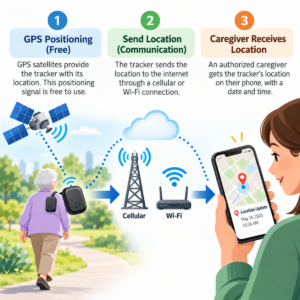
The most important distinction is between GPS positioning and location communication.
GPS satellites can help a compatible device determine its position. According to GPS.gov, civilian GPS signals are provided without direct user fees.
However, transmitting that location to a caregiver may require:
- An existing smartphone.
- Cellular data or mobile internet.
- Wi-Fi connectivity.
- Bluetooth communication.
- A participating nearby-device network.
- A cloud-based location service.
- An active prepaid or subscription plan.
A GPS Tracker for Elderly No Monthly Fee may determine its location without being able to send that information remotely.
For this reason, families should identify the specific tracking purpose before choosing a no-subscription GPS device.
When a no-monthly-fee GPS tracker for elderly care may be reasonable
A GPS Tracker for Elderly No Monthly Fee may be suitable when the older adult consistently carries a charged smartphone, accepts location sharing, and travels through areas with dependable connectivity.
It may also work when caregivers need occasional location reassurance rather than continuous monitoring.
Common uses include:
- Confirming arrival at a familiar destination.
- Supporting planned neighborhood walks.
- Sharing smartphone location with authorized family members.
- Locating a nearby device or personal item.
- Providing additional information after a missed check-in.
- Testing location-sharing routines before choosing a dedicated tracker.
A no-monthly-fee GPS tracker for seniors may be particularly practical when the household already pays for a compatible smartphone and data connection.
However, the family should test the complete tracking process rather than relying only on the absence of subscription charges.
When the best GPS tracker for elderly users is not the cheapest one
The lowest-cost GPS tracking device is not always the most suitable solution.
A GPS Tracker for Elderly No Monthly Fee may reduce recurring expenses but also provide fewer connectivity, support, or emergency features than a paid tracking service.
Subscription fees may cover:
- Cellular network access.
- Cloud-based location storage.
- Tracking application maintenance.
- Technical support.
- Alert delivery.
- Location history.
- Professional monitoring.
- Emergency response coordination.
Not every paid product includes all these services, and not every free option lacks them.
Families should compare the exact capabilities of each device.
A GPS Tracker for Elderly No Monthly Fee is most useful when its limitations are understood and the family has an appropriate response plan.
How consent affects a personal GPS tracker for the elderly
Privacy and consent are essential when choosing a GPS Tracker for Elderly No Monthly Fee.
Explain what information the device collects, when location is shared, who can access it, and whether tracking history is stored.
The older adult should have an opportunity to ask questions and participate in decisions whenever possible.
Discuss whether the family needs continuous tracking, scheduled check-ins, emergency-only location access, or occasional location requests.
A subscription-free GPS tracker should support the person’s safety without creating unnecessary surveillance.
Review the agreement when health needs, caregiving arrangements, software settings, or daily routines change.
Understand the no-monthly-fee GPS tracker options for elderly care
Families searching for a GPS Tracker for Elderly No Monthly Fee often encounter several types of tracking technology.
These options should not be treated as interchangeable.
Some provide smartphone location sharing, while others offer Bluetooth proximity tracking, home-based monitoring, or prepaid cellular connectivity.
Understanding the differences helps caregivers select a realistic tracking arrangement.
Existing smartphone location sharing for an elderly GPS tracker
An existing smartphone can sometimes function as a GPS Tracker for Elderly No Monthly Fee without requiring separate GPS tracking hardware.
Many smartphones include built-in GPS positioning, cellular connectivity, Wi-Fi, and location-sharing applications.
When configured appropriately, these tools may allow authorized caregivers to view location information or confirm arrivals.
A smartphone-based GPS Tracker for Elderly No Monthly Fee may provide several advantages:
- No separate dedicated GPS tracker purchase.
- Familiar smartphone technology.
- Location sharing through compatible applications.
- Voice calling and text messaging.
- Existing internet connectivity.
- Access to emergency contacts.
However, this approach depends on the person’s habits.
An older adult may forget the smartphone at home, leave it charging, disable location access, silence notifications, or carry it inside a bag that becomes separated from them.
A smartphone left at home cannot accurately represent the person’s current location.
Test the complete routine during a planned, safe outing before relying on smartphone-based GPS tracking for elderly care.
Bluetooth tags and nearby-device networks for an elderly tracker
Bluetooth tracking tags are frequently advertised as affordable alternatives to subscription-based GPS devices.
A Bluetooth tag may be useful for locating keys, bags, clothing, or other personal belongings.
Some tags use a network of nearby compatible smartphones to report their last detected location.
However, a Bluetooth tag is not automatically a standalone GPS Tracker for Elderly No Monthly Fee.
Many Bluetooth tracking devices lack:
- Independent GPS receivers.
- Dedicated cellular communication.
- Continuous wide-area location tracking.
- Two-way voice communication.
- Professional emergency response.
- Reliable device-removal alerts.
A tag may also become separated from the person when attached to clothing or belongings.
Before using Bluetooth technology as part of an elderly safety plan, verify how the device obtains and transmits location information.
Bluetooth tags may provide an additional layer of information, but they should not automatically replace a dedicated personal GPS tracking system.
Wi-Fi or home-based location options without a monthly tracker bill
A GPS Tracker for Elderly No Monthly Fee may sometimes be advertised alongside Wi-Fi monitoring devices or smart-home technology.
Home-based systems can help caregivers receive door notifications, arrival alerts, or other household status updates.
However, Wi-Fi-dependent devices generally operate within the range of the configured network.
A home tracking system may stop communicating when:
- The person leaves the property.
- The router loses power.
- Internet connectivity fails.
- Wi-Fi credentials change.
- Account permissions expire.
- The device moves outside network coverage.
Home monitoring should not automatically be described as wide-area personal GPS tracking.
Families requiring outdoor location information should test whether the device continues communicating away from the home.
Prepaid and annual plans for a GPS tracker for elderly users
Some GPS tracking devices avoid monthly invoices by offering prepaid or annual cellular service plans.
These arrangements may appeal to families searching for a GPS Tracker for Elderly No Monthly Fee.
However, prepaid tracking does not necessarily mean the service is permanently free.
The family may pay upfront for several months or a full year of connectivity.
Before selecting a prepaid GPS tracker, review:
- Total service price.
- Renewal date.
- Coverage requirements.
- Available tracking features.
- Data limits.
- Cancellation conditions.
- International roaming.
- Customer support.
- What happens after expiration.
A prepaid GPS tracker should be accurately described as a no-monthly-billing option rather than a device with no ongoing service cost.
Check whether annual plans include the same location frequency, geofencing, history, and alerts as monthly plans.
One-time-purchase claims for the best wearable GPS tracker for elderly care
Some manufacturers advertise a GPS Tracker for Elderly No Monthly Fee as a one-time purchase.
However, families should determine what the purchase actually includes.
A one-time GPS device may:
- Store coordinates for later retrieval.
- Require an existing smartphone.
- Use Bluetooth communication.
- Depend on nearby compatible devices.
- Offer limited free tracking.
- Include a temporary trial.
- Require later payments for advanced features.
Be cautious with advertising claims such as «lifetime GPS,» «free worldwide tracking,» or «no SIM required.»
A device that calculates location without transmitting it remotely may not meet a family’s safety needs.
Before purchasing a GPS Tracker for Elderly No Monthly Fee, ask how the location reaches the caregiver and what happens if the provider changes its application or service.
| Option | What may avoid a monthly tracker fee | What the wearer must have | Main limitation to test |
|---|---|---|---|
| Existing smartphone | Location sharing through an already active phone plan | Charged phone, mobile data, permissions, and consistent carrying | The phone may be forgotten, silenced, or left behind |
| Bluetooth tag | One-time hardware purchase or existing compatible network | Nearby compatible devices or a participating network | May not provide independent live GPS tracking |
| Wi-Fi device | Use of an existing home internet connection | Power, functioning router, and network coverage | May stop reporting outside the home |
| Prepaid or annual cellular tracker | Upfront service payment instead of monthly billing | Supported device, coverage, active plan, and charged battery | Service still costs money and may expire |
| Hardware-only GPS device | No ongoing remote tracking service | A method of retrieving stored coordinates | May not send live location information to caregivers |
This comparison helps families distinguish the different technologies marketed as a GPS Tracker for Elderly No Monthly Fee.
The most important question is whether the device can communicate useful location information under the conditions in which the family plans to use it.
Compare no-monthly-fee GPS tracker costs beyond the sticker price
The total cost of a GPS Tracker for Elderly No Monthly Fee may extend beyond the advertised purchase price.
Even when a device does not require monthly tracking fees, families may still pay for cellular service, smartphone data, replacement accessories, charging equipment, or technical support.
A realistic comparison should consider the entire operating period.
What “free GPS” means for a GPS tracker for elderly users
Civilian GPS signals are available without direct user fees, according to GPS.gov.
However, this does not mean that tracking hardware, smartphone service, mobile data, cloud storage, or caregiver notifications are free.
A GPS Tracker for Elderly No Monthly Fee may use free satellite positioning while depending on a paid internet or cellular connection.
Separate the positioning service from the communication service when comparing products.
A useful buying checklist should identify:
- GPS positioning technology.
- Device hardware cost.
- Location transmission method.
- Cellular or internet requirements.
- Application fees.
- Cloud storage charges.
- Emergency monitoring availability.
Understanding these differences prevents families from confusing free satellite signals with free remote GPS tracking.
How no-monthly-fee GPS tracker costs can appear later
A GPS Tracker for Elderly No Monthly Fee may include hidden or delayed expenses.
Potential charges include:
- Temporary trials that become paid subscriptions.
- Device activation.
- Annual renewals.
- Cellular data.
- Replacement batteries.
- Additional caregiver accounts.
- Location history.
- Technical support.
- International roaming.
- Replacement devices or accessories.
Read purchase and cancellation terms carefully.
Keep a record of the pricing and service conditions available when the device is purchased.
Also consider the practical cost of caregiver time.
A free tracking application may require more frequent manual checks, troubleshooting, and account management than a dedicated supported service.
The most affordable arrangement is one that the family can maintain reliably.
UK, India, and other regional limits for a no-fee elderly GPS tracker
A GPS Tracker for Elderly No Monthly Fee advertised in one country may not provide equivalent service elsewhere.
Cellular networks, compatible frequency bands, payment terms, emergency services, application availability, and privacy requirements vary by region.
Families searching for GPS trackers without monthly fees in the United Kingdom, India, the United States, Canada, or other countries should verify local compatibility.
Check the exact device model, supported carrier, service region, warranty, and customer support arrangements.
An imported GPS tracker may be inexpensive but incompatible with local networks.
Do not assume that «worldwide tracking» guarantees uninterrupted connectivity.
gps-tracker-elderly-no-monthly-fee-cost-checklist.webp
Test a no-monthly-fee GPS tracker for elderly routines before relying on it
A GPS Tracker for Elderly No Monthly Fee should be tested during normal activities before caregivers depend on its location information.
Successfully installing an application or connecting a tracker does not demonstrate reliable real-world performance.
Testing should examine device positioning, location transmission, battery life, network coverage, and caregiver notifications.
Write the safety job for the elderly GPS tracker
Before choosing a GPS Tracker for Elderly No Monthly Fee, define the specific purpose of the device.
Possible goals include:
- Confirming arrival at a familiar destination.
- Supporting an agreed daily walking routine.
- Locating a smartphone or attached device.
- Receiving safe-area notifications.
- Providing information after a missed check-in.
- Supporting communication between authorized caregivers.
A clearly defined purpose makes it easier to determine whether the tracking arrangement works.
Also identify unacceptable failures.
For example, a family may require location updates within an agreed interval or continued tracking without a nearby smartphone.
The correct requirements depend on the person’s needs and environment.
Check the phone, battery, permission, and network chain
A GPS Tracker for Elderly No Monthly Fee may depend on several technologies working together.
For smartphone-based tracking, verify:
- Location permissions.
- Mobile data.
- Wi-Fi.
- Bluetooth.
- Background application activity.
- Notifications.
- Account access.
- Battery-saving settings.
Restart the phone and repeat the tracking test.
For standalone or prepaid GPS devices, confirm the active service plan, cellular network, battery status, charging method, and last successful update.
If a device claims to function independently of a smartphone, verify that capability during a safe, planned activity.
Test location timestamps for a personal GPS tracker for the elderly
A GPS Tracker for Elderly No Monthly Fee may display an old location as a map marker.
Caregivers should check the timestamp associated with every update.
Test the device in several environments, including open outdoor spaces, buildings, vehicles, and areas with trees.
GPS.gov explains that signal obstruction, reflected satellite signals, receiver design, and indoor conditions may affect location accuracy.
A tracker may identify a nearby road or building without establishing the person’s exact position.
Compare the reported location with the actual route.
Determine whether the device updates continuously, at scheduled intervals, after movement, or only when another connected device is nearby.
Test low battery, removal, and no-connection scenarios
A GPS Tracker for Elderly No Monthly Fee may stop communicating when its battery becomes depleted or its network connection fails.
During safe, controlled testing, evaluate:
- Low-battery alerts.
- Disconnected smartphones.
- Weak cellular coverage.
- Device removal.
- Unavailable Wi-Fi.
- Missed location updates.
- Delayed caregiver notifications.
Do not create a dangerous wandering scenario to test the device.
Document what caregivers should do when tracking becomes unavailable.
A practical response process should include checking the timestamp and battery, contacting the person, checking the expected destination, involving a backup caregiver, and seeking emergency assistance when necessary.
Practice charging and carrying with an elderly GPS tracker
A GPS Tracker for Elderly No Monthly Fee works only when the required equipment remains available and powered.
Establish a charging routine that fits the older adult’s daily habits.
A smartphone may be charged overnight but forgotten in the morning.
A Bluetooth tag may remain attached to clothing that is not worn.
A wearable tracker may be removed before bathing or sleeping.
Choose a consistent location for charging and returning the device.
Review whether the older adult remains comfortable with the tracking arrangement.
Use accessibility and consent to choose the best wearable GPS tracker for elderly care
Accessibility is an important factor when selecting a GPS Tracker for Elderly No Monthly Fee.
Some subscription-free systems require additional smartphone interaction or caregiver troubleshooting.
These requirements may create challenges for people with reduced vision, hearing, memory, or hand coordination.
Make a no-fee GPS tracker simple to carry and charge
A GPS Tracker for Elderly No Monthly Fee should be easy to manage during everyday activities.
Use a consistent carrying location and accessible charging station.
Large-print instructions or picture reminders may help.
If the device includes buttons, clasps, charging connectors, or a touchscreen, test whether the older adult can operate them comfortably.
A device that is difficult to charge or attach may be left unused.
Reduce phone and app complexity for an elderly GPS tracker
A smartphone-based GPS Tracker for Elderly No Monthly Fee should provide a simple experience for both the wearer and caregiver.
Keep essential information easy to locate.
Caregivers should be able to identify:
- Battery status.
- Last location update.
- Network connection.
- Tracking history.
- Alert notifications.
- Authorized contacts.
A backup caregiver should also understand how to access and interpret the information.
Avoid relying on an arrangement that only one family member can operate.
Recheck consent when tracking rules or health needs change
A GPS Tracker for Elderly No Monthly Fee should be reviewed when circumstances change.
Changes in health, mobility, caregivers, residence, software settings, or privacy policies may affect the tracking agreement.
Explain new features and permissions clearly.
The Federal Trade Commission emphasizes data minimization, secure practices, and meaningful consent when handling sensitive information.
Whenever possible, involve the older adult in reviewing what data is shared and who can access it.
Protect privacy on a GPS tracker for elderly users with no monthly fee
A GPS Tracker for Elderly No Monthly Fee may collect sensitive personal information even when the application or service is free.
Depending on the provider, collected information may include location history, account details, device identifiers, contact information, and application usage.
The absence of subscription charges does not guarantee strong privacy protections.
Ask who receives location data from the elderly GPS tracker
Before activating a GPS Tracker for Elderly No Monthly Fee, identify who can access the location data.
Possible recipients include:
- Primary caregivers.
- Authorized family members.
- Backup responders.
- Cloud service providers.
- Technical support staff.
- Connected network services.
Limit sharing to people who need the information for an agreed purpose.
Avoid publishing tracking links or account credentials in broad family conversations.
Review access after changes in caregiving responsibilities.

Secure the account behind a no-monthly-fee GPS tracker
Account security is important for any GPS Tracker for Elderly No Monthly Fee.
Use a unique password, enable multi-factor authentication when supported, and keep connected devices updated.
Learn how to recover account access, remove authorized users, delete location history, and close the account.
Store recovery information securely and make it available only to appropriate caregivers.
If the provider cannot explain its privacy practices or account deletion process, consider that limitation when evaluating the device.
Keep the older adult involved in GPS tracking decisions
A GPS Tracker for Elderly No Monthly Fee should support the older adult’s safety while respecting their preferences.
Explain how the device works using familiar situations.
For example, location sharing may help caregivers know where to begin checking if someone misses an agreed arrival.
Show the person what information is shared and when.
Ask whether the device is comfortable, useful, or confusing.
A transparent arrangement is more likely to be maintained consistently than one that the wearer does not understand or accept.
Build a caregiver response plan around a no-monthly-fee GPS tracker
A GPS Tracker for Elderly No Monthly Fee may provide useful information, but it does not necessarily include professional monitoring.
Caregivers should establish clear responsibilities before relying on tracking alerts.
Decide who checks notifications, contacts the older adult, verifies destinations, and seeks additional assistance.
The plan should account for work schedules, overnight hours, holidays, and caregiver availability.
Define stale location and missed check-in rules for elderly GPS tracking
A GPS Tracker for Elderly No Monthly Fee may display a location that is no longer current.
Families should establish a practical rule for identifying stale location information.
For example, a defined update interval may be appropriate for a particular walking route, depending on the person’s needs and available support.
Check:
- Last successful update.
- Battery status.
- Network connection.
- Expected destination.
- Normal route.
- Likely reasons for delay.
Do not interpret an old map marker as proof of the person’s present location.
If the person is missing or danger is suspected, contact local emergency services promptly rather than waiting for another update.
Use identification and recent photos with a GPS tracker for the elderly
A GPS Tracker for Elderly No Monthly Fee should be combined with appropriate identification and preparedness.
The National Institute on Aging recommends layered safeguards for people who may wander.
Families may keep a private record containing:
- Preferred name.
- Recent photograph.
- General appearance.
- Typical clothing.
- Mobility aids.
- Communication needs.
- Likely destinations.
- Caregiver contact numbers.
Update the information as circumstances change.
Share it with authorized responders when necessary.
Know what no-fee tracking cannot do for wandering prevention
A GPS Tracker for Elderly No Monthly Fee cannot physically prevent someone from leaving a location.
It also cannot guarantee continuous connectivity, detect every fall, or ensure that someone will respond to an alert.
The device may be removed, forgotten, uncharged, disconnected, or inaccurate.
Combine GPS tracking with appropriate home safeguards, scheduled check-ins, identification, caregiver communication, and professional support when needed.
Maintain a GPS tracker for elderly no monthly fee over time
A GPS Tracker for Elderly No Monthly Fee requires regular maintenance even when no monthly tracker subscription is charged.
Device performance may change because of battery deterioration, software updates, altered permissions, expired prepaid plans, or network changes.
A simple maintenance routine helps caregivers identify problems before they affect location sharing.
Weekly no-fee GPS tracker readiness check
Use the following checklist to maintain a GPS Tracker for Elderly No Monthly Fee:
- Confirm the older adult carries or wears the agreed device.
- Check battery level and charging accessories.
- Inspect the tracker attachment and case.
- Check comfort and skin contact.
- Verify the latest successful location update.
- Confirm Wi-Fi, Bluetooth, or cellular connectivity.
- Review location permissions and notifications.
- Confirm authorized caregivers can access the tracking information.
- Ask whether the arrangement remains comfortable and acceptable.
A weekly check can help identify common tracking problems.
Monthly account and service review for an elderly GPS tracker
A monthly review of the GPS Tracker for Elderly No Monthly Fee should include application updates, caregiver permissions, safe-area settings, privacy controls, support information, and service renewal dates.
Review the emergency response plan and current photograph.
Conduct one planned, low-risk tracking or alert test.
Remove account access that is no longer necessary.
Document important changes so authorized caregivers understand the current arrangement.
When to replace a no-monthly-fee GPS tracker for elderly care
A GPS Tracker for Elderly No Monthly Fee should be replaced or reconsidered when it no longer meets practical safety requirements.
Possible reasons include:
- Repeatedly depleted batteries.
- Unreliable connectivity.
- Unsupported applications.
- Expired service plans.
- Uncomfortable attachments.
- Frequent device removal.
- Inaccurate or delayed updates.
- Changes in mobility or daily routine.
- Privacy concerns.
- Inadequate caregiver support.
A paid or professionally supported service may be worth evaluating when a free tracking option no longer provides the required features.
The best solution is not necessarily the cheapest device, but the arrangement that can be operated and maintained reliably.

Frequently asked questions about GPS tracker for elderly no monthly fee options
Is GPS itself free for an elderly tracker?
Yes. Civilian GPS positioning signals are available without direct user fees.
However, a GPS Tracker for Elderly No Monthly Fee may still require hardware, smartphone service, cellular data, or internet connectivity to transmit information.
Free satellite positioning should not be confused with unlimited free live tracking.
What is the best GPS tracker for elderly users with no monthly fee?
The best GPS Tracker for Elderly No Monthly Fee depends on the older adult’s daily routine, device habits, location-sharing needs, privacy preferences, and available caregiver support.
A smartphone-based solution may work when the person consistently carries a charged phone.
Bluetooth tags may help locate nearby objects but do not necessarily provide independent GPS tracking.
Prepaid or annual cellular trackers may offer wider coverage without monthly billing, although service costs still apply.
Choose according to actual requirements rather than advertising claims.
Can a GPS tracker for the elderly work without a phone?
Some GPS tracking devices include cellular communication and can operate without a nearby smartphone.
However, not every GPS Tracker for Elderly No Monthly Fee supports independent connectivity.
Bluetooth, Wi-Fi, and smartphone-based tracking arrangements may require compatible nearby devices or networks.
Verify the exact model and test phone-free operation before relying on it.
Are Bluetooth tags the same as personal GPS trackers for the elderly?
No. Bluetooth tags and dedicated personal GPS trackers use different technologies.
A Bluetooth tag may help locate an object or provide a nearby-device-based last-known location.
It may not contain independent GPS, cellular connectivity, two-way voice communication, or professional emergency response.
A GPS Tracker for Elderly No Monthly Fee based on Bluetooth should be evaluated according to its actual limitations.
Can a no-monthly-fee GPS tracker send an emergency alert?
Some GPS tracking devices may include emergency buttons or alert features, but availability depends on the exact device and service.
A GPS Tracker for Elderly No Monthly Fee should not automatically be considered a medical alert system.
Emergency notifications may depend on battery power, network connectivity, application settings, and caregiver availability.
Test who receives the alert and what action is expected.
Does a no-fee GPS tracker work in the UK or India?
A GPS Tracker for Elderly No Monthly Fee may work in the United Kingdom, India, or other countries when its hardware and communication service are compatible with local networks.
However, availability, service terms, application support, taxes, privacy requirements, and emergency contacts differ by region.
Verify the exact model and supported services before purchasing or importing a tracker.
Do not assume that worldwide advertising guarantees reliable local tracking.
How can caregivers tell whether an elderly GPS location is current?
Caregivers using a GPS Tracker for Elderly No Monthly Fee should check the timestamp of the last successful location update.
Also review battery level, connection status, and the source of the location information.
A map marker may represent a historical position.
If the application does not clearly indicate when the device last communicated, treat the location as uncertain and follow the agreed response plan.
Can a no-monthly-fee tracker prevent wandering?
No. A GPS Tracker for Elderly No Monthly Fee cannot prevent an older adult from leaving a location.
Some tracking systems may provide location updates or safe-area notifications that help caregivers respond.
However, devices can be removed, forgotten, disconnected, or inaccurate.
Combine tracking technology with identification, appropriate home safeguards, caregiver check-ins, and an individualized response plan.
Official sources for GPS tracker for elderly no monthly fee safety
These sources support the distinctions and safety limits in this guide. They do not endorse a particular tracker, app, plan, or seller.
GPS.gov free civilian access and accuracy for elderly trackers
GPS.gov: Policies and Documentation supports the distinction between free civilian GPS access and the separate costs of hardware or communication service. GPS.gov: GPS Accuracy supports the limits caused by signal blockage, indoor use, buildings, trees, reflected signals, atmospheric conditions, and receiver quality.
FTC privacy guidance for a no-fee GPS tracker
FTC: Mobile Health App Developers Best Practices supports minimizing data, limiting permissions, considering authentication, using security by design, giving clear notice, and obtaining affirmative consent for sensitive collection or sharing.
NIA wandering guidance for a GPS tracker for the elderly
National Institute on Aging: Wandering and Getting Lost supports combining GPS with identification, a recent photograph or video, local awareness, and other safeguards rather than depending on one device.
FDA home-device checklist for elderly GPS tracker maintenance
FDA: Home Healthcare Medical Devices: A Checklist supports understanding how a device works, following care instructions, monitoring alarms, training caregivers, and keeping an alternative plan when appropriate. It is general home-device guidance, not an endorsement of consumer GPS trackers.
Final GPS tracker for elderly no monthly fee checklist
Before relying on a no-monthly-fee GPS tracker for an older adult, answer these questions: What safety job does it perform? How does it calculate location? How does that location reach a caregiver? What recurring, prepaid, phone, data, or support costs remain? What happens when the battery, phone, network, plan, or app fails? Does the wearer consent and accept the device? Can a backup caregiver respond? Is there a current photo, identification record, and escalation plan?
Test the arrangement on the real route, under ordinary clothing, with the phone left behind when relevant, and with a safe low-battery or no-connection exercise. Record the last-update behavior and review it regularly. A no-monthly-fee option can be a reasonable tool when its limits are visible and the household can maintain it. It is not a bargain if the missing monthly fee also removes the connection or response the family needs.