
best rollators for seniors | SeniorTechLife mobility guide
The best rollators for seniors are the models a person can control, brake, sit on safely, fit through real spaces, and transport when needed. This guide compares the categories and the decisions behind a safe choice.
Best Rollators For Seniors: How should families compare the best rollators for seniors?
Start with the person’s ability to control a rolling frame, then compare brakes, fit, seat transfers, wheels, home access, transport, and service. The best rollators for seniors are not a universal ranked list. A compact model may excel indoors but vibrate outdoors; a tall heavy-duty frame may fit one user while blocking another user’s bathroom.
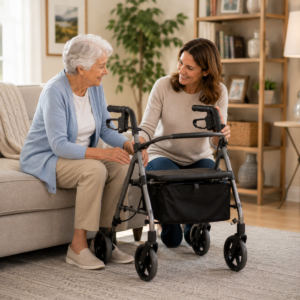
A rollator generally has three or four wheels and hand brakes, and many include a seat. It moves more freely than a standard or two-wheel walker. That can reduce effort, but it also means the person must control speed and direction. A physical therapist or other qualified professional can help when falls, neurologic changes, surgery, severe weakness, or uncertainty about the correct walker category are involved.
Types and practical tradeoffs
| Category | Possible advantage | Important tradeoff |
|---|---|---|
| Four-wheel rollator | Seat, storage, continuous movement, and broad availability | Requires brake control and may be wide or heavy |
| Three-wheel rollator | Narrow turning and compact folding | Usually less lateral stability and no full rest seat |
| Lightweight rollator | Easier vehicle loading for some caregivers | Weight label does not prove fit, durability, or control |
| Heavy-duty or tall-user rollator | Higher capacity and dimensions for specified users | Greater width and weight can restrict access |
| Upright or forearm-support rollator | Different upper-body support and handle position | Posture claims require assessment; braking may be harder to reach |
| Hybrid rollator/transport chair | Two labeled modes in one product | More weight, setup steps, footrests, and strict mode instructions |
Search labels such as “rollator lightweight walkers for seniors,” “rollators for tall seniors,” and “lightweight rollators for seniors” describe overlapping features rather than standardized classes. “Rollators best” is an awkward dataset phrase, not an editorial recommendation. Compare verified measurements and use conditions.
Smart and specialty designs
Smart rollators for seniors may add sensors, navigation assistance, alerts, tracking, or powered functions. Ask what the feature actually does, whether evidence supports the claim, how data are stored, what happens without connectivity, how batteries are serviced, and whether ordinary braking remains available.
The long phrase “heavy duty standing upright rollator senior walker” combines capacity, posture, and walker terminology. Treat each attribute separately. The phrase “health line compact rollator for seniors” may resemble a product or brand label; it appears here only as approved search vocabulary, not as a recommendation or verified model.
Who may benefit and who should avoid guessing
A rollator may suit a person who can walk, steer, slow, stop, turn, and follow seat-safety steps but benefits from rolling support or planned rest. It may be inappropriate when substantial weight must be placed through the frame, brakes cannot be controlled, the device accelerates beyond the user, or cognition prevents safe sequencing.
The best rollator for seniors is therefore conditional. Compare the person on their best and more fatigued days. Sudden weakness, fainting, chest discomfort, severe shortness of breath, or an unexplained fall needs medical evaluation rather than a faster equipment purchase.
Medicare and purchase boundaries
Medicare.gov states that Part B may cover walkers, including rollators, when eligibility and medical-necessity conditions are met and a provider prescribes the equipment for home use. Supplier enrollment, assignment, rental or purchase rules, deductibles, coinsurance, and other insurance affect cost. This Hub does not reproduce the reserved detailed coverage questions.
Compare total cost: fitting, delivery, replacement wheels or brake parts, warranty labor, return shipping, and future service. Do not assume an affiliate retailer, marketplace listing, or prescription guarantees reimbursement.
Selection checklist
- Confirm that a continuously rolling frame is the appropriate walker category.
- Test both slowing and parking brakes repeatedly.
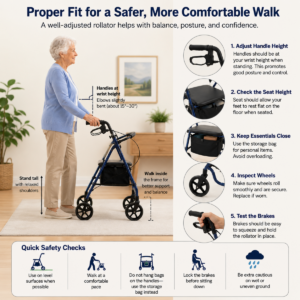
- Fit handles, seat, frame width, and capacity to the person.
- Measure every essential home route and vehicle task.
- Trial turns, backing, slopes, thresholds, and fatigue.
- Confirm that a seat is for stationary rest unless the product is transport-labeled.
- Verify instructions, parts, warranty, service, and returns.
- Keep brand, coverage, repair, and product-review child intents separate.
Eight decisions that matter more than marketing
The following framework turns a broad product search into observable questions. Complete it with the older adult and, when risk or medical complexity is present, with a qualified rehabilitation or healthcare professional. A specification is useful only when it connects to a real task.
Support and control
Decision question: Can the person walk within the frame and slow or stop it without chasing it?
A rollator reduces lifting effort but moves more freely than a standard walker. It suits people who retain enough balance, judgment, and hand control for a rolling device.
Practical check: Observe starts, normal pace, sudden stops, gradual turns, backing, and fatigue on the actual surfaces.
Pause and reassess when: The frame repeatedly rolls ahead, the person leans heavily, cannot stop on request, or needs another person to control speed.
Best Rollators For Seniors: Brake reach and force
Decision question: Can both parking and slowing functions be operated repeatedly?
Arthritis, weakness, numbness, tremor, or cognitive change can make bicycle-style levers unreliable even when a single squeeze succeeds.
Practical check: Test each hand separately, both brakes together, parking locks, release, and performance after several minutes.
Pause and reassess when: One lever cannot be reached, a lock releases, cables bind, or the user forgets brakes before sitting.
Seat transfer
Decision question: Can the user turn, lock, feel the seat, sit, and rise under control?
A rollator seat is generally intended for stationary rest. Seat height, width, back support, and brake integrity affect the complete transfer.
Practical check: Practice on level ground with ordinary footwear and the person’s normal mobility routine.
Pause and reassess when: The device moves, feet cannot stabilize, the seat is too high or low, or the person drops backward.
Body fit
Decision question: Do handle height, frame width, seat dimensions, and capacity match the user?
Capacity is a limit, not a fit recommendation. A high-capacity frame can still be too wide, deep, tall, or difficult to steer.
Practical check: Measure hand height, seated dimensions, hip clearance, foot position, posture, and clothing clearance.
Pause and reassess when: Shoulders rise, wrists bend sharply, feet strike the frame, or the user cannot sit fully within the stated seat.
Home access
Decision question: Can the rollator complete the bathroom, bedroom, kitchen, and exit routes?
Overall wheel width, turning circle, handles, brake cables, baskets, and furniture determine access.
Practical check: Measure true clear openings and complete a realistic route at daytime and nighttime.
Pause and reassess when: The user must leave the rollator outside an essential room or take unsupported steps around an obstacle.
Outdoor surfaces
Decision question: Do wheel diameter, tread, frame geometry, and brakes suit the intended community route?
Cracks, slopes, grass, gravel, rain, curb cuts, and crowds demand more control than a showroom floor.
Practical check: Trial a safe sample of the actual route and observe vibration, steering, and stopping.
Pause and reassess when: Front wheels stop abruptly, the device pulls on slopes, or the user cannot keep a safe pace.
Transport and folding
Decision question: Can the available person fold, latch, lift, and secure the device?
A low advertised weight does not describe awkward shape, trunk height, pinch points, or the need to keep the user supported while loading.
Practical check: Perform the full vehicle routine with the exact configuration and accessories.
Pause and reassess when: The caregiver strains, the frame opens unexpectedly, or the user is left standing without support.
Service and evidence
Decision question: Are parts, instructions, warranty, and truthful measurements available?
Useful senior walker reviews report test conditions and limitations. Marketing claims such as upright, all-terrain, or smart require evidence and definitions.
Practical check: Request the manual, dimensional drawing, brake-adjustment policy, parts list, and local service route.
Pause and reassess when: The seller cannot identify the manufacturer, compatible parts, return rules, or responsibility for repairs.
Ownership, service, and disruption planning
Mobility equipment must remain usable after the first week. Include cleaning, inspection, storage, service, transportation, changing health needs, and an alternative plan. Do not accept a product whose safe-use instructions, compatible parts, or service route are unclear.
Daily checks
Before walking, verify the frame is open, brakes respond, wheels turn, seat and bag are secure, and nothing is caught near moving parts.
Maintenance point: Inspect fasteners, cables, pads, tires, latches, grips, and frame alignment on a schedule.
Backup point: Keep a fitted alternative available during repair; never substitute an unknown walker from storage.
Best Rollators For Seniors: Cleaning and weather
Dry the rollator after rain and keep oil away from brake and gripping surfaces.
Maintenance point: Follow manufacturer cleaning directions and remove debris from wheels only as permitted.
Backup point: Choose another route or device when ice, water, or debris defeats predictable control.
Accessories and loads
Use only compatible bags, trays, cane holders, oxygen holders, and lights, and keep loads balanced.
Maintenance point: Recheck attachments after folding and transport; stay within each accessory’s limit.
Backup point: Carry essential items another safe way if an accessory changes steering or blocks the feet.
Changing health
Track pain, fatigue, falls, hand function, vision, attention, and walking speed.
Maintenance point: Schedule reassessment after meaningful health, footwear, brace, or environment changes.
Backup point: Have a caregiver and clinician plan for periods when the rollator is no longer enough.
Emergency planning
Label the device, keep communication accessible, and include mobility needs in travel and evacuation plans.
Maintenance point: Check the device after airline handling, impacts, or emergency use.
Backup point: If brakes or wheels fail away from home, stop, sit safely, and arrange assistance rather than improvising a repair.
Real-world trial scenarios
Equipment should be tested as part of a complete activity, not as an isolated object. The following scenarios expose access, control, fatigue, caregiver, and maintenance problems that can remain invisible in a showroom. A trial is not permission to exceed the person’s care plan or the manufacturer’s instructions.
Morning home route
Set up the trial: Begin from the usual bed or chair and include the bathroom, kitchen, tightest doorway, and a place to park the rollator. A meaningful trial uses the person’s ordinary footwear, usual assistive devices, realistic timing, and the exact equipment configuration being considered.
Observe: Check whether the user retrieves the frame before standing, keeps it close, clears furniture, and manages the route without unsupported steps. Watch the person and caregiver throughout the complete task rather than judging the equipment from a single successful moment.
Compare: Compare overall width, turning, wheel behavior, brake-cable position, and the effect of fatigue or urgency. Record objective observations, settings, dimensions, assistance, and any reminders so alternatives can be compared without relying on memory.
Boundary: Do not accept leaving the rollator outside the bathroom if the person then furniture-walks or crosses a wet floor unsupported. Stop the trial if safety depends on catching, lifting, uncontrolled movement, ignored instructions, or a workaround the manufacturer or care plan does not permit.
Seat and rest sequence
Set up the trial: Use a level space and practice stopping, parking both brakes, turning, feeling the seat, sitting, resting, and standing. A meaningful trial uses the person’s ordinary footwear, usual assistive devices, realistic timing, and the exact equipment configuration being considered.
Observe: Check brake memory, hand reach, seat height, foot contact, back support, balance, and where personal items are placed. Watch the person and caregiver throughout the complete task rather than judging the equipment from a single successful moment.
Compare: Compare seat dimensions and transfer control before considering padding, bags, or appearance. Record objective observations, settings, dimensions, assistance, and any reminders so alternatives can be compared without relying on memory.
Boundary: Never allow another person to push an occupied ordinary rollator or use the seat on a slope unless the exact product permits it. Stop the trial if safety depends on catching, lifting, uncontrolled movement, ignored instructions, or a workaround the manufacturer or care plan does not permit.
Outdoor sidewalk
Set up the trial: Choose a safe part of the actual route with a curb cut, small crack, change in slope, and typical pedestrian traffic. A meaningful trial uses the person’s ordinary footwear, usual assistive devices, realistic timing, and the exact equipment configuration being considered.
Observe: Watch front-wheel deflection, vibration, pace, stopping distance, steering on cross-slope, and attention to obstacles. Watch the person and caregiver throughout the complete task rather than judging the equipment from a single successful moment.
Compare: Compare wheel diameter, tread, frame length, brake modulation, and whether rests occur before control declines. Record objective observations, settings, dimensions, assistance, and any reminders so alternatives can be compared without relying on memory.
Boundary: Stop when the user begins chasing the frame, wheels jam, brakes cannot hold, or weather creates unpredictable traction. Stop the trial if safety depends on catching, lifting, uncontrolled movement, ignored instructions, or a workaround the manufacturer or care plan does not permit.
Vehicle loading
Set up the trial: Include the approach to the vehicle, user transfer, folding, lifting, cargo placement, securement, unloading, and reopening. A meaningful trial uses the person’s ordinary footwear, usual assistive devices, realistic timing, and the exact equipment configuration being considered.
Observe: Observe caregiver reach, balance, pinch points, folded latch, loose accessories, trunk height, and support available to the user. Watch the person and caregiver throughout the complete task rather than judging the equipment from a single successful moment.
Compare: Compare actual lifted weight and shape rather than catalog weight alone, and record every removed component. Record objective observations, settings, dimensions, assistance, and any reminders so alternatives can be compared without relying on memory.
Boundary: Do not leave the user standing without support or allow an unsecured rollator to become a projectile. Stop the trial if safety depends on catching, lifting, uncontrolled movement, ignored instructions, or a workaround the manufacturer or care plan does not permit.
this topic: Crowded destination
Set up the trial: Simulate a clinic, store, restaurant, or community event with doors, queues, chairs, and people passing nearby. A meaningful trial uses the person’s ordinary footwear, usual assistive devices, realistic timing, and the exact equipment configuration being considered.
Observe: Watch wheel contact, basket width, turns around chairs, automatic-door timing, divided attention, and the need for rest. Watch the person and caregiver throughout the complete task rather than judging the equipment from a single successful moment.
Compare: Compare compactness with stability and determine whether venue assistance or a different device is needed. Record objective observations, settings, dimensions, assistance, and any reminders so alternatives can be compared without relying on memory.
Boundary: Avoid escalators and routes the user has not been trained to manage; use elevators and accessible entrances. Stop the trial if safety depends on catching, lifting, uncontrolled movement, ignored instructions, or a workaround the manufacturer or care plan does not permit.
Fatigue and variable symptoms
Set up the trial: Repeat a familiar route after enough safe activity for normal fatigue to appear. A meaningful trial uses the person’s ordinary footwear, usual assistive devices, realistic timing, and the exact equipment configuration being considered.
Observe: Look for shorter steps, forward posture, weaker braking, delayed decisions, pain, breathlessness, or confusion. Watch the person and caregiver throughout the complete task rather than judging the equipment from a single successful moment.
Compare: Compare performance at the start and end, and decide whether planned rest, a shorter route, or another mobility aid is required. Record objective observations, settings, dimensions, assistance, and any reminders so alternatives can be compared without relying on memory.
Boundary: New severe symptoms, fainting, chest discomfort, or a sudden decline require medical attention rather than equipment adjustment. Stop the trial if safety depends on catching, lifting, uncontrolled movement, ignored instructions, or a workaround the manufacturer or care plan does not permit.
Tall or heavy-duty fit
Set up the trial: Trial the exact size with ordinary clothing, footwear, and intended bag load. A meaningful trial uses the person’s ordinary footwear, usual assistive devices, realistic timing, and the exact equipment configuration being considered.
Observe: Observe handle range, elbow and shoulder position, inside width, seat depth, foot support, frame flex, and doorway clearance. Watch the person and caregiver throughout the complete task rather than judging the equipment from a single successful moment.
Compare: Compare measured fit and lowest system capacity instead of relying on tall, bariatric, or heavy-duty labels. Record objective observations, settings, dimensions, assistance, and any reminders so alternatives can be compared without relying on memory.
Boundary: Reject a frame that meets capacity but creates poor posture, insufficient clearance, or inaccessible essential routes. Stop the trial if safety depends on catching, lifting, uncontrolled movement, ignored instructions, or a workaround the manufacturer or care plan does not permit.
Technology and smart features
Set up the trial: Demonstrate the ordinary mobility function first, then sensors, alerts, navigation, connectivity, charging, and app controls. A meaningful trial uses the person’s ordinary footwear, usual assistive devices, realistic timing, and the exact equipment configuration being considered.
Observe: Check whether technology distracts, delays braking, fails offline, shares data, or creates a task the user cannot manage. Watch the person and caregiver throughout the complete task rather than judging the equipment from a single successful moment.
Compare: Compare evidence, privacy, subscription, battery replacement, software support, and the manual fallback. Record objective observations, settings, dimensions, assistance, and any reminders so alternatives can be compared without relying on memory.
Boundary: Do not depend on an alert or powered feature as a substitute for physical control, supervision, or emergency planning. Stop the trial if safety depends on catching, lifting, uncontrolled movement, ignored instructions, or a workaround the manufacturer or care plan does not permit.
Questions for a supplier, retailer, or clinician
Ask for answers in writing when they affect compatibility, capacity, warranty, returns, insurance, or service. A product page can be outdated or describe a related configuration rather than the exact item delivered. Keep the model and version attached to every answer.
- What exact model, revision, and included configuration will be delivered?
- How are overall width, inside width, seat width, seat height, handle range, and folded dimensions measured?
- What is the user capacity and what separate limits apply to the seat, bag, tray, or accessories?
- Can the user trial the exact brake system and frame on realistic surfaces?
- Is the seat intended only for stationary rest or is occupied transport explicitly allowed?
- Which wheels, cables, pads, grips, latches, and accessories are manufacturer compatible?
- Who performs brake adjustment and structural repairs locally?
- What parts and labor are covered by warranty, and who pays transportation?
- What return restrictions begin after assembly, indoor trial, or outdoor use?
- Are measurements and claims supported by the manufacturer’s current manual?
- If insurance is involved, are the prescriber and supplier properly enrolled and is assignment accepted?
- What fitted backup is recommended while service is pending?
Do not treat “medical grade,” “premium,” “smart,” “portable,” “heavy duty,” “upright,” “all terrain,” or “caregiver friendly” as measurable claims unless the seller explains the test, limit, and exact configuration. A high review average cannot replace manufacturer instructions or an individualized assessment.
Common selection and use mistakes
Mistakes often begin with a reasonable goal—speed, independence, comfort, or lower cost—but skip an important constraint. Recognizing the pattern early prevents an unsuitable product from becoming a permanent workaround.
Buying a rollator for maximum support
Four wheels and a seat can look more supportive than a standard walker, but a rollator moves freely and may be unsuitable for someone who needs substantial weight bearing or cannot brake.
Better approach: Confirm walker category with a professional and trial control before comparing product features. Document the reason for the decision so another caregiver, editor, or clinician can understand what was tested and what remains unresolved.
Choosing low weight without fit
A light frame may be easier to lift yet too narrow, short, flexible, or difficult to brake. Removing material or using smaller wheels can introduce tradeoffs.
Better approach: Evaluate user fit, control, durability, capacity, and surfaces together with vehicle loading. Document the reason for the decision so another caregiver, editor, or clinician can understand what was tested and what remains unresolved.
Treating the seat as a wheelchair
A stationary rest seat lacks the design, foot supports, occupant setup, and intended use of a transport chair.
Better approach: Use occupied transport only with a product explicitly labeled and configured for that mode. Document the reason for the decision so another caregiver, editor, or clinician can understand what was tested and what remains unresolved.
Best Rollators For Seniors: Trusting parking locks without inspection
Brakes can drift out of adjustment, cables can bind, and tires or pads can wear. A lever position does not prove that wheels are secured.
Better approach: Test both brakes before sitting and arrange qualified service when holding force changes. Document the reason for the decision so another caregiver, editor, or clinician can understand what was tested and what remains unresolved.
Adding every accessory
Bags, trays, holders, lights, and oxygen equipment can add width, weight, imbalance, and interference with folding or feet.
Better approach: Add only compatible accessories that solve a defined need and retest the complete route. Document the reason for the decision so another caregiver, editor, or clinician can understand what was tested and what remains unresolved.
Letting a temporary workaround become permanent
Furniture walking, caregiver steering, tying a brake, or lifting a heavy frame may continue because returning equipment is inconvenient.
Better approach: Treat recurring workarounds as evidence that fit, category, service, or the care plan must change. Document the reason for the decision so another caregiver, editor, or clinician can understand what was tested and what remains unresolved.
Delivery, follow-up, and reassessment
Delivery is the beginning of ownership, not the final QA step. Verify the exact product, condition, components, instructions, training, settings, and return deadline. Reassessment should respond to the person, caregiver, environment, and equipment as each changes.
Delivery verification
At first use: Match model and serial number to the order, inspect damage, count components, verify settings, and retain packaging.
Over time: Recheck settings after folding, transport, impacts, and changes in footwear or posture.
Escalate when: The delivered version differs, a part is missing, a latch or brake behaves unexpectedly, or the return window is unclear.
First-week review
At first use: Record routes, reminders, hand comfort, collisions, braking, seat transfers, and caregiver lifting.
Over time: Look for patterns rather than isolated frustration and contact the fitter before modifying the product.
Escalate when: Falls, near-falls, repeated brake errors, pain, or inability to enter essential rooms occur.
Monthly inspection
At first use: Use the manual to check wheels, brakes, frame, seat, bag, grips, fasteners, latches, and labels.
Over time: Increase frequency with heavy outdoor use, weather, travel, or known wear.
Escalate when: A structural, wheel, or brake repair exceeds routine manufacturer-approved maintenance.
Clinical reassessment
At first use: Review whether the rollator still matches balance, endurance, cognition, vision, hand function, and goals.
Over time: Schedule follow-up after hospitalization, medication effects, new diagnosis, or progressive change.
Escalate when: The person needs more support, cannot follow the seat sequence, or the frame changes walking negatively.
Travel return
At first use: Inspect the rollator after airline, bus, rideshare, or cargo handling before weight is placed through it.
Over time: Keep a record of settings and promptly report damage to the carrier and manufacturer as applicable.
Escalate when: A wheel, brake, folding joint, frame, or accessory has shifted, cracked, loosened, or disappeared.
Best Rollators For Seniors: Emergency and backup planning
A rollator does not replace an evacuation or fall-response plan. Identify accessible exits, who will assist, where the device can travel, and what happens if smoke, darkness, crowds, water, debris, or an outage disables the normal route.
Keep a phone or alert method accessible, label equipment without exposing unnecessary private information, and place manuals and service numbers where caregivers can find them. A backup device must be fitted, inspected, and included in the care plan; equipment borrowed during an emergency is not automatically safe.
After a fall, collision, uncontrolled movement, hard impact, flood, fire exposure, or airline handling, remove the equipment from use until its safety can be confirmed. Seek appropriate medical attention for injury or concerning symptoms. Do not hide a failure with tape, improvised fasteners, mixed parts, or a caregiver’s physical effort.
Documented plan for best rollators for seniors
Create a one-page record that connects the user’s goals to the selected category, exact measurements, trial results, training, home routes, transport, inspection, service, and backup. This prevents a future caregiver from treating the rollator as a generic walker or changing settings without context.
For a commercial investigation, also record why no universal ranking was used. Product awards should follow current model research, verified specifications, availability, official image rights, and an approved affiliate route. Until those checks exist, category recommendations are more honest than invented winners.
- State the activities the user wants to reach and the circumstances that currently limit them.
- Record why a rollator rather than a cane, two-wheel walker, standard walker, scooter, or wheelchair was selected.
- Attach handle, seat, frame, folded, wheel, and capacity measurements for the exact configuration.
- Summarize brake, seat, home, outdoor, fatigue, and vehicle trial observations.
- List compatible accessories and the limits for every load.
- Identify who performs fitting, training, inspection, adjustment, and repair.
- Document insurance verification separately from the product decision.
- Name the fitted backup and the conditions that trigger reassessment.
Record what was rejected
Record models or categories rejected for specific reasons such as brake force, width, seat height, instability, weight, unavailable parts, misleading specifications, or an unsuitable transport mode. This protects the user from receiving the same rejected option later simply because another seller describes it differently.
Set the next review date
Review after the first week, after the return deadline approaches, and after any fall, repair, hospitalization, home move, or meaningful health change. A product that was appropriate at delivery can become unsuitable as the person, route, or caregiver changes.
What this Hub intentionally does not answer
This Hub owns the broad commercial question represented by best rollators for seniors. It compares rollator categories, fit, brakes, seats, wheels, home use, transport, service, and suitability. It does not own a specific brand review, a detailed coverage answer, a repair tutorial, or a complete seat-only buying guide.
Model rankings require a fresh product-research pass using official specifications, current availability, service evidence, image rights, and approved monetization routes. No marketplace or manufacturer is assumed to accept SeniorTechLife into an affiliate program, and no merchant URL should be hard-coded into the article.
How future child guides should connect
A future child guide should answer one narrower intent, link back to this Hub with a natural rollator anchor, and avoid repeating the complete category comparison. Before activation, compare its H1, primary keyword, slug, metadata, tables, and intended answer with this page.
Until a child guide is published and reviewed, its cluster card remains visible as navigation architecture but not as an active link. This protects readers from broken destinations and prevents unpublished URLs from being treated as finished advice.

Frequently asked questions
Is a rollator the same as a standard walker?
No. A rollator rolls continuously on three or four wheels and commonly uses hand brakes; a standard walker is normally lifted and placed. They require different control and suit different users.
Should every senior choose a rollator with a seat?
No. A seat can provide planned rest, but it adds weight and requires safe braking, turning, sitting, and standing. Some users need a two-wheel or standard walker instead.
Are lightweight rollators always safer?
No. Lower weight can help transport, but safety also depends on fit, frame stability, wheels, brakes, capacity, user control, and maintenance.
Can someone be pushed while seated on a rollator?
Only when the exact product is explicitly designed and labeled for occupied transport. An ordinary stationary rest seat is not a transport chair.
When should a rollator be reassessed?
After a fall, new weakness, declining brake control, repeated collisions, hand pain, posture change, a home move, or any repair affecting wheels or frame.
Sources used for this guide
SeniorTechLife used the following sources to verify safety, fitting, coverage, and product-category facts. Sources support the statements linked in the article; they do not replace individualized clinical advice.
- Mobility Aids — MedlinePlus, U.S. National Library of Medicine.
- Tip Sheet: Choosing the Right Cane or Walker — Health in Aging Foundation.
- Walkers — Medicare.gov, Centers for Medicare & Medicaid Services.
- Unique Considerations in the Home — U.S. Food and Drug Administration.
Build a safer mobility plan
Return to the published Mobility Resource Center for broad guidance. Focused links from this Hub will be activated only after their destination assets pass editorial, safety, originality, and WordPress QA.