
lift chairs for seniors | SeniorTechLife mobility guide
Lift chairs for seniors can assist the movement between sitting and standing when the chair fits the user, the transfer remains controlled, and the room and power plan are appropriate.
How should families choose lift chairs for seniors?
Choose a lift chair by matching the person’s body dimensions, transfer ability, preferred positions, hand controls, room layout, and service needs. Lift chairs for seniors are powered recliners that raise and tilt the seat to assist movement between sitting and standing. The safest option should support the complete transfer without launching the user forward, leaving the feet unsupported, or requiring a painful reach.
A chair is not a treatment for the condition making transfers difficult. New weakness, fainting, severe dizziness, chest symptoms, sudden pain, or repeated falls need medical attention. A physical or occupational therapist can assess transfers, joint precautions, strength, balance, and whether a lift recliner is appropriate. Some people need a higher fixed chair, grab support, exercise, caregiver training, or a different transfer device.
Fit comes before upholstery and extra functions. Record seat height, depth, width, back support, footrest relationship, capacity, recline clearance, power access, control ability, delivery route, warranty, and repair support. Trial the actual size whenever possible.
this topic: Lift chair, stair lift, and patient lift are different devices
A lift chair is an upholstered powered recliner whose seat rises and tilts. A stair lift carries a seated rider along a rail installed on stairs. A patient lift supports a person in a sling or other body-support system during transfers. A wheelchair lift raises a mobility device between levels or into a vehicle. These products solve different problems and are not interchangeable.
Search data often merges words into “chair lift chair,” “lift chairs chair,” “chair lift chairs,” “lift chair lift chair,” and “lift chair power.” Those strings are not useful technical categories. In this Hub, “lift chair,” “power lift chair,” and “lift chair for seniors” mean a powered lift recliner intended to assist the sit-to-stand transition.
This distinction prevents a serious architecture problem. SeniorTechLife will not route stair-lift or patient-lift questions into this Hub simply because the words “chair” and “lift” overlap. Each device deserves its own intent, safety boundaries, and future guide.
When a lift chair may help an older adult
A lift recliner may help a person who can bear weight and complete a supported stand but struggles to rise from a low, deep, or soft seat. Arthritis, limited hip or knee motion, muscle weakness, fatigue, or recovery can make ordinary furniture difficult. The chair changes seat height and angle so the person begins closer to standing.
Assistance is not the same as lifting the whole person
The user still needs enough foot placement, balance, judgment, and control to leave and approach the chair safely. If the knees buckle, the person cannot bear weight, or hands-on lifting is required, a lift chair may not solve the transfer. Pulling a person from the rising seat can injure both people.
Temporary and long-term use
Some people use a chair during recovery and later return to ordinary seating. Others need long-term assistance. Ask whether expected changes in mobility, swelling, posture, weight, or caregiver availability should influence size and features. A chair sized for today may not remain appropriate if the user’s condition changes significantly.
When to request professional assessment
Assessment is especially useful after joint surgery, stroke, recurrent falls, pressure injury, significant swelling, severe pain, cognitive change, or when the person sleeps in the chair. A clinician can observe the full transfer, identify unsafe compensations, and determine whether the seat supports or undermines daily function.
Types of lift chairs for seniors
Retail labels usually describe the number of resting positions or the relationship between motors. They do not guarantee a specific recline angle, wall clearance, or health benefit. Compare the manufacturer’s movement diagram and test the complete range.
| Type | Movement | Potential advantage | Important caution |
|---|---|---|---|
| Two-position | Limited back recline with linked leg rest | Simple control and modest range | May not provide the resting position expected |
| Three-position | Greater recline, usually with linked movement | Broader reading and resting positions | Back and legs may not adjust independently |
| Infinite-position or multi-motor | Independent back and leg movement | More positioning flexibility | More controls, components, cost, and room-clearance questions |
| Heavy-duty | Frame and mechanism for a stated higher capacity | Appropriate dimensions and capacity when correctly fitted | Larger size can restrict delivery and room access |
| Petite or short-user | Reduced seat height and depth | May improve foot support and transfer fit | Labels are not standardized; measurements matter |
| Wall-hugger | Mechanism reduces required rear clearance | May fit smaller rooms | Forward movement and footrest clearance still require space |
Two-position and three-position lift recliners
These chairs often use one motor to coordinate the back and leg rest. The control can be simpler, and fewer independent movements may reduce decision load. The tradeoff is less customization. Confirm whether the chosen position supports the head, trunk, legs, and feet rather than assuming the category name describes comfort.
Infinite-position and multi-motor power lift chairs
Independent motors can allow the back and leg rest to move separately and may add headrest or lumbar controls. This flexibility can help particular comfort preferences. It also creates more buttons, motors, wires, and possible service needs. “Zero gravity” is a marketing position label, not a promise of medical benefit.
Heavy-duty, petite, wide, and tall sizes
Capacity and dimensions should match the user. Heavy-duty does not simply mean more durable for everyone, and petite does not mean narrow in every dimension. Compare usable seat width, depth, height, back height, footrest length, arm position, overall dimensions, and the manufacturer’s capacity.
Lift-chair measurements for safe sitting and standing
A good fit allows the person to sit back with the trunk supported, knees near a comfortable bend, feet supported when appropriate, and arms resting without raised shoulders. During the lift, the feet should reach a stable floor position before the body is tipped too far forward. Measure the user in ordinary clothing and footwear and observe actual movement.
Seat height
A seat that is too low can make rising difficult. A seat that is too high can leave feet unsupported and bring the user to standing before balance is ready. The lifting arc matters as much as the starting height. Trial the full powered movement and confirm the user can pause it at any point.
Seat depth
Excessive depth may prevent the back from reaching support or press behind the knees. Too little depth reduces thigh support. Pillows can alter posture and slide during transfer; do not use loose cushions to correct a major sizing error without professional advice.
Seat width and arm support
The seat should provide clothing and body clearance without allowing excessive lateral movement. Arms should reach the supports and control comfortably. A wider chair may create an awkward reach or fail to pass through doors. Capacity does not determine usable width.
this topic: Back, head, legs, and feet
Back height and contour affect head position, trunk support, and comfort. The footrest should support the legs without pressing the heels or ending at an uncomfortable point. People with swelling, skin concerns, breathing problems, or postural needs should obtain individualized guidance about prolonged positions.
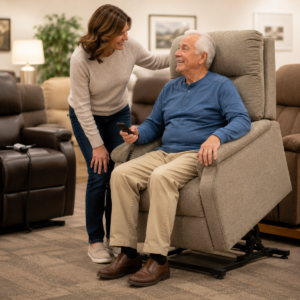
Lift-chair transfer safety for older adults
The user should learn where to place the feet, when to lean, how to use the armrests, and how to stop the motor. Approach and sitting are as important as standing. The chair should be returned to a suitable position before the person backs up, and the area must remain free of rugs, pets, cords, walkers, and caregiver feet.
Standing from the raised seat
Move only as high as needed. If the seat continues rising after the person is stable, it can push behind the legs. If the user releases the control but movement continues, stop using the chair and disconnect power if it is safe to do so. Never stand on the footrest or use the chair as a platform.
Returning to sit
The user must feel the chair behind the legs, control balance, and reach the supports as instructed. A chair raised too high can make sitting feel like falling backward. A caregiver should not pull on the user’s arms or the moving chair. Request hands-on instruction if guarding is required.
Dizziness and blood-pressure changes
Some people become dizzy when moving upright. The motor’s slow pace does not eliminate that risk. Pause, follow the healthcare team’s advice, and report recurrent symptoms. Fainting, chest pain, new severe shortness of breath, or new neurologic symptoms require urgent medical attention.
Recline positions, sleeping, and prolonged sitting
Reading, television, napping, and leg elevation require different support. A position that feels comfortable for ten minutes may create neck strain, sliding, heel pressure, or difficulty breathing after hours. Trial the chair long enough to notice pressure and support without assuming a showroom session predicts all-day comfort.
Linked versus independent movement
Single-motor chairs may raise the legs as the back reclines. Multi-motor chairs can separate those movements. More independence can improve preference but does not guarantee better posture. Save only positions the user can enter, exit, and understand.
Sleeping in a lift chair
Some people sleep in recliners because of comfort, breathing, pain, or inability to transfer to bed. That pattern deserves clinical discussion. Prolonged sitting can affect skin, swelling, joints, sleep quality, and emergency evacuation. A lift chair is not automatically a substitute for an adjustable bed or pressure-management plan.
Leg elevation and swelling
Elevation needs differ. The footrest may not raise the legs to the expected level, and a gap can leave heels unsupported. New or one-sided swelling, redness, warmth, or pain needs medical assessment. Do not treat a furniture position as therapy without professional advice.
Power lift chair with heat and massage considerations
A power lift chair with heat and massage may feel soothing, but these functions add controls, wiring, heat exposure, vibration, weight, and service needs. Ask whether the user can sense temperature normally, operate the timer, and recognize discomfort. Follow medical advice when neuropathy, circulation concerns, fragile skin, implants, pregnancy, or other conditions may change suitability.
Heat controls and skin safety
Confirm temperature settings, automatic shutoff, heated zones, and whether heat can operate accidentally. Never sleep on an active heating function unless the manufacturer and healthcare team specifically support that use. Stop if redness, burning, numbness, or unusual discomfort occurs.
Massage expectations
Many chairs provide vibration rather than manual-style massage. It may change comfort but should not be marketed as treating disease. Test sound and vibration, because some users find them disorienting or unpleasant. Clarify whether the feature can be serviced independently.
Lift Chairs For Seniors: Comparing “best” power lift chair language
Searches for “best power lift chair for seniors,” “best power lift chair for elderly,” and “best power lift chairs for elderly” suggest a universal ranking that does not exist. A power lift recliner chair for elderly users must be judged by individual fit, transfer control, room access, electrical safety, support, warranty, and service—not by age labeling alone.
Lift-chair motors, hand controls, cords, and backup power
The user should reach, identify, and operate the control without twisting. Large buttons may help, but extra functions can complicate use. Confirm whether the control is tethered or wireless, where it will be stored, whether buttons are illuminated, and how movement stops.
Electrical outlet and cord route
Use the power supply, outlet, surge protection, and extension practices specified by the manufacturer. Keep cords away from the lifting mechanism, walking route, pets, moisture, and heat. Do not place the chair where moving parts pinch the cord. A qualified electrician should address inadequate outlets.
Battery backup and outages
Many backup systems are intended to return the chair toward a neutral position, not provide normal operation through a long outage. Learn the exact capability, battery type, replacement interval, test procedure, and disposal method. Keep another safe seat and transfer plan available.
Motor sound and movement
Record new grinding, clicking, hesitation, uneven lifting, unexpected stopping, overheating, or odor. Stop use if movement becomes uncontrolled or the frame shifts. Do not open motors or power supplies unless authorized and qualified.
Room clearance, floors, pets, and delivery routes
Measure the complete delivery path: exterior entrance, turns, stairs, elevator, doors, hallway, and final room. Compare carton dimensions and assembled dimensions. Confirm whether backs or arms detach and who is authorized to assemble them.
Recline and lift clearance
Measure behind, in front, beside, and above the chair through its full range. A wall-hugger still moves. The footrest must not strike a table, walker, fireplace, or another chair. The rising seat should not contact shelves or put the user beneath a hanging fixture.
Stable floor and movement
The chair should sit level and remain stable during lift and recline. Protect flooring only with products the manufacturer permits. A slippery pad or thick rug can allow movement or interfere with the mechanism. Recheck position after cleaning or moving furniture.
Children and pets
Moving mechanisms can create pinch and entrapment zones. Keep children, pets, blankets, toys, cords, and hands away before operating. Do not allow play on the chair or beneath it. Store the control to prevent unintended activation when supervision is absent.
Lift-chair safety checks and recalls
Inspect upholstery, seams, frame stability, footrest, moving gaps, control, cord, plug, power supply, battery, and unusual sound. Check after delivery, relocation, an impact, a spill, or any movement problem. Keep the model and serial number accessible for recall searches.
The CPSC has documented a model-specific lift-chair power-supply recall involving shock risk, and a separate powered-recliner recall involved a chair-back fall hazard. These examples do not mean every chair is defective; they show why model identification and current recall checks matter.
Stop-use warning signs
- Unexpected, jerky, uneven, or continuing movement.
- A loose back, arm, footrest, base, fastener, or frame component.
- Heat, smoke, sparks, burning odor, damaged insulation, or exposed wiring.
- A cracked, wet, noisy, or unusually warm power supply.
- A control that sticks, fails to stop, or activates the wrong function.
- A chair that shifts, rocks, tips, or no longer sits level.
- New pain, skin injury, near-falls, or inability to complete the transfer.
Stop operation, keep the user safe, disconnect power when safe, and contact the manufacturer or qualified service provider. Call emergency services for fire, shock, serious injury, or an immediate medical emergency.
Cleaning, maintenance, warranty, and repair
Follow upholstery and mechanism instructions. Blot spills promptly, keep moisture away from electrical parts, vacuum moving areas only when the chair is unplugged and the manufacturer allows it, and avoid household oils on mechanisms. Do not staple covers or route accessories where they contact moving parts.
Service records
Keep purchase date, seller, model, serial number, manuals, warranty, service contacts, and repair history. Note intermittent faults with video only when recording can be done safely. Ask whether in-home service is available and how the user will sit and transfer while the chair is unavailable.
this topic: Replacement parts
Controls, motors, transformers, batteries, and upholstery components must match the exact model and manufacturer requirements. Unapproved electrical parts can introduce shock, fire, or uncontrolled movement. Use qualified technicians for structural or powered repairs.
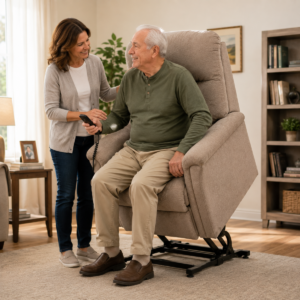
Lift-chair costs and Medicare coverage context
Price varies with size, fabric, motors, positions, capacity, heat, massage, headrest, lumbar support, delivery, assembly, warranty, and service. Compare the total installed cost and return conditions. A chair may be difficult or expensive to return after delivery, so confirm trial policies in writing.
The CMS National Coverage Determination for seat lifts describes medical-necessity conditions and states that payment for a unit combining a recliner with a seat lift is limited to the amount payable for the lift without the recliner feature. Coverage is not automatic, and the furniture portion may remain the buyer’s responsibility. Verify current plan, clinician, supplier, coding, documentation, assignment, and cost details before purchase.
Questions for a seller or supplier
- Can the user trial the exact size and movement range?
- Which dimensions are usable seat measurements and which are overall?
- What capacity applies and what accessories affect it?
- Who delivers, assembles, positions, and demonstrates the chair?
- What happens if the chair does not fit the user or room?
- Who provides in-home warranty and post-warranty service?
- Which part, if any, may qualify under an insurance benefit?
Lift-chair delivery and trial checklist
Before delivery, photograph and measure the route, clear obstacles, protect but do not destabilize floors, identify the outlet, and reserve enough time for setup. Ensure the older adult has safe seating and assistance while assembly occurs.
At setup
Confirm the model, size, fabric, capacity, and features match the order. Inspect for shipping damage, verify that every detachable component locks in place, and test the full range without a person first if the manufacturer directs. Keep children and pets away.
During the user trial
Observe sitting depth, feet, arms, head, control reach, lift arc, standing balance, return to sit, recline comfort, and exit during a simulated power problem. Test with ordinary footwear and any usual walker or cane positioned safely nearby.
Before signing
Obtain manuals, warranty registration, service contacts, model and serial numbers, return terms, battery instructions, and receipts. Document unresolved fit or function issues immediately. Do not accept reassurance that a major sizing problem will disappear after the user “gets used to it.”
How caregivers can support lift-chair use
Caregivers can keep the route clear, position mobility aids, inspect cords, charge or replace approved backup batteries, arrange service, and observe changes. They should not lift by pulling the arms, stand in the moving mechanism, or force the chair manually unless the manufacturer provides a safe emergency procedure.
Create an outage and failure plan
Identify a safe alternative seat, accessible phone, emergency contacts, and the manufacturer’s approved method for returning the chair when power fails. If the person cannot leave a reclined chair during an outage, address that risk before relying on it for sleep or unsupervised use.
Respect the user’s preferences
Comfort, appearance, independence, and dignity matter. Explain safety concerns without treating the older adult as a passive passenger. Include the user in fabric, control, and position choices after narrowing the field to chairs that fit and function safely.
Lift chairs for seniors selection checklist
- Define the transfer problem and rule out a sudden medical change.
- Confirm the user can bear weight and control the assisted stand.
- Arrange professional assessment for complex transfers, falls, surgery, skin, or positioning needs.
- Measure seat height, depth, width, back height, foot support, and user capacity.
- Compare position range, motor independence, controls, heat, massage, and wall clearance.
- Measure the delivery route and full operating space.
- Inspect outlets, cord routes, backup power, children, pets, and floor stability.
- Trial sitting, lifting, standing, returning, reclining, and emergency exit.
- Confirm warranty, in-home service, parts, recalls, return terms, and backup seating.
- Verify insurance details before assuming any part is covered.
Lift chairs for seniors FAQ
Is a lift chair the same as a stair lift?
No. A lift chair is a powered recliner that raises its seat. A stair lift carries a person along a rail installed on stairs. They have different purposes, installation, risks, and coverage questions.
How should a lift chair fit?
The user should reach the back and arm supports, have appropriate thigh and foot support, operate controls comfortably, and meet the floor in a stable position during the lift. Seat height, depth, width, back height, and capacity all matter.
Are more motors always better?
No. More motors provide more independent positioning but add controls, parts, cost, and service needs. Choose the movement the user can understand and benefit from.
Can a person sleep in a lift chair?
Some people do, but prolonged sitting, skin, swelling, posture, breathing, evacuation, and the reason bed transfers are difficult should be reviewed with a healthcare professional.
Does Medicare pay for the entire lift chair?
Do not assume so. CMS policy distinguishes the medically necessary seat-lift mechanism from the recliner feature and applies specific conditions. Verify current individual eligibility, documentation, supplier, coding, and costs.
A practical trial for this topic
A useful trial includes more than reclining. The user should approach with the usual cane or walker, position it safely, turn, sit, operate every intended control, return upright, rise only as high as necessary, establish balance, and leave the chair. Repeat the sequence when the person is somewhat tired, provided it is safe to do so.
Watch the feet, knees, hips, trunk, shoulders, hands, and face. Feet should reach a stable position; knees should not be forced against furniture; the user should not slide or pull painfully on the arms. Ask whether any position creates pressure behind the knees, at the heels, along the back, or beneath the arms.
Trial the exact size, not a similar showroom chair
A fabric sample or nearby model cannot prove fit. Two chairs from the same collection may have different seat dimensions, motors, controls, and lift arcs. If the correct size cannot be trialed, obtain detailed measurements and a written return plan that covers fit failure after delivery.
Practice interruption and reversal
The user should be able to stop movement at any point and understand how to reverse direction. Test whether the control remains reachable when reclined and whether buttons are distinguishable by touch. A control that is simple for a caregiver may still confuse the primary user.
Simulate a power outage safely
Learn the approved backup procedure without placing the user at risk. Determine whether the backup returns only toward neutral and whether fresh batteries must be installed. If the user cannot exit without power, the chair should not become the only safe seat or sleeping location.
Lift Chairs For Seniors: Allow time to identify pressure
Remain seated long enough to notice support and discomfort, but follow clinical advice for skin or circulation concerns. A soft first impression can conceal poor depth or lumbar support. Do not accept numbness or persistent redness as normal adjustment.
How to compare lift-chair specifications
Product pages can list seat dimensions, overall dimensions, required wall clearance, capacity, chair weight, motor count, recline language, upholstery, and warranty. Confirm where every measurement begins and ends. Seat width between arms differs from outside width; seat depth differs from total depth; wall clearance may change through the movement cycle.
Capacity and user fit
Capacity is a safety limit, not a sizing recommendation. A chair rated above the user’s weight can still be too deep, wide, tall, or short. Count any load as the manufacturer directs and never place another person, pet, or heavy object on the chair during movement.
Motor count and independent zones
Ask which sections each motor controls and whether one motor failure disables all movement. Headrest and lumbar motors adjust smaller zones but may add complexity. Determine which positions the user will actually operate. Paying for unused controls can make the interface harder without improving function.
Upholstery and cleaning
Fabric, vinyl, and leather differ in feel, temperature, friction, cleaning, and durability. A slippery cover may affect transfers; a high-friction surface may make repositioning difficult. Ask about incontinence protection, approved cleaners, seam repair, and whether adding a cover interferes with heat, massage, or movement.
Noise, speed, and duty cycle
Manufacturers may specify how long motors can run before cooling. Repeated cycling for play or troubleshooting can overheat components. The movement should be predictable and controllable, not necessarily fast. Ask the seller what sound is normal and how to document a change.
Warranty details
Separate coverage for frame, mechanism, motors, electrical parts, upholstery, labor, and transportation. A lifetime frame statement may exclude labor and powered parts. Confirm whether technicians come to the home and what happens if the manufacturer or retailer discontinues the model.
Skin, swelling, pain, breathing, and cognition
A lift recliner changes posture and time spent sitting. Those changes can affect skin loading, swelling, joint position, breathing, sleep, and activity. The chair should support an overall plan that includes movement and appropriate care, not become a reason to remain seated all day.
Skin and pressure
People with reduced sensation, limited repositioning, fragile skin, or prior pressure injury need individualized assessment. Decorative cushioning does not equal a pressure-management surface. Inspect skin as advised and report persistent redness, warmth, blistering, or open areas.
Swelling and circulation concerns
A footrest can elevate the legs somewhat, but the actual position varies. New one-sided swelling, redness, warmth, or pain requires medical attention. Avoid making claims that a chair treats circulation or replaces compression or movement recommendations.
Pain and joint precautions
Hip, knee, shoulder, back, or neck pain may improve or worsen with seat dimensions and recline. After surgery, follow range-of-motion and weight-bearing precautions. A high lift angle is not automatically safer if it violates control or positioning needs.
this topic: Breathing and sleep
Some users prefer an elevated trunk, but unexplained breathing difficulty deserves clinical evaluation. Sleeping upright can introduce skin, swelling, evacuation, and equipment-failure issues. Discuss the reason for chair sleeping rather than treating it as a furniture preference alone.
Cognition and control use
Multiple buttons, saved positions, heat, massage, and lights can confuse a user. Observe whether the person can stop movement and avoid unintended activation. A simpler control or supervised use may be safer. Do not hide a remote in a way that prevents emergency access.

Household routines, visitors, and emergency planning
Choose a location that supports conversation, lighting, temperature, outlets, mobility-aid access, and an unobstructed exit. The chair should not isolate the older adult or force every activity into one seat. Keep frequently used items within reach without creating a table or cord barrier during standing.
Mobility aids beside the chair
A cane or walker must be reachable after the chair lifts but not inside the mechanism or under the footrest. Use a consistent parking location and practice the hand transition. Do not hang a walker on the chair or rely on furniture that rolls.
Visitors and unfamiliar users
Children and guests may not understand the moving mechanism. Store controls appropriately and explain that the chair is not a toy. A visitor should not change saved positions, unplug the backup system, or place objects beneath the seat.
Evacuation and outages
Include the user’s transfer needs in fire and weather planning. Identify an accessible route, communication method, backup lighting, and people who can assist appropriately. If stairs are unavoidable, seek local emergency-planning guidance; the lift chair itself does not solve evacuation.
Extended service interruption
Arrange an alternative chair with suitable height and arms before repair is needed. Know whether the retailer offers a loaner and how quickly technicians respond. Never continue using a chair with an intermittent electrical or structural fault merely because no backup seat is available.
Common lift-chair selection mistakes
A common mistake is ordering by user weight and fabric color while overlooking seat depth and height. Capacity is essential, but a chair can remain poorly fitted within its limit. Another mistake is assuming that the highest lift angle provides the most help; an excessive angle can place the user beyond controlled balance.
Families may also focus on heat, massage, or many saved positions before confirming control reach, outlet safety, room clearance, delivery access, and repair support. Optional comfort features belong near the end of the decision, after the transfer and fit have succeeded.
Do not promise independence the chair cannot provide
A lift recliner assists one part of a transfer. The user may still need a walker positioned correctly, supervision, help with clothing, or another plan during dizziness and fatigue. Describe the expected benefit honestly and identify who will help when conditions differ from the ideal trial.
Do not discard the ordinary seating plan
The lift chair should not automatically become the only chair used for meals, sleep, social activity, and every transfer. Preserve suitable alternatives, encourage movement according to professional advice, and reassess if the person spends progressively more time seated or can no longer exit safely.
Sources used for this guide
SeniorTechLife used the following sources to verify safety, fitting, coverage, and product-category facts. Sources support the statements linked in the article; they do not replace individualized clinical advice.
- Mobility Aids — MedlinePlus, U.S. National Library of Medicine.
- National Coverage Determination: Seat Lift (280.4) — Centers for Medicare & Medicaid Services.
- La-Z-Boy Recalls Power Supplies Sold With Lift Chairs Due to Shock Hazard — U.S. Consumer Product Safety Commission.
- Havertys Recalls Concord Dual Power Recliner Chairs Due to Fall Hazard — U.S. Consumer Product Safety Commission.
Build a safer mobility plan
Return to the published Mobility Resource Center for broad guidance. Focused links from this Hub will be activated only after their destination assets pass editorial, safety, originality, and WordPress QA.