mobility transport and vehicle transfer | SeniorTechLife mobility guide
Vehicle transport is a systems decision. The same wheelchair or scooter can become safe, exhausting, inaccessible, or unstable depending on the vehicle, carrier, loading route, and driver.
Mobility Transport And Vehicle Transfer: What belongs in this guide
A mobility transport and vehicle transfer plan must connect the person, device, car, route, loading method, and backup. The main phrase is kept broad while the approved carrier phrases clarify distinct transport situations.
The primary topic is mobility transport and vehicle transfer. Approved support phrases include wheelchair carrier for car; wheelchair carrier for car uk (regional comparison term); wheelchair carrier for back of car; wheelchair carrier for car without hitch; wheelchair carrier for car south africa. They clarify category decisions without creating competing pages.
Use mobility transport and vehicle transfer as the broad starting point, then move to the narrow question that matches the person and the setting.
- Identify the person and the outcome this category must support.
- Match the option with the environment, caregiver, privacy, and emergency plan.
- Separate broad education from brand reviews, local searches, and narrow child intents.
- Verify current instructions, limits, service, and total ownership cost.
A decision starts with the person and setting
Vehicle transport is a systems decision. The same wheelchair or scooter can become safe, exhausting, inaccessible, or unstable depending on the vehicle, carrier, loading route, and driver.
Two options can look similar online and behave differently under stress. This guide therefore treats fit, control, connection, maintenance, consent, and human support as part of the decision.
Eight decisions that matter more than marketing
The following framework turns a broad product search into observable questions. Complete it with the older adult and, when risk or medical complexity is present, with a qualified rehabilitation or healthcare professional. A specification is useful only when it connects to a real task.
Person and task
Decision question: For vehicle transfer & mobility transport, what should a family verify about person and task before choosing an option?
In a vehicle transfer & mobility transport decision, person and task changes the practical fit, burden, and safety. Consider the person, the task, the environment, and the support available.
Practical check: For this vehicle transfer & mobility transport question, write down the exact task, observe it in the real setting, and compare the result with the manufacturer information and professional advice.
Pause and reassess when: For vehicle transfer & mobility transport, pause when the person cannot control the option, the setting requires an untested workaround, or the plan depends on a claim that cannot be verified.
Fit and access
Decision question: For vehicle transfer & mobility transport, what should a family verify about fit and access before choosing an option?
In a vehicle transfer & mobility transport decision, fit and access changes the practical fit, burden, and safety. Consider the person, the task, the environment, and the support available.
Practical check: For this vehicle transfer & mobility transport question, write down the exact task, observe it in the real setting, and compare the result with the manufacturer information and professional advice.
Pause and reassess when: For vehicle transfer & mobility transport, pause when the person cannot control the option, the setting requires an untested workaround, or the plan depends on a claim that cannot be verified.
Control and usability
Decision question: For vehicle transfer & mobility transport, what should a family verify about control and usability before choosing an option?
In a vehicle transfer & mobility transport decision, control and usability changes the practical fit, burden, and safety. Consider the person, the task, the environment, and the support available.
Practical check: For this vehicle transfer & mobility transport question, write down the exact task, observe it in the real setting, and compare the result with the manufacturer information and professional advice.
Pause and reassess when: For vehicle transfer & mobility transport, pause when the person cannot control the option, the setting requires an untested workaround, or the plan depends on a claim that cannot be verified.
Coverage and connection
Decision question: For vehicle transfer & mobility transport, what should a family verify about coverage and connection before choosing an option?
In a vehicle transfer & mobility transport decision, coverage and connection changes the practical fit, burden, and safety. Consider the person, the task, the environment, and the support available.
Practical check: For this vehicle transfer & mobility transport question, write down the exact task, observe it in the real setting, and compare the result with the manufacturer information and professional advice.
Pause and reassess when: For vehicle transfer & mobility transport, pause when the person cannot control the option, the setting requires an untested workaround, or the plan depends on a claim that cannot be verified.
Privacy and consent
Decision question: For vehicle transfer & mobility transport, what should a family verify about privacy and consent before choosing an option?
In a vehicle transfer & mobility transport decision, privacy and consent changes the practical fit, burden, and safety. Consider the person, the task, the environment, and the support available.
Practical check: For this vehicle transfer & mobility transport question, write down the exact task, observe it in the real setting, and compare the result with the manufacturer information and professional advice.
Pause and reassess when: For vehicle transfer & mobility transport, pause when the person cannot control the option, the setting requires an untested workaround, or the plan depends on a claim that cannot be verified.
Caregiver support
Decision question: For vehicle transfer & mobility transport, what should a family verify about caregiver support before choosing an option?
In a vehicle transfer & mobility transport decision, caregiver support changes the practical fit, burden, and safety. Consider the person, the task, the environment, and the support available.
Practical check: For this vehicle transfer & mobility transport question, write down the exact task, observe it in the real setting, and compare the result with the manufacturer information and professional advice.
Pause and reassess when: For vehicle transfer & mobility transport, pause when the person cannot control the option, the setting requires an untested workaround, or the plan depends on a claim that cannot be verified.
Mobility Transport And Vehicle Transfer: Service and cost
Decision question: For vehicle transfer & mobility transport, what should a family verify about service and cost before choosing an option?
In a vehicle transfer & mobility transport decision, service and cost changes the practical fit, burden, and safety. Consider the person, the task, the environment, and the support available.
Practical check: For this vehicle transfer & mobility transport question, write down the exact task, observe it in the real setting, and compare the result with the manufacturer information and professional advice.
Pause and reassess when: For vehicle transfer & mobility transport, pause when the person cannot control the option, the setting requires an untested workaround, or the plan depends on a claim that cannot be verified.
Backup plan
Decision question: For vehicle transfer & mobility transport, what should a family verify about backup plan before choosing an option?
In a vehicle transfer & mobility transport decision, backup plan changes the practical fit, burden, and safety. Consider the person, the task, the environment, and the support available.
Practical check: For this vehicle transfer & mobility transport question, write down the exact task, observe it in the real setting, and compare the result with the manufacturer information and professional advice.
Pause and reassess when: For vehicle transfer & mobility transport, pause when the person cannot control the option, the setting requires an untested workaround, or the plan depends on a claim that cannot be verified.
Ownership, service, and disruption planning
Mobility equipment must remain usable after the first week. Include cleaning, inspection, storage, service, transportation, changing health needs, and an alternative plan. Do not accept a product whose safe-use instructions, compatible parts, or service route are unclear.
Setup
For vehicle transfer & mobility transport, plan how setup will work after the first week, including who will explain it and where information will be kept.
Maintenance point: For this vehicle transfer & mobility transport setup, check the relevant parts, settings, battery or signal status, cleaning, updates, and service contacts on a documented schedule.
Backup point: For vehicle transfer & mobility transport, keep a simple alternative plan for power, coverage, damage, travel, caregiver absence, or a changed health need.
Daily use
For vehicle transfer & mobility transport, plan how daily use will work after the first week, including who will explain it and where information will be kept.
Maintenance point: For this vehicle transfer & mobility transport setup, check the relevant parts, settings, battery or signal status, cleaning, updates, and service contacts on a documented schedule.
Backup point: For vehicle transfer & mobility transport, keep a simple alternative plan for power, coverage, damage, travel, caregiver absence, or a changed health need.
Power or signal
For vehicle transfer & mobility transport, plan how power or signal will work after the first week, including who will explain it and where information will be kept.
Maintenance point: For this vehicle transfer & mobility transport setup, check the relevant parts, settings, battery or signal status, cleaning, updates, and service contacts on a documented schedule.
Backup point: For vehicle transfer & mobility transport, keep a simple alternative plan for power, coverage, damage, travel, caregiver absence, or a changed health need.
Cleaning and updates
For vehicle transfer & mobility transport, plan how cleaning and updates will work after the first week, including who will explain it and where information will be kept.
Maintenance point: For this vehicle transfer & mobility transport setup, check the relevant parts, settings, battery or signal status, cleaning, updates, and service contacts on a documented schedule.
Backup point: For vehicle transfer & mobility transport, keep a simple alternative plan for power, coverage, damage, travel, caregiver absence, or a changed health need.
Travel
For vehicle transfer & mobility transport, plan how travel will work after the first week, including who will explain it and where information will be kept.
Maintenance point: For this vehicle transfer & mobility transport setup, check the relevant parts, settings, battery or signal status, cleaning, updates, and service contacts on a documented schedule.
Backup point: For vehicle transfer & mobility transport, keep a simple alternative plan for power, coverage, damage, travel, caregiver absence, or a changed health need.
Caregiver handoff
For vehicle transfer & mobility transport, plan how caregiver handoff will work after the first week, including who will explain it and where information will be kept.
Maintenance point: For this vehicle transfer & mobility transport setup, check the relevant parts, settings, battery or signal status, cleaning, updates, and service contacts on a documented schedule.
Backup point: For vehicle transfer & mobility transport, keep a simple alternative plan for power, coverage, damage, travel, caregiver absence, or a changed health need.
Service
For vehicle transfer & mobility transport, plan how service will work after the first week, including who will explain it and where information will be kept.
Maintenance point: For this vehicle transfer & mobility transport setup, check the relevant parts, settings, battery or signal status, cleaning, updates, and service contacts on a documented schedule.
Backup point: For vehicle transfer & mobility transport, keep a simple alternative plan for power, coverage, damage, travel, caregiver absence, or a changed health need.
Mobility Transport And Vehicle Transfer: Emergency backup
For vehicle transfer & mobility transport, plan how emergency backup will work after the first week, including who will explain it and where information will be kept.
Maintenance point: For this vehicle transfer & mobility transport setup, check the relevant parts, settings, battery or signal status, cleaning, updates, and service contacts on a documented schedule.
Backup point: For vehicle transfer & mobility transport, keep a simple alternative plan for power, coverage, damage, travel, caregiver absence, or a changed health need.
Real-world trial scenarios
Equipment should be tested as part of a complete activity, not as an isolated object. The following scenarios expose access, control, fatigue, caregiver, and maintenance problems that can remain invisible in a showroom. A trial is not permission to exceed the person’s care plan or the manufacturer’s instructions.
An ordinary day
Set up the trial: For vehicle transfer & mobility transport, use the exact configuration in a realistic route or emergency scenario. A meaningful trial uses the person’s ordinary footwear, usual assistive devices, realistic timing, and the exact equipment configuration being considered.
Observe: Observe vehicle transfer & mobility transport control, reach, comprehension, comfort, privacy, and what happens when the first plan fails. Watch the person and caregiver throughout the complete task rather than judging the equipment from a single successful moment.
Compare: Compare the vehicle transfer & mobility transport result with the person’s needs, the written instructions, and the service or response promise. Record objective observations, settings, dimensions, assistance, and any reminders so alternatives can be compared without relying on memory.
Boundary: For vehicle transfer & mobility transport, stop when safety relies on guessing, rushing, ignored consent, or a person compensating beyond their ability. Stop the trial if safety depends on catching, lifting, uncontrolled movement, ignored instructions, or a workaround the manufacturer or care plan does not permit.
A difficult route
Set up the trial: For vehicle transfer & mobility transport, use the exact configuration in a realistic route or emergency scenario. A meaningful trial uses the person’s ordinary footwear, usual assistive devices, realistic timing, and the exact equipment configuration being considered.
Observe: Observe vehicle transfer & mobility transport control, reach, comprehension, comfort, privacy, and what happens when the first plan fails. Watch the person and caregiver throughout the complete task rather than judging the equipment from a single successful moment.
Compare: Compare the vehicle transfer & mobility transport result with the person’s needs, the written instructions, and the service or response promise. Record objective observations, settings, dimensions, assistance, and any reminders so alternatives can be compared without relying on memory.
Boundary: For vehicle transfer & mobility transport, stop when safety relies on guessing, rushing, ignored consent, or a person compensating beyond their ability. Stop the trial if safety depends on catching, lifting, uncontrolled movement, ignored instructions, or a workaround the manufacturer or care plan does not permit.
A caregiver handoff
Set up the trial: For vehicle transfer & mobility transport, use the exact configuration in a realistic route or emergency scenario. A meaningful trial uses the person’s ordinary footwear, usual assistive devices, realistic timing, and the exact equipment configuration being considered.
Observe: Observe vehicle transfer & mobility transport control, reach, comprehension, comfort, privacy, and what happens when the first plan fails. Watch the person and caregiver throughout the complete task rather than judging the equipment from a single successful moment.
Compare: Compare the vehicle transfer & mobility transport result with the person’s needs, the written instructions, and the service or response promise. Record objective observations, settings, dimensions, assistance, and any reminders so alternatives can be compared without relying on memory.
Boundary: For vehicle transfer & mobility transport, stop when safety relies on guessing, rushing, ignored consent, or a person compensating beyond their ability. Stop the trial if safety depends on catching, lifting, uncontrolled movement, ignored instructions, or a workaround the manufacturer or care plan does not permit.
A disrupted or urgent situation
Set up the trial: For vehicle transfer & mobility transport, use the exact configuration in a realistic route or emergency scenario. A meaningful trial uses the person’s ordinary footwear, usual assistive devices, realistic timing, and the exact equipment configuration being considered.
Observe: Observe vehicle transfer & mobility transport control, reach, comprehension, comfort, privacy, and what happens when the first plan fails. Watch the person and caregiver throughout the complete task rather than judging the equipment from a single successful moment.
Compare: Compare the vehicle transfer & mobility transport result with the person’s needs, the written instructions, and the service or response promise. Record objective observations, settings, dimensions, assistance, and any reminders so alternatives can be compared without relying on memory.
Boundary: For vehicle transfer & mobility transport, stop when safety relies on guessing, rushing, ignored consent, or a person compensating beyond their ability. Stop the trial if safety depends on catching, lifting, uncontrolled movement, ignored instructions, or a workaround the manufacturer or care plan does not permit.
Questions for a supplier, retailer, or clinician
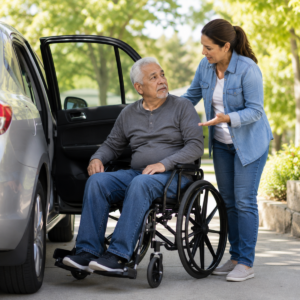
Ask for answers in writing when they affect compatibility, capacity, warranty, returns, insurance, or service. A product page can be outdated or describe a related configuration rather than the exact item delivered. Keep the model and version attached to every answer.
- What exact task and user ability does this option need to support?
- What are the coverage, signal, battery, power, or access limits?
- Who will set up, explain, inspect, and maintain it?
- What happens when the person cannot press, hear, see, carry, or remember the device?
- Which information is collected, shared, stored, or printed?
- What are the fees, contract, return, warranty, and service terms?
- What professional or manufacturer help is available?
- What is the tested backup if the primary plan fails?
Do not treat “medical grade,” “premium,” “smart,” “portable,” “heavy duty,” “upright,” “all terrain,” or “caregiver friendly” as measurable claims unless the seller explains the test, limit, and exact configuration. A high review average cannot replace manufacturer instructions or an individualized assessment.
Common selection and use mistakes
Mistakes often begin with a reasonable goal—speed, independence, comfort, or lower cost—but skip an important constraint. Recognizing the pattern early prevents an unsuitable product from becoming a permanent workaround.
Vehicle Transfer & Mobility Transport: choosing by a single feature
A family may select a vehicle transfer & mobility transport option because one feature sounds reassuring while overlooking coverage, fit, training, or maintenance.
Better approach: For vehicle transfer & mobility transport, use a short decision record that names the task, constraint, evidence, and unresolved risk. Document the reason for the decision so another caregiver, editor, or clinician can understand what was tested and what remains unresolved.
Mobility Transport And Vehicle Transfer: Vehicle Transfer & Mobility Transport: assuming “senior” is one use case
Older adults differ in hearing, vision, dexterity, cognition, mobility, language, privacy preferences, and caregiver access.
Better approach: Test the actual person and vehicle transfer & mobility transport routine rather than relying on an age label. Document the reason for the decision so another caregiver, editor, or clinician can understand what was tested and what remains unresolved.
Vehicle Transfer & Mobility Transport: confusing availability with suitability
A vehicle transfer & mobility transport product or service can be easy to order yet difficult to use, charge, explain, return, or repair.
Better approach: Verify the complete vehicle transfer & mobility transport ownership path before paying or relying on it. Document the reason for the decision so another caregiver, editor, or clinician can understand what was tested and what remains unresolved.
Vehicle Transfer & Mobility Transport: treating a backup as automatic
A second vehicle transfer & mobility transport device or printed record is not useful if it is outdated, inaccessible, untested, or incompatible.
Better approach: Assign an owner and a review date for every vehicle transfer & mobility transport backup. Document the reason for the decision so another caregiver, editor, or clinician can understand what was tested and what remains unresolved.
Delivery, follow-up, and reassessment
Delivery is the beginning of ownership, not the final QA step. Verify the exact product, condition, components, instructions, training, settings, and return deadline. Reassessment should respond to the person, caregiver, environment, and equipment as each changes.
Vehicle Transfer & Mobility Transport: first setup
At first use: Record the exact vehicle transfer & mobility transport model or service configuration, settings, contacts, and training completed.
Over time: Review the vehicle transfer & mobility transport routine after the first few uses and after any change in health, home, vehicle, or caregiver.
Escalate when: Escalate when the promised vehicle transfer & mobility transport response, fit, privacy, or control does not match the documented need.
Vehicle Transfer & Mobility Transport: monthly reality check
At first use: Ask whether the person still uses and understands the vehicle transfer & mobility transport plan.
Over time: Check vehicle transfer & mobility transport supplies, batteries, coverage, labels, contacts, and access routes.
Escalate when: Escalate after a missed vehicle transfer & mobility transport alert, false confidence, fall, failed transfer, inaccessible route, or repeated confusion.
Vehicle Transfer & Mobility Transport: travel or disruption
At first use: Decide how the vehicle transfer & mobility transport plan works away from home, during outages, and when a caregiver is absent.
Over time: Keep current vehicle transfer & mobility transport instructions and a backup contact with the person.
Escalate when: Escalate if the vehicle transfer & mobility transport plan cannot be verified in the new setting.
Vehicle Transfer & Mobility Transport: change in condition
At first use: Treat new weakness, falls, confusion, hearing loss, or medication changes as a reason to reassess the vehicle transfer & mobility transport plan.
Over time: Do not silently adapt vehicle transfer & mobility transport equipment or service beyond its instructions.
Escalate when: Seek qualified help when the change affects vehicle transfer & mobility transport safety or emergency communication.
Emergency and backup planning
Before using a carrier or modified vehicle, verify the exact equipment, loading points, securement, visibility, and professional installation. Do not infer compatibility from a product family name.
Keep a phone or alert method accessible, label equipment without exposing unnecessary private information, and place manuals and service numbers where caregivers can find them. A backup device must be fitted, inspected, and included in the care plan; equipment borrowed during an emergency is not automatically safe.
After a fall, collision, uncontrolled movement, hard impact, flood, fire exposure, or airline handling, remove the equipment from use until its safety can be confirmed. Seek appropriate medical attention for injury or concerning symptoms. Do not hide a failure with tape, improvised fasteners, mixed parts, or a caregiver’s physical effort.
Mobility Transport And Vehicle Transfer: Documented plan for mobility transport and vehicle transfer
Turn the research into a short, documented decision record.
Broad category guide with distinct child intents.
- Define the person and task.
- Measure the environment and access route.
- Verify the exact device or service limits.
- Test setup and failure scenarios.
- Document cost, privacy, support, and backup.
Record what was rejected
Record options rejected because of fit, coverage, privacy, cost, complexity, or unavailable service.
Set the next review date
Set a review date and repeat the assessment after any material change.
What this Hub intentionally does not answer
This broad hub provides education and decision structure; it does not rank current models or answer every narrow child query.
Use official instructions and qualified help for any safety-critical setup, installation, transfer, or emergency plan.
How future child guides should connect
Future child guides must own narrower questions and remain inactive until separately reviewed.
Until a child guide is published and reviewed, its cluster card remains visible as navigation architecture but not as an active link. This protects readers from broken destinations and prevents unpublished URLs from being treated as finished advice.
Frequently asked questions
Is a wheelchair carrier for a car the same as an occupied transport system?
No. A carrier may transport an empty device outside the vehicle; an occupied wheelchair requires a separately designed securement and restraint plan.
Can every carrier work without a hitch?
No. The vehicle, carrier, mounting method, payload, lighting, and manufacturer instructions must be evaluated together.
Who can assess a modified vehicle?
A qualified vehicle modifier or driver-rehabilitation specialist can help review compatibility and safe use.
What is the most important first measurement?
Record the actual device weight and dimensions, vehicle limits, route, loading effort, and the person’s transfer needs.
Measure the route before the carrier
A vehicle transfer plan begins outside the product page. Measure the doorway, driveway, parking position, turning area, lift height, trunk opening, and the distance the caregiver must walk while handling the device. Record slopes, curbs, weather exposure, traffic, and lighting. A wheelchair carrier for back of car may appear compatible yet become impractical when the person must transfer beside a narrow door or when the carrier blocks lights and visibility. A wheelchair carrier for car without hitch deserves the same scrutiny: identify the mounting method, the manufacturer’s approved load, the vehicle’s payload, and the installation limit. Do not treat “fits most cars” as a final answer.
Write the observation down, identify the responsible person, and set a date to review it. This keeps the broad Hub useful without turning one narrow question into a competing page.
Separate empty-device transport from occupied travel
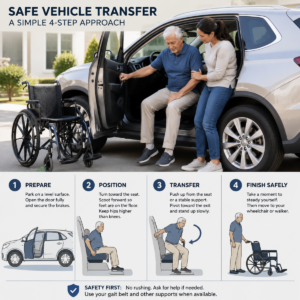
A carrier for an empty wheelchair or scooter does not automatically create a safe seat for a passenger. If a person remains seated in a wheelchair during travel, the vehicle, securement points, occupant restraint, head support, and forward-facing arrangement require a separate assessment. Public or accessible transport may follow different rules from a private car. Families should write down whether the person transfers to a vehicle seat, remains in a mobility device, or uses a folding device in the cabin. That single distinction prevents a carrier purchase from being mistaken for a complete passenger-safety solution.
Write the observation down, identify the responsible person, and set a date to review it. This keeps the broad Hub useful without turning one narrow question into a competing page.
Loading effort is a daily safety factor
The best theoretical carrier is not useful if the caregiver cannot lift, fold, position, latch, and inspect it without twisting or rushing. Test the real sequence with the actual device and the person who will repeat it. Include wet hands, cold weather, a tired caregiver, a narrow parking space, and the need to unload at the destination. Compare a wheelchair carrier for car with a ramp, van lift, folding transport chair, or another route when effort is the limiting factor. Document what assistance is needed and what happens if that person is absent.
Write the observation down, identify the responsible person, and set a date to review it. This keeps the broad Hub useful without turning one narrow question into a competing page.
Installation and service deserve their own decision
Vehicle modifications can affect payload, lighting, doors, sensors, visibility, warranty, and future resale. Ask who installs the equipment, what training is provided, how recalls are handled, where replacement parts come from, and what the vehicle owner must inspect. NHTSA points families toward experienced driver-rehabilitation and vehicle-modification professionals for compatibility questions. Keep receipts, model numbers, installation photographs, and service contacts together. If a carrier or lift is difficult to remove, the long-term cost includes every future vehicle change.
Write the observation down, identify the responsible person, and set a date to review it. This keeps the broad Hub useful without turning one narrow question into a competing page.
Mobility Transport And Vehicle Transfer: Build a backup route
A transportation plan is fragile when one car, one caregiver, or one carrier is the only option. List alternatives for a flat tire, dead battery, rain, illness, repair appointment, or a trip where the carrier cannot be used. A backup may be a ride service, accessible van, family route, community program, or postponed trip, but it needs a contact and a realistic lead time. Rehearse the backup without putting the person at risk. The written plan should say when to stop driving and who decides whether the mobility device travels.
Write the observation down, identify the responsible person, and set a date to review it. This keeps the broad Hub useful without turning one narrow question into a competing page.
Use a product page as evidence, not permission
Product pages often combine several frame sizes, hitch classes, battery configurations, and accessories. Save the exact model, revision, dimensions, capacity, installation diagram, and warranty before making a decision. Confirm that the wheelchair carrier for car uk (regional comparison term) language, for example, does not imply United States compatibility, service, or vehicle standards. A local phrase such as local carrier search remains outside this national hub because service availability must be verified locally. Broad education should not pretend to deliver a local installer.
Write the observation down, identify the responsible person, and set a date to review it. This keeps the broad Hub useful without turning one narrow question into a competing page.
Check the destination before checking the price
A carrier can be affordable and still fail at the destination. Identify where the device will be unloaded, whether the surface is level, how it will be moved indoors, where it will be stored, and who cleans it after rain or snow. A scooter may need charging after the journey; a folding wheelchair may need a dry, accessible storage point. Add the return route to the test. A transport choice that works only one way is not a complete mobility transport plan.
Write the observation down, identify the responsible person, and set a date to review it. This keeps the broad Hub useful without turning one narrow question into a competing page.
Record the decision in plain language
Finish with one sentence that explains why the chosen category fits: for example, the person can transfer with support, the device meets the vehicle payload, the carrier keeps lights visible, and the caregiver can load it without unsafe effort. Then list what remains uncertain. This makes it easier to revisit the decision after surgery, a new vehicle, a new wheelchair, or a caregiver change. The goal is not a perfect purchase; it is a transparent plan that can be checked and corrected.
Write the observation down, identify the responsible person, and set a date to review it. This keeps the broad Hub useful without turning one narrow question into a competing page.
A final transport check
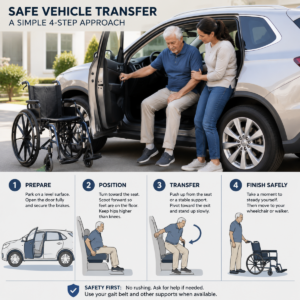
Before a trip, confirm the person’s transfer plan, the device’s condition, the carrier’s latch or securement, visible lights, tire or battery status, and the destination route. Leave enough time to stop if a step does not feel controlled. Keep emergency contacts and the carrier instructions in the vehicle, but do not leave private health information exposed. After returning, inspect for impact, water, dirt, or a changed setting. Transport should be repeatable by the caregiver who actually drives, not merely possible for an installer during a demonstration.
Why broad guidance stays broad
This page does not choose one carrier, vehicle, van, or scooter. That boundary protects readers from an attractive but unsupported recommendation and leaves model-level evidence for a future asset. The Hub instead gives a comparison language: person, device, vehicle, route, loading effort, securement, service, and backup. Those dimensions remain useful even when a model is discontinued or a vehicle changes.
A practical handoff
When a family member, paid caregiver, or transport service takes over, explain the route and the stop rules aloud. Show where the device is stored, how it is checked, who may install or remove it, and which failures require a different plan. Record questions rather than improvising in a parking lot. A clear handoff is part of the safety system.
Sources used for this guide
Transportation claims are checked against NHTSA, Access Board, FDA home-use, and manufacturer-safety principles; sources do not certify a specific installation.
- Adapted Vehicles — National Highway Traffic Safety Administration.
- How to Secure Your Load — National Highway Traffic Safety Administration.
- Guidelines for Accessible Vehicles — U.S. Access Board.
- Unique Considerations in the Home — U.S. Food and Drug Administration.
Build a safer plan
Return to the Mobility Resource Center for broad mobility guidance; focused carrier and securement pages remain inactive until separately reviewed.