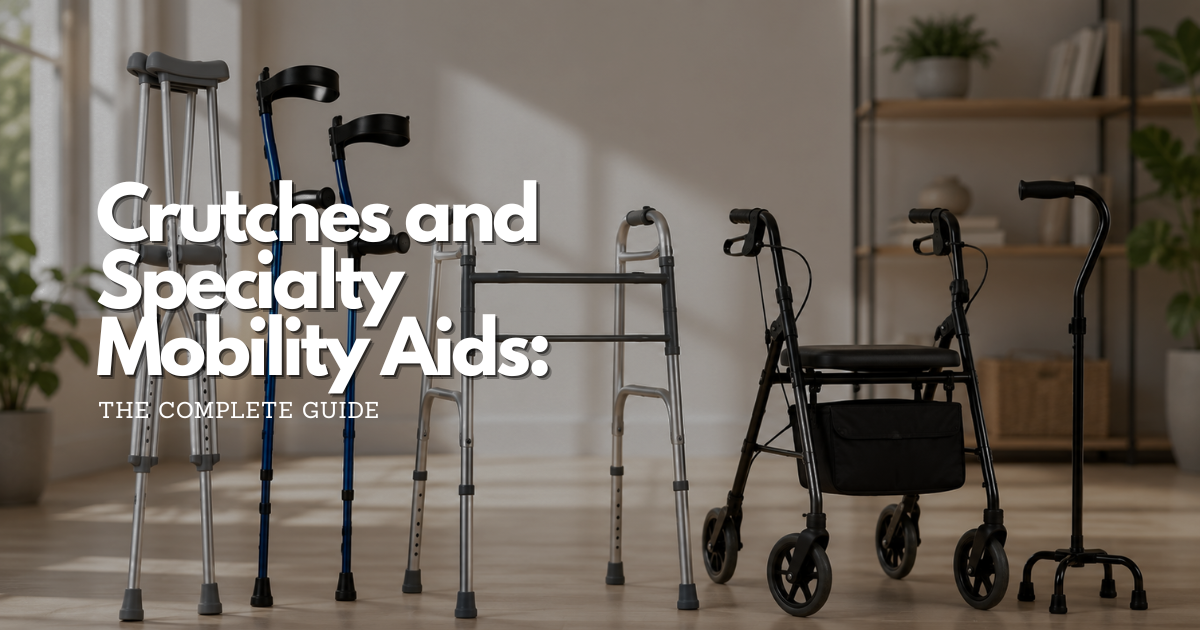
crutches and specialty mobility aids | SeniorTechLife mobility guide
Crutches and specialty mobility aids must match the prescribed weight-bearing plan, the user’s strength and balance, the environment, and the ability to learn the technique. This guide compares categories without replacing training.
Crutches And Specialty Mobility Aids: How should families compare crutches and specialty mobility aids?
Begin with the prescribed weight-bearing plan, then match the user’s balance, upper-body capacity, fit, environment, duration, and ability to learn the technique. Crutches and specialty mobility aids include axillary, forearm, platform, and hands-free designs as well as neighboring aids such as knee scooters. They are not interchangeable.
MedlinePlus notes that crutches may be useful after injury or surgery but that a walker may be more appropriate when pain, weakness, or balance problems are substantial. The clinician’s instructions determine how much weight may pass through the affected leg.
Types and practical tradeoffs
| Category | Possible use | Important boundary |
|---|---|---|
| Axillary crutches | Common temporary support after lower-limb injury or surgery | Load belongs through the hands; fit and underarm clearance are critical |
| Forearm crutches | One- or two-sided use, including some long-term mobility plans | Require cuff, grip, balance, and technique assessment |
| Platform crutches | Forearm loading when grip or wrist loading is limited | Attachments must be compatible, aligned, secured, and fitted |
| Hands-free knee crutch | Selected below-knee conditions for users with suitable balance and knee motion | Not suitable for every injury, user, stair, or surface |
| Knee scooter | Wheeled support for selected non-weight-bearing lower-leg conditions | Requires steering, brakes, knee tolerance, turning space, and surface control |
| Specialty gait aid | Condition-specific trunk, forearm, or one-sided support | Requires individualized assessment and training |
Platform terminology
A platform attachment for crutches or platform attachment for axillary crutches changes how the arm bears weight. Crutches with platform attachment may be configured as platform forearm crutches, forearm platform crutches, or axillary crutches with platform attachment. These phrases do not establish compatibility. Platform crutches use must follow the prescriber, fitter, and manufacturer.
Hands-free product search language
“iwalk 3 0 hands free crutch” and “iwalk 2 0 hands free crutch” are model-style queries included in the approved keyword map. Their presence does not create an endorsement. Product version, fit, contraindications, instructions, availability, and current safety information must be verified before a model review.
Temporary recovery and long-term use
Temporary recovery may prioritize availability and changing height as swelling, footwear, or braces change. Long-term use adds energy efficiency, hand and cuff comfort, durable tips, replacement parts, travel, and the effect on shoulders and wrists. The best forearm crutches for long term use cannot be identified from one feature or star rating.
Reassessment should follow changes in pain, strength, sensation, falls, weight-bearing status, or the environment. Do not keep using an old setting simply because the holes are marked.
Home and community safety
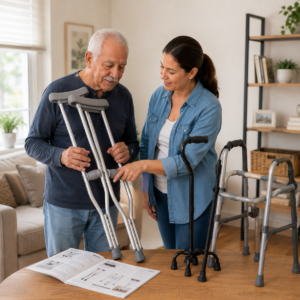
The FDA identifies home-device issues such as space, power, pets, clutter, slippery surfaces, and poor lighting. Crutch users also need both hands available, so carrying food, laundry, or a pet leash requires a separate plan.
Stairs deserve specific professional training or an accessible alternative. Do not infer a stair sequence from a general article when weight-bearing orders, rails, strength, and injury location differ.
Selection checklist
- Confirm diagnosis-related precautions and the current weight-bearing order.
- Assess hands, arms, shoulders, balance, vision, cognition, and endurance.
- Compare axillary, forearm, platform, hands-free, knee scooter, and walker options.
- Fit the exact pair and inspect technique with ordinary footwear.
- Test home routes, bathrooms, doors, stairs, vehicles, and outdoor surfaces.
- Verify capacity, tips, cuffs, attachments, parts, instructions, warranty, and return terms.
- Keep technique queries and local shopping intents in separate child assets.
- Plan daily inspection, a fitted backup, and reassessment.
Eight decisions that matter more than marketing
Crutch selection should translate a diagnosis and weight-bearing order into observable demands on hands, arms, shoulders, balance, and attention. Review those demands with the user and a rehabilitation professional when the need is new, long term, painful, or changing. Measurements matter only when they improve fit and safe movement.
Crutches And Specialty Mobility Aids: Weight-bearing order
Decision question: What loading has the treating clinician prescribed for the affected leg?
Non-weight-bearing, touch-down, partial, and tolerated loading are not interchangeable. The device and gait pattern must support the current order.
Practical check: Keep written instructions and practice with a therapist using the exact crutches and footwear.
Pause and reassess when: The order is unclear, pain or swelling changes, or the user cannot maintain the prescribed loading.
Upper-body capacity
Decision question: Can the hands, wrists, elbows, shoulders, and trunk support the required movement?
Crutches transfer substantial demand to the upper body. Arthritis, weakness, limited range, numbness, or cardiopulmonary limits can change the safest category.
Practical check: Observe repeated steps, turns, transfers, and fatigue rather than one static hold.
Pause and reassess when: Hands become numb, shoulders rise, wrists collapse, pain increases, or control deteriorates.
Balance and coordination
Decision question: Can the user sequence two aids and the affected leg while looking ahead?
Crutches generally demand more balance and coordination than a walker. Cognitive load increases on stairs, crowds, and uneven surfaces.
Practical check: Have a qualified professional assess starts, stops, turns, distractions, and recovery from small errors.
Pause and reassess when: The user crosses tips, looks down continuously, forgets the pattern, or needs another person to hold the torso.
Axillary or forearm fit
Decision question: Do length, handgrips, cuffs, elbow position, and tip placement fit the user?
Poor fit can reduce control and increase nerve, skin, joint, and fall risk. Clothing and footwear affect real use.
Practical check: Fit both sides in ordinary shoes and inspect posture, underarm clearance, cuff release, and hand pressure.
Pause and reassess when: Weight rests in the armpits, cuffs trap the arms, adjustment buttons are unequal, or the user cannot release safely.
Platform support
Decision question: Does the user need forearm loading because grip or wrist function limits ordinary handles?
A platform attachment changes leverage, width, alignment, and transfers. “Best platform crutches” depends on the impairment and exact configuration.
Practical check: Verify platform angle, strap, padding, compatibility, capacity, fasteners, and door clearance.
Pause and reassess when: The forearm slides, straps impair release, the attachment rotates, or posture becomes asymmetric.
Hands-free alternatives
Decision question: Can the person safely use a knee-platform or wearable device in the intended setting?
Hands-free designs can free the arms but require knee tolerance, balance, strength, and strict injury-location limits. Stairs and wet surfaces add risk.
Practical check: Trial with professional guidance and read the exact product contraindications and setup instructions.
Pause and reassess when: The knee cannot flex, the injury is incompatible, balance is insufficient, or emergency removal is difficult.
Home and community
Decision question: Can the aid manage stairs, doors, bathrooms, weather, carrying, and seating?
Both hands may be occupied. Loose rugs, wet floors, narrow routes, and the need to carry objects can defeat safe technique.
Practical check: Walk every essential route and plan hands-free carrying, rest, rail use, and accessible alternatives.
Pause and reassess when: The person must hop unsupported, carry heavy items, use unsafe stairs, or abandon the aid in an essential room.
Duration and progression
Decision question: Is the need temporary, long term, or changing through rehabilitation?
Long-term use raises the importance of energy cost, cuffs, hand comfort, durable parts, and follow-up. Recovery may require repeated adjustment.
Practical check: Schedule reassessment when weight-bearing status, strength, swelling, braces, or footwear changes.
Pause and reassess when: Old settings persist after the care plan changes or temporary equipment becomes permanent without review.
Ownership, service, and disruption planning
Crutches need a maintenance routine that follows them indoors, outdoors, and into vehicles. Inspect tips, cuffs, pads, grips, fasteners, and adjustment holes; replace worn pairs together when instructed; and keep a correctly fitted alternative available. A specialty attachment is a poor choice when replacement parts or fitting support cannot be identified.
Crutches And Specialty Mobility Aids: Daily inspection
Check tips, shafts, adjustment buttons, collars, handgrips, cuffs, platforms, straps, fasteners, and unusual movement.
Maintenance point: Replace worn compatible tips and remove damaged crutches from service.
Backup point: Keep a fitted backup or alternative mobility plan; do not borrow an unadjusted pair.
Home hazards
Keep floors dry, routes bright, rugs and cords secured, and pets away from the crutch path.
Maintenance point: Inspect tips after outdoor use and clean only as directed.
Backup point: Use another route or obtain help when weather, clutter, or stairs exceed safe control.
Carrying and storage
Use an approved backpack or hands-free method that does not alter balance; store crutches where they cannot fall into the path.
Maintenance point: Check storage heat, moisture, folding joints, and vehicle impact damage.
Backup point: Keep a phone accessible and plan what happens if a crutch falls out of reach.
Travel and transport
Label the aids, photograph settings, protect detachable parts, and inspect after handling.
Maintenance point: Reconfirm equal adjustments, tips, cuffs, and attachments after flights or vehicle loading.
Backup point: Arrange airport or venue assistance rather than exceeding endurance or surface limits.
Follow-up and service
Keep the model, size, manual, capacity, supplier, replacement parts, and clinician’s plan.
Maintenance point: Do not drill shafts, mix unmatched pairs, or install unapproved platforms or tips.
Backup point: Reassess promptly after a fall, new pain, skin injury, or any change in weight-bearing status.
Real-world trial scenarios
A useful crutch trial includes standing, starting, stopping, turning, reaching a chair, entering the bathroom, managing doors, and completing the distance that occurs on an ordinary day. Observe pain and fatigue rather than judging only the first few steps. The trial must remain within the prescribed weight-bearing plan and professional instruction.
Sit-to-stand setup
Set up the trial: Begin from the chair, bed, toilet, or vehicle seat normally used and follow the clinician’s transfer instructions. A meaningful trial uses the person’s ordinary footwear, usual assistive devices, realistic timing, and the exact equipment configuration being considered.
Observe: Observe whether crutches are reachable, adjusted equally, controlled after standing, and kept from falling into the route. Watch the person and caregiver throughout the complete task rather than judging the equipment from a single successful moment.
Compare: Compare chair arms, seat height, device category, and the need for supervision without changing the prescribed sequence. Record objective observations, settings, dimensions, assistance, and any reminders so alternatives can be compared without relying on memory.
Boundary: Stop when the person pulls on unstable equipment, loses balance before the crutches are placed, or needs unplanned lifting. Stop the trial if safety depends on catching, lifting, uncontrolled movement, ignored instructions, or a workaround the manufacturer or care plan does not permit.
Level indoor walking
Set up the trial: Use a clear hallway with ordinary footwear and the current weight-bearing order. A meaningful trial uses the person’s ordinary footwear, usual assistive devices, realistic timing, and the exact equipment configuration being considered.
Observe: Watch hand loading, axillary clearance or cuff fit, elbow position, tip placement, step consistency, gaze, turns, and fatigue. Watch the person and caregiver throughout the complete task rather than judging the equipment from a single successful moment.
Compare: Compare axillary, forearm, platform, walker, or other options with a therapist rather than choosing by appearance. Record objective observations, settings, dimensions, assistance, and any reminders so alternatives can be compared without relying on memory.
Boundary: Do not continue if weight-bearing restrictions are violated, tips cross, pain rises, or another person must hold the torso. Stop the trial if safety depends on catching, lifting, uncontrolled movement, ignored instructions, or a workaround the manufacturer or care plan does not permit.
Bathroom and narrow doorway
Set up the trial: Map the route, door swing, floor moisture, toilet approach, crutch storage, clothing tasks, and return. A meaningful trial uses the person’s ordinary footwear, usual assistive devices, realistic timing, and the exact equipment configuration being considered.
Observe: Observe whether both aids fit, whether tips land fully, and whether the person takes unsupported hops or grabs fixtures. Watch the person and caregiver throughout the complete task rather than judging the equipment from a single successful moment.
Compare: Compare device width, one-sided alternatives only if prescribed, grab supports, and environmental changes. Record objective observations, settings, dimensions, assistance, and any reminders so alternatives can be compared without relying on memory.
Boundary: Towel bars, moving doors, wet floors, and improvised furniture support are not acceptable substitutes for a safe plan. Stop the trial if safety depends on catching, lifting, uncontrolled movement, ignored instructions, or a workaround the manufacturer or care plan does not permit.
Stairs boundary
Set up the trial: Have a therapist assess rails, tread depth, landing, weight-bearing order, strength, balance, and available assistance. A meaningful trial uses the person’s ordinary footwear, usual assistive devices, realistic timing, and the exact equipment configuration being considered.
Observe: Observe only within trained practice; confirm where each crutch goes, how it is carried with a rail, and how fatigue is handled. Watch the person and caregiver throughout the complete task rather than judging the equipment from a single successful moment.
Compare: Compare an accessible route, temporary relocation, seated alternative, or assistance before making stairs routine. Record objective observations, settings, dimensions, assistance, and any reminders so alternatives can be compared without relying on memory.
Boundary: Do not learn stairs from this Hub, attempt them alone before training, or use platform or hands-free devices contrary to instructions. Stop the trial if safety depends on catching, lifting, uncontrolled movement, ignored instructions, or a workaround the manufacturer or care plan does not permit.
this topic: Outdoor surface
Set up the trial: Choose a safe sample of sidewalk, curb cut, slope, and weather conditions that reflect normal travel. A meaningful trial uses the person’s ordinary footwear, usual assistive devices, realistic timing, and the exact equipment configuration being considered.
Observe: Watch tip grip, placement, vibration, pace, gaze, hand fatigue, and recovery from a small surface change. Watch the person and caregiver throughout the complete task rather than judging the equipment from a single successful moment.
Compare: Compare tip design, footwear, route, rest, and another mobility aid for longer distances. Record objective observations, settings, dimensions, assistance, and any reminders so alternatives can be compared without relying on memory.
Boundary: Ice, wet leaves, gravel, grass, steep slopes, and poor lighting may require another route or assistance. Stop the trial if safety depends on catching, lifting, uncontrolled movement, ignored instructions, or a workaround the manufacturer or care plan does not permit.
Carrying and daily tasks
Set up the trial: Identify how the person will carry a phone, medication, food, laundry, keys, and other essentials while hands are occupied. A meaningful trial uses the person’s ordinary footwear, usual assistive devices, realistic timing, and the exact equipment configuration being considered.
Observe: Observe whether bags swing, alter balance, catch cuffs, block tips, or encourage unsupported steps. Watch the person and caregiver throughout the complete task rather than judging the equipment from a single successful moment.
Compare: Compare an approved backpack, caregiver help, task relocation, delivery, or another device with storage. Record objective observations, settings, dimensions, assistance, and any reminders so alternatives can be compared without relying on memory.
Boundary: Do not hang heavy loads from crutches, carry hot liquids, or wedge an aid under the arm while walking. Stop the trial if safety depends on catching, lifting, uncontrolled movement, ignored instructions, or a workaround the manufacturer or care plan does not permit.
Hands-free or knee-supported aid
Set up the trial: Use only after confirming injury location, knee motion, balance, strength, cognition, size, and product restrictions. A meaningful trial uses the person’s ordinary footwear, usual assistive devices, realistic timing, and the exact equipment configuration being considered.
Observe: Watch kneeling comfort, straps, alignment, standing, turning, stopping, stairs, emergency removal, and fatigue. Watch the person and caregiver throughout the complete task rather than judging the equipment from a single successful moment.
Compare: Compare the hands-free option with crutches, a knee scooter, walker, or wheelchair for each environment. Record objective observations, settings, dimensions, assistance, and any reminders so alternatives can be compared without relying on memory.
Boundary: Stop for knee pain, pressure, numbness, instability, incompatible braces or wounds, or inability to dismount safely. Stop the trial if safety depends on catching, lifting, uncontrolled movement, ignored instructions, or a workaround the manufacturer or care plan does not permit.
Long-term endurance
Set up the trial: Repeat the intended community routine long enough to reveal realistic upper-body and cardiopulmonary demand. A meaningful trial uses the person’s ordinary footwear, usual assistive devices, realistic timing, and the exact equipment configuration being considered.
Observe: Observe palms, cuffs, wrists, elbows, shoulders, posture, breathing, pace, rest, and skin. Watch the person and caregiver throughout the complete task rather than judging the equipment from a single successful moment.
Compare: Compare weight, geometry, cuff style, grips, tips, durability, and wheelchair or walker support for longer distances. Record objective observations, settings, dimensions, assistance, and any reminders so alternatives can be compared without relying on memory.
Boundary: Do not normalize numbness, skin damage, progressive shoulder pain, severe fatigue, or repeated falls. Stop the trial if safety depends on catching, lifting, uncontrolled movement, ignored instructions, or a workaround the manufacturer or care plan does not permit.
Questions for a supplier, retailer, or clinician
Get written specifications for the exact crutch size, cuff or platform, tip, adjustment range, user capacity, replacement parts, and return conditions. Keep the model beside the answer because an attachment advertised for a product family may not fit every shaft, handle, or revision.
- What exact crutch type and size range is this model designed for?
- What user capacity applies to the complete pair and any platform attachment?
- How are overall length, handgrip height, cuff position, platform angle, and tip size adjusted?
- Are both crutches a matched pair with identical components and settings?
- Which tips, grips, cuffs, straps, pads, fasteners, and platform parts are approved replacements?
- Is a platform attachment approved for the exact crutch and configuration?
- What injury locations, weight-bearing plans, and user abilities are required for a hands-free product?
- Can the exact device be fitted and trialed by a qualified professional?
- What return restrictions begin after fitting or outdoor use?
- Who performs structural repairs and checks recalls or safety notices?
- What warranty covers shafts, adjustments, cuffs, platforms, and labor?
- What fitted backup is available during recovery, travel, or repair?
Terms such as ergonomic, shock absorbing, hands free, all terrain, or professional grade need measurable support. Compare materials, adjustment limits, tip design, cuff release, declared capacity, and replacement availability for the exact pair. Popularity and star ratings do not establish safe fit or an appropriate gait pattern.
Common selection and use mistakes
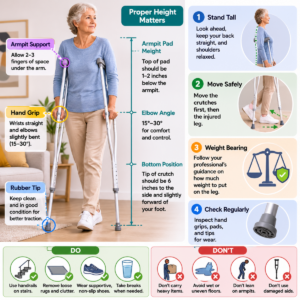
A crutch choice can look successful because it restores movement immediately while quietly increasing wrist pressure, shoulder effort, instability, or fatigue. Treat pain, repeated tip slips, poor posture, and avoidance of necessary routes as evidence that fit, technique, or the device category needs reassessment.
Resting on the armpits
Underarm crutches are sometimes treated like supports for hanging body weight, which can create pressure, poor control, and injury.
Better approach: Fit for clearance and transmit support through the hands according to professional instruction. Document the reason for the decision so another caregiver, editor, or clinician can understand what was tested and what remains unresolved.
Copying another person’s settings
Two people of similar height can need different handgrip, cuff, length, footwear, and weight-bearing configurations.
Better approach: Fit the exact user and matched pair, then recheck after health or footwear changes. Document the reason for the decision so another caregiver, editor, or clinician can understand what was tested and what remains unresolved.
Choosing crutches when a walker is safer
Crutches may be selected because they look less restrictive even when balance, strength, or coordination is insufficient.
Better approach: Compare categories with a clinician and choose the least restrictive aid that still provides adequate control. Document the reason for the decision so another caregiver, editor, or clinician can understand what was tested and what remains unresolved.
Crutches And Specialty Mobility Aids: Adding an unapproved platform
A platform changes leverage, width, alignment, capacity, release, and the way loads enter the crutch.
Better approach: Use manufacturer-approved components fitted by a qualified professional and inspect every fastener. Document the reason for the decision so another caregiver, editor, or clinician can understand what was tested and what remains unresolved.
Assuming hands-free means easier
A knee-supported aid frees the hands but may demand more balance, knee tolerance, coordination, and careful surface selection.
Better approach: Assess the person, injury, environment, and emergency dismount before considering convenience. Document the reason for the decision so another caregiver, editor, or clinician can understand what was tested and what remains unresolved.
Ignoring worn tips or loose buttons
Small components can gradually wear until the crutch slips, changes length, or separates under load.
Better approach: Inspect daily, use compatible parts, and remove the device from service before failure. Document the reason for the decision so another caregiver, editor, or clinician can understand what was tested and what remains unresolved.
Delivery, follow-up, and reassessment
At delivery, confirm that both crutches match, all adjustment buttons lock, tips sit flat, cuffs or platforms are correct, and no tube or fastener is damaged. Complete fitting and technique training before routine use, preserve the return deadline, and reassess after healing, strength changes, new pain, or a change in footwear and environment.
Initial fitting
At first use: Verify matched pair, length, grips, cuffs or platforms, tips, capacity, footwear, and the prescribed weight-bearing plan.
Over time: Keep a record of settings but allow qualified adjustment as swelling, braces, strength, and status change.
Escalate when: The user cannot maintain technique, develops pain or numbness, or violates the loading order.
First-week review
At first use: Record hand and skin comfort, fatigue, falls, near-falls, difficult routes, carrying problems, and reminders.
Over time: Address patterns before they become habits and request retraining for turns, transfers, or environment changes.
Escalate when: The person avoids the device, hops unsupported, uses furniture, or experiences repeated instability.
Tip and hardware inspection
At first use: Check tips before use and shafts, buttons, collars, grips, cuffs, straps, platforms, and fasteners on schedule.
Over time: Replace only with compatible parts and keep both sides consistently maintained.
Escalate when: A tip hardens or splits, a shaft bends, an adjustment does not fully engage, or an attachment moves.
Weight-bearing progression
At first use: Update device fit and training each time the clinician changes loading or precautions.
Over time: Do not advance because pain improves or because another patient progressed faster.
Escalate when: Instructions conflict, swelling or pain worsens, or the user cannot perform the new pattern safely.
Long-term review
At first use: Assess shoulders, elbows, wrists, hands, skin, endurance, community access, travel, and participation.
Over time: Compare whether another mobility aid or combination now better supports the person’s goals.
Escalate when: Overuse pain, nerve symptoms, falls, inaccessible routes, or progressive conditions change the decision.
Crutches And Specialty Mobility Aids: Emergency and backup planning
Crutch users need a plan for falls, a broken aid, sudden pain, weather, fire, and evacuation. Keep a communication method accessible and identify who can bring a fitted backup or provide trained assistance. The person should not crawl, hop long distances, or use damaged equipment to reach help.
Because both hands may be occupied, plan how the user will carry a phone or alert control without altering grip. Store adjustment notes and replacement-part details with the care plan. Spare or borrowed crutches must be fitted and inspected; a nearby pair at the wrong height is not a safe emergency solution.
After a fall, hard strike, bent tube, cracked cuff, loose platform, missing fastener, or tip failure, stop using the affected crutch until it has been evaluated or replaced. Attend to possible injury before equipment troubleshooting. Avoid tape, mismatched halves, improvised tips, and attachments not approved for the exact device.
Documented plan for crutches and specialty mobility aids
Write down the current weight-bearing order, crutch category, matched-pair settings, footwear, tips, cuffs or platforms, difficult routes, training provider, inspection routine, and fitted backup. A documented plan reduces accidental changes when different relatives or caregivers help.
Crutches and specialty mobility aids often change during recovery. The plan should distinguish temporary precautions from long-term mobility goals and should explain why axillary, forearm, platform, hands-free, walker, scooter, or wheelchair options were accepted or rejected for each activity.
- Attach the clinician’s current weight-bearing and movement precautions.
- Record exact length, handgrip, cuff, platform, strap, tip, and footwear settings.
- List the transfers, level routes, stairs, outdoor surfaces, carrying tasks, and community destinations assessed.
- Name the person who provided fitting and technique training.
- Record pain, skin, fatigue, balance, and upper-body observations from realistic trials.
- List approved replacement parts, inspection frequency, supplier, warranty, and service contacts.
- Keep model reviews and technique-specific queries assigned to their own validated child guides.
- Define the fitted backup and the health or environment changes that trigger reassessment.
Record what was rejected
Record why a device failed: insufficient balance, upper-body demand, incompatible injury, poor fit, unsafe stairs, inaccessible bathroom, unapproved attachment, unavailable parts, or misleading marketing. This is more useful than a simple star rating and prevents the same unsuitable setup from returning.
Set the next review date
Schedule review whenever the weight-bearing order changes, swelling or a brace alters fit, tips or hardware are replaced, pain or numbness appears, a fall occurs, or temporary crutches become long-term equipment. Progress should be confirmed by the treating team rather than assumed from elapsed time. Also review the plan before travel, a return to work, a home move, or a new caregiver. These changes introduce unfamiliar surfaces, carrying demands, schedules, and assistance that a successful clinic trial may not have tested. Record the updated decision and effective date.
What this Hub intentionally does not answer
This Hub owns the broad comparison of crutches and specialty mobility aids. It explains categories, fit, weight-bearing context, upper-body demands, environment, trial, maintenance, and follow-up. It deliberately does not teach a complete gait or stair sequence.
Forearm and platform technique, local shopping, hands-free model reviews, and condition-specific recommendations require distinct child assets and fresh validation. Approved model-style phrases appear only as terminology, not endorsements, affiliate assumptions, or instructions to purchase.
How future child guides should connect
A child guide should solve one defined question and return the reader to this Hub for category context. Its headings and examples must not reproduce the entire comparison, and any technique needs qualified human YMYL review before WordPress publication. The editorial brief should state the applicable device category, intended reader, weight-bearing assumptions, environment, professional-training boundary, sources, and exact stop conditions. Product claims need current manufacturer evidence, while model availability, warranty, image rights, and monetization must be checked independently. If a keyword could refer to a brand, attachment, walking technique, local retailer, or general category, the SERP and user intent must be resolved before the URL is assigned. An unresolved ambiguity blocks drafting rather than being hidden in a broad paragraph.
The cards below define the future crutch resource center, not completed destinations. A card becomes clickable only after its specific question has passed SEO separation, safety review, originality testing, and page-level QA.

Frequently asked questions
Are forearm crutches better than underarm crutches?
Neither is universally better. Forearm crutches may suit some long-term users, while axillary crutches are common for temporary recovery. Strength, balance, fit, diagnosis, and training determine suitability.
Should body weight rest on the armpits?
No. General crutch guidance places load through the hands rather than the armpits. Incorrect axillary pressure can cause pain or injury.
Can platform attachments fit any crutch?
No. Compatibility, alignment, capacity, fasteners, and manufacturer approval must be verified for the exact device.
Are hands-free crutches suitable for every lower-leg injury?
No. They require knee flexion, balance, strength, coordination, and a compatible injury and environment. Clinical and manufacturer restrictions matter.
When should crutches be replaced or reassessed?
After a fall or impact, worn tips, loose buttons, bent shafts, cuff or platform damage, new pain, a changed weight-bearing order, or declining control.
Sources used for this guide
The references below were used to verify general crutch fitting, weight-bearing cautions, inspection, home conditions, and mobility-aid distinctions. They support this educational overview but cannot determine the correct device or walking method for an individual reader.
- Using crutches — MedlinePlus, U.S. National Library of Medicine.
- Product Classification: Crutch — U.S. Food and Drug Administration.
- Unique Considerations in the Home — U.S. Food and Drug Administration.
- Mobility Aids — MedlinePlus, U.S. National Library of Medicine.
Build a safer mobility plan
Return to the Mobility Resource Center when a walker, rollator, wheelchair, or other support may be more appropriate than crutches. The planned hands-free and forearm guides will be linked here only after their independent reviews are complete.