
Safety note: A GPS wristband is a location-monitoring and communication tool, not a restraint or a guarantee of rescue. Never use it to confine, secretly control, or unnecessarily restrict an older adult. GPS information can be delayed or approximate, signals may be unavailable indoors, buildings can interfere with reception, and tracking may stop when a device is removed or its battery runs out. If an older adult is injured, missing, or in immediate danger, follow the established emergency response plan and contact local emergency services rather than waiting for another tracker update.
Quick Answer: When Does a Wristband GPS Tracker for Elderly Care Make Sense?
A Wristband GPS Tracker for Elderly care arrangement may be appropriate when an older adult has a specific location-related safety concern, agrees to wear a wrist device, can keep it attached during relevant activities, and has a caregiver or response team ready to act on alerts. It may help someone who walks around the neighborhood, attends appointments independently, travels between home and a care facility, or occasionally becomes confused about familiar routes. It can also help family members living far away check a last known location when an expected arrival or check-in is missed.
Start with the situation you need to address, not the product label. Do you need a notification when someone leaves home, an alert when they cross a designated safe-area boundary, the ability to call them through the wristband, a last known outdoor location, or additional information when a scheduled check-in is missed? A Wristband GPS Tracker for Elderly users may address some of these needs but may be unsuitable for others. A door sensor can provide an earlier warning when someone leaves, a smartphone may offer better communication, and a supervised care facility may have an approved resident-safety system. Choose a wristband to fill a clearly identified gap rather than relying on it as the entire safety plan.
Next, evaluate the complete alert-response process. The device must detect or calculate a location, transmit the information through a cellular or paired connection, display it through an app or service, notify an authorized person, and give that person enough information to decide what to do. If any step fails, the displayed location may create false reassurance. The National Institute on Aging identifies GPS as one possible component of a broader wandering-safety plan that can also include identification, recent photographs, local awareness, and home-safety measures. A layered approach is more dependable than assuming a wearable can prevent wandering on its own.
When a GPS Tracker for an Older Adult May Support Independence
GPS tracking may support independence when an older adult wants to continue meaningful activities with an agreed-upon safety arrangement. They might walk to a nearby store, take a familiar bus, visit a friend, attend a religious service, or spend time in a garden. The purpose of a Wristband GPS Tracker for Elderly users should not be to monitor every movement simply because a family member feels anxious. Instead, the goal is to make a specific activity easier to support while preserving dignity, personal choice, and a clear way to request help.
When a Wrist-Worn Tracker Is the Wrong Form Factor
A wristband may be unsuitable if the older adult dislikes wearing anything on the wrist, removes it for dressing or sleeping, has fragile skin, struggles with the clasp, or finds the alerts confusing. A pendant, clip-on tracker, smartphone, pocket device, door sensor, scheduled check-in, or approved facility system may be a better fit.
Comfort and usability matter as much as technical specifications. If an older adult repeatedly removes a Wristband GPS Tracker for Elderly users are expected to wear, or leaves it in a drawer because it is uncomfortable, the device cannot provide a dependable personal location layer. Investigate the reason and consider another solution rather than forcing continued use.
How a Family Should Define Success Before Buying a GPS Wristband
Write down one clear objective before comparing products. For example: “We want to know when Dad leaves his usual walking area and have a reliable way to call him,” or, “We need a backup location tool when Mom misses her expected return time.”
Then identify who will respond and what each person should do. A practical plan might specify that a daughter checks daytime alerts, a nearby contact checks a familiar route when appropriate, and emergency services are contacted if the person may be in danger. Define the limits of the system, including who is responsible when the primary caregiver is unavailable.
This simple exercise helps families evaluate a Wristband GPS Tracker for Elderly care plan based on real needs rather than attractive features they may never use or maintain. It also establishes measurable expectations for battery life, location updates, communication, privacy, and emergency response.
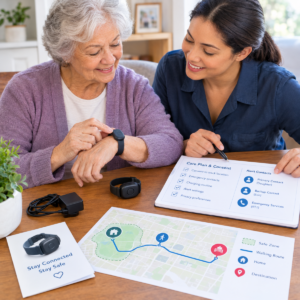
What a Wristband GPS Tracker for Elderly Users Can and Cannot Do
The term “GPS tracker” covers several different technologies. Some wristbands calculate a location and transmit it through a cellular network. Others depend on a nearby smartphone. Certain models combine location tracking with a call button, virtual safe-area alerts, a microphone, movement data, or a companion app. Other devices record activity locally without providing independent, real-time location sharing.
Before relying on a feature, ask how the exact device obtains its location, transmits information, displays updates, and stores data. A Wristband GPS Tracker for Elderly care solution should be evaluated according to its verified capabilities, connectivity requirements, privacy settings, and response arrangements—not simply the features mentioned in its product description.
Location Reporting from a Personal GPS Tracker for an Older Adult
A personal GPS tracker may display a current or recent location, but the meaning of “current” depends on the update interval, satellite reception, cellular coverage, battery level, app connection, and device settings. A location pin can help caregivers decide where to begin checking, but it does not prove that the person is standing at that exact point, that the wristband is still being worn, or that the person is safe.
GPS.gov explains that factors such as signal blockage, atmospheric conditions, satellite geometry, and receiver design can affect positioning accuracy. Indoor and underground environments present additional limitations. Caregivers should therefore treat a location displayed by a Wristband GPS Tracker for Elderly users as useful information that requires context, not as unquestionable proof of a person’s whereabouts.
Safe-Area Alerts and Route Changes in a Senior GPS Wristband
A safe-area alert, also called a geofence notification, can inform a caregiver when a tracked device crosses a virtual boundary. The boundary should reflect the older adult’s actual routine, such as the home, a familiar walking route, a neighborhood, a campus, or a designated facility area.
A boundary that is too small may trigger repeated notifications when the person walks along a nearby sidewalk or spends time in the yard. One that is too large may provide little advance notice when a person moves beyond a familiar area. When evaluating a Wristband GPS Tracker for Elderly care system, ask whether the device, paired phone, or remote service generates the alert and how the system behaves when location updates are delayed or connectivity is lost.
Two-Way Communication on an Elderly GPS Tracker
Some wristbands include a call button, speaker, microphone, or text-to-speech function. These capabilities can sometimes be more useful than a map because they allow an older adult to answer a simple question, explain an unexpected detour, or request assistance.
Test whether the person can hear calls in traffic, remember how to answer, recognize the controls, and distinguish a caregiver’s call from an unfamiliar caller. Confirm whether the feature works independently or requires a paired smartphone or subscription.
A communication feature on a Wristband GPS Tracker for Elderly users should never be assumed to provide professional emergency monitoring. Verify whether the service actually includes staffed monitoring, its operating hours, the situations it covers, and the response procedures it follows.
What a GPS Wristband Cannot Confirm
A GPS wristband cannot reliably establish that an older adult has not fallen, is medically stable, has not removed the device, is alone, or can reach a charger. Tracking may also be unreliable in basements, elevators, large buildings, wooded areas, and places with weak cellular coverage.
The displayed information may represent the last successful location rather than the person’s present position. A Wristband GPS Tracker for Elderly care plan should clearly identify these limitations and explain what caregivers must do when information is missing, delayed, or inconsistent with the expected route.
Choose the Wristband Fit Before Comparing GPS Tracker Features
Even an advanced tracking feature has little practical value if the wristband is uncomfortable, difficult to charge, or unacceptable to the person expected to wear it. Treat comfort and everyday usability as essential purchasing criteria.
Whenever possible, involve the older adult in choosing the wristband’s appearance, visibility, fastening method, notification style, and charging routine. A Wristband GPS Tracker for Elderly users can accept and operate comfortably is more likely to become a consistent part of an agreed care routine than a device selected without their participation.
Wrist Size, Clasp, and Skin Comfort for an Elderly GPS Tracker
Measure the wrist according to the manufacturer’s instructions. The band should allow normal movement without sliding easily over the hand or creating excessive pressure. Check whether the clasp can be operated by the wearer, a caregiver, or both.
Inspect the skin after the wristband has been worn during warm weather, exercise, sleep, and handwashing. Redness, pressure marks, trapped moisture, or repeated snagging are reasons to pause and reassess the fit. Never overlook discomfort simply to maintain tracking coverage.
Before choosing a Wristband GPS Tracker for Elderly care arrangement, confirm that the material, clasp, and dimensions suit the person’s skin sensitivity, dexterity, and daily activities.
Dexterity and Vision When Using a GPS Tracker Watch for an Older Adult
Small buttons can be difficult to operate for people with arthritis, tremors, neuropathy, or reduced vision. Touchscreens may also become harder to use with wet hands, gloves, or limited finger control.
Test the actions the older adult actually needs to perform: pressing the help button, answering a call, checking the battery, and positioning the device on its charger. Prefer clear contrast, simple controls, and straightforward verbal instructions.
If the person cannot reliably operate the Wristband GPS Tracker for Elderly device, caregivers should not assume that its communication functions will work during an emergency. Choose a form factor and response arrangement that reflect the person’s actual abilities.
Hearing, Speech, and Notification Choices on a Wristband GPS Tracker
Test sound, vibration, and visual indicators in the environments where the person will wear the device. A quiet vibration may go unnoticed, while a loud tone may cause embarrassment or distress. Two-way speech may be difficult to understand in wind, traffic, or a busy dining room.
Determine whether the person needs a caregiver call, text notification, audible signal, vibration, or facility alert. Then confirm that the intended recipient can understand and respond to each notification.
The purpose of a Wristband GPS Tracker for Elderly care system is to support a usable safety process. An alert that the wearer cannot recognize or the caregiver cannot act upon provides limited practical value.
Charging Habits for GPS Tracker Watches for Older Adults
Charging must be part of the everyday care routine, not an afterthought. Observe when the older adult normally removes the wristband for bathing, sleeping, or dressing. Use those periods for charging only when doing so does not create an important gap in the agreed safety arrangement.
Label the charger, position it somewhere convenient and away from walking paths, and assign responsibility for checking battery status. Verify that the device resumes tracking after charging and that its low-battery notification arrives early enough for someone to respond.
For a Wristband GPS Tracker for Elderly users, dependable charging habits are just as important as location accuracy. A discharged tracker cannot provide the expected updates or notifications.
Wristband Removal, Loss, and Transfer Between Caregivers
Plan for situations in which the wristband is removed, left in a bathroom, dropped in a vehicle, or accidentally worn by someone else. Some systems can detect removal or separation, while others simply stop reporting location.
Caregivers should know how to check the last update, recognize an offline status, and distinguish a removal notification from a connection failure. Maintain an alternative response method, such as a phone number, door alert, identification card, or scheduled check-in.
If the device is removed, investigate the reason and address any discomfort or usability problem. Never respond by tightening the band beyond a safe fit or using it as a restraint.
| Daily situation | Fit question | Technical question | Backup to plan |
|---|---|---|---|
| Short neighborhood walk | Will the person wear the band comfortably without irritation or embarrassment? | Does it update outdoors and deliver a boundary alert? | Recent photo, familiar route list, and reachable caregiver |
| Appointments and transport | Will the band remain on during clothing changes, transfers, and vehicle rides? | Does it reconnect after buildings, elevators, or signal gaps? | Appointment contact and expected arrival time |
| Memory-related confusion | Can the person tolerate the band and accept a call? | Can caregivers see the last known location and low-battery status? | Identification, likely destinations, and a local response plan |
| Independent living | Who checks fit, skin comfort, and charging? | Who receives alerts when the primary caregiver is asleep or away? | Named backup, phone check-in, and emergency instructions |
| Supervised care setting | Is the band approved and comfortable for the resident? | Can staff identify the wearer and incorporate alerts into their workflow? | Facility policy and documented shift handoff |
This comparison does not rank devices. It identifies the practical questions that determine whether a wristband can become part of a reliable daily routine. If comfort, connectivity, or response responsibilities remain unclear, resolve those issues before purchasing a Wristband GPS Tracker for Elderly care solution.
Match a Wristband GPS Tracker for Elderly Care to the Person’s Routine
Tracking requirements vary according to an older adult’s usual routes, memory, mobility, communication needs, and living arrangements. Rather than choosing a device based on age alone, describe the person’s actual day and identify where additional support may be useful.
Create a simple route plan showing where the person goes, when they usually travel, who might notice a problem, and what a caregiver should do if an expected arrival or check-in is missed. This information helps determine whether a Wristband GPS Tracker for Elderly users wear on the wrist is appropriate or whether another safety measure would address the concern more effectively.
Wristband GPS Tracking for an Active Older Adult
An active older adult may prefer a small, discreet wristband that supports independent walks and outings without making them feel constantly supervised. Ask for permission before enabling location sharing and explain who will be able to access the information.
Agree on whether location will be checked on request, shared during specific outings, or used to trigger an alert after a missed check-in. The arrangement should give the person a clear understanding of the information being shared and an opportunity to discuss or change the settings, subject to any applicable care or legal arrangements.
A Wristband GPS Tracker for Elderly care plan should support meaningful activities while respecting personal boundaries and the older adult’s preferences.
GPS Support for an Older Adult with Memory Changes
Memory changes can affect whether someone remembers to wear, charge, or answer a GPS wristband. Tracking may contribute to a broader wandering-safety plan, but it cannot explain why someone leaves home or prevent every unsafe route.
The Alzheimer’s Association recommends advance planning, maintaining a current photograph, identifying likely destinations, and responding promptly when someone goes missing. Combine these measures with identification, predictable routines, environmental safety measures, and a clearly assigned response team.
When considering a Wristband GPS Tracker for Elderly users with memory-related concerns, assess how the person responds to the device, whether they can tolerate it, and whether caregivers can act quickly when an alert occurs. Tracking should complement appropriate care and supervision rather than replace them.
Wristband GPS Tracking for Someone Who Lives Alone
Living alone raises an important practical question: who can reach the older adult if the tracker displays a concerning location or stops updating?
A family member in another city may be able to call but unable to visit. A neighbor may live nearby but be unavailable during working hours. A monitoring service may offer assistance under specific conditions and contractual terms.
Document the actual response chain, including time zones, overnight coverage, home-access arrangements, and emergency contacts. A location-sharing app without a reachable responder is an incomplete safety plan.
For people living alone, a Wristband GPS Tracker for Elderly care arrangement should identify both a primary responder and a backup who understands the limitations of the technology.
Wristband Use After a Fall or Mobility Change
A GPS wristband is not automatically a fall detector. Some products may offer separate movement-monitoring or fall-related features, but those functions must be independently verified and tested.
After a fall, surgery, new weakness, or a change in balance, consult an appropriate healthcare professional about whether the person needs a medical alert arrangement, mobility assessment, home modifications, or additional support. Do not treat location tracking as a clinical assessment or a substitute for appropriate medical care.
If evaluating a Wristband GPS Tracker for Elderly users after a mobility change, distinguish the need to know where someone is from the need to detect an emergency and summon help. These are different functions and may require different tools.
Wristband GPS Tracking in Assisted Living or Memory Care
Consult the facility before introducing a consumer wristband. Assisted-living and memory-care settings may have approved devices, resident privacy procedures, infection-control requirements, charging rules, and established alert-response workflows.
Confirm who receives each notification, how the wearer and location are identified, what staff must document, and how responsibility transfers between shifts. A family app cannot replace facility policy, and families should never assume that staff are monitoring a personal tracking account.
Before introducing a Wristband GPS Tracker for Elderly residents in a supervised setting, obtain the required approval and make sure the device fits the facility’s procedures and the resident’s individual care plan.
Wristband GPS Use During Travel and Family Visits
Travel changes the assumptions behind a location-sharing plan. The wristband may require compatible cellular service, sufficient battery power, correct time settings, an authorized caregiver account, and an available response contact at the destination.
Test the device at the airport, hotel, vehicle, and destination before relying on it. Carry appropriate identification and a recent photograph, and confirm whether the exact model supports the intended region or country. Do not assume that coverage is universal simply because a provider advertises broad service.
When traveling with a Wristband GPS Tracker for Elderly users, prepare a destination-specific response plan and confirm that someone can act on an alert if the usual caregiver is unavailable.
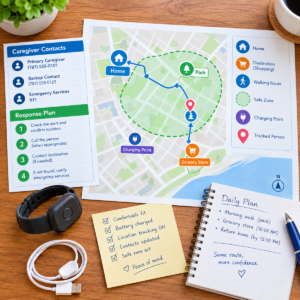
Official sources for wristband GPS tracker and elderly safety guidance
The following sources support the article’s general statements about GPS limits, wandering preparation, privacy, and location-sharing technology. They do not endorse a particular wristband, seller, subscription, or response service.
GPS.gov accuracy limits for a personal GPS tracker
GPS.gov: GPS Accuracy explains that received accuracy depends on factors such as satellite geometry, signal blockage, atmospheric conditions, and receiver design, and identifies indoor or underground use as a limitation. This supports the article’s advice to test real routes and interpret a map point carefully.
National Institute on Aging wandering guidance for older adults
National Institute on Aging: Wandering and Getting Lost supports preparation with identification, a recent photo or video, local awareness, home safeguards, and GPS as one possible aid. It does not recommend a particular wristband or guarantee that tracking prevents a person from becoming lost.
Alzheimer’s Association technology and wandering guidance
Alzheimer’s Association: Wandering and Dementia supports planning ahead, current photos, likely destinations, prompt action when a person is missing, and the limits of safeguards. Its Technology Safety for Older Adults page also describes GPS and location-sharing technology as possible layers for people who may wander.
FTC privacy guidance for GPS location-sharing apps
Federal Trade Commission: Mobile Health App Developers Best Practices supports considering data minimization, clear permission explanations, authentication, limited access, and security by design. The article applies those principles cautiously to location-sharing apps and does not claim that every wristband app is covered by the same legal framework.
Final wristband GPS tracker readiness check for elderly care
Before relying on a wristband GPS tracker, define the real event, involve the older adult, confirm the band fits comfortably, identify the connection path, test the actual route, record indoor and outdoor limitations, check battery and charging, decide who can see the location, assign a primary and backup responder, prepare a recent photo and identification, and document what happens after a missed update. Confirm whether a separate medical alert, door alarm, facility system, or human support is also needed.
The strongest setup is not the one with the longest feature list. It is the arrangement the person accepts, the family can maintain, the caregiver can interpret, and the response team can use without delay. A wristband can add useful awareness while preserving ordinary movement, but its limitations should remain visible in the care plan.