Safety note: This guide is educational and is not medical or emergency advice. For a life-threatening emergency, call 911 (or the local emergency number) immediately. After any fall with injury, head impact, severe pain, new weakness, chest pain, or inability to get up safely, seek urgent help. A device should complement—not replace—clinical fall-risk assessment and an emergency plan.

Quick answer: what a Life Alert Bracelet with Fall Detection can do after a fall
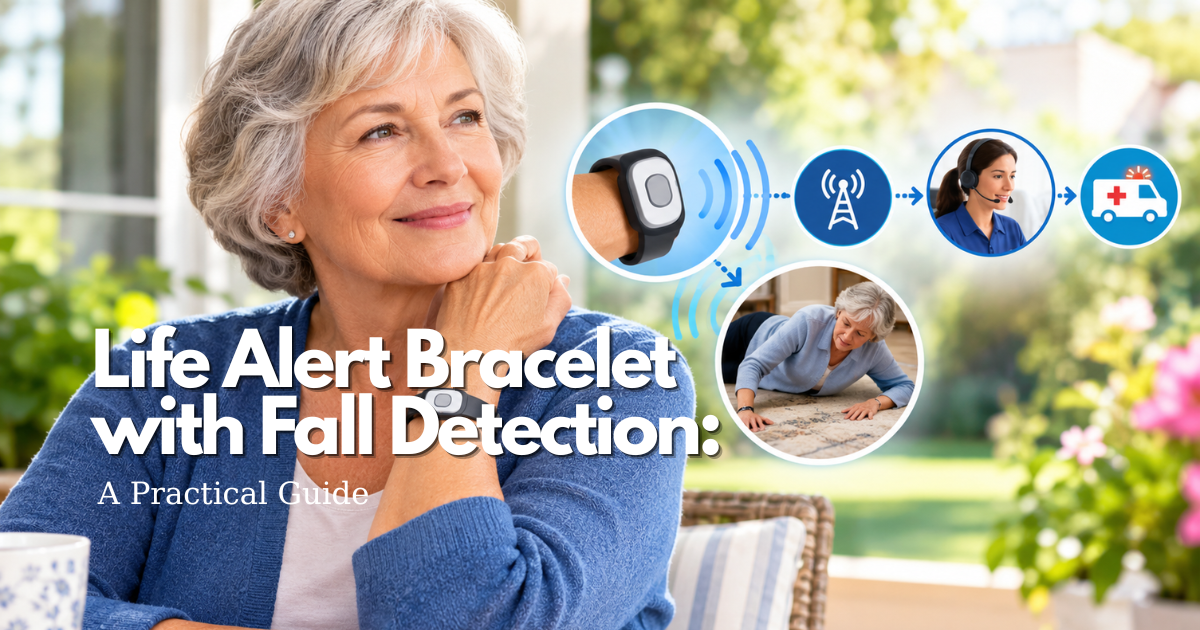
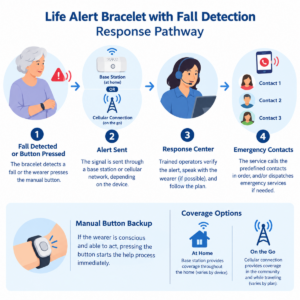
A Life Alert Bracelet with Fall Detection in this category usually offers two different routes to help. The first is a manual help button: when the wearer is conscious and able to act, pressing it starts the service’s defined response process. The second is automatic fall detection, available only on some devices or plans. Sensors and software look for a movement pattern that may indicate a fall, then the device may prompt the wearer, contact a monitoring center, or follow another model-specific workflow.
That distinction matters because neither route is universal. A manual button does nothing if the bracelet is not being worn, cannot reach its base or cellular network, has no charge, or cannot be pressed. Automatic fall detection can miss an event, misinterpret ordinary movement, or require the wearer to answer a prompt. Before anyone relies on a service, confirm the exact device, whether the fall-detection feature is included, how an alert is handled, and what the wearer should do if they can press the button.
Why the manual help button remains central to fall detection bracelets
When a person can press the button, that deliberate action is normally clearer than asking an algorithm to infer what happened. Practice with the hand the person could realistically use after a stumble or while seated on the floor. The practice is also a dignity check: if the button is painful to press, too small to find, or embarrassing enough that it is removed, a technically capable device will not produce a dependable routine.
Ask the service whether one press is enough, whether the wearer will hear a voice through the bracelet or a nearby base unit, and what happens if the wearer cannot speak. Write that sequence in everyday language. “Press, wait, say where you are, say what you need” is more useful in a stressful moment than a brochure stored in a drawer.
What automatic fall detection cannot promise for an older adult
Falls do not all look alike. A quick trip, a slow slide from a chair, a collapse onto a bed, or a fall cushioned by furniture can produce different motion signals. A device may also be on a charging dock, worn loosely, or located where its connection is weak. For that reason, no caregiver should treat automatic detection as a guarantee that every fall will be detected, classified correctly, and escalated at the right time.
Use the feature as a possible extra path to attention. If the wearer can press the manual button, they should do so. If a fall occurs and they cannot get up, cannot reach a phone, or cannot press the button, the automatic feature may help depending on the particular device and circumstances. That limited, realistic expectation supports better decisions than a marketing claim about “protection.”
How a Life Alert Bracelet with Fall Detection connects a button press to help
The label “Life Alert Bracelet with Fall Detection” describes a category, not one uniform service. Some systems work mainly at home with a wearable and a base station. Some use a cellular connection for home and community use. Some offer two-way voice on the wearable; others use a base station or a separate speaker. A smartwatch can have a different interface, charging pattern, and emergency-call workflow. The answer to “Will this call for help?” is found in the account terms and the exact model’s instructions, not in the category name.
During setup, map the full route: button or detected event, device prompt, network or base connection, monitoring center or emergency calling pathway, contact list, and responder. Identify who has authority to change contacts and who checks that the home address, apartment number, gate code, and mobility information are current. A response center cannot act on information the family never supplied or has allowed to become outdated.
In-home Life Alert Bracelet with Fall Detection coverage and the base station
For an in-home Life Alert Bracelet with Fall Detection system, an advertised range is only a starting point. Walls, floors, metal doors, a basement, a detached garage, and the placement of the base station can change real-world performance. Do not assume that a bracelet works in every room because it worked beside the installer. Test from the bathroom, beside the bed, the kitchen, the entrance, and any outdoor space the wearer uses.
During each test, listen for the connection, make sure the operator can hear the wearer, and confirm that the address appears correctly. If the household has a landline, ask whether it is required or optional. If the system uses cellular service, ask how the device signals a service problem. If it relies on household equipment, make a written plan for a power outage and for an internet or phone interruption.
Mobile Life Alert Bracelet with Fall Detection and location limits
A mobile Life Alert Bracelet with Fall Detection can make sense for someone who goes to the mailbox, garden, worship service, appointments, or errands. It can also create more routine demands: cellular coverage, battery charging, correct wear, and an understanding of what location information can and cannot show. A position estimate may be delayed, approximate, or difficult to use inside a large building. The wearer should still know to state a location whenever they can.
Test a mobile device at ordinary destinations rather than treating a first activation call as proof. Check the driveway, elevator, lobby, parking area, and the route between the home and car. Ask what occurs if the unit cannot get a location, leaves a service area, or is charging. A family should never describe a location feature as continuous surveillance or guaranteed rescue; it is an emergency-support feature with technical limits.
Choose a Life Alert Bracelet with Fall Detection around the wearer’s routine
The right question is not “Which bracelet has the longest feature list?” It is “Which response route will this person actually keep available?” Begin with the wearer’s day with the Life Alert Bracelet with Fall Detection: bathing, dressing, sleeping, walking outside, using a walker, forgetting to charge devices, hearing a speaker, and accepting help. Invite the wearer into the decision. A device that feels imposed, stigmatizing, itchy, or cumbersome often ends up on a table when it is most needed.
Consider health, mobility, vision, hearing, dexterity, cognition, and living arrangement without making assumptions. Someone with arthritis may need a larger button. Someone with hearing loss may need a service that does not depend solely on a soft voice prompt. Someone with memory changes may need a visible charging routine and a caregiver check. A person who lives with another adult may still need an alert route for a bathroom or yard, but the response plan can be different from the plan for a person who lives alone.
Bracelet fit, skin comfort, and the likelihood of daily wear
Try the Life Alert Bracelet with Fall Detection during an ordinary part of the day, not only for thirty seconds at a sales demonstration. Check whether the clasp can be opened and closed safely, whether the bracelet snags on clothing, whether the wearer can read or feel the button, and whether it stays secure while using a mobility aid. Ask about water instructions before wearing it in a shower; “water resistant” and “safe for full immersion” are not interchangeable claims.
Comfort is a safety factor. A too-tight band can irritate skin; a too-loose band may rotate or be removed. If the person dislikes a bracelet, explore a pendant, watch-style device, wall button, or a different communication plan. The goal with a Life Alert Bracelet with Fall Detection is not to win an argument about a form factor. The goal is to create an available, understood route to help.
Fall detection for seniors who live alone or spend time alone
Living alone changes the value of a Life Alert Bracelet with Fall Detection as a reliable way to call for help, but it does not reduce the need for prevention or human contact. Discuss regular check-ins, a charged phone within reach, key or entry arrangements, and who is permitted to receive an alert. If the wearer has a pet, locked building, gate, or unusual access instructions, record those details in the plan rather than expecting a responder to infer them.
Ask the person what they would do after a noninjury fall. Some people may need assistance getting up even when they do not want an ambulance. Others may want a relative called first. The service may or may not support those preferences, so reconcile the written plan with the provider’s actual workflow. The most respectful plan gives the wearer clear choices while recognizing that an unresponsive emergency requires a defined escalation path.
When a smartwatch is not the same as a medical alert bracelet
A smartwatch may offer emergency calling or fall detection, but it is not automatically equivalent to a Life Alert Bracelet with Fall Detection. It has its own setup requirements, touch-screen demands, charging cadence, account settings, and service limits. It should not be assumed to function like a monitored medical alert service. Before switching categories, compare the actual response workflow, the person’s ability to operate the interface, battery behavior, and whether a caregiver can maintain the settings.
This guide does not rank watches or services. A short trial with the wearer is more informative than a generic “best device” list. If the person cannot reliably charge a smartwatch or respond to its screen prompts, a simpler dedicated alert device may be more appropriate. If they already wear and manage a watch successfully, its familiar form may be an advantage—but the emergency setup still needs a careful test.
Life Alert Bracelet with Fall Detection: questions to ask before enrolling
Commercial terms for a Life Alert Bracelet with Fall Detection change, and a low advertised monthly number can exclude the feature, connection, or equipment the family expects. Get the full terms in writing. The goal is not to hunt for a bargain; it is to avoid discovering after an event that the account, device, or response plan was different from what the family believed.
Decision table for a Life Alert Bracelet with Fall Detection
Decision area Ask and verify Why it changes the plan
Manual help Can the wearer press it, hear the reply, and practice from likely fall locations? A manual button is often the clearest route when the wearer is able to act.
Automatic feature Is fall detection included for this exact model, and what happens after a detected event? The feature may have prompts, cancellation windows, exclusions, or add-on terms.
Coverage Does it work through a base station, cellular service, or both? Test actual rooms and destinations. Real coverage can differ from a product claim or a map.
Response Who answers first, who is called next, and what happens if the wearer cannot speak? The service workflow must fit the household’s emergency preferences.
Routine What must be charged, worn, cleaned, or renewed, and who owns each task? An uncharged or unworn device cannot provide the intended support.
Costs and exits What are activation, equipment, monitoring, feature, shipping, replacement, return, and cancellation terms? The affordable plan is the complete plan, not only its headline price.
Response-center questions for Life Alert Bracelet with Fall Detection systems
Ask who receives the first Life Alert Bracelet with Fall Detection signal and whether the service attempts two-way voice before contacting emergency services. Ask how long an operator waits for an answer, whether a person can cancel an accidental alert, and how the service treats a silent response. Confirm the support number for non-emergency account changes, because an emergency button should not become the family’s substitute for routine customer service.
Also ask how emergency contacts are called and in what order. A contact list can become unsafe when it includes a former neighbor, a relative who lives far away, or someone who does not know the person’s location. Review it with the wearer, obtain consent where appropriate, and record the date of the review. A useful plan identifies a local person who can access the home if that is part of the agreed arrangement.
Cost, contracts, and coverage questions without assumptions
Do not assume that Medicare, Medicaid, private insurance, a Medicare Advantage plan, or a community program will pay for a particular service. Coverage depends on the specific program, eligibility, location, benefit, and current terms. Ask the insurer or program directly and keep the answer with the plan documents. If a provider claims a benefit, request the exact eligibility and billing explanation rather than relying on a general statement.
Ask whether equipment is rented or owned, what happens if it is lost or damaged, whether fall detection costs extra, and how cancellation works after a move, hospitalization, or death. Promotions may require advance payment or may end after an introductory period. Compare total practical cost with the person’s ability to maintain the service; an account that is cancelled because its real terms were unclear does not create a durable safety plan.
Test fall detection bracelets before calling the emergency plan ready
Activation of a Life Alert Bracelet with Fall Detection is not the same as verification. Schedule a calm test when the wearer and a caregiver can listen, take notes, and contact support if a step fails. Use the provider’s official test instructions and tell the operator that the call is a test. Do not deliberately fall, throw the device, or attempt to “trick” its sensors. That can cause injury, confuse a response center, and provide no reliable information about an actual fall.
Test the manual button first, then test every part of the experience the provider permits. The aim is to learn whether the person understands the routine and whether the service has accurate data—not to create a dramatic simulation. If the test shows a coverage gap, hearing problem, wrong address, or confusing interaction, correct it and repeat the relevant test before deciding the plan is adequate.
A room-by-room life alert bracelet test
Charge or power the device as the official instructions require and place the base unit where the provider directs.
Confirm the account holder, home address, apartment or unit number, gate information, and emergency contacts.
With the service aware that it is a test, press the manual button from the bedroom, bathroom area, kitchen, main exit, and any regular outdoor space within the claimed coverage.
Listen for the connection and speak in a normal voice. Verify that the wearer can hear and be heard from a low position if practical and safe.
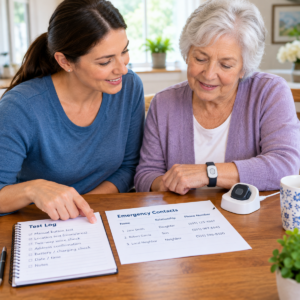
Record the date, location, device status, operator response, address confirmation, and each problem found.
Call support to correct problems, then repeat only the test needed to confirm the correction.
Keep the record simple enough to maintain: one page on the refrigerator, in a care binder, or in a shared secure note. A good test log becomes valuable after a move, a device replacement, a change in caregiver, or a later question about whether the system worked as intended. It also avoids the common mistake of treating an old successful test as evidence that today’s setup is still correct.
Charging, battery, and power-outage routines for emergency bracelets
Every Life Alert Bracelet with Fall Detection has a period when it is charging, and that period deserves a backup. Put the dock in a place the person naturally uses, with a visible cue rather than a complicated calendar reminder. If the device has indicator lights or spoken alerts, teach the wearer what they mean. If the person cannot safely manage charging, assign the task to a specific caregiver and document what should happen if that caregiver is away.
Ask whether the base station has backup power and how long it is expected to operate under the conditions stated by the manufacturer. Ask what happens during a cellular or landline interruption. Keep a charged phone accessible when feasible, but do not call a phone a sufficient backup if the person cannot reach, unlock, hear, or operate it after a fall. Redundancy works only when its failure modes are different.
Fall detection bracelet maintenance after a health or routine change
Review the Life Alert Bracelet with Fall Detection system after any fall, near fall, hospitalization, move, medication change, new mobility aid, decline in hearing or vision, new skin problem, or change in cognition. These events can alter the person’s ability to wear, charge, find, hear, or use the bracelet. A review is not a sign that the person has failed; it is the normal maintenance of a safety tool.
Inspect the band, clasp, button, charging contacts, and instructions for damage. Replace a damaged accessory through the provider’s documented process. Confirm the account remains active and that the service has the correct address and contacts. If the person now spends more time in a different part of the home or begins leaving home with the device, retest the relevant coverage rather than assuming the earlier setup applies.
After a missed alert or unexpected fall detection alarm
A false Life Alert Bracelet with Fall Detection alert should be handled without shaming the wearer. Find out what the device and service instructed them to do, whether they could hear a prompt, and whether the cancellation method was understandable. If alerts happen frequently, contact the provider for model-specific guidance and reassess fit and use. A person who becomes afraid of “setting it off” may stop using the button during a real emergency.
A suspected missed alert requires a calm factual review. Was the device worn? Was it charged? Did the event occur in a coverage gap? Could the person press the button? Was an automatic feature actually active on the account? Do not diagnose the event from memory or use a single incident to make broad claims about a technology category. Record the details, contact support, and update the backup plan if the device cannot meet the person’s needs.
Privacy and consent with a life alert bracelet
A Life Alert Bracelet with Fall Detection may involve account information, contact details, audio, location information, or caregiver access. Before activation, explain plainly what information the service uses, who can change the account, and who will be notified. Read the current privacy notice and terms for the exact provider. Ask the wearer which relatives or friends should receive alerts, and avoid adding people simply because they are available.
Consent strengthens safety because it improves cooperation. A person who understands why a bracelet is suggested is more likely to tell someone when it becomes uncomfortable, stops working, or is being removed for bathing or charging. Caregivers should frame the device as a way to preserve choices and request help, not as a tool for monitoring compliance.
Plan for common fall detection bracelet failure modes
A dependable Life Alert Bracelet with Fall Detection plan assumes that something will eventually be unavailable. The useful question is not whether a bracelet can fail; every technology and every human routine can fail. The question is whether the household has noticed the likely weak points before an urgent moment. Make a short list of the conditions that would interrupt a request for help, then give each one a practical response.
For example, a bracelet on its dock cannot help the wearer in the bathroom. A mobile device outside its service area may not communicate. A base station in the wrong room may make two-way voice difficult. A contact who has moved away may not be able to assist. A plan that names these conditions is not pessimistic. It is more honest and more usable than one that treats a purchased service as self-managing.
When the emergency bracelet is charging or has a low battery
Charging time for a Life Alert Bracelet with Fall Detection is an ordinary vulnerability. Decide where the device charges, when it charges, and what the wearer uses instead. A good time might be a regular seated activity, but only if the person remains within reach of a phone or another alert route. Avoid a rule such as “charge it overnight” if the person is most likely to need assistance on the way to the bathroom at night.
Choose a cue that matches the person: a written sign at the usual chair, a caregiver call, a charging dock beside medication supplies, or a routine linked to an existing habit. Do not create an elaborate system that the person will abandon. If low-battery alerts are audible, practice recognizing them. If the wearer cannot manage that task, make it a named responsibility rather than an informal hope that somebody will remember.
When voice communication is difficult after a detected fall
Consider the possibility that the person using a Life Alert Bracelet with Fall Detection may be frightened, out of breath, hard of hearing, unable to reach the speaker, or unable to speak clearly. Ask the provider what the monitoring center does in a silent call and whether the sequence changes for a detected fall. Record the answer. The family should also decide what information needs to be current: address, apartment, door code, preferred hospital if appropriate, language or communication needs, and a reachable emergency contact.
Do not assume that a nearby family member hears an alert. Unless the service specifically provides that function and it has been set up and tested, family awareness may depend on the response center’s workflow. A neighbor, building manager, or relative should only be part of the plan after agreeing to the role. Their phone number and availability can change, so review the list on a schedule and after any major life event.
When the wearer takes the bracelet off
People remove a Life Alert Bracelet with Fall Detection for bathing, skin care, sleep, charging, medical appointments, discomfort, or simply because they forget. Ask when removal happens in the real routine. If shower use is not permitted, what reachable help method is available then? If the bracelet is removed to charge, where is the phone? If the person removes it because it feels childish or intrusive, would a different style or a different support plan feel more respectful?
Never hide the fact that a device is optional where the person has decision-making capacity. Explain the tradeoff, listen to concerns, and document what the wearer agrees to do. Caregivers can make the arrangement easier—by choosing a comfortable band, reducing confusing alarms, or practicing the button—but cannot make a removed bracelet protect someone. Honest conversation is a safety intervention in its own right.
Build a caregiver response plan around fall detection alerts
A Life Alert Bracelet with Fall Detection plan becomes actionable when everyone knows their role. Start with the wearer: what should they do if they can press the button, if they hear a prompt, or if they feel unwell without falling? Then identify the monitoring service’s role, the first emergency contact’s role, and the backup contact’s role. Keep the plan short enough to be followed under stress, and keep the provider’s official instructions separate from family preferences so they are not confused.
Use neutral language. “If there is an alert, we will check the facts and get help” is less frightening than telling someone they are being watched. Include the wearer in choosing whom to call. The goal is to support autonomy and quick assistance, not to make the device a test of obedience. Where cognition changes make participation difficult, involve the person to the extent possible and confirm legal and caregiving responsibilities with the appropriate professionals.
Emergency contacts for a Life Alert Bracelet with Fall Detection
List Life Alert Bracelet with Fall Detection contacts in the order the provider can actually use. Include a local person only if they have agreed to be called, know the address, and understand what they may be asked to do. A person who is two states away may still be an important decision-maker, but they are not a substitute for a local response. Note if anyone has keys, building access, a gate code, or a reason they cannot reliably respond.
Set a review date rather than waiting for a crisis to reveal a stale list. Update after a move, divorce, death, change in caregiver, new phone number, or new apartment management. Keep the same information in the provider account, the caregiver binder, and any secure shared care record. Contradictory instructions create avoidable delays when someone is trying to help.
After an alert: what a family should document
After a real or false Life Alert Bracelet with Fall Detection alert, write down only the information that will improve the next response: date, time, place, whether the bracelet was worn, whether a button was pressed, whether automatic detection was involved, whether the person could communicate, and what the service did. If there was a fall, note injuries, symptoms, and whether medical care was obtained. Do not turn the log into a judgment about the wearer.
Review the entry with the person and caregiver team. A recurring pattern—falls after standing, trips near one rug, trouble hearing the operator, a device often left on the charger—points to an actionable change. Bring relevant observations to a clinician when discussing fall risk. The log can support a conversation, but it does not determine the cause of a fall or replace professional evaluation.
When to revise the life alert bracelet plan instead of adding reminders
More reminders are not always the answer when using a Life Alert Bracelet with Fall Detection. If the person repeatedly cannot remember a charging step, cannot tolerate the band, cannot hear the speaker, or cannot manage a cancellation prompt, the fit between person and device may be wrong. Ask the provider about alternatives, simplify the routine, or consider a different emergency route. Repeatedly asking someone to do a task they cannot reliably do can erode confidence without improving safety.
Likewise, a plan should be revised after a change in living arrangement. Moving from a house to an apartment changes access, coverage, and emergency contacts. Beginning to use a walker changes where a fall might occur and how the person can reach a device. A new caregiver may need training and a copy of the plan. Treat these changes as a reason to retest, not as paperwork to postpone.
Match fall detection and emergency response to real-world scenarios
Scenario planning reveals gaps in a Life Alert Bracelet with Fall Detection plan that a feature checklist misses. Walk through a few ordinary situations with the wearer. The purpose is not to frighten them with worst-case stories; it is to discover whether the help route remains usable when hands are wet, a phone is charging, the person is outside, or a caregiver is unavailable. Keep each scenario specific and finish by naming a simple next action.
Bathroom safety and a Life Alert Bracelet with Fall Detection
Bathrooms deserve special attention because wet surfaces, transfers, limited space, and closed doors can make help harder to reach. Confirm the exact device’s water instructions; do not assume that a bracelet can be worn in a shower or bath. If it must be removed, decide where it stays and what alternate support is available. Test the manual route from outside the bathing area only when it is safe and allowed by the provider.
Also consider prevention: adequate lighting for nighttime trips, a clear path, appropriate grab bars installed by a qualified professional when needed, nonslip surfaces, and a clinician conversation about dizziness or urgent bathroom trips. The bracelet does not make a wet floor safe. It can only provide a possible route to help after a problem has already occurred.
Bedroom and nighttime fall detection routines
Nighttime routines raise different questions. Is the bracelet worn while sleeping? Is it charged overnight? Can the person reach a phone or button from the bed? Does the path to the bathroom have lighting? If a base station is used, can its voice be heard from the bedroom with the door closed? Answers should come from a realistic test, not from a daytime assumption.
For people who wake dizzy or unsteady, the response plan should be paired with prevention measures and clinical advice. Encourage the person to sit before standing if that has been recommended, use prescribed mobility support, and ask a clinician about new dizziness, faintness, or falls. An alert device may help summon support, but it cannot tell the wearer whether it is safe to stand.
Outside the home with a mobile emergency bracelet
For a mobile Life Alert Bracelet with Fall Detection, discuss routine destinations and the simplest way to explain location. A person in a parking lot might be able to name a store but not a street address; a person in a park may need to describe an entrance or landmark. Test the device where the person actually goes and make sure the battery routine matches outings. A device left in a purse or car does not provide the same protection as one worn on the body.
Travel requires another review. A change in address, a hotel, a different climate, or unfamiliar cellular service can alter how the service works. Before a trip, ask the provider whether the device is supported at the destination, how address information is handled, and whether any special steps are required. If those answers are unclear, rely on an alternative, clearly understood communication plan rather than making assumptions.
Use fall prevention alongside a Life Alert Bracelet with Fall Detection
An emergency alert system acts after something may have gone wrong. It does not reduce the underlying chance of a fall. For practical home changes, see fall prevention at home for seniors. The CDC and National Institute on Aging describe fall prevention as a multi-part effort that can include discussing fall history and medications with a clinician, addressing vision and hearing, improving strength and balance as appropriate, using mobility aids correctly, and making the home safer. The right combination depends on the individual.
Tell a clinician about a fall even if there was no obvious injury. A fall, dizziness, new unsteadiness, or a change in walking can signal a problem worth evaluating. Bring a list of medicines—including over-the-counter products—and a description of when and where falls or near falls happen. The alert bracelet’s test record may help show whether a device was worn and whether the response plan worked, but it is not a clinical assessment.
Home changes that support emergency bracelet use
Remove or secure trip hazards, improve lighting, keep pathways clear, and make sure a phone or help button is reachable from common fall locations. Bathrooms, stairs, bedside areas, and entrances deserve special attention. If the person uses a walker or cane, ask a health professional to confirm that it is correctly sized and used; a mobility aid that is hard to manage can introduce new risks.
Do not use the bracelet as a reason to accept a hazardous environment. A Life Alert Bracelet with Fall Detection and a prevention plan solve different problems. When a change is needed—such as grab bars, better lighting, non-slip flooring, medication review, or a therapy referral—address it on its own merits. The strongest plan makes a fall less likely and makes help easier to reach if one occurs.
Caregiver check-ins that do not replace a response plan
Scheduled calls and visits can provide reassurance alongside a Life Alert Bracelet with Fall Detection, but they are not real-time emergency monitoring. Decide what happens if a check-in is missed, how long someone waits, who has authority to enter the home, and when emergency services are called. Put the plan in writing, including the person’s preferred contacts and any access information. Review it with everyone who has a role.
A good backup does not share the same weakness as the bracelet. For example, a phone can help during bracelet charging, but not if it is across the room and the wearer cannot stand. A neighbor can help, but only if that person has agreed and is likely to be available. Layered supports are useful when each layer is realistic, consented to, and tested.
Frequently asked questions about a Life Alert Bracelet with Fall Detection
Does a Life Alert Bracelet with Fall Detection call for help after every fall?
No device should be expected to recognize every fall. Automatic detection depends on the exact device, how it is worn, power, connection, and the movement pattern. If the wearer can press the help button, that is usually the clearest action. Verify the provider’s current response process for the exact model and plan.
Can a fall detection bracelet replace a phone or calling 911?
No. For an immediate life-threatening emergency, call 911 or the local emergency number when possible. A bracelet can be one route to help, but it can have battery, coverage, service, and use limitations. Keep an independent backup plan that the person can realistically use.
Does every Life Alert-style bracelet include automatic fall detection?
No. Features vary by provider, device, and service plan. A basic manual button and an automatic-detection add-on are not the same thing. Confirm inclusion, availability, response behavior, fees, and cancellation rules directly with the provider before enrolling.
How often should a Life Alert Bracelet with Fall Detection be tested?
Follow the provider’s official test schedule and repeat a focused test after a move, service change, device replacement, fall, new caregiver, or change in the person’s routine. Routine manual-button tests, with the service notified that they are tests, are more useful than staging a fall.
Can an emergency bracelet be worn in the shower?
Only if the exact device’s current instructions permit it. Water ratings and limits vary, and the charger or base station should remain dry. Confirm whether the bracelet is suitable for shower use, bathing, or only brief splashes; do not infer this from the appearance of the device.
What should caregivers record for a fall detection plan?
Keep the model, account and support numbers, service features, address, access details, emergency contacts, charging responsibility, test dates, and the agreed response sequence. Update the record whenever the person moves, changes routines, or changes the people involved.
Is a false alarm a reason to stop using fall detection?
Not automatically. First determine whether the wearer understood the alert, whether fit or use contributed, and what the provider recommends. Repeated false alerts or a confusing cancellation process may mean the device or form factor needs to change. The wearer should never be discouraged from pressing the manual button during a real concern.
What is the first action after a fall when the person is alone?
Stay as calm as possible, assess for injury, and seek help. If the person can press the alert button or call 911, they should do so. They should not rush to stand if they may be injured. The National Institute on Aging provides general fall guidance; individual medical concerns should be discussed with a clinician.
Final Life Alert Bracelet with Fall Detection readiness check
Before relying on the bracelet, be able to answer six questions without guessing: Is this exact model and plan active? Can the wearer press and hear it? Has manual help been tested in the relevant rooms and routine destinations? Do we understand the automatic-detection limits and response sequence? Are charging, contacts, address, and access instructions current? What independent backup works while the device is unavailable?
If any answer is unclear, the plan is not finished. Resolve the uncertainty with the provider, caregiver team, or clinician, then retest the affected step. A carefully maintained Life Alert Bracelet with Fall Detection can support independence by making it easier to ask for help. Its value comes from the routine around it: prevention, consent, practice, current information, and a backup that remains usable on a difficult day.
Sources for fall detection and fall prevention guidance
- National Institute on Aging: Falls and Fractures in Older Adults — fall risk factors, prevention, and what to do after a fall.
- Centers for Disease Control and Prevention: Preventing Falls and Hip Fractures — clinician discussion, medication review, strength and balance, and prevention resources.
- CDC STEADI — fall-risk screening, assessment, and intervention resources for older adults and caregivers.
1 comentario en «Life Alert Bracelet with Fall Detection: A Practical Guide»