Vehicle Transfer & Mobility Transport | SeniorTechLife
Understand wheelchair accessible vehicles, entry options, transfers, passenger needs, securement, fit testing, and the professionals who can help before a major decision.
A wheelchair accessible vehicle is a vehicle designed or modified so a wheelchair user can enter, travel, transfer, or drive with an arrangement that fits their actual needs. The right choice depends on the person, the wheelchair, who is traveling, where the vehicle will be used, and whether the user transfers to a vehicle seat or remains seated in the wheelchair.
This is a decision guide, not a vehicle ranking, driving assessment, or modification manual. A major vehicle decision should include the wheelchair user, family or caregiver when relevant, a qualified mobility equipment dealer, and often a driver rehabilitation specialist or other professional who can evaluate fit and safety.
Quick answer: what is a wheelchair accessible vehicle?
A wheelchair accessible vehicle may have a lift, ramp, lowered floor, modified doorway, hand controls, transfer seat, wheelchair securement equipment, or another adaptation. Some people drive after transferring into a vehicle seat; others travel as passengers in their wheelchair or may use adaptive controls after specialized evaluation.
The vehicle is only accessible when the entire routine works: approach, entry, turning space, seating or securement, restraint, storage, exit, and the parking space at each destination.
Start with the person, wheelchair accessible vehicle, and daily trips
Begin with real trips, not a brochure. Record who will drive, who will ride, the exact wheelchair accessible vehicle dimensions and loaded weight, whether the user transfers to a seat, how often the vehicle will be used, and the places it must fit: home, work, medical appointments, family visits, parking garages, and community destinations.
| Area | What to confirm | Why it matters |
|---|---|---|
| Wheelchair | Width, length, height, loaded weight, turning radius, battery needs, and manufacturer limitations. | Determines door clearance, ramp or lift capacity, interior space, and securement compatibility. |
| Traveler | Transfer ability, trunk control, vision, reach, fatigue, and need for assistance. | Changes the safest entry method, seating plan, and level of support required. |
| Trips | Frequency, distance, passengers, equipment, weather, and parking conditions. | Shows whether a layout works beyond a short showroom demonstration. |
| Caregiver | Who will operate the ramp or lift, secure the wheelchair, and manage luggage or medical equipment. | Prevents a setup that is technically possible but unsafe or exhausting in daily use. |
NHTSA advises considering cargo capacity, available room for family or passengers, parking space for loading and unloading, and the equipment needed for safe operation. These are practical fit questions, not optional extras.
Compare entry and travel arrangements
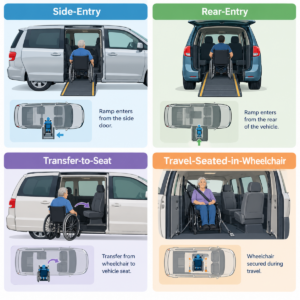
Accessible vehicles can differ in where the person enters and how they travel. Side-entry and rear-entry layouts each change parking needs, interior movement, and who can sit where. A transfer-seat arrangement may suit one person well but be unrealistic for someone who cannot transfer safely or repeatedly.
Side-entry layouts
Side-entry access may be convenient in some curbside or passenger-loading situations, but it needs enough side clearance for the ramp or lift and for the wheelchair to turn. The exact parking environment matters as much as the driveway at home.
Rear-entry layouts
Rear-entry access can work well in driveways or designated accessible spaces, but it changes how the vehicle is approached and how other passengers enter. It may not suit every parking situation or family routine.
Transfer to a vehicle seat
Transferring can reduce the need to travel seated in the wheelchair, but the person must be able to make the transfer safely and repeatedly. Evaluate seat height, door opening, handholds, pivot space, and what happens on a tiring day.
Travel while seated in the wheelchair
Traveling in the wheelchair requires a layout and securement approach that works with the actual chair and occupant. Do not assume that a wheelchair which fits through the door is automatically compatible with the full travel position.
Evaluate the entry method, not only the doorway
Ramps and lifts can both be useful, but each changes setup, maintenance, weather exposure, capacity, and the amount of assistance required. A ramp may require a gentler approach and enough clearance; a lift may require careful operation, stable positioning, and a routine for power or equipment failure.
Ask the provider to demonstrate the full entry and exit sequence with the exact wheelchair. Watch the clearance at the doorway, ground contact, transition angles, headroom, and any place where footrests, casters, anti-tip devices, or batteries could catch.
Plan seating, restraints, and securement with qualified help
Seat belts, wheelchair accessible vehicle securement, and occupant restraints are safety systems, not accessories to sort out later. The correct arrangement depends on the vehicle, the wheelchair, the travel position, the person, and the modification. Follow the equipment instructions and obtain hands-on training from qualified professionals.
NHTSA encourages people who need adaptive equipment to work with experienced driver rehabilitation specialists, registered mobility equipment dealers and modifiers, and other professionals before purchasing or modifying a vehicle. The dealer or modifier should provide documentation for the work performed and identify affected federal safety standards where required.
Separate driver needs from passenger needs
A person who plans to drive has different needs from a person who will travel as a passenger. Driver needs can include line of sight, reach to controls, transfer method, seating position, hand controls or other adaptive equipment, and a professional assessment of safe operation. Passenger needs may focus more on entry, securement, comfort, communication, caregiver assistance, and space for other travelers.
Do not assume that a vehicle which works well for a passenger will work for the same person as a driver. NHTSA notes that driver rehabilitation specialists can help evaluate seating, entry and exit, and equipment needs. Their role is especially valuable before a costly conversion or long-term commitment.
Check parking and destination access before choosing a layout
A vehicle can fit perfectly at home and still fail at a medical office, grocery store, apartment garage, school, workplace, or family home. Think through where the ramp or lift will deploy, whether a caregiver can stand safely beside it, and whether the wheelchair user can avoid traffic, puddles, snowbanks, curbs, or sloped parking surfaces.
Make a list of the three or four destinations used most often and test the proposed layout there when possible. This helps reveal whether side clearance, rear clearance, turning space, lighting, or weather exposure will become a daily barrier.
Test the full loading and unloading routine
A short test drive is not enough. Test the routine in the order it will happen in daily life, using the actual wheelchair and the people who will travel together.
- Approach and park. Confirm there is enough space to deploy the ramp or lift and maneuver the wheelchair.
- Enter slowly. Check headroom, footrest clearance, door operation, and transitions.
- Reach the travel position. Confirm the user can transfer or position the wheelchair without strain or unsafe twisting.
- Complete the restraint and securement routine. The trained person should be able to do it consistently, not just once in a showroom.
- Store essential items. Oxygen, bags, communication devices, and mobility equipment must not block exits or interfere with controls.
- Exit at the destination. Repeat the process in a typical parking space, not only an open lot.
Stop and revise the plan if the routine requires unsafe lifting, repeated awkward reaching, a caregiver to work beyond their capacity, or a wheelchair user to wait in traffic while equipment is adjusted.
Look beyond the purchase price
The total decision can include the base vehicle, conversion or adaptive equipment, delivery, inspection, insurance, maintenance, repair access, training, warranty terms, parking changes, and replacement planning. Ask what is included and what is not, in writing.
Do not assume a used vehicle or a vehicle already modified for someone else will fit your wheelchair, transfer ability, or daily trips. The previous arrangement may be incompatible even if the vehicle looks similar to what you need.
Ask for documentation, training, and a service plan
Before completing the transaction, ask who will provide training, what documentation comes with the modification, where service will be performed, and what to do if the ramp, lift, securement system, or adaptive equipment stops working. Keep operating instructions and emergency contacts in a place that the regular driver and caregiver can reach.
Ask the dealer or modifier to explain maintenance intervals, inspection points, warranty coverage, and any vehicle features affected by the conversion. A clear service plan is part of accessibility because equipment that cannot be maintained promptly can leave a person without a safe way to travel.
Keep rental and purchase decisions separate
A rental can be useful for a temporary need or a short trip, while a purchase or conversion requires a longer-term evaluation. The questions overlap, but availability, contracts, training, maintenance responsibility, and local service differ enough that each decision deserves its own detailed research.
For this guide, focus first on the fit and safety framework. Only compare specific vehicles, rentals, dealers, or conversion providers after current availability, specifications, support, and image rights have been independently verified.
Common questions about wheelchair accessible vehicles
These answers provide an overview. A driver rehabilitation specialist, mobility equipment dealer, or other qualified professional should evaluate the actual person, wheelchair, vehicle, and intended use.
What is the best wheelchair accessible vehicle?
The best option is the one that fits the wheelchair user, travel routine, entry and exit needs, parking environment, and support available. A universally “best” layout does not exist.
Can a wheelchair accessible vehicle be rented?
Rental availability varies by area and provider. Before committing, confirm the exact wheelchair fits, the access equipment can be used safely, and the person who will operate it receives appropriate instructions.
Can I modify my current vehicle?
Possibly, but compatibility depends on the vehicle, the needed equipment, structural and safety considerations, and the user’s requirements. Obtain a qualified assessment rather than assuming a conversion can be added to any vehicle.
Should I transfer into a vehicle seat or travel in my wheelchair?
The safer arrangement depends on the person’s transfer ability, the wheelchair, the vehicle, and professional evaluation. Do not decide based only on convenience or appearance.
Final wheelchair accessible vehicle checklist
- The exact wheelchair and its loaded dimensions have been measured.
- The user, caregiver, passengers, and real trips have been considered.
- Entry, turning, transfer or travel position, securement, and exit have been tested.
- Parking and loading space work at home and common destinations.
- A qualified specialist or dealer has reviewed the proposed setup.
- Costs, documentation, training, maintenance, and support have been discussed in writing.
1 comentario en «Wheelchair Accessible Vehicle: A Practical Guide»