
walking canes for seniors | SeniorTechLife mobility guide
Walking canes for seniors can provide light balance or weight-bearing support when the type, height, handle, tip, and walking pattern match the person. This guide explains what to assess before choosing.
How should families choose walking canes for seniors?
Choose a cane by matching the amount of support required, the person’s hand and arm function, the walking pattern, and the places where the device will be used. Walking canes for seniors should be the correct height, remain stable when loaded, feel secure in the hand, and have an intact nonslip tip. A cane that looks attractive but is too tall, too short, painful to grip, or unable to provide enough support can make walking harder rather than easier.
A cane is usually intended for relatively light balance or weight-bearing assistance. Someone who needs substantial support through both arms, cannot control the device, has repeated unexplained falls, or cannot walk safely even with a cane may need a professional assessment for a different aid. MedlinePlus advises involving a healthcare provider or physical therapist when selecting a mobility aid.
Begin with the mobility problem, not the product catalog. Identify when balance is lost, which side feels weaker or painful, how far the person walks, whether stairs are unavoidable, and whether hand pain or poor sensation changes grip. Then compare only cane types capable of addressing that clearly defined need.
When a walking cane may support an older adult
A cane may help a person who remains able to walk but benefits from an additional point of contact with the ground. Common reasons include mild balance difficulty, pain in one hip or knee, reduced confidence after a fall, weakness on one side, or a need for feedback about where the ground is. The reason matters because it influences cane style, height, side of use, and whether training is advisable.
Age alone is not a reason to prescribe a cane. Some older adults walk safely without equipment, while others have changing needs related to arthritis, stroke, neuropathy, vision, surgery, medication, endurance, or environmental barriers. A sudden change in walking, new one-sided weakness, fainting, chest pain, severe shortness of breath, or a head injury after a fall deserves prompt medical evaluation rather than a hurried equipment purchase.
Cane support for pain or one-sided weakness
When one leg is painful or weaker, a clinician may recommend holding the cane on a particular side to improve the support pattern. That decision can feel counterintuitive, and the correct sequence depends on the person’s condition. A short demonstration in a store cannot replace individualized instruction when pain, neurologic changes, joint precautions, or complex stairs are involved.
Cane support for confidence and community mobility
Some people want a cane mainly for crowded places, uneven parking lots, long queues, or unfamiliar buildings. Occasional use still requires a correct fit and a reliable tip. A folding design stored in a car is not useful if its joints are loose, it is left out of reach, or the person has never practiced opening and checking it before standing.
Signs that a cane may not provide enough support
Reconsider the device if the person grabs furniture with the free hand, leans heavily over the shaft, repeatedly places the tip too far away, cannot recover from a small loss of balance, or needs another person to hold the torso. Those observations do not prove that a walker is required, but they justify assessment instead of simply choosing a heavier cane.
Types of this topic and their tradeoffs
Cane labels are not perfectly standardized. Focus on the base, shaft, handle, adjustability, intended load, and the person’s ability to place the cane. A familiar name does not establish that two products provide the same support.
| Type | Often considered for | Potential advantage | Important caution |
|---|---|---|---|
| Single-point adjustable cane | Light balance or unloading support | Simple, relatively light, and height adjustable | Provides a smaller base than a multi-point cane |
| Offset-handle cane | People who benefit from the hand being centered over the shaft | Can direct load more directly down the shaft | Grip shape and height must still fit the user |
| Quad cane | People needing a wider base and able to place it correctly | Multiple tips may increase ground contact | Can be heavier, awkward on stairs, and a trip hazard if poorly positioned |
| Tripod or pivot-base cane | Users seeking a somewhat broader or flexible base | May stand independently and adapt to some surfaces | A moving base can feel unstable to some users |
| Folding cane | Travel or intermittent use | Compact storage | Every joint and tension cord needs inspection |
| Fixed-length wooden cane | People who prefer a rigid traditional design | Simple construction and many handle styles | Must be cut or selected to the correct height |
Single-point and offset walking canes
A single-point cane is often the starting category for light support. Adjustable aluminum models simplify height changes and may be practical when footwear or posture changes. An offset handle positions the user’s hand more directly over the shaft. Neither feature compensates for poor placement, inadequate strength, or a worn tip.
Check whether the adjustment button fully enters its hole and whether the locking collar is tight. Listen for rattling, but do not treat sound alone as a safety test. Inspect the full shaft for bending, corrosion, cracks, or modifications not approved by the manufacturer.
Quad and multi-point walking canes
A quad base may offer more ground contact, but more tips do not automatically make walking safer. The base must face the correct direction, land flat, clear the person’s feet, and fit on steps. A large base may be cumbersome in narrow rooms. A small base may be easier to move but offer less of the stability the buyer expected.
The VA/DoD stroke rehabilitation guideline describes single-point, tripod, and quad canes as distinct options and notes that multi-point designs offer more stability. That general distinction is useful, but a person’s diagnosis, balance, and training still determine whether the device is appropriate.
Walking Canes For Seniors: Folding and fixed-length walking sticks
A folding cane can be convenient when space is limited. Before each use, confirm that all sections are fully seated and that the tension system has not weakened. A fixed-length shaft has fewer moving parts but provides no quick correction if it was sized incorrectly. Wooden shafts also require inspection for splits, damage, and a secure tip.
Walking cane and walking stick terminology
People and retailers use “cane” and “walking stick” inconsistently. A walking stick may describe a mobility aid, a recreational hiking pole, or a decorative staff. Search systems also produce awkward strings such as “walking stick walking stick,” “walking stick canes wooden,” “cane for walking stick,” “walking stick and cane,” “cane and walking sticks,” and “cane walking sticks.” Those labels are not recognized clinical categories and should never replace specifications, fit, or a professional recommendation.
For this guide, a walking cane is a one-handed mobility aid intended to provide balance feedback or limited support during walking. Hiking poles, novelty staffs, self-defense products, and decorative objects are outside the selection scope. When shopping, verify that the manufacturer identifies the product as a mobility aid, states a user-weight limit, provides adjustment and maintenance instructions, and offers a compatible replacement tip.

How this topic should be fitted
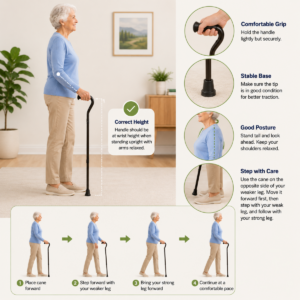
Height affects posture, weight transfer, and the ability to advance the cane. A cane that is too high may elevate the shoulder and reduce useful support. A cane that is too low may encourage bending or place the handle beyond comfortable reach. Common fitting references use the wrist crease and a slight elbow bend while the person stands upright in ordinary shoes, but individual conditions can require a different setup.
Mayo Clinic’s cane guidance discusses handle height, elbow bend, grip selection, and tip condition. Use those principles as a conversation starter, not as permission to ignore a clinician’s instructions after surgery, stroke, significant joint disease, or a recent fall.
Measure in the shoes and posture used every day
Measure with the person wearing the footwear used most often. Thick soles, slippers, and barefoot walking change effective height and traction. If posture varies during the day, record when the cane feels least controlled. Someone who stands upright during a brief fitting may bend more when tired, so a real walking trial is more informative than a single static measurement.
Check elbow, shoulder, wrist, and trunk response
Look beyond the number on the adjustment hole. The shoulder should not be forced upward, the wrist should not remain sharply bent, and the trunk should not collapse toward the cane. Pain, numbness, weakness, swelling, or skin irritation in the hand can change which handle is tolerable and how much weight can safely pass through the device.
Recheck fit after health or footwear changes
A new joint replacement, brace, shoe, leg-length change, weight change, or progression of weakness can make an old setup unsuitable. Marking the shaft height can help detect accidental adjustment, but it should not prevent intentional reassessment. If a borrowed cane has been shortened permanently, do not improvise an extension.
Cane handles, grips, shafts, and tips
The user interacts with the handle, while the tip interacts with the floor. Both must work. A cushioned grip may feel comfortable yet twist under load. A decorative handle may be difficult to hold with arthritis. A broad base may grip dry tile but catch on a rug edge. Evaluate the entire system rather than selecting one feature in isolation.
Handle shapes and hand comfort
Contour, derby, crook, offset, T-shaped, and ergonomic handles distribute pressure differently. People with hand arthritis, reduced sensation, tremor, or weak grip may need a larger surface or a shape that limits rotation. Try the handle while standing and walking, not only while seated. Rings, watches, and bulky sleeves should not interfere.
Rubber tips and traction
The tip should be the correct size for the shaft, fully installed, and free of cracks, hardening, embedded debris, or uneven wear. Replace it before the tread disappears. Moisture, oil, loose grit, ice, wax, and smooth flooring can defeat even a new tip, so the user still needs to look at the surface and adjust pace.
Walking Canes For Seniors: Accessories that can introduce new risks
Wrist straps, lights, ice tips, free-standing bases, bags, and holders may be useful in specific situations. They also add failure points, swing into the legs, catch on objects, or change balance. Use accessories only when compatible with the cane and practiced in the intended environment. Never hang a heavy bag from the shaft or handle.
Safe walking patterns deserve individualized instruction
This Hub explains selection and safety but intentionally does not replace hands-on gait training. Which hand holds the cane, when it advances, and how it coordinates with an affected leg can depend on the reason for use. Detailed technique belongs in a focused child guide and, when risk is meaningful, in instruction from a physical therapist or another qualified professional.
Cleveland Clinic provides general education about fit, level walking, curbs, and stairs. A reader should pause and seek help if the sequence causes pain, the cane repeatedly catches a foot, the user cannot remember the pattern, or another person must pull on the user’s arm.
Stairs, curbs, and uneven ground
Stairs require enough strength, balance, vision, and attention to manage the rail, cane, feet, and direction of travel. A multi-point base may not fit completely on a tread. Curbs and sloped driveways add similar placement problems. If the person freezes, rushes, crosses the feet, or cannot keep every required point of contact secure, choose another route and obtain training.
Carrying items while using a cane
A cane occupies one hand and may make a tray, laundry basket, pet leash, or heavy shopping bag unsafe. Plan hands-free alternatives such as a correctly fitted backpack or caregiver assistance, while considering balance and medical restrictions. Do not wedge the cane under an arm to free the hand while continuing to walk.
Using a walking cane at home
Walk the routes used after waking, at night, and when fatigued. Check the bed, bathroom, kitchen, stairs, favorite chair, entrance, and path to the vehicle. Remove loose cords and unstable rugs, improve lighting, and keep frequently used items within safe reach. The cane tip needs clear floor space; a visually attractive room can still be difficult to navigate.
Floors, thresholds, and rugs
Transition strips, curled rug edges, deep carpet, and wet bathroom floors can interrupt a cane’s placement. Observe the tip and feet from several angles. A rubber-backed mat can still slide or create an edge. If a mat is essential, make sure it lies flat and remains secured under real use.
Bathrooms and nighttime movement
Urgency, low lighting, bare feet, and wet surfaces raise risk. Keep the cane consistently within reach without creating a trip hazard. A cane is not a substitute for correctly installed grab bars, safe shower access, or assistance when transfers are difficult. Nightlights should illuminate the route without glare.
Pets, doors, and divided attention
A pet crossing the route, a door that swings back, or a ringing phone can disrupt the walking pattern. Train pets to stay clear, use door hardware that does not require prolonged balancing, and allow calls to wait. Safe mobility depends as much on attention and timing as on the device.
Community and travel planning with a cane
Parking lots, crowds, escalators, wet entrances, cobblestones, grass, and long standing periods may demand more than the home routine. Preview accessible entrances, seating, elevators, and restrooms. A cane that is adequate for a smooth hallway may not provide sufficient support for a long outdoor event.
When flying, keep essential mobility equipment available for as long as possible and label it with contact information. If a folding cane goes through security or is stored, inspect every section before standing. Carry a compatible spare tip and basic manufacturer information, but do not make unapproved repairs with tape or improvised fasteners.
this topic: Weather and seasonal conditions
Rain reduces traction, cold can stiffen hands, bright sun can hide changes in surface level, and winter conditions may make a familiar route unsafe. An ice accessory does not create permission to walk on a hazardous surface. Postpone the trip, choose an accessible entrance, or use another form of assistance when conditions exceed the person’s control.
Walking cane safety checks for older adults
Inspect the cane on a schedule and after any fall, hard impact, or unusual noise. Check the tip, shaft, handle, adjustment button, locking collar, folding joints, base, and accessories. Press down on the handle while the cane is planted on a dry nonslip surface and look for movement that should not occur.
Stop-use warning signs
- The shaft is bent, cracked, loose, or corroded.
- The handle rotates, separates, or causes skin injury.
- The adjustment button does not fully engage or the collar will not tighten.
- A folding joint separates, twists, or fails to seat completely.
- The tip is split, hardened, uneven, loose, or the wrong size.
- The person has new pain, repeated near-falls, or increasing dependence on furniture.
Do not drill new holes, combine parts from unrelated products, or exceed the stated capacity. Contact the manufacturer or a qualified supplier when the correct replacement part is uncertain.
Falls are information, not embarrassment
Record what happened before a fall or near-fall: time, surface, footwear, lighting, task, symptoms, cane placement, and medication timing. That pattern may reveal an environmental problem, a device problem, or a health change. Seek urgent care after serious injury or concerning symptoms and discuss recurrent events with a healthcare professional.
Cleaning, maintenance, and replacement planning
Follow the manufacturer’s cleaning directions. Dry the handle and tip completely, keep oils away from gripping surfaces, and avoid solvents that may weaken rubber or finishes. After travel, inspect the shaft and joints before returning the cane to daily service.
Replacement timing cannot be determined by age alone. Usage, body weight, surface, storage, temperature, and material all affect wear. Create a simple monthly reminder and keep the supplier’s model and tip information with household records. A spare tip is useful only if someone knows how to install it correctly.
Backup mobility planning
Decide what happens if the cane is misplaced or damaged. A backup should be fitted and inspected, not an unknown cane retrieved from a closet. Store it where the user or caregiver can reach it without walking unsupported. During a repair, do not substitute a decorative stick or another person’s device simply because the height looks similar.
Cost, trial, and purchase considerations
Price varies with materials, adjustability, base, handle, capacity, folding design, accessories, and service. A lower-cost cane can be appropriate when it fits and meets the need. A premium finish does not prove better safety. Include replacement tips, professional assessment, delivery, and return terms in the decision.
Walking Canes For Seniors: Questions for a retailer or supplier
- What user-height and weight ranges does the manufacturer state?
- Can the person test the exact handle and base on realistic surfaces?
- Are compatible tips and parts readily available?
- What modifications are permitted without voiding the warranty?
- What is the return policy after indoor trial or professional review?
- Who handles defects, recalls, and fitting questions?
Insurance rules vary, and a prescription does not automatically mean a particular retail purchase will be reimbursed. Verify current plan requirements, documentation, supplier participation, and out-of-pocket responsibility before assuming coverage.
How caregivers can help with cane decisions
Ask what the older adult wants to do and what feels difficult. Observe without shaming or rushing. A person may reject a cane because it symbolizes decline, feels painful, looks medical, or was introduced after a frightening fall. Address the real concern and include the person in style and routine decisions.
Caregivers can help inspect the tip, keep routes clear, carry items, arrange assessment, and document problems. They should not pull the person by the cane, hold the moving arm in a way that disrupts the gait pattern, or improvise training. If hands-on guarding is needed, request professional instruction.
Build a consistent routine
Choose a storage location near the bed or favorite chair where the cane remains reachable but not in the walkway. Bring it to the person before standing. Keep the same setup during trips, and make sure everyone assisting understands the plan. Consistency reduces hurried, unsupported steps.
this topic selection checklist
- Define the specific balance, pain, endurance, or one-sided support need.
- Confirm that one-handed light support is sufficient.
- Arrange assessment when falls, neurologic changes, surgery, or complex gait are involved.
- Compare single-point, offset, multi-point, folding, and fixed-length designs.
- Fit height in ordinary footwear and observe real walking.
- Test handle comfort, reach, tip placement, and base clearance.
- Inspect home routes, stairs, thresholds, bathrooms, and outdoor surfaces.
- Check capacity, manufacturer instructions, warranty, parts, and return policy.
- Plan inspection, replacement tips, storage, travel, and a fitted backup.
- Stop and reassess if pain, near-falls, furniture walking, or instability continues.
Walking canes for seniors FAQ
Is a single-point cane or quad cane better?
Neither is universally better. A single-point cane is lighter and simpler, while a quad base may provide more ground contact but can be heavier and harder to place. The right choice depends on support needs, control, stairs, surfaces, and professional assessment.
How do I know whether a cane is the correct height?
General fitting references consider upright posture, the wrist area, ordinary footwear, and a slight elbow bend. Comfort and walking quality must also be observed. A therapist should fit the device when gait, pain, surgery, or neurologic conditions complicate the decision.
Can an older adult use a decorative walking stick as a cane?
Only if it is designed and rated as a mobility aid, fits correctly, has a secure nonslip tip, and provides the required support. Decorative or hiking products may not meet those needs.
When should a cane tip be replaced?
Replace it when it is cracked, hardened, loose, unevenly worn, missing tread, or no longer grips reliably. Use the manufacturer’s compatible size and inspect it routinely.
When is a walker worth considering instead?
A walker may be considered when one-handed support is insufficient, the person relies heavily on furniture, repeated instability continues, or support through both arms is needed. Assessment is preferable to guessing.
A practical trial for this topic
A meaningful cane trial should reproduce the person’s day instead of limiting the test to a few showroom steps. Begin from the chair or bed normally used, walk through a doorway, turn in both directions, stop, restart, and approach a destination such as a kitchen counter or bathroom sink. If community use matters, include a safe sample of pavement, a ramp, and the process of entering a vehicle.
Observe the person’s face and breathing as well as the cane. Concentration that disappears after several minutes, increasing grip tension, shoulder elevation, or hurried foot placement can reveal a problem that a brief demonstration misses. Ask where the person feels pressure or uncertainty. A device can appear technically stable while still being painful or mentally demanding.
Compare one variable at a time
If possible, compare two or three appropriate canes that differ in one important feature, such as handle shape or base. Changing height, handle, base, weight, and tip simultaneously makes it difficult to identify why one option feels different. Record settings and observations rather than relying on memory after several trials.
Test the complete storage routine
Have the user place the cane in its planned location, retrieve it before standing, and keep it accessible during meals and bathroom use. A cane that repeatedly falls to the floor may need an approved holder or a different storage plan. Avoid leaning it where a child, pet, door, or passerby can knock it into the walking path.
Revisit the decision after several days
When return terms allow a safe home trial, document fatigue, hand discomfort, near-falls, surfaces, and activities. Do not ignore a recurring problem because the cane is new or cannot be returned easily. Contact the fitter or supplier while details are fresh and before making unapproved modifications.
How to read cane specifications and reviews
Product pages often emphasize weight, material, capacity, foldability, or appearance. Translate each claim into an everyday task. Low device weight matters if the user lifts or carries the cane, but a slightly heavier base may feel more predictable. High capacity matters only when the complete product is rated for the user and still fits the hand, gait, and environment.
Capacity is a limit, not a recommendation
A stated maximum does not explain how much support a person should place through the cane. It also does not indicate whether the handle, tip, base, or height works for that person. Stay within the manufacturer’s limit and obtain professional advice when substantial weight-bearing support is needed.
Material claims need context
Aluminum can be light and adjustable; steel may be heavier; wood offers rigidity and style; composites can reduce weight. Material alone does not establish strength, durability, or comfort. Look for a complete product rating, clear instructions, replaceable parts, and a reliable warranty rather than inferring performance from the shaft material.
Walking Canes For Seniors: Review quality matters
A useful review reports the reviewer’s height range, hand issues, surfaces, trial duration, measurement method, and any failure. Star ratings can mix shipping complaints, aesthetic preferences, and unrelated users. Treat reviews as clues for questions, not as proof that the cane is appropriate.
Returns and hygiene restrictions
Some sellers restrict returns after outdoor use or tip wear. Read the policy before trial and ask how fit can be evaluated without losing return rights. Keep all packaging until the decision is complete. If a supplier cuts a wooden shaft, confirm whether that customization makes the sale final.
Health, vision, medication, and confidence factors
A cane works inside a broader mobility system. Vision helps identify edges and surface changes. Sensation provides feedback from the feet and hand. Attention supports sequencing. Blood pressure, pain, breathing, and medication effects influence how safely a person can stand and walk. Equipment selection should account for these factors without attempting to diagnose them.
Hand pain and sensation
Arthritis, neuropathy, swelling, or skin fragility can make a narrow or hard handle intolerable. Inspect the palm after realistic use. Numbness deserves particular caution because the person may not feel excessive pressure, heat, or a slipping grip. A clinician may recommend a different handle, reduced load, or another device.
Vision and contrast
A high-contrast shaft or tip may be easier to locate against the floor, while glare can hide wet surfaces. Improve lighting and contrast along routes. Reflective elements can improve visibility to others outdoors, but they do not make nighttime walking safe without adequate illumination.
Medication and timing
If balance is worse after a medication dose, on waking, or late in the day, record the pattern and discuss it with the healthcare team. Do not change medication independently. The appropriate mobility plan may include timing, supervision, route changes, rest, or a different aid during higher-risk periods.
this topic: Confidence after a fall
Fear can cause stiff steps, rushing, avoidance, or an overly tight grip. A cane may support confidence, but confidence also grows through appropriate training and successful practice. Avoid forcing exposure to a feared route. Break the task into controlled steps and involve a rehabilitation professional when fear sharply limits activity.

Emergency and evacuation planning with a cane
Include the cane in household emergency planning. Keep it consistently reachable, place a fitted backup near an alternate exit when practical, and ensure emergency contacts know the person’s mobility needs. Smoke, darkness, alarms, crowds, and wet floors can make normal technique unreliable.
Do not store the only cane behind furniture or in a vehicle overnight. Add identification that does not expose unnecessary personal information. During travel, photograph the device and keep its dimensions and replacement-tip specification available.
If the person falls
Do not rush to pull the person up by the cane or arms. Check for injury, follow the person’s medical plan, and call for appropriate help. A caregiver who cannot safely assist from the floor should wait for trained help. Afterward, inspect the cane and document the event before resuming use.
If the cane fails away from home
Stop walking, move to a safe seated location with assistance, and use the backup plan. Tape, glue, or a branch may not provide predictable support. Contact a caregiver, venue staff, transportation service, supplier, or emergency assistance according to the situation.
Common cane-selection mistakes
One common mistake is buying by height alone. Correct height matters, but so do support level, handle comfort, tip condition, side of use, gait pattern, and environment. Another is choosing a wide base only because it appears safer; if the base catches the feet or cannot land flat, its theoretical stability is not useful.
Families also sometimes delay replacement until the tip is completely smooth, accept hand pain as unavoidable, or keep an old cane after a fall without inspection. These shortcuts can turn small maintenance issues into unreliable support. Build inspection and follow-up into the purchase from the beginning.
Do not compare appearance instead of function
Color, pattern, and material can help a person feel comfortable using the cane, and that preference deserves respect. Narrow the field to safe, fitted choices first, then let style guide the final selection. A cane that stays in a closet because the user dislikes it is not an effective mobility plan.
Do not let urgency eliminate assessment
After a fall or hospital discharge, families may buy the first available device. If immediate support is necessary, ask the care team for a temporary fitted option and a follow-up plan. The first cane should not quietly become permanent without confirming that it remains appropriate.
Sources used for this guide
SeniorTechLife used the following sources to verify safety, fitting, coverage, and product-category facts. Sources support the statements linked in the article; they do not replace individualized clinical advice.
- Mobility Aids — MedlinePlus, U.S. National Library of Medicine.
- Tip Sheet: Choosing the Right Cane or Walker — Health in Aging Foundation.
- Canes: Tips for choosing and using — Mayo Clinic.
- How To Use a Cane — Cleveland Clinic.
- VA/DoD Clinical Practice Guideline for Management of Stroke Rehabilitation — U.S. Department of Veterans Affairs and Department of Defense.
Build a safer mobility plan
Return to the published Mobility Resource Center for broad guidance. Focused links from this Hub will be activated only after their destination assets pass editorial, safety, originality, and WordPress QA.
2 comentarios en «🦯 Walking Canes for Seniors: The Complete Guide»