
Walkers | SeniorTechLife
Learn when a walking stick, cane, standard walker, or wheeled walker may offer the right support, plus fit, safety, and decision tips.
Sticks for walkers can mean a walking stick or cane chosen instead of a walker, and the right choice depends on the amount of support the person needs. These devices are not interchangeable. A stick or single-tip cane provides light, one-sided assistance. A walker creates a wider base of support and may be more suitable when balance, weakness, pain, or endurance problems affect both sides of the body.
The safest choice is the least complicated device that still provides enough support for the person’s real routine. It should fit the user, work in the home, and be used with a movement pattern the person can repeat without rushing or leaning heavily. A physical therapist, occupational therapist, or other qualified clinician can help when the correct level of support is uncertain.
Quick answer: walking stick, cane, or walker?
A walking stick or cane may be enough when a person needs a small amount of balance help, can bear weight through both legs, and can walk without pulling hard on the device. A walker may be more appropriate when the person needs support from both arms, has difficulty keeping a steady path, tires quickly, or cannot safely coordinate a cane.
- Consider a walking stick or single-tip cane for mild one-sided support and short, predictable routes.
- Consider a quad cane only when a clinician confirms that the broader base and the person’s stepping pattern work together.
- Consider a standard walker when maximum stability matters more than speed and the user can lift or advance it safely.
- Consider a two-wheel walker when lifting a standard frame for every step is difficult but the user still needs controlled forward movement.
- Consider a four-wheel walker or rollator when the user can manage brakes and needs smoother movement or planned seated rest breaks.
MedlinePlus advises that canes and walkers should be fitted and that a health care professional or physical therapist can help select the right aid. Poor fit can make an otherwise useful device uncomfortable or unsafe.
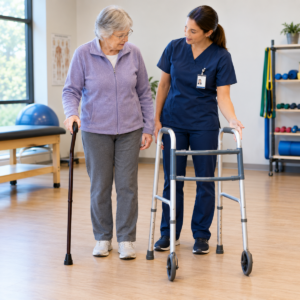
How much support do you need?
The decision begins with function, not appearance. Ask what happens during the most difficult part of the day. Someone who walks steadily in the morning but becomes unsteady after lunch may need a different solution from someone with pain in one knee but good balance and endurance.
| What you notice | A stick or cane may be enough when… | A walker may deserve evaluation when… |
|---|---|---|
| Balance | The person needs an occasional touch point and remains upright without pulling on the handle. | The person sways, reaches for furniture, or needs support on both sides. |
| Leg weakness or pain | One side is mildly weaker or painful and the other side is dependable. | Both legs are weak, weight bearing is limited, or a cane does not reduce the instability. |
| Endurance | Short walks are manageable without leaning heavily or stopping unexpectedly. | The person tires quickly, needs planned rest, or loses form as the walk continues. |
| Coordination | The person can move the stick with the affected leg and keep a steady rhythm. | The cane sequence is confusing or the person repeatedly places the tip in an unsafe position. |
| Environment | Routes are narrow but clear, level, and predictable. | Long hallways, community trips, or uneven transitions require a larger support base. |
If a person has to pull upward on a cane to avoid falling, the cane may not provide enough support. That is a reason to pause and request a professional mobility assessment rather than simply buying a heavier stick.
What is the difference between a walking stick and a walker?
A walking stick contacts the ground at one point and is usually held in one hand. A medical cane is also a one-handed aid, although it may have one tip or a multi-point base. A walker surrounds the user’s front and sides with a frame and normally requires both hands. That wider support area changes how the person stands, turns, approaches a chair, and moves through a doorway.
Some recreational walking sticks are designed for trails rather than clinical support. Their handles, tips, shock absorption, and length-adjustment systems may not be appropriate for someone who relies on the device inside the home. A device marketed for hiking should not automatically be treated as a substitute for a properly fitted cane.
A walker also demands enough hand control, upper-body capacity, judgment, and space. The broadest device is not always the safest if the user cannot manage it. A frame that catches furniture or is placed too far ahead can create a new fall risk.
Fit matters for both sticks and walkers
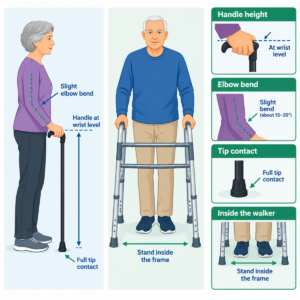
Handle height affects posture and control. A walking aid that is too high can lift the shoulder and reduce leverage. One that is too low can encourage bending and place extra load on the arms and back. The user’s everyday shoes should be worn during fitting because heel height changes body position.
Check a walking stick or cane
- The handle should sit near wrist level when the person stands upright with arms relaxed.
- The elbow should remain slightly bent while the handle is held.
- The tip should make full contact with the floor and should not be cracked, hardened, loose, or worn smooth.
- The locking mechanism on an adjustable shaft should be fully engaged.
- The handle should be comfortable without forcing the wrist into a painful angle.
Check a walker
- Both handles should be the same height unless a clinician has prescribed otherwise.
- The user should stand inside the frame rather than pushing it far ahead.
- Rubber tips, wheels, glides, brakes, and folding locks should match the manufacturer’s configuration.
- The width should fit the narrowest required doorway with room for hands and elbows.
- The frame should remain stable when the user applies the amount of support expected during walking.
What about a walker with wheels and a seat?
A walker with wheels and a seat is usually a rollator rather than a standard walker. It can move smoothly and provide a place for a planned rest, but it normally offers less resistance to forward movement. The user must be able to control the brakes, keep the device close, turn without crossing the feet, and sit only after the brakes are fully locked.
Before using a seated walker, check that the seat fits, both brake levers can be reached and squeezed, the frame remains stable during a turn, and the caregiver can handle folding or lifting without strain.
Comfort matters, but brake control and walking stability come first. A seat should not be used while the walker is moving, and the person should not be pushed while seated unless the exact device is specifically designed and approved for transport use.
A seated walker can be useful for planned rest breaks, but it is not the right substitute when a person needs a device that resists forward movement or more support during standing.
Can you carry a walking stick on a walker?
Some people use a walker for longer routes and a cane for short transfers. That can be reasonable after professional training, but the unused device must be carried securely. A loose cane hung over a frame can swing into the user’s legs, fall into a wheel, catch a doorway, or change the balance of the walker.
Use only a holder or attachment that the walker manufacturer allows for that exact frame. Check that it does not block folding, brakes, wheels, reflectors, a seat, or the user’s hand position. Do not improvise with cords that can stretch, unravel, or create a loop near the wheels.
Changing devices during a route should be planned, not improvised while standing without support. Make the change beside a stable chair, rail, or caregiver and practice the sequence with a therapist if balance is limited.
How to test a walking aid safely
Begin on a dry, level surface with a sturdy chair nearby. Wear the shoes normally used for walking. A helper should stand close enough to assist without pulling on the device or changing the user’s natural movement.
- Check the equipment. Confirm height settings, tips, wheels, brakes, fasteners, and folding locks.
- Practice standing still. The person should be able to place both feet securely and find the handles without reaching dangerously.
- Take several slow steps. Watch whether the device stays close, the shoulders remain relaxed, and the feet clear the frame.
- Practice a wide turn. The person should take small steps instead of twisting sharply on one leg.
- Approach a chair. Back up until the legs touch the seat, reach for the armrests when appropriate, and sit under the technique taught by the clinician.
- Repeat after a brief walk. Fatigue can reveal problems that are not obvious during the first few steps.
Stop the test if the person becomes dizzy, short of breath, confused, painful, or unable to control the device. Do not use stairs, curbs, wet floors, or outdoor slopes as the first trial area.
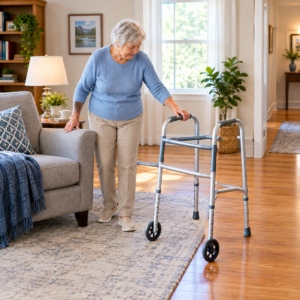
Prepare the home for the chosen walking aid
A walking aid works only when the route around it is usable. Remove clutter, secure cords, repair loose flooring, and improve lighting between the bed, bathroom, kitchen, and main exit. Rugs that curl or slide should be secured or removed.
Measure doorways at the narrowest point, including door hardware. Make sure the user can reach switches and open doors without abandoning the aid. If a walker is stored across the room, the unsupported steps required to reach it can defeat the purpose of having it.
Keep frequently used items within easy reach so the person does not carry objects in both hands. A small approved walker bag or a securely worn shoulder bag may help, provided it does not interfere with balance or controls.
When to reassess the device
Walking ability changes. Reassessment is appropriate after a fall, surgery, hospitalization, medication change, new pain, rapid fatigue, or a noticeable decline in balance. It is also needed when the user begins leaning much harder on the aid, catches a foot on the frame, stops using one brake, or avoids important rooms because the device does not fit.
Equipment wear can look like a change in the person. A worn cane tip, uneven walker glide, loose handle, misaligned wheel, or weak brake cable may alter the movement pattern. Inspect the device regularly and follow the manufacturer’s maintenance instructions.
Common questions about sticks and walkers
These answers reinforce the central choice: use the aid that provides enough support, fits the person and home, and can be used with control.
Is a walking stick safer than a walker?
Neither is automatically safer. A stick is simpler and smaller but provides less support. A walker offers a wider base but requires more space, coordination, and hand use. Safety depends on fit, the person’s abilities, and the environment.
Can a walking stick replace a medical cane?
Not always. A recreational stick may have a different grip, tip, length, or locking system. Someone who relies on the device for daily balance should have the actual stick evaluated and fitted.
When is a walker better than a cane?
A walker may be better when support is needed on both sides, balance remains poor with a cane, the person reaches for furniture, or fatigue causes the walking pattern to deteriorate. A professional assessment is the safest way to confirm the change.
Can you switch between a cane and a walker?
Yes, some people use different devices for different routes. The transition should be practiced, and each device should be fitted. The cane must be secured when carried on the walker.
Are seated walkers suitable for everyone?
No. The user must be able to control the rolling frame and brakes. A rollator may move too easily for someone who needs a device that resists forward motion.
What should I do if the walking aid feels unstable?
Stop using it in risky areas and check the fit, tips, wheels, brakes, and locks. Contact the prescribing clinician, therapist, supplier, or manufacturer rather than compensating with a faster or more awkward walking pattern.
Final decision checklist
- The device provides enough support without encouraging heavy leaning.
- The height and handle position fit the user in everyday shoes.
- The user can start, stop, turn, and sit safely.
- The device fits every required doorway and storage location.
- Tips, wheels, brakes, and locks are intact.
- The user understands when and where each device should be used.
- A clinician has reviewed the choice when falls, pain, weakness, or coordination are concerns.
The right choice is the device that supports a repeatable, controlled walking pattern in the places the person actually goes. Start with function, fit, and safety; product features come later.