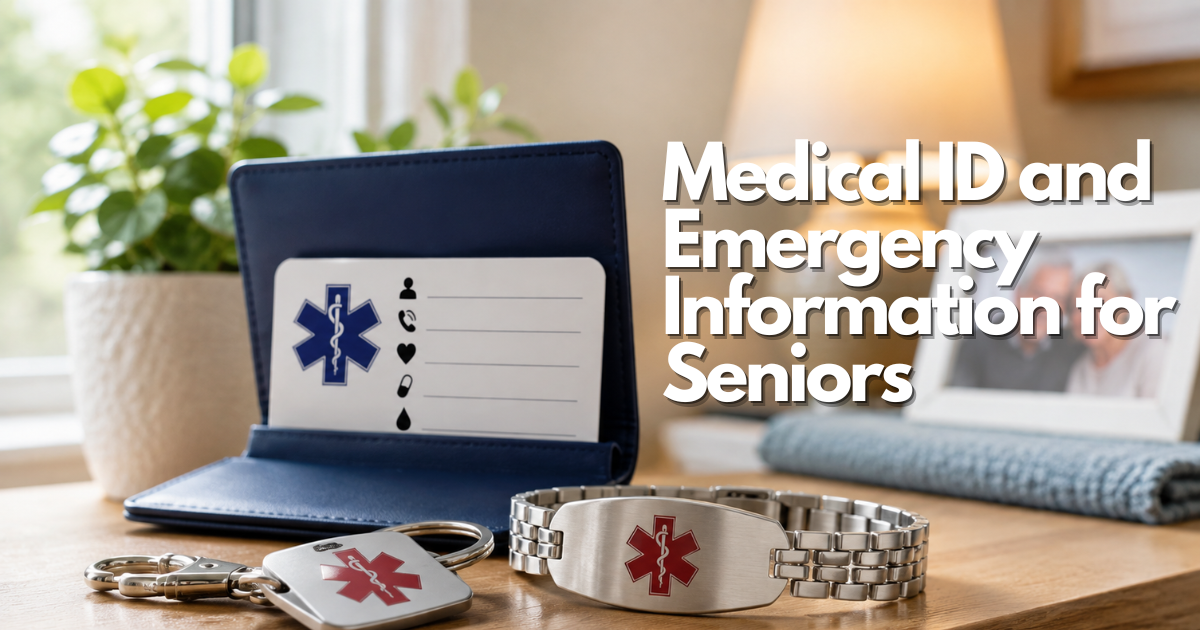
Medical ID For Seniors: What belongs in this guide
Medical ID for seniors content should explain what a wearable signal can and cannot do, how to keep emergency information current, and how to balance visibility with privacy.
The primary topic is medical id for seniors. Approved support phrases include bracelet medical id; medical id bracelet; medical bracelet id; my medical id bracelet; id medical bracelet; medical id bracelet with qr code; medical id bracelets with qr code; best medical id bracelet for men. They clarify category decisions without creating competing pages.
Use medical id for seniors as the broad starting point, then move to the narrow question that matches the person and the setting.
- Identify the person and the outcome this category must support.
- Match the option with the environment, caregiver, privacy, and emergency plan.
- Separate broad education from brand reviews, local searches, and narrow child intents.
- Verify current instructions, limits, service, and total ownership cost.
A decision starts with the person and setting
MedlinePlus and NIA support medical identification as part of wider emergency preparation; information must remain concise and current.
Two options can look similar online and behave differently under stress. This guide therefore treats fit, control, connection, maintenance, consent, and human support as part of the decision.
Eight decisions that matter more than marketing
The following framework turns a broad product search into observable questions. Complete it with the older adult and, when risk or medical complexity is present, with a qualified rehabilitation or healthcare professional. A specification is useful only when it connects to a real task.
Person and task
Decision question: For medical id & emergency information, what should a family verify about person and task before choosing an option?
In a medical id & emergency information decision, person and task changes the practical fit, burden, and safety. Consider the person, the task, the environment, and the support available.
Practical check: For this medical id & emergency information question, write down the exact task, observe it in the real setting, and compare the result with the manufacturer information and professional advice.
Pause and reassess when: For medical id & emergency information, pause when the person cannot control the option, the setting requires an untested workaround, or the plan depends on a claim that cannot be verified.
Fit and access
Decision question: For medical id & emergency information, what should a family verify about fit and access before choosing an option?
In a medical id & emergency information decision, fit and access changes the practical fit, burden, and safety. Consider the person, the task, the environment, and the support available.
Practical check: For this medical id & emergency information question, write down the exact task, observe it in the real setting, and compare the result with the manufacturer information and professional advice.
Pause and reassess when: For medical id & emergency information, pause when the person cannot control the option, the setting requires an untested workaround, or the plan depends on a claim that cannot be verified.
Control and usability
Decision question: For medical id & emergency information, what should a family verify about control and usability before choosing an option?
In a medical id & emergency information decision, control and usability changes the practical fit, burden, and safety. Consider the person, the task, the environment, and the support available.
Practical check: For this medical id & emergency information question, write down the exact task, observe it in the real setting, and compare the result with the manufacturer information and professional advice.
Pause and reassess when: For medical id & emergency information, pause when the person cannot control the option, the setting requires an untested workaround, or the plan depends on a claim that cannot be verified.
Coverage and connection
Decision question: For medical id & emergency information, what should a family verify about coverage and connection before choosing an option?
In a medical id & emergency information decision, coverage and connection changes the practical fit, burden, and safety. Consider the person, the task, the environment, and the support available.
Practical check: For this medical id & emergency information question, write down the exact task, observe it in the real setting, and compare the result with the manufacturer information and professional advice.
Pause and reassess when: For medical id & emergency information, pause when the person cannot control the option, the setting requires an untested workaround, or the plan depends on a claim that cannot be verified.
Privacy and consent
Decision question: For medical id & emergency information, what should a family verify about privacy and consent before choosing an option?
In a medical id & emergency information decision, privacy and consent changes the practical fit, burden, and safety. Consider the person, the task, the environment, and the support available.
Practical check: For this medical id & emergency information question, write down the exact task, observe it in the real setting, and compare the result with the manufacturer information and professional advice.
Pause and reassess when: For medical id & emergency information, pause when the person cannot control the option, the setting requires an untested workaround, or the plan depends on a claim that cannot be verified.
Caregiver support
Decision question: For medical id & emergency information, what should a family verify about caregiver support before choosing an option?
In a medical id & emergency information decision, caregiver support changes the practical fit, burden, and safety. Consider the person, the task, the environment, and the support available.
Practical check: For this medical id & emergency information question, write down the exact task, observe it in the real setting, and compare the result with the manufacturer information and professional advice.
Pause and reassess when: For medical id & emergency information, pause when the person cannot control the option, the setting requires an untested workaround, or the plan depends on a claim that cannot be verified.
Service and cost
Decision question: For medical id & emergency information, what should a family verify about service and cost before choosing an option?
In a medical id & emergency information decision, service and cost changes the practical fit, burden, and safety. Consider the person, the task, the environment, and the support available.
Practical check: For this medical id & emergency information question, write down the exact task, observe it in the real setting, and compare the result with the manufacturer information and professional advice.
Pause and reassess when: For medical id & emergency information, pause when the person cannot control the option, the setting requires an untested workaround, or the plan depends on a claim that cannot be verified.
Medical ID For Seniors: Backup plan
Decision question: For medical id & emergency information, what should a family verify about backup plan before choosing an option?
In a medical id & emergency information decision, backup plan changes the practical fit, burden, and safety. Consider the person, the task, the environment, and the support available.
Practical check: For this medical id & emergency information question, write down the exact task, observe it in the real setting, and compare the result with the manufacturer information and professional advice.
Pause and reassess when: For medical id & emergency information, pause when the person cannot control the option, the setting requires an untested workaround, or the plan depends on a claim that cannot be verified.
Ownership, service, and disruption planning
Mobility equipment must remain usable after the first week. Include cleaning, inspection, storage, service, transportation, changing health needs, and an alternative plan. Do not accept a product whose safe-use instructions, compatible parts, or service route are unclear.
Setup
For medical id & emergency information, plan how setup will work after the first week, including who will explain it and where information will be kept.
Maintenance point: For this medical id & emergency information setup, check the relevant parts, settings, battery or signal status, cleaning, updates, and service contacts on a documented schedule.
Backup point: For medical id & emergency information, keep a simple alternative plan for power, coverage, damage, travel, caregiver absence, or a changed health need.
Daily use
For medical id & emergency information, plan how daily use will work after the first week, including who will explain it and where information will be kept.
Maintenance point: For this medical id & emergency information setup, check the relevant parts, settings, battery or signal status, cleaning, updates, and service contacts on a documented schedule.
Backup point: For medical id & emergency information, keep a simple alternative plan for power, coverage, damage, travel, caregiver absence, or a changed health need.
Power or signal
For medical id & emergency information, plan how power or signal will work after the first week, including who will explain it and where information will be kept.
Maintenance point: For this medical id & emergency information setup, check the relevant parts, settings, battery or signal status, cleaning, updates, and service contacts on a documented schedule.
Backup point: For medical id & emergency information, keep a simple alternative plan for power, coverage, damage, travel, caregiver absence, or a changed health need.
Cleaning and updates
For medical id & emergency information, plan how cleaning and updates will work after the first week, including who will explain it and where information will be kept.
Maintenance point: For this medical id & emergency information setup, check the relevant parts, settings, battery or signal status, cleaning, updates, and service contacts on a documented schedule.
Backup point: For medical id & emergency information, keep a simple alternative plan for power, coverage, damage, travel, caregiver absence, or a changed health need.
Travel
For medical id & emergency information, plan how travel will work after the first week, including who will explain it and where information will be kept.
Maintenance point: For this medical id & emergency information setup, check the relevant parts, settings, battery or signal status, cleaning, updates, and service contacts on a documented schedule.
Backup point: For medical id & emergency information, keep a simple alternative plan for power, coverage, damage, travel, caregiver absence, or a changed health need.
Caregiver handoff
For medical id & emergency information, plan how caregiver handoff will work after the first week, including who will explain it and where information will be kept.
Maintenance point: For this medical id & emergency information setup, check the relevant parts, settings, battery or signal status, cleaning, updates, and service contacts on a documented schedule.
Backup point: For medical id & emergency information, keep a simple alternative plan for power, coverage, damage, travel, caregiver absence, or a changed health need.
Service
For medical id & emergency information, plan how service will work after the first week, including who will explain it and where information will be kept.
Maintenance point: For this medical id & emergency information setup, check the relevant parts, settings, battery or signal status, cleaning, updates, and service contacts on a documented schedule.
Backup point: For medical id & emergency information, keep a simple alternative plan for power, coverage, damage, travel, caregiver absence, or a changed health need.
Medical ID For Seniors: Emergency backup
For medical id & emergency information, plan how emergency backup will work after the first week, including who will explain it and where information will be kept.
Maintenance point: For this medical id & emergency information setup, check the relevant parts, settings, battery or signal status, cleaning, updates, and service contacts on a documented schedule.
Backup point: For medical id & emergency information, keep a simple alternative plan for power, coverage, damage, travel, caregiver absence, or a changed health need.
Real-world trial scenarios
Equipment should be tested as part of a complete activity, not as an isolated object. The following scenarios expose access, control, fatigue, caregiver, and maintenance problems that can remain invisible in a showroom. A trial is not permission to exceed the person’s care plan or the manufacturer’s instructions.
An ordinary day
Set up the trial: For medical id & emergency information, use the exact configuration in a realistic route or emergency scenario. A meaningful trial uses the person’s ordinary footwear, usual assistive devices, realistic timing, and the exact equipment configuration being considered.
Observe: Observe medical id & emergency information control, reach, comprehension, comfort, privacy, and what happens when the first plan fails. Watch the person and caregiver throughout the complete task rather than judging the equipment from a single successful moment.
Compare: Compare the medical id & emergency information result with the person’s needs, the written instructions, and the service or response promise. Record objective observations, settings, dimensions, assistance, and any reminders so alternatives can be compared without relying on memory.
Boundary: For medical id & emergency information, stop when safety relies on guessing, rushing, ignored consent, or a person compensating beyond their ability. Stop the trial if safety depends on catching, lifting, uncontrolled movement, ignored instructions, or a workaround the manufacturer or care plan does not permit.
A difficult route
Set up the trial: For medical id & emergency information, use the exact configuration in a realistic route or emergency scenario. A meaningful trial uses the person’s ordinary footwear, usual assistive devices, realistic timing, and the exact equipment configuration being considered.
Observe: Observe medical id & emergency information control, reach, comprehension, comfort, privacy, and what happens when the first plan fails. Watch the person and caregiver throughout the complete task rather than judging the equipment from a single successful moment.
Compare: Compare the medical id & emergency information result with the person’s needs, the written instructions, and the service or response promise. Record objective observations, settings, dimensions, assistance, and any reminders so alternatives can be compared without relying on memory.
Boundary: For medical id & emergency information, stop when safety relies on guessing, rushing, ignored consent, or a person compensating beyond their ability. Stop the trial if safety depends on catching, lifting, uncontrolled movement, ignored instructions, or a workaround the manufacturer or care plan does not permit.
A caregiver handoff
Set up the trial: For medical id & emergency information, use the exact configuration in a realistic route or emergency scenario. A meaningful trial uses the person’s ordinary footwear, usual assistive devices, realistic timing, and the exact equipment configuration being considered.
Observe: Observe medical id & emergency information control, reach, comprehension, comfort, privacy, and what happens when the first plan fails. Watch the person and caregiver throughout the complete task rather than judging the equipment from a single successful moment.
Compare: Compare the medical id & emergency information result with the person’s needs, the written instructions, and the service or response promise. Record objective observations, settings, dimensions, assistance, and any reminders so alternatives can be compared without relying on memory.
Boundary: For medical id & emergency information, stop when safety relies on guessing, rushing, ignored consent, or a person compensating beyond their ability. Stop the trial if safety depends on catching, lifting, uncontrolled movement, ignored instructions, or a workaround the manufacturer or care plan does not permit.
A disrupted or urgent situation
Set up the trial: For medical id & emergency information, use the exact configuration in a realistic route or emergency scenario. A meaningful trial uses the person’s ordinary footwear, usual assistive devices, realistic timing, and the exact equipment configuration being considered.
Observe: Observe medical id & emergency information control, reach, comprehension, comfort, privacy, and what happens when the first plan fails. Watch the person and caregiver throughout the complete task rather than judging the equipment from a single successful moment.
Compare: Compare the medical id & emergency information result with the person’s needs, the written instructions, and the service or response promise. Record objective observations, settings, dimensions, assistance, and any reminders so alternatives can be compared without relying on memory.
Boundary: For medical id & emergency information, stop when safety relies on guessing, rushing, ignored consent, or a person compensating beyond their ability. Stop the trial if safety depends on catching, lifting, uncontrolled movement, ignored instructions, or a workaround the manufacturer or care plan does not permit.

Questions for a supplier, retailer, or clinician
Ask for answers in writing when they affect compatibility, capacity, warranty, returns, insurance, or service. A product page can be outdated or describe a related configuration rather than the exact item delivered. Keep the model and version attached to every answer.
- What exact task and user ability does this option need to support?
- What are the coverage, signal, battery, power, or access limits?
- Who will set up, explain, inspect, and maintain it?
- What happens when the person cannot press, hear, see, carry, or remember the device?
- Which information is collected, shared, stored, or printed?
- What are the fees, contract, return, warranty, and service terms?
- What professional or manufacturer help is available?
- What is the tested backup if the primary plan fails?
Do not treat “medical grade,” “premium,” “smart,” “portable,” “heavy duty,” “upright,” “all terrain,” or “caregiver friendly” as measurable claims unless the seller explains the test, limit, and exact configuration. A high review average cannot replace manufacturer instructions or an individualized assessment.
Common selection and use mistakes
Mistakes often begin with a reasonable goal—speed, independence, comfort, or lower cost—but skip an important constraint. Recognizing the pattern early prevents an unsuitable product from becoming a permanent workaround.
Medical Id & Emergency Information: choosing by a single feature
A family may select a medical id & emergency information option because one feature sounds reassuring while overlooking coverage, fit, training, or maintenance.
Better approach: For medical id & emergency information, use a short decision record that names the task, constraint, evidence, and unresolved risk. Document the reason for the decision so another caregiver, editor, or clinician can understand what was tested and what remains unresolved.
this topic: Medical Id & Emergency Information: assuming “senior” is one use case
Older adults differ in hearing, vision, dexterity, cognition, mobility, language, privacy preferences, and caregiver access.
Better approach: Test the actual person and medical id & emergency information routine rather than relying on an age label. Document the reason for the decision so another caregiver, editor, or clinician can understand what was tested and what remains unresolved.
Medical Id & Emergency Information: confusing availability with suitability
A medical id & emergency information product or service can be easy to order yet difficult to use, charge, explain, return, or repair.
Better approach: Verify the complete medical id & emergency information ownership path before paying or relying on it. Document the reason for the decision so another caregiver, editor, or clinician can understand what was tested and what remains unresolved.
Medical Id & Emergency Information: treating a backup as automatic
A second medical id & emergency information device or printed record is not useful if it is outdated, inaccessible, untested, or incompatible.
Better approach: Assign an owner and a review date for every medical id & emergency information backup. Document the reason for the decision so another caregiver, editor, or clinician can understand what was tested and what remains unresolved.
Delivery, follow-up, and reassessment
Delivery is the beginning of ownership, not the final QA step. Verify the exact product, condition, components, instructions, training, settings, and return deadline. Reassessment should respond to the person, caregiver, environment, and equipment as each changes.
Medical Id & Emergency Information: first setup
At first use: Record the exact medical id & emergency information model or service configuration, settings, contacts, and training completed.
Over time: Review the medical id & emergency information routine after the first few uses and after any change in health, home, vehicle, or caregiver.
Escalate when: Escalate when the promised medical id & emergency information response, fit, privacy, or control does not match the documented need.
Medical Id & Emergency Information: monthly reality check
At first use: Ask whether the person still uses and understands the medical id & emergency information plan.
Over time: Check medical id & emergency information supplies, batteries, coverage, labels, contacts, and access routes.
Escalate when: Escalate after a missed medical id & emergency information alert, false confidence, fall, failed transfer, inaccessible route, or repeated confusion.
Medical Id & Emergency Information: travel or disruption
At first use: Decide how the medical id & emergency information plan works away from home, during outages, and when a caregiver is absent.
Over time: Keep current medical id & emergency information instructions and a backup contact with the person.
Escalate when: Escalate if the medical id & emergency information plan cannot be verified in the new setting.
Medical Id & Emergency Information: change in condition
At first use: Treat new weakness, falls, confusion, hearing loss, or medication changes as a reason to reassess the medical id & emergency information plan.
Over time: Do not silently adapt medical id & emergency information equipment or service beyond its instructions.
Escalate when: Seek qualified help when the change affects medical id & emergency information safety or emergency communication.
Emergency and backup planning
The responsible person should know where the full record is kept, how it is updated, and what information the wearer consents to share.
Keep a phone or alert method accessible, label equipment without exposing unnecessary private information, and place manuals and service numbers where caregivers can find them. A backup device must be fitted, inspected, and included in the care plan; equipment borrowed during an emergency is not automatically safe.
After a fall, collision, uncontrolled movement, hard impact, flood, fire exposure, or airline handling, remove the equipment from use until its safety can be confirmed. Seek appropriate medical attention for injury or concerning symptoms. Do not hide a failure with tape, improvised fasteners, mixed parts, or a caregiver’s physical effort.
Documented plan for medical id for seniors
Turn the research into a short, documented decision record.
This broad hub explains the role and limits of medical ID; engraving, QR, brand, and shopping questions remain separate.
- Define the person and task.
- Measure the environment and access route.
- Verify the exact device or service limits.
- Test setup and failure scenarios.
- Document cost, privacy, support, and backup.
Medical ID For Seniors: Record what was rejected
Record options rejected because of fit, coverage, privacy, cost, complexity, or unavailable service.
Set the next review date
Set a review date and repeat the assessment after any material change.
What this Hub intentionally does not answer
This broad hub provides education and decision structure; it does not rank current models or answer every narrow child query.
Use official instructions and qualified help for any safety-critical setup, installation, transfer, or emergency plan.
How future child guides should connect
Future child guides must own narrower questions and remain inactive until separately reviewed.
Until a child guide is published and reviewed, its cluster card remains visible as navigation architecture but not as an active link. This protects readers from broken destinations and prevents unpublished URLs from being treated as finished advice.
Frequently asked questions
What should be decided first?
Start with the person, the task, the environment, and the consequence of a failure before comparing medical id options.
Can technology replace a caregiver?
No. It can support a plan, but it cannot replace consent, check-ins, clinical judgment, or emergency services.
What should families record?
Keep the exact device or service, settings, contacts, limitations, fees, privacy choices, and review date.
When should the plan be reassessed?
After a missed alert, outage, fall, new symptom, medication change, move, or caregiver change.
Choose the information before the format
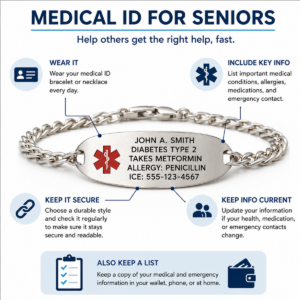
A medical ID bracelet, necklace, wallet card, phone record, and QR-linked file solve different communication problems. Start by identifying which condition, allergy, medication, device, or emergency instruction a responder may need to notice quickly. Keep the wearable concise and place the fuller record somewhere maintained by a responsible person. Do not engrave a diagnosis that is uncertain, outdated, or too vague to guide urgent care. The goal is accurate signal, not a crowded surface.
Write the observation down, identify the responsible person, and set a date to review it. This keeps the broad Hub useful without turning one narrow question into a competing page.
Visibility and comfort affect use
An ID that irritates skin, catches on clothing, opens easily, or draws unwanted attention may be left at home. Test the clasp, material, size, contrast, readability, and bathing or sleep routine. Ask the wearer whether a bracelet, necklace, tag, card, or discreet alternative feels acceptable. The best medical ID bracelet for men or women is not a demographic universal; it is a comfortable, readable format the person will keep with them.
Write the observation down, identify the responsible person, and set a date to review it. This keeps the broad Hub useful without turning one narrow question into a competing page.
QR codes add a second system
A medical id bracelet with qr code depends on a visible code, a charged phone, a camera, network access, an accessible page, and a reader willing to use it. It must not replace a short visible warning that can be understood without technology. Review what the QR destination exposes and how quickly it can be changed. If a service closes or a link expires, the printed object may still circulate. Schedule a test from a second phone and remove unnecessary personal data.
Write the observation down, identify the responsible person, and set a date to review it. This keeps the broad Hub useful without turning one narrow question into a competing page.
Keep a change log
Medication lists, allergies, clinicians, contacts, implanted devices, and emergency preferences change. Put a review date on the wallet card and digital record, and give one person responsibility for updating every location. Compare the wearable with the full record after a hospital discharge, new prescription, diagnosis, or move. A current medical bracelet id is useful only when the information remains accurate. Old information can create confusion or cause a responder to act on a condition that no longer applies.
Write the observation down, identify the responsible person, and set a date to review it. This keeps the broad Hub useful without turning one narrow question into a competing page.
Balance public information and privacy
A wearable is visible by design, but the wearer may not want a full diagnosis, address, or phone number exposed. Discuss what strangers, first responders, service staff, and online viewers can learn. A QR service may have account controls, but the user must understand them. Use the minimum information that can change emergency care and keep sensitive details in a protected record. Consent should be revisited when a caregiver, diagnosis, or living arrangement changes.
Write the observation down, identify the responsible person, and set a date to review it. This keeps the broad Hub useful without turning one narrow question into a competing page.
Medical ID For Seniors: Coordinate the people around the record
Tell family, caregivers, clinicians, and trusted neighbors what the medical ID means and where the fuller emergency information lives. Do not assume a bracelet can explain a complex care plan. Add a plain-language note for the person, a professional contact, and an emergency route. Rehearse what a caregiver does after seeing a missing bracelet, an unreadable engraving, or a QR link that does not open. The record needs an owner and a backup owner.
Write the observation down, identify the responsible person, and set a date to review it. This keeps the broad Hub useful without turning one narrow question into a competing page.
Use digital records as complements
A phone emergency-information card, lock-screen message, paper wallet card, and wearable can reinforce one another, but duplication increases update work. Decide which record is authoritative and how the others are checked. Make accessibility part of the test: text size, language, contrast, voice access, and offline availability. A digital record that requires a password a responder cannot use may fail at the exact moment it is needed.
Write the observation down, identify the responsible person, and set a date to review it. This keeps the broad Hub useful without turning one narrow question into a competing page.
Review the plan without panic
A medical ID is not a prediction of an emergency. It is a practical communication tool for a possibility. Review it calmly on a calendar, after health changes, and after any event that exposes a gap. Ask the older adult what feels respectful and useful. This keeps the device from becoming a frightening symbol and makes the information more likely to remain current, worn, and understood.
Write the observation down, identify the responsible person, and set a date to review it. This keeps the broad Hub useful without turning one narrow question into a competing page.
Make the wearable readable
Use high contrast, plain abbreviations, durable engraving, and enough spacing for a responder to read quickly. Avoid unexplained codes that only a family member understands. If space is limited, prioritize the information most likely to change urgent care and place the full record elsewhere. Test readability in daylight, low light, and with ordinary glasses. Replace a scratched, loose, or illegible item rather than assuming a responder will decipher it.
Plan for lost or removed items
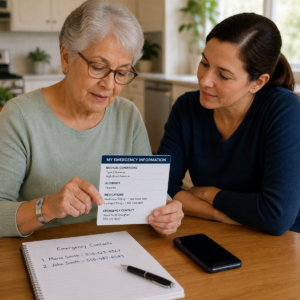
A bracelet can be removed for surgery, bathing, sports, imaging, or comfort. Decide where it goes and how the person remains identified during that gap. Keep the wallet card and phone record synchronized, and tell caregivers who retrieves the wearable. If a QR service is used, maintain the account and confirm the link after updates. A backup is only useful when somebody knows it exists and checks it.
Finish with a calendar reminder
Pick a date for a medical ID review and connect it to another routine, such as a medication review or annual appointment. Ask whether the wearer still accepts the information and the amount of privacy it reveals. Confirm contacts, allergies, devices, medicines, language, and consent. A modest, current record is safer than a detailed but abandoned one.
Keep every copy aligned
Compare the wearable, wallet card, phone emergency record, QR destination, caregiver notes, and clinician list. If one copy says an allergy is current and another says it is resolved, the family must clarify the discrepancy rather than letting a responder guess. Assign one owner to make changes and a second person to check that the change reached every format. Store the review date with the record, not only in a private calendar.
Do not place a full medication list or home address on a public bracelet simply because there is space. Use the smallest useful signal on the wearable and a protected, fuller record elsewhere. Recheck readability after engraving, printing, or a digital redesign. Ask the older adult whether the wording still feels accurate, respectful, and acceptable to wear in public. Keep the update responsibility visible to the whole care team today.
Sources used for this guide
MedlinePlus and NIA support the framework; they do not prescribe wording for a specific condition or endorse a product.
- Medical alert bracelet — MedlinePlus, U.S. National Library of Medicine.
- Recognizing medical emergencies — MedlinePlus, U.S. National Library of Medicine.
- Aging in Place: Growing Older at Home — National Institute on Aging.
Build a safer plan
Return to the Safety & Alert Resource Center for broad preparation; focused child pages remain inactive until reviewed.