This guide explains how to check coverage without assuming that an advertisement, a family member’s plan, or a general online answer applies to you. It also explains what to ask about equipment, monthly monitoring, activation fees, replacements, travel use, returns, and the difference between a covered benefit and a discount. It is educational information, not insurance, legal, or medical advice.

The short answer: coverage is plan-specific
When people ask whether United Healthcare medical alert systems are covered, they often mean several different things at once: whether the device itself is paid for, whether a monthly monitoring fee is paid for, whether a fall-detection feature is included, whether a doctor must recommend it, and whether a particular company is approved. Those questions can have different answers under the same plan. A plan may cover a limited set of equipment, contribute a fixed amount, offer a contracted supplier, or provide a related benefit that does not pay the full ongoing service cost.
UnitedHealthcare directs members to their individual plan information for complete benefit details. That is the appropriate starting point when researching United Healthcare medical alert systems. A coverage statement is reliable only when it identifies the exact plan, benefit period, service, supplier rules, cost sharing, and any conditions that apply. If a representative cannot confirm those points, ask for the answer in writing or ask where it appears in the Evidence of Coverage, Summary of Benefits, or member portal.
What counts as a medical alert systems for a coverage question
A medical alert system is usually a combination of an emergency-help button and a way to reach a response service or chosen contacts. It can be a pendant, wrist button, in-home base unit, cellular device, mobile unit, smartwatch, or a device with optional fall detection. These are not interchangeable benefits. A plan might describe the service as a personal emergency response system, PERS, emergency response service, remote support, durable medical equipment, supplemental benefit, or safety program.
Before calling, write down the exact service you are considering. Note whether it works at home only or away from home, whether it needs a landline, whether it uses cellular service, whether fall detection is optional, and whether the fee is a one-time purchase, rental, subscription, or a mixture. This makes the conversation concrete and reduces the chance of receiving a generic answer about a different type of medical alert system.
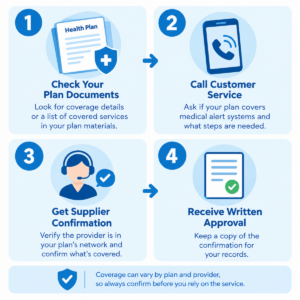
How to verify United Healthcare coverage step by step
1. Find the plan name and member materials
Use the ID card and member portal to identify the exact plan. Keep the plan name, group number when applicable, state, and current plan year available. Benefits can change at renewal, so an older brochure or a web search result is not enough. Look for plan documents that discuss supplemental benefits, home safety, personal emergency response, durable medical equipment, or care-management programs.
2. Ask about the service and every fee separately
Ask whether the plan covers the equipment, installation or activation, monthly monitoring, cellular service, fall detection, shipping, replacement units, and cancellation fees. A member should not interpret coverage of a device as coverage of every subscription feature. Ask whether the benefit is a reimbursement, direct billing arrangement, allowance, discount, or fully covered service after any deductible or copayment.
3. Ask about eligibility and authorization
Some benefits have eligibility rules. Ask whether a clinician order, functional assessment, diagnosis, care-manager referral, prior authorization, or documentation of a safety need is required. Also ask when approval must occur: before purchase, before shipment, or before activation. If authorization is needed, ask who submits it and how you will know it was approved.
4. Ask which suppliers can be used
Even when coverage exists, it may apply only to a contracted supplier or a specific program. Ask for the supplier name, telephone number, ordering steps, shipping process, return policy, and what happens if the chosen device is not suitable. Buying first from an unrelated retailer can create a payment problem even when a similar service would have been available through the plan.
5. Record the confirmation
Write down the date, representative’s name or ID, reference number, the language used to describe the benefit, and any remaining steps. Request written confirmation through the secure message system or mail if possible. This record is useful if a later bill, denial, or supplier conversation does not match what was explained. When evaluating United Healthcare medical alert systems, keeping this documentation can help you verify what was actually approved and under which terms.
Questions to ask before choosing among medical alert systems
When evaluating United Healthcare medical alert systems, coverage is only one part of a safe choice. A person may need a home system with a base unit, a mobile device that works beyond the home, a wearable button that is comfortable to keep on, or a service with particular language and contact preferences. Ask who answers an alert, how they verify an emergency, what happens if the user cannot speak, whether the system can contact family first, and whether the response plan can be changed as needs change.
Also ask about testing and maintenance. A device is not useful simply because it is covered. The person needs to be able to wear or carry it, press it, hear it, charge it when needed, and understand what will happen after an alert. Test it according to the provider’s instructions and make sure the contact list, address, apartment number, gate instructions, and medication or allergy information are current where the service allows those details.
Why a fall-detection feature deserves a separate answer
For United Healthcare medical alert systems, fall detection should be reviewed separately from the base emergency response benefit. Automatic fall detection is not the same as a button press, and it should not be treated as a guarantee that every fall will be detected. Coverage, availability, and cost for this feature may differ from the base device. Ask whether it is optional, whether a separate monthly charge applies, how it can be turned off, and whether the person can still press the button if an automatic alert does not occur.
A thoughtful decision begins with the person’s everyday situation: how often they are alone, whether they can reliably use a button, their history of falls or fainting, their comfort with charging a device, and the availability of nearby help. A clinician, occupational therapist, or care team can help assess safety needs, but they do not replace the plan administrator’s coverage decision.
What to do if the answer is no or unclear
If your question involves United Healthcare medical alert systems, an unclear coverage response should be verified before you purchase or enroll. An initial “not covered” answer may mean that the representative did not find the right benefit category, that a supplier rule was not checked, or that the plan truly excludes the service. Ask which of those applies. Request the specific exclusion or benefit language. If the plan offers an appeal, grievance, care-management, or case-management process, ask how to use it and what documentation would be relevant. Do not assume that submitting a receipt later will change an exclusion.
If the plan offers a discount rather than coverage, compare the full cost carefully. A discount can still be useful, but it is not the same as a covered benefit. Compare the device, activation, monitoring, cellular, fall-detection, return, replacement, and cancellation costs. Avoid choosing a system solely because it appears in a marketing list; first confirm that the service fits the person and that the financial terms are understood.
Prepare for the call with a one-page needs summary
A concise summary helps a member, caregiver, or advocate ask for the right benefit. Start with the living situation rather than a diagnosis alone. Is the person alone for long periods? Do they move between several floors? Are they frequently away from home? Can they hear a base station? Are they likely to remember to charge a mobile device? Is there a neighbor, family member, or building staff member who can help if the first call cannot be completed? These answers guide device selection, but they also make it easier to explain why a particular service is being requested.
Then describe the service, not a marketing label. For example: “a wearable button that can call a monitoring center from home and outdoors,” or “a home-based emergency response unit with a waterproof pendant.” Write down the desired features separately: mobile coverage, fall detection, Spanish-language support, a lockbox, caregiver notifications, or a cellular base unit. A representative may not recognize a brand name, while they may be able to identify a covered category or a participating supplier from the service description.
Finally, collect the practical information a supplier will need if coverage is approved. Confirm the delivery address, apartment and building access instructions, landline availability if relevant, cellular coverage at the home, emergency contacts, and who will help with setup. These details are not insurance eligibility requirements by themselves; they prevent a covered service from becoming frustrating or unusable after it arrives.
Understand common payment arrangements
Plans can structure a personal emergency response benefit in several ways. Direct provision means the member receives the service through an approved program or vendor, usually after meeting the program’s steps. An allowance means the plan contributes up to a stated amount, which may or may not cover all service charges. Reimbursement means the member pays first and submits documents afterward; this approach may have strict timing and proof requirements. A discount program lowers a retail price but does not create an insurance claim. Each arrangement can be valuable, but they should not be confused.
Ask specifically what document will show the member’s responsibility. A verbal statement that something is “available” does not explain whether there is a deductible, a copayment, a monthly maximum, an annual limit, a required contract period, or a charge for optional features. If a representative says the service is “included,” ask whether that includes taxes, cellular connectivity, fall detection, shipping, and replacement equipment. Ask what will happen at the end of the plan year or if the member changes plans.
Do not assume that a plan’s extra benefit is available to every person with the same insurer. Employer-sponsored coverage, individual coverage, Medicare Advantage arrangements, retiree plans, and state-specific programs can use different rules. The member ID card and current plan documents—not a general insurer logo—are what connect a person to the applicable benefit.
When a caregiver calls on someone else’s behalf
A family caregiver can make the verification process more efficient when the member is present and able to give permission, or when the plan has the needed authorization on file. Before calling, ask the member what they are comfortable sharing and whether they want the caregiver listed for future conversations. Have the member ID card available and avoid sending personal health information through ordinary email unless the plan directs you to a secure method.
During the call, focus on the person’s own needs and the exact benefit question. It is useful to ask the representative to explain unfamiliar terms in plain language. If the caller feels pressured to enroll in a service before understanding the cost, they can pause, request the written terms, and call back. A good coverage decision should not depend on a rushed phone conversation.
After the call, share a simple written summary with the person who will use the system: what was approved, what still needs to be done, the supplier contact, any expected cost, and the date to follow up. This avoids a common problem in which one family member assumes another has completed setup or testing.
Safety steps after a device arrives
Read the setup instructions and complete the provider’s test process. Make a non-emergency test call when instructed, confirm that the service has the correct address and contact names, and check whether a lockbox or access instruction is needed. If the device is mobile, test it in the places where the person spends time rather than assuming coverage is identical everywhere. If it is water-resistant or waterproof, use it only as the manufacturer directs.
Build the device into an ordinary routine. A pendant that stays on a dresser, a wrist device removed for every shower, or a mobile unit left uncharged cannot provide the expected help. Choose a wearing or charging routine that is realistic for the person. Review it after a medication change, hospitalization, move, new caregiver arrangement, or change in emergency contacts.
An emergency response device is one part of a safety plan, not a substitute for clinical care, fall prevention, home modifications, or regular contact. Call emergency services immediately in a life-threatening situation. If someone has new weakness, severe chest pain, difficulty breathing, confusion, or symptoms of a stroke, do not wait for an insurance coverage question to be resolved.
How this question differs from Medicare, Medicaid, and other insurers
Coverage rules for Medicare, Medicaid, employer coverage, Medicare Advantage plans, Medigap policies, and other insurers are separate questions. A person can have UnitedHealthcare branding through different kinds of arrangements, so the word “UnitedHealthcare” alone does not identify a coverage rule. Keep your question narrow: “Under my plan, is this named personal emergency response service covered, under what conditions, and through which supplier?”
For a general comparison of service types, the planned SeniorTechLife guide to medical alert systems for seniors will be the appropriate resource when it is published. This page remains focused on the verification process for UnitedHealthcare coverage so that it does not compete with broader buying guides or separate coverage guides.
Documents that can resolve conflicting answers
When a phone answer and an online message do not match, the written plan materials matter. Depending on the type of coverage, useful documents may include a Summary of Benefits, Evidence of Coverage, Certificate of Coverage, benefit grid, rider, annual notice of change, or an employer benefit guide. Search the document for “personal emergency response,” “emergency response,” “home safety,” “supplemental,” “remote,” “monitoring,” and “durable medical equipment.” A missing word does not always prove that a benefit is unavailable, but it gives the representative a focused place to investigate.
Ask the representative to identify the page, benefit name, and rule being used. If they refer to a vendor program, ask whether its enrollment materials state the eligibility and cost. If the service is administered by another company, obtain that company’s details without assuming it can make a final insurance decision. Keep copies of messages and documents in one folder. This is especially helpful during open enrollment, a move, or a switch from employer coverage to retirement coverage.
A denial should also be specific. It might be based on plan exclusion, lack of eligibility, lack of authorization, use of a nonparticipating supplier, an exhausted allowance, or a missing document. Those circumstances call for different next steps. A vague statement that “medical alert systems are not covered” is not enough to tell a member what can be corrected or whether an appeal is appropriate.
Examples of precise questions that produce clearer answers
Instead of asking only, “Do you cover medical alerts?”, try: “Does my current plan have a personal emergency response system benefit?” Then ask: “Does it cover a wearable device, the monitoring subscription, or both?” If you have a provider in mind, ask: “Is this supplier in the approved program for my plan, and can you give me the enrollment instructions?” If fall detection is important, ask: “Is automatic fall detection included, excluded, or separately priced?”
For an in-home device, ask whether a landline is required and whether cellular equipment is included. For a mobile device, ask whether travel outside the home area affects service or coverage. For a person who uses a wheelchair, walker, or other mobility aid, ask whether the device can be worn or positioned safely without interfering with transfers, clothing, charging equipment, or a seat belt. These are usability questions rather than coverage guarantees, but resolving them before enrollment reduces wasted spending.
When an answer includes an allowance, ask what it covers and how often it resets. “Up to” language is not a promise that the full amount will be paid. Ask whether the allowance applies before or after a deductible, whether unused funds carry forward, and whether it can be used only for the plan’s designated service. Ask for a written estimate from the supplier that separates recurring and one-time charges.
Make a decision without turning coverage into the only criterion
When comparing United Healthcare medical alert systems, coverage should be considered alongside usability, reliability, and the person’s everyday needs. It is understandable to focus first on cost. Still, a service that is covered but difficult to use may be less helpful than an affordable alternative that the person will consistently wear and understand. Start with the person’s ability to use the device during an ordinary day. Consider hand strength, vision, hearing, memory, mobility, bathing routine, clothing preferences, phone use, and whether they feel comfortable speaking to a response operator. Include the person in the decision whenever possible; safety planning works better when it respects autonomy and routines.
Test the service’s response pathway with the provider’s approved test process. Ask whether alerts go first to a monitoring center, family contacts, emergency services, or a sequence chosen by the member. Confirm that emergency contacts know their role. A daughter who lives several states away may be an important contact but should not be the only plan for a time-sensitive emergency. A neighbor’s availability can change. Review the response plan at least after major life events.
Read the service agreement before accepting delivery. Look for renewal terms, trial period, cancellation procedure, return deadline, replacement charges, lost-device policy, and who owns the equipment. If a claim will be submitted, save the invoice, order confirmation, proof of payment, and any authorization number. These practical records matter whether the plan pays directly or the member seeks reimbursement.
When to seek help beyond the member-services call
Member services is normally the first stop, but it may not be the only resource. A plan care manager may understand supplemental programs, an employer benefits office may clarify a group-plan option, and a state health-insurance assistance program may help an eligible Medicare beneficiary understand coverage documents. A clinician or occupational therapist can discuss functional needs and safe use, although neither can promise that a plan will cover a particular service.
If a member believes a claim or authorization was handled incorrectly, use the plan’s formal appeal or grievance instructions and deadlines. Submit only accurate information and keep copies. The appropriate route depends on the plan and the reason given. Do not rely on a sales representative to resolve an insurance dispute, and do not cancel a functioning service during an appeal without arranging another safe way to call for help.
In an immediate emergency, call 911 or the local emergency number. A medical alert service can be a valuable layer of support, but it is not a substitute for emergency care or professional clinical advice. This distinction is particularly important when a person has new symptoms, repeated falls, a sudden decline in mobility, or a caregiver who can no longer safely provide the needed support.
Does United Healthcare cover medical alert systems when needs change?
A benefit that was useful last year may have different terms after renewal, a plan change, a move, or a change from home-based to mobile service. Recheck coverage when the person’s needs change rather than assuming the original approval applies forever. For example, a person who is no longer comfortable using a landline-based unit may need a different type of service; a person returning from a hospital stay may need additional support while routines are being rebuilt. The right next step is to ask whether the current plan covers the new service arrangement and whether a new authorization is necessary.
Update the emergency plan at the same time. Confirm emergency contacts, apartment access information, preferred hospital where appropriate, and the person’s ability to hear or operate the device. If a caregiver begins sharing responsibilities, make sure everyone understands the difference between a test alert, a monitoring-center call, and an emergency that requires calling 911. A clear plan prevents a device from becoming a false sense of security.
Coverage questions often feel bureaucratic, but the underlying goal is simple: ensure the service is financially understood and genuinely usable for the person who may need it. Taking a few extra minutes to verify the details can prevent an avoidable surprise later.
Keep the final confirmation with the device records
Store the benefit confirmation, supplier order number, service agreement, test date, and cancellation instructions together. A caregiver may need them after a hospitalization or a move, when details are harder to reconstruct. Set a reminder to review the plan at renewal and to test the device according to the provider’s directions. If a bill arrives that does not match the confirmation, contact the plan and supplier promptly with the reference number and documents at hand.
This small record also helps the person remain involved: it makes clear what the service does, who should be contacted, and what the family should not assume about insurance coverage.

Coverage call checklist
- What is the exact benefit name in my plan?
- Is the device, monitoring service, or both covered?
- What deductible, copayment, allowance, or limit applies?
- Is authorization, a clinician order, or a care-manager referral required?
- Must I use a particular supplier?
- Are cellular service and fall detection included or extra?
- How are replacements, returns, and cancellations handled?
- Can you send the coverage decision and reference number in writing?
Frequently asked questions
Can I order a device before I call?
It is safer to verify the benefit and supplier rules first. A purchase made outside an approved process may not be reimbursed, even if a similar service could have been available through the plan.
Does a doctor’s recommendation guarantee coverage?
No. A recommendation may support a request when the plan requires documentation, but the plan decides whether its benefit terms are met.
Are the best medical alert systems automatically covered?
No. A system’s reputation, feature list, or online reviews do not determine an individual plan’s benefit. Fit, supplier rules, and the member’s plan terms still matter.
What if a representative gives a different answer later?
Use your written notes and reference number, ask for a supervisor or formal benefit review, and request the applicable plan language. Keep every explanation focused on the exact service and plan year.
Bottom line
Does United Healthcare cover medical alert systems? Sometimes a plan may offer coverage, an allowance, a contracted service, or a related program, but no general answer can replace verification under the member’s own benefits. Confirm the exact service, every ongoing cost, eligibility requirements, supplier rules, and the result in writing before committing. That process protects both the budget and the person who will depend on the system in a stressful moment.