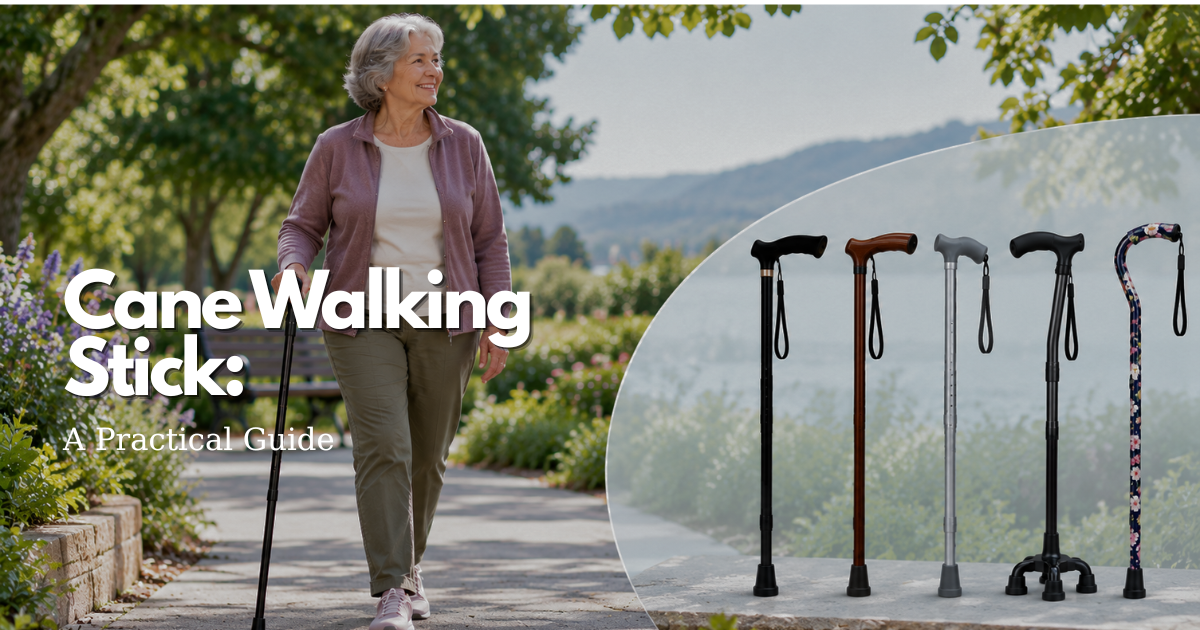
This guide is educational. A clinician or qualified mobility professional should help when balance, pain, transfers, sensation, or a recent fall makes device selection uncertain.
Quick answer
Start with the person, the daily route, and the existing equipment. Identify the problem to solve, confirm fit and compatibility, and test only on a dry, level, clear surface.

Choose by the real need
List the routine first: getting up, moving through doors, carrying essentials, sitting, parking, or walking on uneven surfaces. Avoid adding an item that makes the device heavier, harder to fold, or more difficult to control. Check manufacturer instructions before attaching any accessory or changing a component.
Comfort and convenience matter only when they do not reduce safe fit, stability, or access.
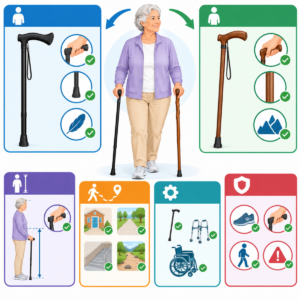
Check fit, condition, and compatibility
Inspect handles, tips, brakes, wheels, fasteners, straps, and adjustment points. A cane or wheelchair accessory should not interfere with transfers, wheel movement, folding parts, emergency access, or a caregiver’s ability to help. Do not rely on a generic product description to determine compatibility.
Practice before daily use
Use a clear indoor area or level pavement for a slow practice session. If the person has to lean, twist, reach, or use more force than expected, pause and reassess. For a new or complex setup, ask a therapist or mobility professional to review it.

Know the difference between a cane and a walking stick
A cane used as a mobility aid is generally selected and fitted to provide reliable support. A walking stick may be used for light support, recreation, or appearance, but it is not automatically an appropriate clinical mobility device. The handle, shaft, tip, height, and intended use affect how much support it can safely provide.
If a person depends on the aid every day, has significant weakness, or has fallen recently, a clinician or therapist should help determine whether a cane, walker, or another option is safer.
Check height, handle, and tip
Wear usual walking shoes and stand upright on level ground. The handle should allow a comfortable elbow bend without lifting the shoulder or forcing a forward lean. The rubber tip must sit flat, show usable tread, and be replaced when it becomes worn or loose.
A decorative handle or wooden shaft can still be unsuitable if it causes wrist pain, slips in the hand, or cannot support the intended use. Treat the device as safety equipment, not only as an accessory.
Use it on an appropriate route
Practice on a dry, clear, level surface before relying on a new cane walking stick outdoors. Avoid using it as a substitute for a handrail on stairs, as a tool for testing unstable ground, or as the only support when the person needs a broader base. Stop and seek advice if the user leans heavily, feels pain, or has near-falls.
Choose the level of support honestly
A cane walking stick can add a point of contact for light support, but it is not designed to replace a walker when a person needs a wider base or relies heavily on the device. Notice how the person moves at home and outdoors. Reaching for walls, pulling on furniture, holding a caregiver’s arm, or leaning hard through the handle can mean the current aid does not provide enough support.
Ask a therapist or clinician for an assessment when there is a new fall, severe weakness, one-sided changes, pain, or uncertainty about the safest device. A more decorative or familiar stick is not necessarily the safest choice.
Learn the basic walking pattern with professional guidance
The safest pattern depends on the reason for using the aid. In many common situations, the aid moves with the weaker or more painful leg, followed by the stronger leg. But individual surgical, neurological, or balance needs can change that instruction. Follow the technique taught by the care team rather than copying a pattern from another person.
Keep the device close enough to control and take short, deliberate steps. Avoid placing it far ahead and pulling the body forward. Practice on dry, level ground before trying uneven paths, crowds, or a long outing.
Handle stairs, curbs, and wet surfaces carefully
A cane walking stick should not replace a handrail. When stairs are unavoidable, obtain individual instruction and use the available handrail whenever possible. Curbs, wet leaves, ice, loose gravel, deep carpet, and uneven pavement can make a rubber tip slide or catch.
Slow down before changes in surface and do not carry items that leave the hands unable to use the aid safely. If the route cannot be completed without rushing or guessing, choose a safer route or ask for assistance.
Maintain the device and replace worn parts
Inspect the tip, shaft, handle, wrist strap if present, and adjustment mechanism regularly. A tip that is smooth, cracked, loose, or uneven should be replaced before it fails. Check adjustable parts after travel or a fall; a height setting that has slipped can change posture and control.
Use parts approved for the device when possible. Do not cover a damaged handle with tape or continue using a cracked shaft because it still feels mostly stable.
Final checklist
Confirm the item addresses a real need, fits the person and device, works with the home route, is in good condition, and has been practiced safely. Reassess whenever mobility or the environment changes.
Cane and walking stick differences that matter
In everyday speech, cane and walking stick may describe the same object, but intended use matters more than the label. A mobility cane is selected to provide repeatable support during ordinary walking. A hiking pole or decorative stick may be intended for occasional terrain feedback, appearance, or recreation. Its handle, tip, shaft, and load rating may not be suitable for continuous medical support.
Ask how much body weight the user places through the aid, whether it is needed indoors, and what happens when fatigue increases. Someone who needs the device for every step should not depend on an item whose manufacturer does not describe it as a mobility aid. A clinician can determine whether one point of support is sufficient.
Choose by function, not by the word printed on the package. A beautiful walking stick that is too tall, slippery, flexible, or unverified can be less useful than a plain adjustable cane that fits correctly.
Single-point, quad, folding, and offset cane walking sticks
A single-point cane is light and easy to position but provides a smaller support base. A quad cane has four contact points and may offer more standing support, yet its wider base can catch a foot or sit unevenly on a slope. An offset cane places the handle over the shaft and may distribute pressure differently through the hand.
A folding cane is convenient for storage but adds joints that must lock fully. A seat cane adds weight and should be used only as its manufacturer directs. White canes used for orientation and mobility serve a different purpose and require specialist training; they should not be treated as interchangeable with support canes.
Compare these types during a professional assessment when balance is changing. More feet or features do not automatically mean more safety. The user must be able to advance, place, and control the exact base without tripping over it.
How to measure a cane walking stick
Wear the shoes normally used for walking and stand upright on level ground with the arms relaxed. MedlinePlus and the American Academy of Orthopaedic Surgeons describe a common starting point in which the handle is near the wrist crease and the elbow remains slightly bent. Individual conditions can require a different setup.
Check height while the person walks, turns, approaches a chair, and uses the normal route. A cane set too high can raise the shoulder and reduce leverage. One set too low can encourage bending and place the tip too far ahead. Adjustable holes or collars must lock completely after every change.
Do not cut a wooden shaft until the intended shoes, tip, and handle position have been confirmed. Cutting is difficult to reverse, and a replacement tip may change final height. When in doubt, have a therapist or qualified supplier complete the fitting.
Cane handle shapes and hand comfort
Common handles include derby, crook, fritz, offset, T-shaped, ergonomic, and palm-grip designs. A larger surface may spread pressure, while a narrow or decorative handle may concentrate it. Arthritis, reduced sensation, weakness, tremor, and wrist pain affect which shape can be controlled safely.
The hand should close around the handle without painful squeezing or slipping. Test it with gloves if gloves are part of the routine. A wrist strap can keep a cane nearby, but it should not be wrapped so tightly that a fall pulls the wrist or prevents release.
Persistent hand, elbow, shoulder, or neck pain is not a normal price of cane use. Recheck height, handle, technique, and whether the person is loading the cane more heavily than a single-point aid can safely support.
Rubber tips, ice tips, and cane traction
The tip is the only part that normally contacts the ground, so its condition directly affects traction. It should fit the shaft securely, sit flat, and retain visible tread. Check it daily when the cane is used often, and replace it when smooth, cracked, hardened, loose, or worn unevenly.
Specialty tips may flex, pivot, widen the base, or add an ice point. Each changes placement and feedback. An ice tip that is useful outdoors can damage floors and become hazardous indoors unless it retracts or is removed. A broad tip may not sit flat on stairs or cross-slopes.
Carry a compatible spare on travel when the cane is essential. Do not repair a split tip with tape or glue. Verify the shaft diameter and manufacturer guidance instead of selecting a replacement by appearance.
Wood, aluminum, carbon fiber, and steel shafts
Wood offers a traditional appearance and can feel solid, but fixed height requires careful sizing and the shaft should be checked for cracks, warping, or moisture damage. Aluminum adjustable canes are common and easy to fit, although buttons and collars must lock. Carbon-fiber designs can be light and stiff but still require inspection after impact.
Steel or reinforced models may support higher published capacities but can be heavier. A listed weight capacity does not prove the cane is appropriate for heavy loading or severe instability. Capacity, handle, tip, height range, and user technique must all agree.
Avoid modifying the shaft, drilling holes, or adding a decorative part that changes strength. After a fall or strong impact, inspect the complete cane even if the damage is not obvious.
Walking sticks versus a cane for outdoor routes
A recreational walking stick may help probe uneven ground and support rhythm on a trail. A mobility cane is usually expected to provide consistent support on indoor and community routes. The correct choice depends on terrain, duration, hand use, footwear, weather, and the person’s balance.
Loose gravel, grass, wet leaves, sand, ice, and cross-slopes can make any small tip slide or sink. A trekking basket or pointed tip is not automatically safe on household flooring. Plan how the device will transition between outdoor and indoor surfaces.
For a person with a fall history or neurologic condition, outdoor walking should be assessed rather than solved by buying a taller stick. A walker, rollator, poles used with professional instruction, or another route may provide safer support.
Safe walking pattern with a cane
For many one-sided weakness or pain patterns, clinicians teach the cane in the hand opposite the affected leg. The cane and weaker leg move forward together, followed by the stronger leg. This can widen support and reduce load, but the exact instruction depends on surgery, diagnosis, coordination, and goals.
Place the tip a short comfortable distance ahead, not far enough to pull the torso forward. Look toward the route, take controlled steps, and turn with several small steps rather than twisting on a planted foot. Do not switch hands simply to carry an object.
This article does not replace the dedicated how-to assets MOB-CA-002 and MOB-CA-003. Anyone learning after surgery, stroke, or a fall should receive individual instruction before practicing alone.
Stairs, curbs, doors, and transfers
A cane does not replace a handrail. A common taught stair sequence is up with the stronger leg and down with the weaker leg and cane, but the user needs individual instruction. If no safe handrail is available or the person cannot coordinate the sequence, use another access plan.
At a door, stop before reaching, stabilize, and avoid holding the door in a way that pulls the body outside the base of support. For sitting, approach until the chair is felt behind the legs, reach for stable armrests, and lower with control. Do not pull on a cane to stand.
Curbs, revolving doors, escalators, crowded aisles, and pets add complexity. Practice each essential route with a therapist or trained helper instead of improvising during a busy outing.
Home safety for walking cane users
A correctly fitted cane cannot compensate for loose rugs, cords, dim lighting, wet floors, clutter, unstable furniture, or pets underfoot. Map the route from bed to bathroom, kitchen, entrance, and preferred chair. Keep enough space to place the cane without striking furniture.
Store the device within reach but not where it can fall across the path. Avoid leaning it against a wall if it repeatedly slides. A freestanding tip can help in some situations, but it changes the base and must remain compatible with the user’s technique.
Review footwear, vision, medications, dizziness, and strength when balance changes. MedlinePlus fall-prevention guidance emphasizes environmental and health factors because a mobility aid is only one part of reducing fall risk.
Traveling with a cane walking stick
Record the cane’s folded or full length and keep the user’s name and contact information on it without exposing unnecessary medical data. During vehicle travel, secure it so it cannot become a projectile. After unfolding or adjustment, confirm every joint and button is locked before standing.
Airlines and venues may have their own screening and storage procedures. Keep the cane available as long as possible, explain that it is an assistive device, and ask for mobility assistance when long distances exceed the user’s ability. Do not place it in an overhead bin where it can fall on another passenger.
Bring a spare tip and the model information on longer trips. New terrain, fatigue, crowds, and unfamiliar bathrooms may justify a backup mobility plan even when the cane works well at home.
Cane maintenance and replacement schedule
Inspect the handle, shaft, adjustment button, locking collar, tip, strap, and accessories. Listen for new clicking and feel for movement between parts. Clean according to the manufacturer’s directions and keep water out of mechanisms not designed to be submerged.
Replace the entire device when the shaft is cracked, bent, badly corroded, or no longer locks reliably. A used cane can be reasonable only when its history, capacity, fit, and condition are known. The low cost of a basic replacement is rarely worth risking structural failure.
Reassess after a fall, hospitalization, new diagnosis, medication change, or noticeable decline. The correct height and device category can change as strength, posture, footwear, and the home environment change.
Cane walking stick comparison table
| Type | Best use | Main limitation |
|---|---|---|
| Single-point cane | Light support and easy placement | Small support base |
| Quad cane | Greater standing support when clinically appropriate | Heavier base can catch or sit unevenly |
| Folding cane | Travel and storage | Joints must lock fully |
| Recreational walking stick | Terrain feedback and hiking | May not be rated as a daily mobility aid |
Frequently asked questions about cane walking sticks
Is a walking stick the same as a cane?
Sometimes, but not always. Confirm intended use, fit, tip, handle, and load guidance.
Which hand should hold a cane?
For many one-sided problems, clinicians teach the hand opposite the affected leg. Follow individual instruction.
Can a cane prevent every fall?
No. Fit, technique, health, footwear, vision, medication, and environment all matter.
How often should the tip be replaced?
Inspect frequently and replace when smooth, cracked, hardened, loose, or uneven.
Official cane safety sources
Cane walking sticks after a fall
A fall can change confidence, gait, pain, and the amount of support a person needs. Replacing a damaged tip or buying a heavier cane without an assessment may hide a new medical or functional problem.
Report the fall and any head impact, new pain, dizziness, weakness, or confusion. Ask a clinician or physical therapist to reassess gait and the support category before returning to the usual route.
Inspect the shaft, handle, tip, height setting, and any folding joints. Recreate the circumstances of the fall only in a safe professional assessment, not as an unsupervised test.
Practical outcome: The person resumes walking with a device and route matched to current ability rather than relying on the pre-fall setup.
Cane walking stick use after surgery
Weight-bearing restrictions and walking patterns differ after hip, knee, foot, ankle, and other procedures. A cane may be introduced only after crutches or a walker, or it may not be appropriate for the recovery stage.
Use the surgeon’s and therapist’s instructions for which hand holds the cane, how much weight may be placed, stair sequence, and when to progress. Do not advance because pain is temporarily controlled.
Bring the prescribed brace or footwear to fitting. Observe swelling, fatigue, incision protection, transfers, and the ability to follow the sequence late in the day.
Practical outcome: The cane supports the rehabilitation plan without encouraging premature weight bearing or unsafe independence.
One-sided weakness and neurologic conditions
Stroke, neuropathy, Parkinsonian symptoms, multiple sclerosis, and other neurologic conditions can affect timing, sensation, vision, attention, and foot clearance as well as strength.
A therapist should select the device and teach the pattern. The familiar opposite-hand rule may be appropriate in many cases, but coordination, neglect, tremor, or hand weakness can require another solution.
Watch whether the tip lands consistently, the weaker foot clears, turns remain controlled, and the user notices hazards on both sides. Reassess when medication or symptoms change.
Practical outcome: The chosen aid supports the person’s actual movement pattern instead of oversimplifying a complex condition.
Arthritis and painful hands
Hand arthritis may make a narrow handle, hard surface, small adjustment button, or tight folding joint difficult. Pain can reduce grip precisely when support is needed.
Compare handle shape, diameter, material, and required force. An ergonomic or larger handle may spread pressure, but it must not prevent a secure release or place the wrist at an awkward angle.
Test several minutes of walking, transfers, opening a door, and setting the cane aside. Check for numbness, redness, shoulder elevation, and loss of control.
Practical outcome: The user can hold and operate the cane throughout the routine without trading balance support for hand pain.
Cane walking sticks for taller and shorter users
A cane that falls outside the user’s height range cannot be made safe through posture compensation. Very tall and very short users may also find that standard handle and tip proportions feel wrong.
Verify published adjustment range with normal shoes and intended tip installed. For a fixed wooden cane, use professional sizing before cutting. Never extend a shaft with an improvised tube.
Check handle height, elbow angle, shoulder position, tip placement, and whether the adjustment button has enough tube engagement at the selected setting.
Practical outcome: The device fits without operating at an unsafe limit or forcing the user to lean and reach.
Higher-capacity cane walking sticks
A higher listed weight capacity can be important, but the user’s body weight is not the same as the force placed through the cane. Heavy reliance can exceed what a single point of support should provide.
Use a clinical assessment to decide whether a reinforced cane, quad cane, walker, or other device is appropriate. Compare the complete system, including handle, shaft, adjustment, and tip.
Confirm the rating from the manufacturer, inspect for flex or looseness, and ensure the wider or heavier design does not interfere with the feet or route.
Practical outcome: Support capacity and support category are both addressed, rather than treating a larger number as the entire solution.
Cane walking sticks in winter weather
Cold can harden rubber tips, snow hides uneven ground, and ice can defeat ordinary traction. Gloves may reduce grip, while bulky clothing changes reach and visibility.
Use a safer route, assistance, or another mobility plan when surfaces are not controllable. An ice tip may help under limited conditions but requires training and safe retraction indoors.
Check weather, cleared entrances, lighting, footwear, tip condition, and where the ice attachment will be changed without standing unsupported.
Practical outcome: The outing is postponed or adapted when conditions exceed the device, instead of trusting an accessory to eliminate winter risk.
When to replace a cane with a walker
A person may continue using a cane because it is familiar, compact, or less stigmatizing even after balance or strength has declined. Furniture walking and repeated near-falls are important clues.
Discuss the change respectfully and arrange an assessment. A walker or rollator has different advantages and control demands, so the replacement must also be fitted and taught.
Observe morning and evening performance, longer routes, transfers, turns, and the amount of caregiver contact. Include the person’s goals and home dimensions.
Practical outcome: The mobility plan provides enough support while preserving as much independence and dignity as possible.
Cane walking stick storage beside a chair
A cane left flat on the floor becomes a trip hazard, while one leaned against furniture may slide away.
Use a compatible holder, stable stand, or consistent reachable location that does not block the transfer path.
Practice reaching only after the person is fully stable. Never use an unsecured cane to pull up from sitting.
Practical outcome: The aid remains accessible without creating the next fall hazard.
Carrying personal items while using a cane
A drink, plate, phone, pet leash, or shopping bag can occupy the hand needed for balance and change posture.
Use a small backpack, cross-body bag, or caregiver help. Keep loads light and do not hang weight from the cane.
Test door opening and transfers with the carrying system before a longer outing.
Practical outcome: Both hands and attention remain available for safe movement.
Cane walking sticks and pets
Pets can cross the cane path, pull a leash, or move toward a dropped item without warning.
Separate early practice from pets and arrange gates, feeding locations, and leash help around the person’s route.
Observe morning and nighttime routines when animals and lighting may be less predictable.
Practical outcome: The household plan reduces collisions instead of expecting the cane user to react quickly.
Questions for a cane fitting appointment
A useful fitting covers the reason for support, device category, height, hand, walking pattern, stairs, home surfaces, and reassessment.
Bring usual shoes, current cane, fall history, and photographs of difficult routes. Ask for the technique in writing.
Demonstrate walking, turning, sitting, standing, and the most important route before leaving.
Practical outcome: The user and caregiver understand not only what to buy but how to recognize when it no longer works.
Cane walking stick pre-use check
Before each outing, confirm the handle is secure, the shaft is straight, the height lock is engaged, and the tip has usable tread. Look at the first part of the route for water, clutter, pets, or a surface change.
If anything has changed, correct the environment or use the backup plan before walking. Do not test a questionable cane by loading it heavily.
Keep the spare tip and supplier information where caregivers can find them.
Practical outcome: A sixty-second check prevents avoidable equipment and route failures.
Cane walking stick review after the first week
The first days reveal hand discomfort, poor storage, difficult turns, and routes that were not obvious during fitting.
Ask the user what feels easier and what is still avoided. Observe rather than relying only on confidence.
Recheck height, tip wear, shoulder position, pace, and near-falls with the clinician when needed.
Practical outcome: Early feedback produces a safer long-term setup.