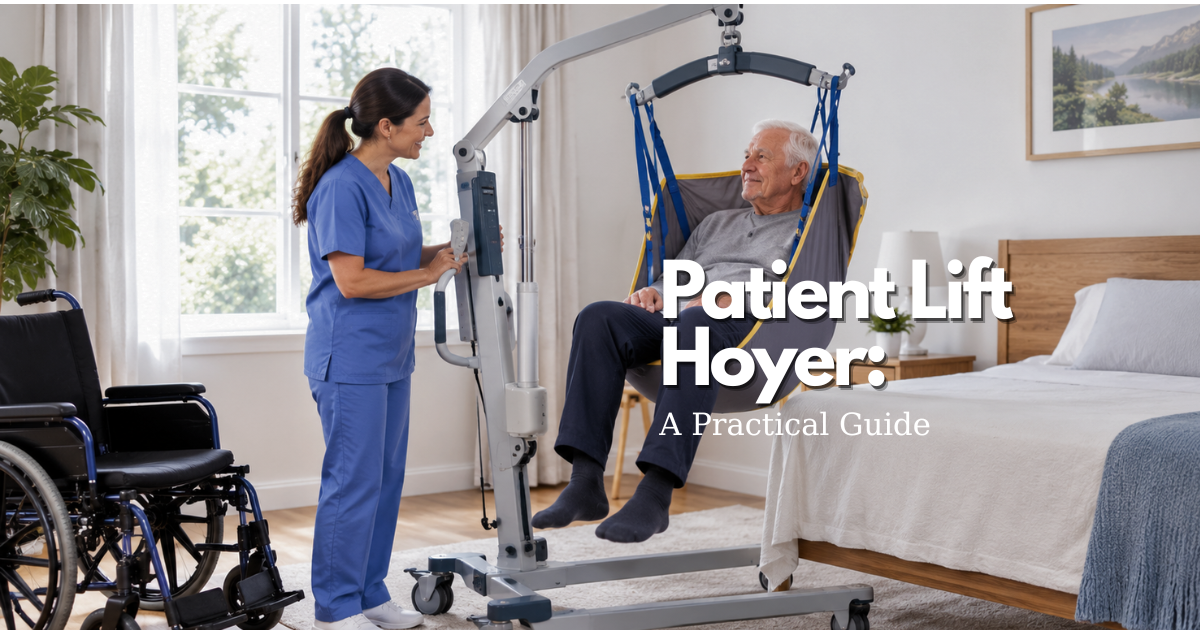
Do not buy a lift before a qualified professional identifies the transfer, sling, user, caregivers, and room conditions it must support. A patient lift is a system, and every part of that system has to match.
A patient lift Hoyer system can help move a person between a bed, wheelchair, commode, or other supported surface while reducing hazardous manual lifting. “Hoyer lift” is commonly used as a general name for a patient lift, but Hoyer is also a product brand. The important decision is not the familiar name; it is whether the selected lift type, sling, safe working load, base width, lifting range, and transfer plan fit the individual.
Patient lifts can reduce risk, but they are not self-explanatory appliances. The U.S. Food and Drug Administration warns that improper use can lead to serious injury, including falls, head trauma, fractures, and death. Training, manufacturer-approved sling compatibility, inspection, maintenance, and a person-specific transfer plan are essential.
Quick answer: what is a Hoyer patient lift?
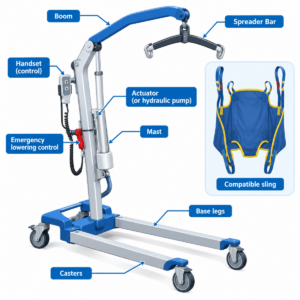
A Hoyer patient lift is a mechanical transfer device that uses a boom, spreader or sling bar, and a compatible sling to raise and move a person who cannot complete a transfer safely with ordinary standing assistance. Mobile floor lifts travel on casters and usually use either a hydraulic pump or battery-powered actuator. Other systems include sit-to-stand lifts and fixed or portable overhead lifts.
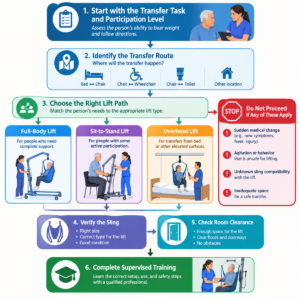
A full-body mobile lift is not the same as a sit-to-stand device. A sit-to-stand lift generally requires the user to meet specific participation, weight-bearing, trunk-control, and cognitive requirements. A full-body sling lift supports a more dependent person. A clinician should decide which transfer method is appropriate.
How a Hoyer patient lift works
The sling supports the person’s body and connects to attachment points on the lift’s spreader bar. The boom raises the spreader bar, which lifts the sling and the person. The caregiver then moves or positions the lift so the person can be lowered onto a prepared receiving surface.
Powered models normally use a rechargeable battery and electric actuator. Manual models commonly use a hydraulic pump. The FDA describes both categories and notes that designs differ by manufacturer. A battery model can reduce pumping effort, while a manual hydraulic model may be useful where charging access is limited. Neither category is automatically safer; compatibility, condition, training, and correct technique matter more than the power source alone.
The lift’s casters, base shape, and turning radius determine whether it can approach a bed, move through a doorway, and turn beside a wheelchair. The lowest and highest attachment positions determine whether the system can reach the intended surfaces. A model may be described as portable or folding, but the actual folded dimensions, weight, disassembly steps, and safe setup procedure must be verified in its official manual.
Who may benefit from a patient Hoyer lift
A full-body lift may be considered when a person cannot reliably bear enough weight, stand, pivot, or follow the sequence needed for another transfer method. It may also be appropriate when manual handling would expose the person or caregiver to an unacceptable risk of falling or musculoskeletal injury.
The decision depends on more than a diagnosis. The assessment should consider alertness, ability to follow directions, pain, skin condition, joint range, muscle tone, body shape, weight distribution, amputations, tubes or medical devices, behavioral changes, and whether abilities vary with fatigue or medication.
OSHA’s safe patient-handling guidance emphasizes systematic assessment of the person’s mobility needs and selection of equipment for the actual task. In a home, that means identifying each transfer rather than assuming one setup covers everything. Bed-to-wheelchair, floor recovery, toileting, bathing, and vehicle transfers can require different equipment, space, and training.
When a full-body lift may not be the right device
A mobile lift may not fit beneath a low bed or around a wide recliner. It may not turn in a small bathroom. A person who becomes severely agitated, grabs the frame, or cannot tolerate the sling may need a different care plan. Some individuals who can participate safely may be better served by a sit-to-stand device or another transfer aid, but that should be decided by a qualified clinician.
Do not use a patient lift as a walking device, restraint, routine chair, or transport vehicle unless the manufacturer explicitly describes that use. Do not suspend a person longer than necessary, and never leave anyone unattended in a raised sling.
Full-body, sit-to-stand, mobile, and overhead lift differences
| Lift type | Typical role | User participation | Critical planning issue |
|---|---|---|---|
| Mobile full-body lift | Supports a dependent transfer in a sling | May require little weight bearing, but the plan is individualized | Under-bed clearance, turning space, sling compatibility, and caregiver training |
| Mobile sit-to-stand lift | Assists a seated person toward standing and another seated surface | Usually requires specific weight-bearing, trunk, grip, and cooperation abilities | Clinical eligibility and correct standing sling or support system |
| Ceiling or overhead lift | Moves along a fixed or portable overhead track | Varies by sling and task | Structural assessment, track coverage, transfer route, and professional installation |
| Manual hydraulic mobile lift | Full-body transfer using a hand pump | Similar clinical considerations to powered full-body lifts | Pumping effort, emergency lowering, maintenance, and floor space |
| Powered mobile lift | Full-body transfer using a battery actuator | Similar clinical considerations to manual full-body lifts | Battery readiness, charger access, emergency lowering, and maintenance |
This article focuses on the general full-body Hoyer patient lift category. It does not replace the separate planned guides for sling selection, lifts for sale, home-use lifts, sit-to-stand lifts, electric lifts, hydraulic lifts, ceiling lifts, or floor-recovery devices. Those topics are recorded as planned internal destinations and are not linked until published.
Hoyer patient lift slings are not interchangeable
The sling is not a generic accessory. The FDA states that no sling is suitable for every patient lift and advises users to match the sling to the specific lift and the person’s weight. The lift manufacturer must approve the sling for use with that lift.
Sling design affects head support, leg position, toileting access, skin exposure, comfort, and the person’s posture while suspended. Size labels are not standardized across every manufacturer. A “medium” from one product family may not match another brand’s dimensions or attachment geometry.
Compatibility must be documented
Confirm the lift model, spreader-bar design, attachment type, sling model, sling size, safe working load, and intended transfer. Do not assume loops can replace clips or that a four-point sling fits a six-point bar. If the manual or compatibility chart is unclear, contact the manufacturer or qualified supplier before use.
Inspect the sling before every transfer
Look for frayed fabric, damaged seams, stretched loops, cracked clips, illegible labels, contamination, or changes after laundering. The FDA advises not to use a sling with signs of wear. Follow the manufacturer’s cleaning method because heat, bleach, or an incorrect process may weaken materials.
Position and attachment require hands-on training
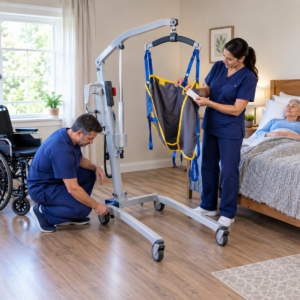
Sling placement changes with the transfer and the person’s needs. The FDA safety guide instructs users to center the sling under the spine, keep leg straps flat, use balanced matching loops, prevent twisted straps, secure all attachments, and provide head or back support when required. These are safety principles, not a complete transfer procedure for every sling.
Do not learn sling placement by experimenting with a dependent person. Receive hands-on instruction using the exact lift and sling. Ask the clinician or equipment provider to observe a complete transfer in the actual room.
Room measurements before choosing a portable patient lift
Many purchase problems begin with capacity specifications and overlook geometry. Measure the open base width, closed base width, overall length, turning radius, mast height, and the clearance required by the boom. Compare these measurements with doorways, furniture, walls, and the receiving surface.
Check under-bed clearance at the point where the legs of the lift must enter. Adjustable beds may have motors, crossbars, or low frames that block the base. A thick rug may reduce effective clearance and make casters harder to move. Confirm whether the lift must approach from the side or foot of the bed.
For wheelchair transfers, verify that the lift can position the person over the seat without the boom, sling bar, knees, footrests, or base colliding. Remove or swing away wheelchair components only as the wheelchair manufacturer permits. Lock the receiving device as directed before lowering.
Flooring changes maneuverability
A lift that rolls easily on hard flooring may be difficult to push on deep carpet or across thresholds. High pushing force can place the caregiver in an awkward posture and make precise positioning harder. Test the route with the actual expected load under professional supervision.
Storage and charging are part of the plan
A powered lift needs an accessible charging routine. Storage should not block an exit or leave the device where children or visitors can operate it. Keep compatible slings clean, dry, labeled, and available. OSHA notes that equipment cannot protect users if it is broken, uncharged, inaccessible, or missing the necessary supplies.
Safe working load and patient weight
The lift, spreader bar, sling, scale attachment, and accessories may have different limits. The system is governed by the lowest applicable limit, not the largest number printed on the lift frame. Weight alone is also insufficient: body shape, height, limb position, and distribution affect fit and clearance.
Never estimate a person’s weight when the result could approach a limit. Ask a clinician or supplier how to obtain an appropriate current measurement. Bariatric transfers need equipment, sling sizing, space, and caregiver planning designed for the individual.
Preparing for a transfer with a Hoyer lift for a patient
A written person-specific plan should identify the starting and receiving surfaces, lift and sling, number of trained caregivers, attachment configuration, relevant precautions, communication method, and what to do if the transfer cannot continue. Reassess before each transfer because fatigue, pain, confusion, illness, medication, and lines or tubes can change risk.
Pre-transfer safety check
- Confirm the person and the planned transfer.
- Check that the person’s current condition matches the care plan.
- Verify the exact lift, sling, size, attachment method, and safe working loads.
- Inspect the lift, sling, clips or loops, spreader bar, controls, battery, and emergency-lowering system.
- Clear the route and position the receiving surface.
- Explain the transfer in calm, simple steps and obtain cooperation when possible.
- Use the number of trained caregivers required by the assessment, manufacturer, employer, or care plan.
If anything is unfamiliar, damaged, uncharged, poorly fitted, or different from the plan, stop. Time pressure is not a reason to improvise.
General transfer principles and critical stop points
Only trained users should operate the device, following the exact manufacturer instructions and care plan. Keep the person low during necessary movement, maintain communication, and watch the sling and attachments continuously. The FDA recommends keeping the base legs in the maximum open position for stability and making sure clips, latches, and hanger bars remain secure.
Do not pull a lift by the boom, spreader bar, or person. Use the designated push handles and body position described in training. Move slowly, avoid abrupt turns, and do not cross slopes or thresholds that the manufacturer does not permit.
Stop immediately if an attachment shifts, the sling fabric stretches abnormally, the lift tilts, a caster catches, the person becomes distressed, a line or tube pulls, the actuator behaves unpredictably, or an unusual sound occurs. Lower the person safely if possible under the trained emergency procedure and take the equipment out of service until evaluated.
Wheel locks are task-specific
The receiving wheelchair, stretcher, bed, or chair is generally secured as directed so it does not move during the transfer. The handling of the patient lift’s own casters can differ by model and transfer phase. Follow the lift manual and hands-on training instead of applying a universal lock rule.
Emergency lowering is not optional knowledge
Before the first transfer, every operator should know where the emergency stop and emergency-lowering controls are and how they work on that model. A powered lift should have a plan for low battery or power failure. Practice the approved procedure without a suspended person unless a trainer directs otherwise.
Manual hydraulic versus portable electric patient lifts
A hydraulic lift uses a pump handle to raise the boom and a control valve to lower it. It does not depend on a charged battery, but pumping can add caregiver effort and may be difficult in tight spaces. Lowering must be smooth and controlled.
A portable electric patient lift uses a battery-powered actuator. It may provide smoother raising with less pumping effort, but charging, battery condition, handset function, and emergency lowering become part of routine readiness. A spare battery is useful only if the manufacturer supports that arrangement and the battery is maintained.
Folding does not mean the lift is easy for one person to transport. Verify total weight, the weight of any removable component, folded dimensions, safe lifting points, reassembly steps, and post-assembly inspection. Do not transport a lift with a person in the sling.
Understanding Hoyer Advance and Hoyer Journey searches
The keyword data includes searches for the Hoyer Advance E 340 portable lift and the Hoyer Journey sit-to-stand lift. These are not interchangeable product types. A full-body mobile lift and a stand aid support different transfer abilities and use different support systems.
Joerns describes the Hoyer Journey as a compact folding stand aid and publishes a product manual and sling-selection materials. Because model specifications and availability can change, SeniorTechLife does not reproduce a purchase recommendation in this general guide. Verify the current official manual, safe working load, dimensions, sling compatibility, and clinical eligibility before considering any exact model.
Model names may be used differently in resale listings. Confirm the identification label and serial information rather than relying on a seller’s title. Check the FDA recall database and manufacturer notices before acquiring used equipment.
Buying, renting, or receiving a used patient lift
A supplier should do more than deliver a box. Ask who assesses the person, who selects and sizes the sling, who trains each caregiver, who services the lift, and what happens if the device does not fit the home. Obtain the manual, compatibility documentation, warranty terms, maintenance schedule, and service contact.
Rental may make sense for a temporary recovery or to evaluate fit, but the same assessment and training requirements apply. Confirm which slings are included, how cleaning is handled, who is responsible for maintenance, and whether a replacement is available if the lift fails.
Used lifts require caution. Missing labels, unknown service history, worn casters, an old battery, incompatible slings, unapproved modifications, or an active recall can create serious risk. Have the device inspected by a qualified technician and obtain manufacturer documentation before use.
Medicare coverage for patient lifts
CMS recognizes patient lifts within the durable medical equipment benefit when applicable coverage requirements are met. A covered item generally must satisfy benefit-category, medical-necessity, documentation, ordering, and supplier rules. Some related transfer devices or home modifications are noncovered.
Coverage is not determined by the word “Hoyer” in a product listing. Before ordering, ask the treating practitioner and Medicare-enrolled supplier which HCPCS code applies, what documentation is required, whether rental or purchase rules apply, and whether the supplier accepts assignment. Medicare Advantage plans may have separate networks or prior-authorization procedures.
Do not assume the sling, installation changes, bathroom remodeling, delivery, or every accessory is included. Request a written explanation of covered and noncovered items and appeal information when appropriate.
Cleaning and maintenance
Follow the lift and sling manuals. Establish a checklist for casters, base adjustment, mast and boom connections, spreader bar, attachment points, actuator or hydraulic system, controls, battery, charger, emergency stop, emergency lowering, labels, and fasteners.
Remove the lift from service when movement changes, a component loosens, hydraulic fluid appears, the actuator stalls, a battery will not hold charge, a caster binds, or an attachment point looks damaged. Do not make improvised repairs or substitute hardware.
Maintain sling records separately. Labeling should remain readable, and laundering should follow the exact instructions. The FDA recommends a maintenance safety inspection checklist and immediate replacement of worn or damaged parts.
Common patient lift mistakes
- Choosing a lift before assessing the transfer. Product capacity cannot compensate for the wrong lift category.
- Assuming any sling will fit. Compatibility must be approved and documented.
- Training only one caregiver. Everyone who may perform the transfer needs competency with the exact system.
- Ignoring room geometry. A lift that cannot approach the bed or turn safely cannot perform the intended task.
- Using a sit-to-stand lift for a person who cannot participate as required. Eligibility must be clinically assessed.
- Skipping inspection because the previous transfer went well. Wear or setup can change between uses.
- Trying to stop a falling person by grabbing or lifting manually. This can injure both parties; follow the emergency plan.
- Buying used equipment without recall and service checks. The apparent price may hide missing parts or unsafe history.
Building a person-specific lift and transfer plan
A useful plan describes more than “use the Hoyer lift.” It states which lift, which sling, which attachment configuration, which transfer, which receiving surface, how many trained caregivers, and which precautions apply. It should be available to everyone who may perform the task and updated when the person’s condition or equipment changes.
Start by listing every routine transfer separately: bed to wheelchair, wheelchair to commode, wheelchair to shower equipment, repositioning in bed, and possible floor recovery. A lift approved for one task may not reach or fit another. Vehicle transfers are especially specialized and should not be assumed from the word “portable.”
Document the person’s ability to communicate discomfort and the signs that mean stop. Pain, fear, spasm, skin pulling, breathing difficulty, nausea, agitation, or a sudden change in alertness should prompt reassessment. Include lines, catheters, oxygen tubing, feeding tubes, wounds, and joint precautions in the professional plan.
Plan the destination before raising the person
The receiving surface should be ready, positioned, and secured as directed. Wheelchair cushions, footrests, armrests, recline, and tilt settings can affect positioning. A commode opening or shower chair requires the correct sling and access route. Do not leave setup decisions until someone is suspended.
Define caregiver roles
When two caregivers are required, decide who operates the lift and who monitors the person, sling, attachments, lines, and destination. Use clear verbal checkpoints before raising, moving, and lowering. If either caregiver sees a problem, the transfer stops.
Family members sometimes divide tasks informally, which can lead both people to assume the other checked an attachment. A written checklist prevents this. The checklist should be short enough to use and specific enough to catch the highest-risk errors.
Competency is more than watching a demonstration
A delivery demonstration is helpful, but competency means the caregiver can prepare, inspect, operate, respond to a problem, and complete the transfer with the exact equipment in the actual environment. The trainer should observe each caregiver and correct technique.
Training should include sling identification, sizing, placement, attachment, balanced loop or clip selection, spreader-bar clearance, base positioning, controls, emergency stop, emergency lowering, charging or hydraulic operation, movement, cleaning, inspection, and storage. It should also explain tasks the lift must not perform.
Repeat training after a long gap, a new sling, a replacement lift, a move to another room, or a change in the person’s abilities. A caregiver who feels rushed, injured, or uncertain should not attempt the transfer alone.
Dignity, communication, and comfort during mechanical transfers
Mechanical equipment can feel unfamiliar or frightening. Explain what will happen before touching the person or sling. Preserve privacy during dressing, toileting, and sling placement. Ask about comfort and preferred communication, and allow time for a response.
Avoid talking over the person as if they are part of the equipment. State each transition: the sling is being positioned, the attachments are being checked, the body will rise, the lift will move, and the person will be lowered. Predictability can reduce anxiety and improve cooperation.
Watch skin and pressure areas. Wrinkled fabric, tight leg straps, unsupported limbs, or prolonged suspension can cause discomfort or injury. A clinician should address skin fragility, wounds, pain, amputations, or unusual body shape during sling selection.
Comparing suppliers and service support
Ask whether the supplier provides an in-home assessment, clinical coordination, sling fitting, caregiver training, delivery, setup, and a written service plan. Determine who answers after-hours questions and how quickly a failed lift can be repaired or replaced.
Request the exact manufacturer and model before payment. Obtain the current manual, compatibility chart, warranty, battery information, preventive-maintenance schedule, parts availability, and recall-registration process. If the supplier proposes a substitute, repeat the compatibility and room checks rather than assuming equivalent specifications.
For a rental, clarify cleaning, sling ownership, maintenance responsibility, delivery and pickup charges, minimum period, and replacement response. For a purchase, ask whether the supplier will service the product after the warranty and whether a loaner is available.
Emergency and backup planning
A dependent person may be unable to transfer if the lift fails. Keep the battery charged and know the low-battery indicators. Store the service number where caregivers can find it. If the system uses removable batteries, follow the manufacturer’s rotation and charging instructions.
The backup plan should not default to manual lifting. It may involve delaying a nonurgent transfer, using another approved device, contacting trained help, or calling emergency services when immediate safety or medical care is at stake. Discuss the plan with the clinical team before a failure occurs.
For evacuation, a mobile lift may be impractical or unsafe. Household emergency planning should consider accessible exits, power loss, fire, severe weather, and how responders will know the person’s mobility needs. Keep essential medical and equipment information available without obstructing evacuation routes.
Questions to ask before accepting a patient lift
- Which assessed transfer and person is this exact lift intended to support?
- Is it full-body, sit-to-stand, overhead, manual hydraulic, or powered?
- Which exact slings are manufacturer-approved, and who selected the size?
- What is the lowest safe working load among every system component?
- Will the base fit under the bed and around the wheelchair in the real room?
- Can the lift reach the intended starting and receiving surfaces?
- Who will train and observe every caregiver?
- How do emergency stop and emergency lowering work?
- What daily and scheduled inspections are required?
- Who provides service, parts, recall notices, and a backup if the lift fails?
- Which costs are covered, which are not, and what documentation is required?
Frequently asked questions about a patient lift Hoyer system
Is Hoyer a brand or a type of lift?
Hoyer is a brand, but the name is often used informally for mobile patient lifts. Always identify the actual manufacturer and model because manuals, slings, parts, and procedures are model-specific.
Can one caregiver use a Hoyer lift alone?
The answer depends on the person’s assessment, the exact lift and sling instructions, the care setting, and applicable policies. Do not reduce staffing because a product listing suggests simple operation. Follow the person-specific plan and hands-on training.
Can any sling be used with a Hoyer patient lift?
No. The FDA states that no sling is suitable for all lifts. The sling must be compatible with the specific lift and appropriate for the person, transfer, attachment system, and safe working load.
What is the difference between a Hoyer lift and a sit-to-stand lift?
A full-body lift supports the person in a sling and may be used for a dependent transfer. A sit-to-stand lift requires defined participation and weight-bearing abilities. A clinician should determine which category is appropriate.
Can a patient lift pick someone up from the floor?
Only some models and sling configurations are designed with enough range and appropriate geometry for floor recovery. A fall also requires assessment for injury. Do not improvise a floor lift without a trained plan.
How much room does a portable lift need?
It depends on base width, length, turning radius, boom clearance, furniture, floor surface, and the receiving device. Measure the real route and test the planned transfer before routine use.
Does Medicare pay for a Hoyer lift?
Medicare may cover a patient lift as DME when all applicable coverage, ordering, documentation, medical-necessity, and supplier requirements are met. Confirm the exact item and code with the practitioner and enrolled supplier.
How often should a sling be replaced?
Follow the manufacturer’s inspection and replacement rules. Remove it from use immediately if fabric, seams, loops, clips, labels, or fit show unsafe change; do not wait for a calendar date.
Official sources and further reading
- U.S. Food and Drug Administration: Patient lifts
- FDA: Patient Lifts Safety Guide
- OSHA: Safe patient handling
- CMS: Patient Lifts policy article
- Joerns Healthcare: Hoyer Journey official product information
Build the transfer plan before choosing the lift
A safe Hoyer lift system is the combination of the right person-specific assessment, lift, sling, room, trained caregivers, and maintenance process. Ask an occupational therapist, physical therapist, nurse, physician, ATP, or qualified supplier to observe the real transfer and document the plan.
SeniorTechLife will connect this page to the planned Patient Transfer Hub, sling guide, home-use lift guide, and buying resources after those destinations are published. Until then, use the official FDA, OSHA, CMS, and manufacturer materials recorded with this draft.