
Safety note: Do not use an unfamiliar powered wheelchair on roads, steep slopes, wet surfaces, curbs, or crowded areas. New weakness, fainting, severe pain, sudden confusion, or loss of control needs medical evaluation rather than a device adjustment alone.
Quick answer: how to choose an electric motor Wheelchair
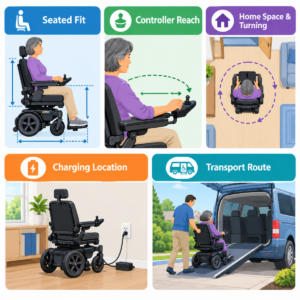
Start with the person’s seated posture, transfers, hand control, vision, endurance, home dimensions, outdoor route, charging location, and transport plan. Then compare only the devices whose official specifications and safety instructions fit those facts. An electric motor Wheelchair should match the rider’s real environment rather than a general product description.
A powered chair is a mobility system: the chair, seating, battery, charger, home, caregiver support, and daily route must work together. The same principle applies when evaluating an electric motor Wheelchair for everyday use.

Decide whether powered mobility fits the person’s needs
A power wheelchair may help when a person cannot walk far enough or safely enough for the routine they want to maintain, and when they can safely operate the device or have a professional plan for their use. That is different from simply being tired after a long day or wanting a device for occasional convenience. For an electric motor Wheelchair, the same distinction should be considered before purchase.
Ask what problem needs solving. Is it moving through the home, reaching medical appointments, using a community path, reducing caregiver strain, or conserving energy for daily tasks? The answer influences the kind of seating, drive controls, tires, range, and support that may be needed when selecting an electric motor Wheelchair.
Mobility aids should be matched to a person’s abilities. MedlinePlus notes that some devices require upper-body strength or balance and that professional guidance can help with selection. For powered mobility, also consider decision-making, visual awareness, reaction time, and the ability to use a stop control deliberately. These factors are important when assessing an electric motor Wheelchair.
Put seating, posture, and transfers before performance claims
Seat width, depth, back support, armrest height, footrest position, head support, and pressure management can matter as much as motor power. A person who slides forward, cannot reach the controller comfortably, develops numbness, or feels pressure in one area may need a seating assessment before an electric motor Wheelchair is purchased.
Weight capacity is not a complete measure of fit. It does not tell you whether the person can maintain a stable position, transfer safely, reach the controls, or use the chair throughout the day without discomfort. If the person has skin concerns, reduced sensation, a significant asymmetry, or a history of pressure injury, ask a qualified clinician about seating needs before choosing an electric motor Wheelchair.
Before a demonstration, bring the footwear, bag, oxygen equipment, or other everyday items that influence the person’s posture and routine. A chair that looks fine for five minutes can be a poor fit after an hour, including an electric motor Wheelchair that appears suitable from specifications alone.
Check control access and safe operation
The user should be able to find the controls, start and stop intentionally, steer without pain, and scan the path without needing to stare at the controller. Observe whether the person can reach the joystick or other control without lifting a shoulder, leaning far forward, or twisting through the trunk. This should be tested with any electric motor Wheelchair under consideration.
Do not assume a small joystick movement is easy for everyone. Tremor, weakness, limited reach, reduced sensation, arthritis, vision changes, and cognitive changes can alter control safety. A trained professional can help identify an appropriate control setup or decide that a different mobility solution is safer for the person using an electric motor Wheelchair.
If the rider repeatedly bumps furniture, misses the stop point, or appears unsure of direction during a demonstration, pause the process rather than trying to solve the issue with a higher speed setting or a different accessory.
Measure the complete home route
Measure more than the front door. Follow the route from the storage and charging area to the bedroom, bathroom, kitchen, living area, entrance, elevator, and vehicle. Note narrow doorways, tight turns, thresholds, floor transitions, door swings, loose rugs, low furniture, cords, and areas where another person must pass. These measurements are essential before bringing an electric motor Wheelchair into the home.
A chair can fit through a doorway but still be unable to turn into a bathroom or approach a bed safely. Do not solve that by reversing repeatedly in a tight space or by moving heavy furniture without a plan. An occupational therapist or accessibility professional can help identify safer changes when the home itself is the barrier for an electric motor Wheelchair.
Outside, consider the entire trip: driveway, sidewalk, curb cut, slope, surface, lighting, weather, traffic, destination entrance, and access to a restroom. Follow the exact model’s manual for intended surfaces and slope limits. Tire size or an online review is not a substitute for the manufacturer’s instructions when operating an electric motor Wheelchair.
Create a battery and charging routine
Charging is part of ownership, not an afterthought. Identify a dry, clear, well-ventilated location that does not block a walking path or exit. Use the charger and battery instructions supplied for the exact device. Keep the manual and service contact information near the charging area for the electric motor Wheelchair.
Range depends on more than the figure in a brochure. Rider weight, surface, slopes, temperature, tire condition, battery age, stops, and accessory load can all change how far a chair goes on a charge. Build a margin into every route and avoid leaving home with an uncertain battery, particularly when relying on an electric motor Wheelchair for essential trips.
Do not replace a battery or charger with a generic option unless the manufacturer or authorized service provider confirms compatibility. If charging takes unusually long, the chair loses power quickly, or a battery appears damaged, stop using it and ask for qualified service.
Practice the essential skills before independent use
Begin on a dry, level, uncluttered surface with a trained professional or caregiver available. Practice starting, stopping, changing direction, turning, reversing, parking, and powering down. The goal is calm control, not speed. These basic skills should be established before independent use of an electric motor Wheelchair.
Progress only when the user can complete the basic sequence consistently. Do not start practice on a slope, near a curb, beside traffic, or in a crowded store. If the chair feels difficult to control, the person is uncomfortable, or a caregiver is unsure how to respond, stop and seek additional instruction.
Review the routine again after any adjustment, repair, move to a new home, change in health, or extended period without using the device. Skills and equipment both require reassessment over time, including for an electric motor Wheelchair.
Know who will provide service and support
Before purchase, identify who will service the chair, how repairs are requested, whether there is local authorized support, what the warranty covers, and what happens if the device is unavailable. Keep the exact model name, serial number when available, manual, battery information, receipts, and service contacts together. This information is especially important for an electric motor Wheelchair.
Inspect the chair regularly for unusual noises, loose components, tire damage, braking changes, controller problems, or charging issues. Do not use household repairs, tape, wire, or unapproved parts to solve a structural or electrical problem.
Medicare and other insurance programs may cover some powered mobility devices when their own requirements are met. Coverage depends on the individual, medical need, documentation, supplier, and device. It does not establish that one particular electric motor Wheelchair is right for the person.
Electric wheelchair motors and drive-wheel layouts
Powered wheelchairs are often described as front-wheel, mid-wheel, or rear-wheel drive. The label refers to the wheel pair that drives the chair, not merely the wheel that appears largest. Drive position influences turning behavior, obstacle approach, tracking, and the space needed to maneuver. It should be treated as one part of a complete clinical and environmental decision when comparing an electric motor Wheelchair.
Mid-wheel drive for compact indoor turning
A mid-wheel chair pivots near the rider and can feel intuitive in a small room. Its published turning radius is useful, but the complete footprint still includes front and rear casters, foot supports, and anything mounted behind the seat. A chair may rotate in a narrow circle yet still catch a footplate on a cabinet or swing a rear caster into a wall. Test actual bathroom and bedside approaches rather than relying on one dimension when evaluating an electric motor Wheelchair.
Front-wheel drive for obstacle approach
A front-drive chair places the powered wheels ahead of the rider’s center. This arrangement may approach some thresholds or obstacles differently from a mid-wheel design and can offer useful foot-positioning options. The rear of the chair can swing outward during a turn, so the user must understand where the entire chair is moving. Driving style, programming, and the home layout matter for an electric motor Wheelchair.
Rear-wheel drive for directional tracking
Rear-drive chairs often track predictably in a straight line and may feel familiar to experienced riders. They generally need more room to turn than compact mid-wheel chairs. No drive layout is universally “best.” The right question is which layout the rider can control on the surfaces, corners, doorways, ramps, and transportation routes that matter.
Electric wheelchair measurements to verify before ordering
Record the chair’s overall width, overall length with foot supports, seat-to-floor height, ground clearance, turning radius, occupied weight, unoccupied weight, and the weight of any removable pieces. For a folding chair, record folded dimensions and the heaviest lift. For a complex chair, include the added height and length created by headrests, leg supports, trays, ventilator mounts, or oxygen equipment. These details help determine whether an electric motor Wheelchair fits the intended routine.
Measure the environment at its limiting points. Door width should be measured with the door open to the angle normally available. Hallway width must be considered together with the turn into the doorway. Check elevator depth, ramp clear width, threshold height, bedside turning space, table clearance, and the location of outlets. For vehicle travel, measure the lift platform, door opening, interior height, tie-down positions, and combined weight rating.
A successful measurement is not simply “the chair fits.” The rider must be able to approach, turn, stop, transfer, and leave space for a caregiver without scraping hands or trapping feet. Add a practical clearance margin instead of designing the route around the smallest possible gap.
Powered wheelchair seating and pressure-management decisions
People who use a chair for many hours may need more than a standard seat and back. A seating specialist may evaluate pelvic position, trunk support, leg alignment, head control, skin risk, sensation, pain, and the ability to change position. Cushions, contoured backs, lateral supports, elevating leg rests, tilt, recline, and seat elevation each solve different problems and can add weight, height, cost, and service needs to an electric motor Wheelchair.
Tilt changes the orientation of the seating system while preserving the angle between the seat and back. Recline opens the seat-to-back angle. Those functions are not interchangeable, and either may create safety concerns if used at the wrong time or without appropriate support. Seat elevation can improve reach and social interaction, but it changes stability and may be restricted while driving. Follow the exact equipment instructions and clinical plan.
Pressure management is individualized. A cushion marketed for comfort does not automatically prevent pressure injury. A person with reduced sensation, previous skin breakdown, inability to reposition, incontinence, or significant asymmetry should receive qualified assessment and a written monitoring routine. Inspect skin as instructed and report persistent redness, warmth, discoloration, or an open area promptly.
Wheelchair electric motor controls beyond a standard joystick
A conventional joystick is common, but it is not the only way to operate a power chair. Depending on the person and the equipment, a specialist may consider a compact joystick, touchpad, head array, sip-and-puff control, switches, attendant control, or another alternative-access system. These configurations require assessment, programming, training, and reliable service for an electric motor Wheelchair.
Controller programming can change acceleration, deceleration, turning response, maximum speed, and how the chair behaves near a stop. Slowing every setting is not always the correct answer; a chair that responds too slowly may be hard to position or cross a route safely. Programming should be performed by an authorized professional who can observe the rider and document the reason for each change.
Mounting is equally important. The control must remain reachable through daily posture changes, transfers, and powered seating movements. Cables should not snag or become a handhold. The rider and caregiver should know how to power down, release the drive system only when instructed, and recognize a fault code without attempting unauthorized repairs.
Electric wheelchair batteries, range, and charging questions
Battery chemistry, capacity, charger type, and replacement procedure vary by model. Some chairs use sealed lead-acid batteries; others use lithium-based systems. Do not mix chemistries, capacities, chargers, or batteries of different ages unless the manufacturer explicitly permits it. Use the approved charging process and keep the charging area away from heat, moisture, blocked exits, and trip hazards.
Published range is normally measured under defined test conditions. Real-world range can be shorter because of hills, soft surfaces, cold weather, frequent starts, heavy seating systems, low tire pressure, rider and cargo weight, and battery age. Plan essential trips around a conservative range and know where help is available. A battery gauge is a planning aid, not a promise of remaining miles for an electric motor Wheelchair.
Ask how long routine charging takes, whether the battery can be charged off-board, how the chair behaves when the charge becomes low, and who can replace the battery. If the case swells, leaks, becomes unusually hot, smells abnormal, or shows impact damage, stop charging and follow the manufacturer’s emergency guidance. Battery work should not be improvised.
Air travel with an electric motor Wheelchair
In the United States, the Air Carrier Access Act prohibits disability discrimination by airlines, and the Department of Transportation publishes guidance for passengers traveling with powered wheelchairs and other assistive devices. Airline procedures still depend on aircraft, battery type, chair dimensions, and the specific trip. Contact the airline well before departure and provide accurate information from the chair manual.
Create a one-page handling sheet with the make and model, dimensions, occupied and unoccupied weight, battery type, freewheel or brake-release procedure, safe lifting points, how to disconnect power if required, and the owner’s contact information. Photograph the chair before check-in, remove loose accessories when instructed, protect the controller, and label detachable parts. Do not rely on airport staff to infer the correct procedure for an electric motor Wheelchair.
Ask where the chair will be returned, how assistance will be provided between the gate and seat, and how damage should be reported. If a chair is customized for posture, pressure relief, communication, or medical equipment, explain why substitute airport equipment may not be equivalent. The DOT’s airline-passenger disability resources are the authoritative starting point for current U.S. rights and complaint procedures.
Wheelchair transportation and occupied travel
There is a major difference between carrying an empty chair as cargo and riding in a vehicle while seated in the chair. For cargo, the chair must be secured so it cannot move during a sudden stop. For occupied travel, the vehicle, wheelchair, securement system, occupant restraints, head support, and trained procedure must work together. A household strap or cargo hook is not an occupant-protection system.
Whenever possible, transfer to the vehicle’s original seat and use the vehicle’s restraint system if the person can do so safely and the care plan supports it. When the wheelchair must serve as the vehicle seat, consult a qualified mobility-equipment dealer and follow the chair and securement manufacturers’ instructions. NHTSA advises consumers to work with qualified professionals when adapting vehicles for disability needs.
Include emergency evacuation in the plan. Caregivers should know where controls, release points, and important documents are located, but they should not perform an emergency maneuver they have never practiced. Review the plan after a change in chair, vehicle, seating system, or caregiver.
Medicare coverage for a power wheelchair
Medicare Part B may cover a power wheelchair as durable medical equipment when it is medically necessary for use in the home and coverage requirements are met. Medicare’s current public guidance describes a face-to-face examination, a written prescription, and use of enrolled suppliers. Some power wheelchairs require prior authorization. Coverage rules do not mean every model or feature will be approved.
Begin with the clinician treating the condition that limits mobility. Describe the activities that cannot be completed safely inside the home, what less-complex equipment has been considered, and what assistance is available. The supplier should explain documentation, authorization, rental or purchase arrangements, assignment, and expected personal cost before delivery. Verify information directly with Medicare or the plan before obtaining an electric motor Wheelchair.
Medicare Advantage plans must cover at least the benefits provided by Original Medicare but may use networks and authorization procedures. Medicaid, veterans’ programs, private insurance, workers’ compensation, and charitable programs have separate rules. Do not order from an unknown seller based on a promise of “free” equipment or provide a Medicare number in response to an unsolicited call.
Total cost of owning an electric wheelchair
Purchase price is only one part of cost. Budget for evaluation, delivery, fitting, seating, batteries, tires, casters, arm pads, foot supports, controller protection, routine service, repairs, transport equipment, and possible home modifications. A low-priced chair without local parts or authorized service can become expensive when a small failure makes it unusable, including an electric motor Wheelchair that requires specialized support.
Ask for a written warranty explanation. Identify which components have different coverage periods, whether labor and travel are included, who approves a repair, and whether a loaner is available. For online purchases, clarify who performs assembly, programming, and warranty service locally. Keep serial numbers, receipts, manuals, authorization records, and service notes together.
A backup mobility plan also has value. The rider should know how essential activities will be handled if the chair is charging, damaged, or awaiting a part. The plan may include a manual wheelchair, accessible transportation, caregiver help, or temporary rental, but it must be realistic for the person’s seating and transfer needs.
Electric wheelchair comparison checklist
Evidence to record for every powered wheelchair under consideration
| Decision area | What to verify | Why it matters |
|---|---|---|
| Clinical fit | Seating assessment, transfers, pressure needs, control access | Determines whether the rider can use the chair safely and comfortably |
| Dimensions | Overall width and length, turning space, ground clearance | Shows whether the chair can complete the real route |
| Performance | Intended surfaces, slope limits, braking, speed settings | Prevents using marketing language as a safety instruction |
| Power | Battery type, charger, real-world reserve, replacement support | Reduces avoidable stranding and incompatible replacements |
| Transport | Weight, folding or disassembly, lift rating, occupied-travel plan | Protects riders, caregivers, and other passengers |
| Service | Authorized local provider, parts, warranty, loaner process | Keeps a critical mobility device usable |
Warning signs during an electric wheelchair trial
- The rider cannot stop consistently at a chosen line.
- The joystick requires painful reach or causes the shoulder to lift.
- Feet slide, knees contact furniture, or posture changes within minutes.
- The chair fits through a door but cannot turn or transfer on the other side.
- The supplier cannot identify local authorized service or replacement batteries.
- A seller promises insurance approval before reviewing medical documentation.
- The chair is described as safe for any slope, surface, or weather.
- A folding claim ignores the weight of the heaviest piece the caregiver must lift.
Any one concern may be solvable through fitting, programming, environmental changes, or a different category of equipment. The correct response is to investigate it before purchase, not to hope the rider will adapt later.
Preparing for a powered-wheelchair evaluation
Bring a concise record of the rider’s daily routine rather than a list of desired features. Include the rooms and destinations that must be reached, recent falls or near-falls, current mobility devices, transfer method, hours expected in the chair, pain or skin concerns, and the people available to assist. Add doorway and vehicle measurements, photographs of tight routes, and a list of medical equipment that travels with the person. This information can make an electric motor Wheelchair evaluation more practical.
During the evaluation, test more than forward driving. Ask the rider to approach a table, position beside a bed, enter and leave a simulated doorway, turn in both directions, reverse, stop at a precise point, and reach the controls after several minutes of sitting. If powered seating is being considered, practice it only with professional instruction. Note fatigue, discomfort, cueing, and any contact between the chair and the environment.
Before signing an order, request a written equipment summary. It should identify the base, seating system, controller, batteries, charger, accessories, measurements, and service provider. Confirm which changes can be made after delivery and which would require a new component or authorization. Keep the evaluation notes so the delivered configuration can be checked against what was approved for the electric motor Wheelchair.
At delivery, repeat essential maneuvers and inspect every ordered component. Confirm the serial number, manuals, charger, tools, emergency procedures, programming, and contact information. The rider and caregiver should demonstrate charging, power-down, safe transfers, and the response to a fault before the provider leaves. A rushed delivery is not adequate training.
Official electric wheelchair resources
Medicare.gov: Wheelchairs and scooters
U.S. Department of Transportation: Powered wheelchair travel guide
U.S. Department of Transportation: Airline Passengers with Disabilities Bill of Rights
NHTSA: Adapted vehicles
FDA: Powered wheelchair device classification
Questions to ask the supplier before accepting the chair
Ask who completed the final setup, whether controller programming matches the written order, how the chair was tested, and which accessories may change stability or battery use. Request a demonstration of manual wheel release, emergency stopping, charging, transport preparation, and every powered seating function. Confirm the phone number for after-hours problems and whether remote troubleshooting can accidentally leave the chair in a mode the rider cannot use.
Clarify delivery responsibilities. The supplier should not leave a boxed chair without confirming assembly and operation when professional setup is part of the service. Ask what happens if the chair cannot complete a required home route, causes pain, or differs from the authorized configuration. Record names, dates, and promised follow-up.
Finally, separate comfort preferences from safety requirements. Color, upholstery, cup holders, and storage can matter to daily satisfaction, but they should be considered only after seating, controls, dimensions, transport, power, and service are resolved. An electric motor Wheelchair that the rider likes and can safely control is more likely to support consistent use than one chosen solely from specifications.
Schedule a follow-up after the chair has been used in the real environment. Review posture, skin, transfers, controller reach, battery reserve, near-collisions, transportation, and tasks the rider still avoids. Small concerns should be corrected before they become habits. A new electric motor Wheelchair is not the end of the evaluation; it begins a period of observation, training, and adjustment.
Keep the rider involved in every decision to the greatest extent possible. Independence includes knowing how the chair works, which risks have been accepted, who can provide help, and how concerns will be reported. A technically suitable configuration can still fail if it does not respect the rider’s goals, privacy, communication needs, and daily preferences.
Write the final operating plan in plain language and keep it with the manual. Include charging, inspections, approved surfaces, transport, emergency contacts, and the conditions that require professional review. Everyone who assists should follow the same plan.
Electric motor Wheelchair questions people ask
These answers provide a planning framework. The exact manual and professional assessment control decisions for an individual person and device.
Is an electric motor Wheelchair the same as a mobility scooter?
No. Both provide powered mobility, but seating, controls, transfer requirements, transport, and intended use can differ. Compare them against the person’s actual abilities and route rather than choosing by appearance. An electric motor Wheelchair may be more appropriate for one routine while another powered mobility option may suit a different situation.
Can a powered wheelchair handle every slope or curb?
No. Use only the surfaces and slope limits allowed by the exact manufacturer instructions. Wet leaves, gravel, loose soil, curbs, traffic lanes, and steep grades can be unsafe even when a route looks familiar. Always follow the instructions for the specific electric motor Wheelchair.
Should I buy a powered wheelchair without trying it?
When a demonstration or fitting is available, use it. A safe decision includes seated fit, controls, home route, transport, charging, and support—not only a product description. This is particularly important for an electric motor Wheelchair because small differences in fit and controls can affect everyday use.
What should a caregiver learn?
Caregivers should know the chair’s basic safety controls, charging routine, transport plan, service contact, and when to stop use and ask for help. They should not improvise repairs or force the chair through an unsafe route.
Final decision checklist
Before choosing an electric motor Wheelchair, confirm: the person can be safely seated and assessed; controls are reachable and understandable; the home and outdoor route work; transport and charging are realistic; official specifications have been checked; practice and service support are available; and the plan still makes sense when health or routine changes.
The best powered wheelchair decision is one that supports safe, repeatable independence in the person’s real life.