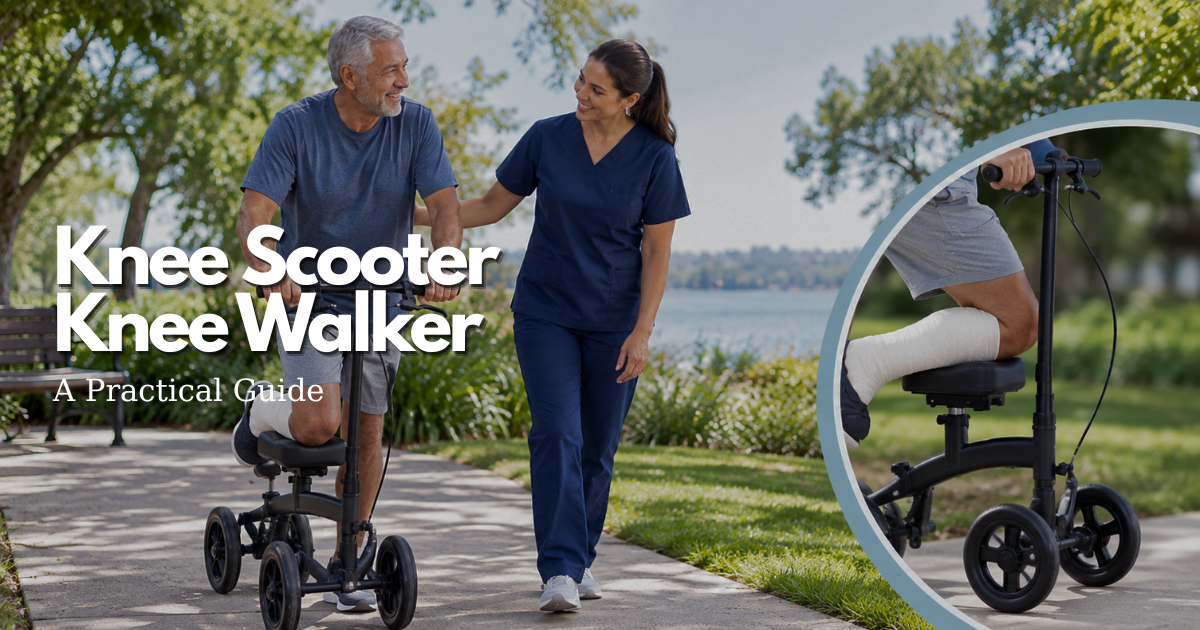
This guide explains how to assess a knee scooter knee walker safely. It does not replace weight-bearing instructions, fitting, or rehabilitation advice from the care team.
Quick answer: when a knee scooter may be appropriate
A knee scooter may be useful when a clinician has instructed the person to keep weight off one leg and the person can steer, brake, balance, and use a clear route safely. It is not automatically a better option than crutches, a walker, or a wheelchair.
The recovery plan controls the device choice. Convenience must not override medical instructions.
Confirm the fit before relying on the device
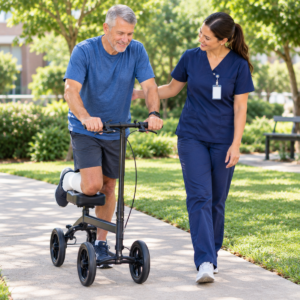
Fit affects balance and comfort. The knee platform should support the injured leg as instructed, the handlebar should allow a comfortable upright position, and the brakes should be easy to reach and operate. A person should not have to lean far forward, twist the back, or place the injured limb in a painful position to steer.
Check the device before every use. Look for loose hardware, damaged wheels, worn brakes, unstable handlebars, and a knee pad that is torn or uneven. Do not make improvised repairs with household wire, tape, or mismatched parts.
Prepare the home and carry items safely
Clear loose rugs, cords, pet items, low tables, and tight turns from the path. Measure narrow hallways and plan how to get through doors without forcing the device. Keep stairs, wet floors, loose gravel, steep slopes, curbs, and uneven ground out of the first-use route.
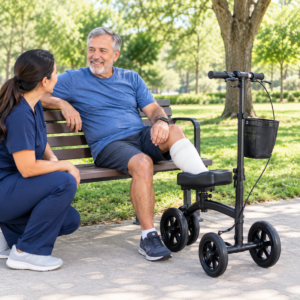
Plan how to carry water, medication, a phone, or small personal items. A heavy bag on the handlebars can change steering and stability. Use a compatible basket or bag only if it does not interfere with braking, turning, or the clinician’s instructions.
Practice on level ground before an outing
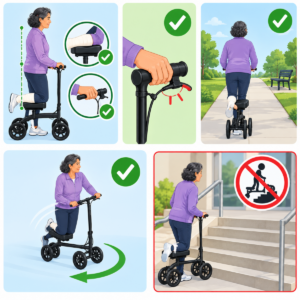
Begin in an open, dry, level area. Practice starting, stopping, slow turns, reversing if applicable, and parking with the brake engaged. Keep both hands on the handlebar while moving and keep the injured leg positioned as instructed.
Do not try a busy store, a long sidewalk, a ramp, or a crowded parking lot as the first practice location. Fatigue, speed, uneven pavement, and distraction can make a device that felt easy indoors much harder to control outdoors.
Plan for fatigue, weather, and recovery changes
Recovery needs can change from day to day. A person who can use a knee walker for a short indoor route may not be ready for an appointment, shopping trip, rain, or uneven terrain. Build in rest, accessible transportation, and a backup plan such as a wheelchair or caregiver assistance when the trip exceeds safe limits.
Follow-up visits are a good time to ask whether the device, fit, and amount of activity still match the recovery plan. Do not increase weight-bearing or distance because the knee scooter feels faster than another option.
Compare a knee scooter with other mobility options
A knee scooter is not the right answer for every non-weight-bearing plan. Crutches may work when stairs are unavoidable and the person has enough upper-body strength and balance. A walker can offer a broader base for some people, although it may not be appropriate for a strict non-weight-bearing restriction. A wheelchair may be safer for longer distances, fatigue, uneven environments, or a person who cannot steer and brake a knee scooter reliably.
The care team should help select the device when there is neuropathy, poor vision, dizziness, weakness on the uninjured side, a history of falls, or a complex home route. Switching devices for a particular outing is sometimes safer than forcing one device to do everything.
Use safe turning and stopping habits
Slow down before a turn and keep the handlebar under control. Sharp turns, sudden stops, distractions, and carrying items in one hand can destabilize the device. Park only on level ground, apply the brake as instructed, and make sure the scooter cannot roll before transferring to a chair, bed, toilet, or car.
Do not use the knee platform as a seat when the device is not designed for that purpose. Do not let children ride on it or use it as a cart. A knee scooter is a recovery aid, not a recreational device.
Coordinate travel, appointments, and caregiving
Before leaving home, check how the device will be transported, whether the destination has a step-free entrance, and where the person will rest. A caregiver should know how to manage doors, bags, and unexpected fatigue without pulling the scooter or trying to catch the rider during a fall.
For medical appointments, allow extra time for parking, transfers, and the route from vehicle to clinic. If the person cannot manage the trip safely with the knee scooter, arrange accessible transportation or use a wheelchair instead.
Care for the injured leg while using the device
Follow elevation, dressing, splint, boot, and weight-bearing instructions exactly. Watch for changes such as increased swelling, color change, numbness, unusual warmth, drainage, fever, or pain that does not improve with the plan provided by the care team. The scooter should not hide a complication or encourage activity beyond what the clinician approved.
Contact the treating team promptly after a fall, if the injured limb strikes the ground, or if the device causes new discomfort in the knee, hip, back, hands, or uninjured leg.
Common mistakes to avoid
Common mistakes include using a knee scooter without clinical clearance, failing to check brakes, hanging heavy items from the handlebars, using stairs, turning too quickly, and treating a knee scooter as an all-terrain device. Each can increase fall risk or interfere with recovery.
Do not borrow a device simply because it is available. A borrowed scooter can be the wrong size, poorly maintained, or inconsistent with the person’s medical plan.
What a knee walker scooter is designed to do
A knee walker is a steerable wheeled frame with a padded platform that supports the lower leg while the uninjured leg provides propulsion. It is commonly considered during recovery from certain foot or ankle injuries or procedures when the treating clinician wants the affected side protected from weight bearing. It does not support the body in the same way as a wheelchair and does not eliminate the need to balance.
The user typically stands on one leg, rests the affected lower leg on the pad, holds the handlebar with both hands, and moves using short controlled pushes. Steering geometry, wheel size, brakes, pad shape, handle height, overall width, and frame stiffness influence how the device behaves. A product can be marketed as stable and still be unsuitable for a particular person or surface.
The knee scooter is a route-specific mobility aid, not permission to increase activity. The surgeon, podiatrist, orthopedist, or rehabilitation professional determines whether the affected limb may rest on the platform and how long the device should be used.
Who may be a good candidate for a seated knee walker scooter?
Despite the search phrase “seated knee walker scooter,” most standard knee scooters are used while standing with the lower leg supported; the knee pad is not a seat. A person may be a reasonable candidate when the injury and weight-bearing order permit it, the knee can tolerate the required position, the uninjured leg is strong, both hands can control the handlebar and brakes, vision is adequate, and the person can understand hazards.
It may be a poor choice when there is injury to both legs, significant weakness or pain in the uninjured leg, severe balance difficulty, dizziness, poor hand control, inability to bend the affected knee as required, a high fall risk, or a home dominated by stairs. Neuropathy or reduced sensation may make pressure on the knee platform harder to detect. A clinician should assess these factors.
Age alone is not a decision rule. Some older adults control a properly fitted knee scooter well; some younger adults do not. Medication effects, fatigue, cognition, footwear, floor surfaces, and previous mobility experience often matter more than age.
How to fit a knee scooter knee walker
Follow the exact user manual and obtain professional instruction. In general, the knee platform should support the instructed part of the lower leg without forcing painful pressure on the kneecap, incision, cast, or sensitive tissue. The hips should remain reasonably level, the torso upright, and the shoulders relaxed. The handlebar should allow a slight comfortable bend at the elbows.
The injured foot and any boot or cast need protected clearance from the ground and wheels. The lower leg should not slide sideways during a stop or turn. If the platform has fore-and-aft or height adjustment, change only one setting at a time, tighten it exactly as instructed, and retest on level ground.
Brake levers must be reachable without releasing the grip or twisting the wrist. Confirm which wheel or wheels each lever controls and how a parking brake is engaged. If the user cannot apply enough force or forgets the lock, choose another mobility plan rather than attaching an improvised brake extension.
Knee walker scooter features that affect safety and comfort
| Feature | What to verify | Why it matters |
|---|---|---|
| Knee platform | Height, shape, width, padding, secure adjustment | Affects posture, pressure, and control |
| Handlebar | Height range, grip comfort, steering play, folding lock | Affects upright control and transport safety |
| Brakes | Stopping response, parking lock, cable condition | Allows controlled slowing and stable parking |
| Wheels | Diameter, material, tread, alignment, intended surfaces | Changes rolling resistance and obstacle response |
| Frame | Weight capacity, overall width, turning space, folded size | Determines fit for the user, home, and vehicle |
| Basket or bag | Compatibility, load limit, steering clearance | Keeps hands free without destabilizing the frame |
A larger wheel may manage small surface irregularities better than a smaller wheel, but it does not turn the device into a curb-climbing or all-terrain vehicle. Pneumatic tires add maintenance and can change handling when pressure is low. Solid tires avoid flats but can transmit more vibration. Use the manufacturer’s intended-surface guidance.
How to use a knee scooter for the first time
Have the scooter assembled and inspected by someone who understands the manual. Wear a secure shoe on the uninjured foot and use any boot, cast, or protection exactly as prescribed on the affected side. Choose a dry, open, level area away from stairs, traffic, pets, children, and furniture.
- Apply the parking brake and stand beside the device using a stable support approved by the care team.
- Place the affected lower leg on the platform without loading the injured foot.
- Center the body, hold both grips, and confirm the handlebars and platform are locked.
- Release the parking brake and use one short push from the uninjured leg.
- Practice a gentle stop before adding distance.
- Make wide, slow turns and keep the frame upright.
- Return to a stable surface, stop fully, engage the brake, and transfer as instructed.
Do not experiment with speed. Knee scooters can tip when a wheel stops suddenly, a turn is too sharp, or the rider’s body shifts beyond the frame. Rehearse how to stop when startled. If stopping requires dragging a foot, the setup or device is not safe.
Indoor and outdoor surfaces for a knee walker scooter
Smooth, dry, level floors are the easiest environment. Even there, remove throw rugs, power cords, clutter, and liquids. Approach doorway thresholds squarely and slowly. If a wheel repeatedly sticks, change the route or use another device rather than accelerating.
Outdoors, inspect cracks, gravel, grass, wet leaves, drainage grates, curb cuts, slopes, and cross-slopes. A sidewalk can lean toward traffic even when it looks flat. Rain reduces traction and can affect brakes. Snow and ice are generally incompatible with safe use unless a specific device, professional plan, and conditions clearly allow it.
Never ride a knee scooter up or down stairs. Do not attempt a curb by lifting the front while standing on the device. Arrange step-free access, use a different prescribed aid, or receive individualized stair training with appropriate equipment.
Turning, braking, and parking a knee scooter safely
Slow before the turn, keep both hands on the handlebar, and steer through a broad arc. Sharp handlebar input can shift the frame faster than the upper body. Avoid turning on a slope, reaching sideways while moving, or looking backward for a long period.
Use the brakes to reduce speed gradually. A brake may act on one or two rear wheels depending on the design, and adjustment changes stopping response. Test at the start of every outing. If a lever reaches the grip without enough braking, a cable frays, or a wheel does not release, stop using the scooter until serviced.
Park on level ground. Engage the parking brake before removing the knee from the platform or reaching for another surface. Do not leave the scooter where another person can trip over it, and do not depend on the brake to hold the device on a ramp.
Using a knee scooter in the kitchen, bathroom, bedroom, and workplace
In the kitchen, choose seated preparation when possible and keep hot liquids away from the moving route. Do not carry a pan or plate while steering. A compatible basket may hold light, closed items, but heavy groceries change balance. Keep the uninjured foot away from spills and slippery mats.
Bathrooms are high-risk because of water, small turning spaces, and transfers. The scooter should not enter a wet shower area. Use prescribed bathroom equipment and caregiver support. Plan where the scooter will be parked so it does not block the toilet, door, or emergency access.
At the bedside, allow room to approach and park without twisting. At work or school, ask about elevators, accessible entrances, desk clearance, rest breaks, and emergency evacuation. The fastest route is not always the safest route.
Folding and transporting a knee walker scooter
A folding handlebar does not make every device easy to carry. Record total weight, folded dimensions, loose components, and the exact latch sequence. The person loading it should test the task without bending, twisting, or lifting beyond safe ability. A caregiver injury can interrupt the entire recovery plan.
Secure the scooter in the vehicle so it cannot move during a sudden stop. Keep brake cables and the knee pad from being crushed by luggage. After unloading, inspect the folding joint, handle alignment, brake function, and platform lock before use.
For air or public transportation, contact the carrier and describe the device accurately. Do not assume staff will recognize the term knee walker. Allow extra time and bring the user manual or a photograph showing how the frame folds.
Knee walker scooter rental versus purchase
Rental may make sense for a short, clearly defined recovery when the supplier provides the correct size, cleaning, maintenance, and replacement support. Purchase may be more practical for a longer recovery, repeated procedures, or a person who needs a specific setup. Compare the entire expected period, not only the daily or advertised price.
Before accepting a rental, inspect the frame, wheels, pad, steering, hardware, brakes, and folding latch. Ask who repairs it, how quickly a replacement is provided, what damage charges apply, and whether accessories are included. Photograph its condition at pickup and keep the agreement.
A used device needs the same scrutiny. Confirm model, manual, weight capacity, adjustment range, recall status when applicable, replacement-part availability, and whether structural or brake repairs have been made. Do not buy a device with a bent frame, unknown weld repair, missing label, or improvised hardware.
This guide does not target local “near me” searches. Rental location, store availability, and where-to-buy questions belong to the planned dedicated assets so this article can remain a complete selection and safety guide.
How to compare real knee scooter models without relying on reviews alone
Official manufacturer information should be the source for specifications. For example, KneeRover’s current Economy model page publishes its product weight, capacity, wheel size, adjustment ranges, dimensions, brakes, and manual. Drive Medical’s official page for its steerable knee walker publishes a different capacity, knee-pad range, wheel size, and other specifications. Those figures illustrate why model-level claims must be checked instead of generalized.
A best knee scooter review can help identify questions, but it cannot verify fit for an individual. Reviews often omit the rider’s height, injury, floor surface, assembly quality, and brake adjustment. They may also combine different model generations. Record official specifications in a comparison sheet and confirm the manual matches the exact item number.
Do not use a generated photograph to depict a named product. If a future product comparison includes the KneeRover Economy, Drive Medical model 796, or another specific product, use a current manufacturer-authorized image or affiliate-program asset only after permission and product status are verified.
Knee scooter inspection and maintenance checklist
- Confirm handlebars, platform, and folding mechanisms are fully locked.
- Test service brakes and parking brake before leaving the starting area.
- Check tires or wheels for damage, embedded debris, looseness, and uneven wear.
- Look for bent tubing, cracks, rust, loose fasteners, or movement at welded joints.
- Make sure the knee pad is secure, dry, and free of a tear that changes support.
- Keep brake cables clear of baskets, doors, and folding points.
- Use only compatible replacement parts and the torque or adjustment procedure in the manual.
Schedule inspection after a fall, impact, airline trip, vehicle loading incident, or unexplained change in steering. Stop using a device with structural damage or unreliable brakes. An FDA adverse-event report involving a knee scooter describes serious injury after a platform-support weld failed; one report does not establish the risk of every device, but it reinforces the need to inspect structural components and respond to damage.
Protecting recovery while using a knee scooter
The convenience of rolling can lead to longer outings than the body can tolerate. Follow limits for activity, elevation, wound care, medication, and follow-up. Schedule rest before swelling or pain escalates. Ask whether the knee should remain on the pad for a maximum period and whether the prescribed boot or splint must remain in place.
After each outing, check the affected limb and the knee that rests on the platform as instructed. Report increasing pain, new numbness, color change, drainage, fever, calf pain, shortness of breath, or other urgent symptoms according to the care team’s instructions. After a fall or unintended weight bearing, contact the treating team even if the device appears undamaged.
The uninjured side also works harder. New hip, knee, ankle, wrist, shoulder, or back pain can signal poor fit, overuse, or an unsuitable device. Do not wait until pain changes walking and creates a second problem.
More knee scooter knee walker questions
Can a knee scooter be used with either leg?
Many models can support either side, but the injury, pad position, controls, and environment still require assessment. Confirm the exact manual and clinician’s instructions.
Can you sit on the knee pad?
Not on a standard device unless the manufacturer explicitly designs and labels it as a seat. “Seated scooter” products are a different category and should not be confused with a knee platform.
How fast should a knee scooter be used?
Use a slow walking pace that allows controlled stopping before a hazard. Some manufacturers publish specific speed advice; follow the exact manual. Faster movement sharply reduces response time.
Does insurance cover a knee walker?
Coverage depends on the plan, medical necessity, coding, supplier, and documentation. Ask the insurer and prescribing clinician before renting or buying. A product’s HCPCS code does not guarantee payment.
Can a knee scooter be used on a ramp?
Do not assume so. Slope, cross-slope, surface, brakes, user control, and manufacturer instructions matter. Obtain professional guidance and use another access method when the route cannot be controlled safely.
Planning the transition off a knee scooter
Stopping the device is a clinical milestone, not a calendar guess. The care team may progress the person through different weight-bearing levels and mobility aids. A knee scooter that was useful during strict protection may become unnecessary or may hide poor walking mechanics once loading is allowed. Ask what objective signs will guide the transition.
When a clinician authorizes walking, do not immediately use the scooter only for long distances while walking unsupported for short ones. The mix of devices should be deliberate. A walker, crutches, cane, boot, brace, or wheelchair may be used during different phases, and each requires correct technique.
Return or store the scooter only after the plan is clear. Clean it according to the manual, remove personal items, document any damage, and return rented equipment on time. For a personally owned device, store it dry with the brakes released or positioned as the manufacturer recommends, and inspect it again before any future use.
Recovery is successful when mobility becomes safer and more functional, not when a person keeps using the fastest device. Report fear, limping, new pain, or repeated near-falls during the transition so therapy or the equipment plan can be adjusted.
Official knee scooter and mobility-aid sources
- American Academy of Orthopaedic Surgeons: How to use crutches, canes, and walkers
- KneeRover: Economy knee scooter specifications and manual access
- Drive Medical: Steerable knee walker specifications
- FDA MAUDE: Knee scooter adverse-event report
Questions to ask at a fitting or rental counter
Ask whether the adjustment range fits the user while wearing the prescribed boot or cast, how the brake should feel, which wheel it controls, and how to inspect the folding lock. Request the exact manual and model number. Confirm the weight limit, intended surfaces, total device weight, folded dimensions, basket limit, replacement-part source, and return or repair process.
Demonstrate a controlled start, stop, broad turn, parking-brake use, and transfer before leaving. The user should not be sent home with verbal instructions alone if they cannot reproduce the sequence. A family member should practice loading the device without lifting beyond safe ability.
Ask what signs mean the device should be returned or serviced: loose steering, brake travel, wheel wobble, damaged padding, a shifting platform, cracked tubing, or a folding latch that does not engage completely. Document any preexisting wear on a rental and obtain a contact for urgent replacement.
Plan a short follow-up after the first days of use. Review swelling, knee-platform pressure, fatigue, hand discomfort, braking errors, difficult turns, and routes the person avoids. The clinician or supplier may need to change the fit, reinforce training, or recommend another aid. Early correction is safer than allowing an awkward technique to become the user’s normal pattern.
Keep a phone within reach and tell another person about longer outings. If the user becomes tired, the route changes, or weather worsens, stop in a safe level location and use the backup plan. Continuing simply because the destination is close can turn a manageable problem into a fall or an unintended load on the injured leg.
Place the clinician’s weight-bearing instructions and the supplier’s service number where caregivers can find them. Consistent guidance prevents one helper from encouraging speed or distance that another helper correctly avoids.
Knee scooter questions people ask
These answers support a safer conversation with the care team.
Can I use a knee scooter after any foot or ankle injury?
No. The treating clinician must decide whether it is appropriate and how much weight may be placed on the affected limb.
Can I use a knee scooter on stairs?
No. Use a safer access plan and ask the care team for instruction about stairs and transfers.
Is a knee scooter safer than crutches?
Neither is universally safer. The answer depends on the injury, balance, home, route, hand strength, and ability to follow the recovery plan.
Final checklist
Use a knee scooter only with clearance, correct fit, working brakes, a clear route, and a plan for fatigue or a change in symptoms. When anything feels unsafe, stop and ask for help.