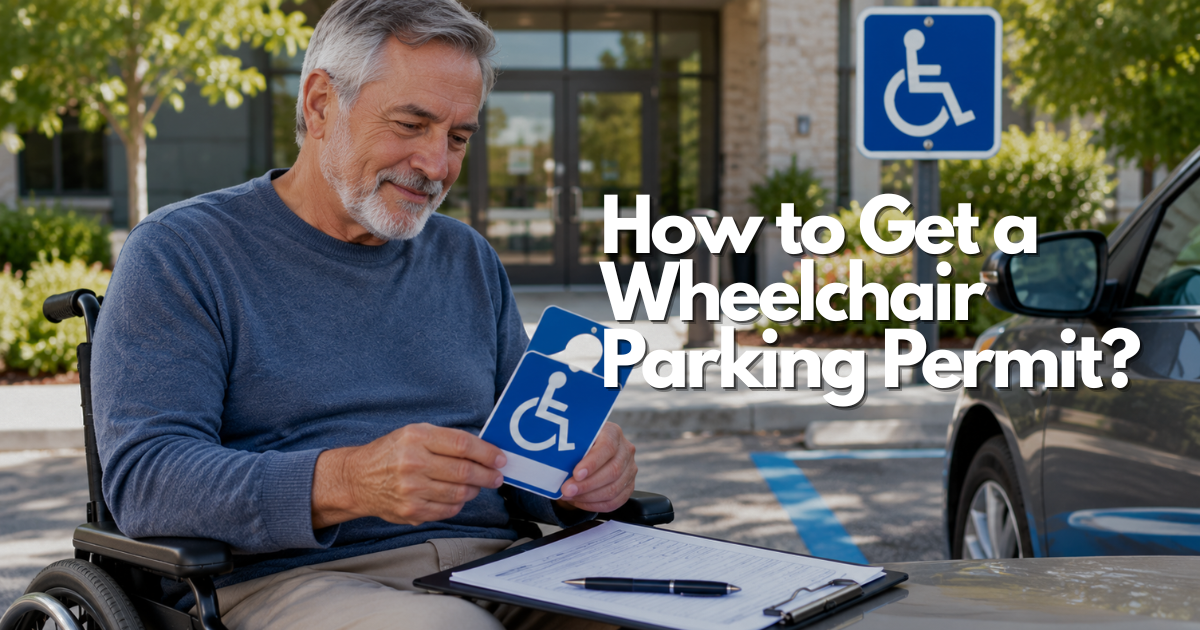
A Wheelchair parking permit is usually a disability-parking credential administered by a state, territory, or local authority. It is not automatically issued simply because a person owns or uses a wheelchair.
Eligibility, applications, medical certification, fees, temporary credentials, renewal periods, and use rules can differ by jurisdiction.
This guide helps you understand how to prepare for a Wheelchair parking permit application without providing state-specific legal advice. Your own motor-vehicle agency, disability-parking program, or local authority remains the final source for current requirements where the applicant lives.
Important: Never use another person’s placard, alter an application, or assume an accessible parking space is available for any purpose. Misuse can lead to penalties and can prevent access for people who need these spaces.
Quick Answer: How to Start a Wheelchair Parking Permit Application
To apply for a Wheelchair parking permit, start with the official state DMV, motor-vehicle department, county office, municipal parking authority, or equivalent government agency.
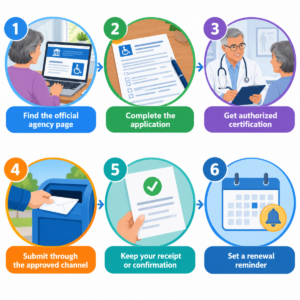
Find the disability-parking page, download the current application, read who may certify it, determine whether the credential is temporary or permanent, and verify where and how the application must be submitted.
Use the official form for your jurisdiction rather than a template or instructions copied from another state. Requirements can change, so confirm the current information before submitting personal or medical details.

Understand What the Program May Ask For
A Wheelchair parking permit application commonly asks for applicant identification and information from an authorized healthcare professional about a qualifying mobility limitation or disability. The exact wording, professional roles, certification requirements, and submission method vary by jurisdiction.
Some programs offer temporary credentials, permanent placards, disability plates, travel credentials, or other arrangements for organizations and transportation providers.
Read the entire application before asking a clinician to complete it. This can help prevent missing signatures, incomplete sections, outdated forms, or certifications that do not match the agency’s instructions.
If a requirement is unclear, contact the issuing agency rather than guessing.
Prepare Accurate Records and a Renewal Plan
Keep a copy of the completed Wheelchair parking permit application, any receipt or confirmation, the date submitted, and the agency’s contact information.
If the application is mailed, record the mailing date. If it is submitted online or in person, save the confirmation or receipt.
A simple record makes it easier to follow up, replace documents, or prepare for renewal.
Check whether the credential expires and set a reminder well in advance. Temporary permits can have different renewal rules from permanent placards or disability plates.
Do not continue displaying an expired credential while waiting for a replacement unless the issuing authority specifically permits it.
Plan the Whole Trip, Not Only the Parking Space
An accessible parking space is only one part of arriving safely. When planning how a Wheelchair parking permit will be used, consider curb cuts, weather, distance to the entrance, door-opening force, restroom access, lighting, and the mobility device needed after parking.
If the route from the parking space to the destination is unsafe, choose another entrance or contact the destination about accessibility before the visit.
Wheelchair users and caregivers may also need time to unload equipment, position a ramp or lift when appropriate, and clear the route.
Do not rush a transfer or equipment setup because a parking area is busy. Allow enough time for the complete arrival routine.
Use the Credential Responsibly
Follow the display and use instructions issued with the Wheelchair parking permit. Rules can vary for meters, airports, private lots, out-of-state travel, passenger use, and accessible spaces marked for a particular need.
The credential belongs to the eligible person, not to the vehicle or caregiver.
When the eligible person is a passenger, check local rules before using the credential. When the eligible person is not involved in the trip, do not use it.
If a placard is lost, stolen, damaged, or no longer needed, report or return it according to the issuing authority’s instructions.
Respecting disability parking rules protects access and helps ensure the credential is used for its intended purpose.

Common Mistakes to Avoid
Common Wheelchair parking permit problems include using an old form, submitting the application to the wrong office, leaving certification sections incomplete, forgetting renewal, assuming another state’s rules apply, and treating a permit as a guarantee of an available space.
Avoid these issues by checking official guidance whenever the credential is applied for, renewed, replaced, or used in a new jurisdiction.
Do not combine the permit process with unrelated questions about Medicare wheelchair coverage, buying a wheelchair, accessible vehicles, or home ramps. Each topic has different rules and may require separate planning.
Wheelchair Parking Permit Questions People Ask
These answers are general. Local official guidance controls.
Does a Wheelchair Automatically Qualify Someone for a Wheelchair Parking Permit?
Not necessarily. The issuing authority determines eligibility under its own rules and application process.
Using a wheelchair does not by itself guarantee that an applicant qualifies for a Wheelchair parking permit.
Use the current official form and certification instructions for the jurisdiction where the application is being made.
How Long Does Approval Take?
Processing time varies by agency and application type.
For a Wheelchair parking permit, submit a complete application as early as permitted and use the agency’s published contact method if you need an update.
Do not rely on an unofficial processing estimate for an important appointment, trip, or discharge from medical care.
Can a Caregiver Use the Placard Alone?
Generally, the credential is intended for the eligible person’s use under the issuing authority’s rules.
A caregiver should not use a Wheelchair parking permit simply for personal convenience when the eligible person is not involved in the trip.
Always confirm the local rules because specific use provisions can vary.
Wheelchair Parking Permit, Disability Placard, and Accessible Parking Terminology
People often say “Wheelchair parking permit,” but agencies may use terms such as disabled parking placard, disability parking permit, accessible parking placard, disabled person plate, or disability license plate.
Search the official agency website using the terminology used in your state.
Eligibility is generally based on applicable disability or mobility requirements, not simply on ownership of a wheelchair or the wheelchair symbol displayed on a parking sign.
A placard is normally portable and displayed in a vehicle according to agency instructions. A disability plate is attached to a registered vehicle.
Some jurisdictions issue temporary and permanent placards, special plates, travel credentials, organizational permits, or disabled-veteran plates. Each may have separate eligibility and use rules.
Do not assume a parking credential is a driver’s license, a medical-equipment benefit, or a guarantee of free parking.
It grants only the privileges defined by the issuing jurisdiction and the rules that apply where the vehicle is parked.
Who May Qualify for a Disability Parking Permit?
Eligibility for a Wheelchair parking permit is defined by state or local law.
Many programs consider significant limits on walking, inability to move without an assistive device or another person, certain cardiac or respiratory limitations, loss of limb use, or qualifying visual impairment.
Exact definitions, distance tests, diagnoses, and certification requirements vary.
A diagnosis alone may not be enough, and visible wheelchair use is not necessarily the only basis for eligibility.
The applicant should describe functional limitations accurately to the authorized clinician.
Useful information can include how far the person can walk, whether stopping is required, which assistive device is used, how symptoms change with exertion, and whether the limitation is expected to be temporary or permanent.
The clinician—not the applicant, caregiver, or website—determines what can be certified under the applicable form.
Some applications allow certification by specified physicians and certain other licensed professionals. The permitted professions differ by jurisdiction and sometimes by condition.
Do not ask an unlisted professional to sign or alter a form. If access to an authorized certifier is difficult, contact the issuing agency for lawful options.
How to Get a Wheelchair Parking Permit Step by Step
1. Identify the Issuing Authority
Start with the official state DMV, motor-vehicle agency, county tax collector, municipal parking office, or another authority identified by your state.
2. Choose the Correct Credential
Confirm whether the need is temporary or permanent and whether a placard or plate fits the person’s transportation routine.
3. Download the Current Form
Check the revision date and instructions directly on the government website.
4. Complete the Applicant Section
Use the legal name and identification information requested.
Do not sign a certification that belongs to the healthcare professional.
5. Obtain Authorized Medical Certification
Give the clinician enough time to review and complete the full form.
Do not provide only a cropped signature page.
6. Review the Application
Check signatures, dates, credential type, contact information, required identification, and any applicable fee.
7. Submit Through an Approved Channel
Online, mail, in-person, and local-office options vary.
8. Keep Proof and Plan Follow-Up
Save a copy, confirmation number, receipt, submission date, and official contact method.
Never pay a third-party website simply to obtain a form that the government provides.
A private service cannot guarantee approval.
Protect medical and identity information, and confirm that an online portal belongs to the official agency before uploading documents.
Temporary Versus Permanent Disability Parking Credentials
A temporary Wheelchair parking permit is generally intended for a qualifying limitation expected to improve, such as recovery after an injury or procedure.
The certifying professional may need to state an expected duration, and the credential may expire after a shorter period.
A permanent credential is intended for a qualifying long-term condition, but “permanent” does not necessarily mean that it never expires or never requires confirmation.
Renewal practices vary widely.
For example, different states publish different validity periods and procedures for permanent, temporary, and travel placards.
These differences are why a national guide cannot provide one universal expiration date for every Wheelchair parking permit.
If the condition improves before expiration, ask the issuing agency what should be done.
If the condition continues beyond a temporary credential’s validity, do not alter the expiration date or continue using the credential after it expires.
Ask whether a new certification, new application, or different credential is required.
Documents That May Be Needed for a Wheelchair Parking Permit Application
An application commonly requests the applicant’s legal name, date of birth, address, signature, and information from the certifying professional.
Depending on the jurisdiction and submission method, the applicant may also need a driver license or state identification number, proof of identity, vehicle information for a disability plate, a fee, or documentation related to a special credential.
Create a private checklist from the official instructions.
Do not email medical forms to an unverified address or leave copies in a shared vehicle.
Redact sensitive information from copies used only for household planning, while keeping the official submitted copy secure.
If the applicant cannot sign or complete the process independently, the form may contain rules for a guardian, power of attorney, or organization.
Do not improvise another person’s signature. Ask the issuing agency which authorization documents are accepted.
Where to Submit a Disability Parking Application
Some states accept Wheelchair parking permit applications online, while others require mail or an in-person office.
Some applications are routed through county or local agencies.
Even within one state, the process for an original placard may differ from replacement, renewal, travel, or disability plate requests.
Follow the address or online portal printed on the current official form.
If applying in person, ask whether an appointment is required and whether the office is accessible.
Plan transportation and bring only the original documents or copies requested.
If mailing the application, use a trackable method when appropriate and never send an original identity document unless the agency explicitly requires it.
Processing time can change, so avoid relying on an unofficial estimate for surgery discharge, travel, or an important appointment.
Apply as early as permitted and create a temporary access plan when necessary.
What to Do When the Wheelchair Parking Permit Arrives
Read the credential and instructions before the first trip.
Verify the name, identification number, expiration date, and any accompanying registration document.
Learn where the placard must be displayed when parked and whether it must be removed before driving.
A hanging placard can obstruct the driver’s view if it is left on the mirror while the vehicle is moving.
Store any registration or identification document as required while protecting it from loss and identity theft.
Photographing a credential number may help with replacement, but a photograph is not necessarily a valid substitute for the original.
Record the renewal date in more than one calendar if several caregivers share transportation.
The eligible person should understand that the Wheelchair parking permit travels with them only according to the applicable rules.
A caregiver may transport the eligible person in a different vehicle when the jurisdiction permits portable placard use, but the caregiver should not use it for unrelated errands.
How to Use Accessible Parking Without Blocking Another Wheelchair User
Park fully within the marked vehicle space.
Never stop in the striped access aisle, even for a few minutes.
The access aisle provides room for wheelchair deployment, side-entry ramps, lifts, walkers, and transfers.
Blocking it can prevent another person from entering or leaving a vehicle safely.
Van-accessible spaces may have additional width, access-aisle, or vertical-clearance features.
A driver with a standard Wheelchair parking permit may be legally allowed to use one in some locations, but signs and local rules must always be followed.
When another suitable accessible space is available, leaving a van-accessible space open can help a driver who needs a side lift or ramp.
The ADA establishes design requirements for accessible spaces provided by covered facilities, including access aisles and accessible routes.
It does not create one national placard application or eliminate state parking laws.
Questions about meters, private lots, residential permits, time limits, tickets, or local enforcement should be directed to the relevant parking authority.
Using a Disability Parking Permit in Another State
Many U.S. jurisdictions recognize valid out-of-state disability credentials, but privileges and display rules can differ.
Free metered parking, time-limit exemptions, residential zones, airport parking, beach access, and municipal permits are not uniform.
Before traveling, check the destination state’s motor-vehicle agency and the city or facility where parking will occur.
Bring any identification or registration document that is required.
Do not copy, laminate, or alter the placard unless the issuing authority specifically instructs you to do so.
For a long stay or out-of-state visit, ask whether the destination has a special travel credential or another process.
International travel requires separate research.
A U.S. Wheelchair parking permit may not be recognized abroad, and rental-car, toll, and parking rules can differ substantially.
Contact official tourism or transportation authorities rather than relying on a travel forum.
Replacing a Lost, Stolen, Damaged, or Undelivered Placard
Use the issuing agency’s replacement process.
The agency may ask for a replacement form, credential number, proof of identity, a theft report, the damaged placard, or a fee.
A replacement process can differ from the original application and may not require the same medical certification.
Report theft when instructed and monitor personal information if documents were taken from a vehicle.
Do not make a color copy and display it as a substitute for the original Wheelchair parking permit.
If the credential never arrives, confirm the mailing address and processing status through an official channel rather than submitting duplicate applications without guidance.
When the credential holder dies, moves, or no longer qualifies, follow the agency’s return or cancellation rules.
Keeping an unused placard “just in case” can create an opportunity for misuse.
What to Do if a Parking Permit Application Is Delayed or Denied
First determine whether the issue is administrative or related to eligibility.
Missing signatures, an outdated form, unreadable certification, the wrong submission office, or omitted documentation may be correctable.
Ask the agency for the specific reason and the approved method for supplying missing information.
If the decision concerns eligibility, review the written notice and any appeal or reconsideration process.
Do not ask a clinician to exaggerate limitations or change a date.
Provide accurate functional information and follow all applicable deadlines.
A disability-rights organization or qualified legal professional may be able to explain general rights, but only the issuing authority can approve the credential.
While waiting for a Wheelchair parking permit, contact destinations about drop-off zones, valet access, curbside service, wheelchairs, or other accommodations.
These arrangements do not replace the permit, but they may reduce the distance or risk of an essential trip.
Why State Wheelchair Parking Permit Rules Must Be Checked Individually
A Wheelchair parking permit is governed by the jurisdiction that issues it.
California, Florida, New York, and other states have their own application structures, eligibility definitions, certification requirements, credential types, and renewal practices.
The similarities can help with general planning, but the differences control the actual application.
Do not copy a relative’s form from another state.
Do not use a national-looking commercial website as the authority.
Government domains, the current application, and the issuing office’s written instructions should agree before personal information is submitted.
The safest general rule is simple: verify every requirement at the official source on the day you apply.
Print or save the instructions with the form so the household has a record of what was current.
Wheelchair Parking Permit Application Checklist
Items to Confirm Before Submitting an Application
| Check | Evidence to Keep | Common Error Prevented |
|---|---|---|
| Official issuing authority | Government page and contact details | Paying an unofficial form service |
| Current form | Revision date or downloaded copy | Submitting an obsolete application |
| Correct credential type | Temporary, permanent, plate, or travel choice | Requesting the wrong program |
| Authorized certification | Completed professional section | Using an ineligible signer |
| Complete submission | Copy, receipt, or confirmation number | Untraceable follow-up |
| Renewal plan | Expiration and reminder date | Using an expired credential |
More Questions About Disability Parking Permits
Can a Permit Be Used Before the Placard Arrives?
Usually, an application or receipt is not the credential.
Follow the issuing authority’s written instructions and do not park in a reserved accessible space based only on a pending request for a Wheelchair parking permit.
Do Accessible Parking Rules Apply on Private Property?
Accessible-space design and enforcement can involve federal, state, local, and property-specific rules.
Display the credential and follow posted signs.
Direct a specific enforcement question to the local authority or property manager.
Does the Permit Reserve a Particular Parking Space?
No.
A placard normally authorizes use of eligible spaces under applicable rules; it does not reserve one specific space or guarantee availability.
Can a Wheelchair Parking Permit Be Used at an Airport?
Airport garages and long-term parking programs may have special payment, display, verification, or duration rules.
Check the airport’s official accessibility and parking information before traveling with a Wheelchair parking permit.
Can a Person Have Both a Placard and a Disability Plate?
That depends on the jurisdiction and credential type.
Ask the issuing agency and do not assume that multiple credentials are automatically permitted.
Building a Caregiver-Friendly Permit Record
When several people help with transportation, create a one-page household record that contains no unnecessary medical detail.
List the credential type, issuing authority, expiration date, renewal lead time, location of the registration document, and official phone number or online portal.
Add a reminder that the Wheelchair parking permit may be used only when the eligible person is involved in the trip.
Keep the placard itself with the eligible person or in the secure location recommended by the agency.
Leaving it permanently in a hot vehicle can damage some materials and can make theft easier.
Do not write medical information on the placard or attach stickers that obscure official details.
If a caregiver changes vehicles, make the credential transfer part of the trip checklist.
For appointments, the driver should know the safest passenger drop-off point, the location of accessible parking, whether a side ramp needs an access aisle, and which entrance has an accessible route.
A permit can reduce parking distance, but it does not remove the need for safe unloading and enough time.
Avoiding Disability Parking Permit Scams and Privacy Mistakes
Warning signs include a website that promises instant approval, asks for payment before identifying the issuing authority, sells a “doctor signature” without a legitimate evaluation, or uses a domain that resembles a government website.
Search for the program independently through the official government domain.
Do not follow an unsolicited text or email link to upload identity documents.
A legitimate Wheelchair parking permit application may contain protected medical and identity information.
Use a secure portal or the submission method printed on the official form.
Avoid public Wi-Fi for sensitive uploads, and do not send the application through ordinary email unless the agency specifically instructs you to do so.
Shred unnecessary drafts and keep the completed copy in a controlled file.
If an organization offers assistance, ask whether it is the government agency, an authorized community partner, or a private service.
Assistance with reading or completing a form can be useful, but it does not change eligibility or guarantee approval.
The applicant should understand what will be submitted in their name.
Accessible Parking When a Caregiver Is Driving
The caregiver should confirm that the eligible person is part of the trip and that the placard is displayed only when parked as instructed.
After helping the person enter the destination, the caregiver should not leave the vehicle in an accessible space for an unrelated activity when local rules do not permit it.
The Wheelchair parking permit follows the eligible person’s access need, not the caregiver’s convenience.
If the passenger uses a side-entry ramp or lift, choose a space with the correct access aisle and keep every part of the deployment within the marked area.
Do not deploy equipment into a traffic lane.
When snow, carts, motorcycles, or another vehicle blocks the access aisle, ask facility staff for a safe solution instead of attempting a hazardous transfer.
Plan for the return trip as well.
A different vehicle may block the lift even if unloading was easy.
Contact facility management or parking enforcement rather than escalating a parking conflict.
Common Wheelchair Parking Permit Scenarios
Short Recovery After Surgery
Ask the clinician whether the limitation meets the state’s temporary-permit standard and how long certification should last.
Apply early enough to account for processing.
Do not assume a hospital discharge document serves as a parking credential.
Progressive Mobility Limitation
Describe present functional limitations accurately.
If a temporary credential no longer matches the person’s situation, ask the authority whether a new application is required.
Do not alter the expiration date or credential type.
A Person Who No Longer Drives
A portable placard may still be relevant when a qualified person travels as a passenger, depending on jurisdictional rules.
The caregiver should carry and display the Wheelchair parking permit only for trips involving the eligible person.
Multiple Caregivers and Vehicles
Portable use does not necessarily permit duplicate placards.
Follow the agency’s limit and keep a check-in system so the credential is not lost or used when the eligible person is absent.
Travel Before an Original Permit Arrives
Contact the destination and issuing authority about lawful alternatives.
An application copy normally does not grant parking privileges.
Use passenger loading, valet accommodation, mobility assistance, or another access plan where available.
Official Parking-Permit and Accessible-Parking Sources
ADA.gov: Accessible parking spaces
California DMV: Disabled person placards and plates
Florida Highway Safety and Motor Vehicles: Disabled parking permit application
Always verify the current official source before submitting an application or relying on a Wheelchair parking permit rule.
Final Verification Before the First Use
Compare the credential with the approval notice and check the expiration date.
Read the display instructions and any restrictions.
Verify whether an identification card must remain with the placard holder and whether the placard should be removed from the mirror before driving.
These small checks help prevent a valid Wheelchair parking permit from being used incorrectly.
For the first trip, choose a familiar destination and allow extra time.
The driver should identify an accessible route, not simply the closest marked space.
Confirm that the access aisle is clear, deploy a ramp or lift only within a safe area, and keep the credential visible exactly as directed while parked.
If a sign, meter, curb color, event restriction, residential-zone rule, or private-lot restriction is unclear, do not infer a privilege from the wheelchair symbol.
Use another lawful space and ask the local parking authority.
Review the routine whenever the applicant moves, changes vehicles, begins traveling with a new caregiver, or receives a replacement credential.
Update the secure household record and discard expired instructions only after verifying that the new process is understood.
Government programs can change forms and procedures, so a successful application from several years ago is not proof that the same steps still apply today.
Accessible parking is most effective when combined with thoughtful trip planning.
Confirm the entrance, curb cut, access aisle, weather exposure, lighting, and distance the person can manage after leaving the vehicle.
When those elements do not work, contact the destination in advance about a safe drop-off point or another reasonable access arrangement.
Keep the eligible person involved in decisions about who carries the placard and how it is used.
The credential represents that person’s access need and private medical certification.
Caregivers should protect both the Wheelchair parking permit and the person’s dignity while following every display, renewal, replacement, and return requirement issued by the responsible agency.
Before relying on any summary, check the official page again.
A fee, form revision, certifier rule, office address, or online option can change.
Saving the source date with the household record makes later renewal and correction easier.
Final Checklist
Use your official state or local source, complete the current form, obtain the required certification, keep copies, plan renewal, and use the credential only as directed. Pair parking access with a safe route from the vehicle to the destination.
A Wheelchair parking permit is one part of an accessible transportation plan, not a guarantee that every destination will have an available space or that every parking rule will be the same. Always verify the current requirements before applying, traveling, renewing, or replacing the credential.