
Wheelchairs | SeniorTechLife
A practical buying framework for a wheelchair: start with fit and daily use, then compare type, condition, seller support, and the full route at home.
When you see a wheelchair for sale, start with the person’s fit and daily routine before comparing the listing, the price, or the frame style. If you are researching a For Sale Wheelchair, treat the listing as a starting point rather than proof that the chair is right for you. A chair can look like a bargain and still be wrong for the user, the caregiver, or the route through the home.
This guide helps you prepare for a purchase of a manual, transport, or powered wheelchair, including what to look for when comparing a For Sale Wheelchair listing. It does not recommend brands or promise that any product is clinically appropriate. For complex seating, pressure concerns, major posture changes, or powered mobility, ask a qualified clinician or mobility professional to be involved.
Safety note: Do not buy a chair based only on a photo or a general size label, especially when a For Sale Wheelchair listing provides limited details. Poor fit, damaged brakes, unstable footrests, or an inaccessible route can lead to falls, pain, and skin problems.
Quick Answer: What to Check Before Buying a For Sale Wheelchair
Confirm the user’s seated fit, ability to propel or transfer, caregiver needs, the home route, and the chair’s condition or support plan. Then compare the type of wheelchair that matches that routine. When reviewing a For Sale Wheelchair, compare the equipment against those needs rather than choosing by appearance alone. New and used equipment both need an honest inspection.
The right purchase supports the user’s real day—from bed or chair to bathroom, doorway, vehicle, and destination—not just the first few minutes of sitting.

Start With Fit and Daily Life, Not a For Sale Wheelchair Listing
Before opening multiple listings, write down who will use the chair, how long they will sit in it, whether they can propel it, who will help, and where it must go. If you are comparing a For Sale Wheelchair, measure the narrowest doors and turns before deciding. Consider leg support, armrest height, footrest position, posture, pressure concerns, and the ability to reach brakes or controls.
MedlinePlus explains that mobility aids should match a person’s abilities and may require professional fitting. A wheelchair that is too wide may not fit the home; one that is too narrow may create pressure or poor posture.
A For Sale Wheelchair should be evaluated against the user’s actual measurements, not a generic size description. If the user has lost or gained weight, notices pressure areas, or has a changing condition, arrange an assessment rather than trying to solve it only with a cushion or accessory.
Compare Manual, Transport, and Powered Choices Before You Buy
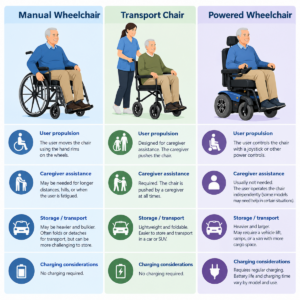
A manual wheelchair is generally intended for self-propulsion or caregiver pushing, depending on the wheel setup and user ability. A transport chair is often designed for a caregiver to push and can be useful when compact storage or occasional transport is the main goal. A powered wheelchair has different control, charging, transport, and coverage considerations. The best type of wheelchair is therefore the one that matches the user’s routine and support needs.
High-Level Wheelchair Choices to Discuss Before You Buy a For Sale Wheelchair
| Type | May suit | Key question before purchase |
|---|---|---|
| Manual wheelchair | A person who can propel it or has regular assistance. | Can the user reach and use the wheels, brakes, and footrests safely? |
| Transport chair | Short trips with reliable caregiver pushing. | Will the caregiver be present for every route where it is needed? |
| Powered wheelchair | A person who needs powered mobility and can safely manage the device with appropriate support. | Has a qualified professional assessed control, fit, charging, and transport needs? |
“Automatic wheelchair for sale” and “wheelchair electric for sale” can describe a wide range of powered devices, including products that appear in a For Sale Wheelchair search. Do not assume that two powered chairs with similar photographs have the same controls, seating, capacity, terrain limits, or service support.
Evaluate the Seller and the Information Provided
A responsible purchase conversation includes the exact model, age, condition, dimensions, user capacity, included parts, service history, return terms, warranty status, and who will support the chair afterward. When considering a For Sale Wheelchair, ask for the owner material, charger information, battery history, and a safe way to verify function before relying on it.
Be cautious if essential information is missing, the seller will not allow an appropriate inspection, or the device cannot be tested on a safe level surface. A For Sale Wheelchair should not be purchased on trust alone. Do not accept statements about medical suitability, range, weight capacity, or condition without verifying the exact model’s official documentation.
Inspect a Used Wheelchair Before Relying on It
A second hand electric wheelchair for sale can require more than a cosmetic check, particularly when it appears in a For Sale Wheelchair search. Look for loose hardware, worn tires, cracked components, damaged seat material, footrests that do not move correctly, brakes that do not hold, abnormal noises, charging problems, or an incomplete manual. A used manual chair also needs its brakes, wheels, casters, armrests, footrests, and folding parts checked.
Test only in a safe location and do not put a vulnerable user at risk to “try it out.” If a powered chair, seating system, or battery condition is uncertain, bring in a qualified professional or choose another option instead of assuming a For Sale Wheelchair is safe because the price is attractive.
A low price does not offset a For Sale Wheelchair that cannot be verified, fitted, maintained, or used safely in the actual environment.

Check Home Access, Transport, and Coverage Before Paying
Follow the chair’s full path through the home and community: entrances, thresholds, bathroom, kitchen, elevator, vehicle, and destination. A ramp, lift, or vehicle plan may be necessary, but each is its own safety decision. Before buying a For Sale Wheelchair, confirm that its dimensions and mobility features match the route. Do not assume that a chair will work with a ramp simply because both are marketed for accessibility.
If Medicare may be involved, confirm coverage with the treating provider, plan, and enrolled supplier before making a payment. Medicare states that wheelchairs and scooters can be covered in different ways depending on the equipment and medical need; the specific rules and costs must be verified for the individual situation.
Confirm the Configuration, Not Just the Chair Name
Two chairs with the same broad name can have different seat widths, wheel positions, armrests, footrests, cushions, controls, batteries, and transport needs. Ask the seller for the exact model and configuration of the For Sale Wheelchair, then compare it with the manufacturer’s current or archived owner information. Do not assume that a replacement part, cushion, charger, or accessory is compatible because it looks similar.
When a listing includes additions such as elevating leg rests, head support, anti-tippers, or a positioning cushion, ask why they were used and whether they fit the new user. Accessories may be important, but they should not be treated as a substitute for a correct base chair and a professional fit check when evaluating a For Sale Wheelchair.
Test the Routine Without Taking Unnecessary Risks
If a chair can be inspected in person, test it on level, dry ground. Check the approach to a chair or bed, brake operation, footrest movement, wheel tracking, and the ability to turn through a realistic amount of space. These checks are important before relying on a For Sale Wheelchair. Do not use stairs, steep slopes, traffic areas, or a crowded parking lot as a first test location.
For a powered chair, confirm the user can reach and understand the controls and can stop intentionally. If a seller cannot explain the charger, battery, manual, or basic condition, treat that as missing information—not as a reason to accept a For Sale Wheelchair at a discount.
Keep Records That Make Future Support Easier
Record the model, serial number when available, date of purchase, seller information, included accessories, and the condition at handoff. Save manuals, receipts, battery information, and any service records. These details help when you need a repair, replacement part, insurance documentation, or a future clinical review.
A clear record also prevents a common problem with used equipment: discovering later that the charger, seating component, or wheel part is unavailable or does not match the chair. If records cannot be obtained, budget for a professional inspection or consider a purchase with better documentation.
For Sale Wheelchair Buying Questions People Ask
These answers prepare you for an informed purchase discussion. They do not replace an evaluation when seating, safety, or medical needs are complex.
Should I Buy New or Used?
Either can be appropriate when fit, condition, support, and the exact equipment history are clear. Used equipment deserves a closer inspection because wear, missing parts, and unavailable support can affect safety. The same standard applies whether the For Sale Wheelchair is new or previously owned.
Can I Buy a Powered Wheelchair Online?
Only after you have verified the exact model, seller, fit, home route, charging plan, service support, and return policy. A product page cannot determine whether the user can safely operate the device. For a For Sale Wheelchair, online information should support—not replace—an in-person or professional assessment when needed.
Do I Need a Prescription?
A prescription or clinical documentation may be needed for insurance coverage or for a professional recommendation. Whether you need one to make a private purchase is different from whether the chair is appropriate for the user.
Final For Sale Wheelchair Purchase Checklist
Pause before paying until you can answer five things: who the chair is for, how it fits, how it will be used, how the route works, and who will support it. Keep manuals and receipts, document the model and condition, and arrange a follow-up if the user’s needs change. This checklist can help you evaluate a For Sale Wheelchair without making the decision based only on price.
A For Sale Wheelchair purchase is safer when it is treated as a mobility plan, not an impulse purchase.