<!doctype html>
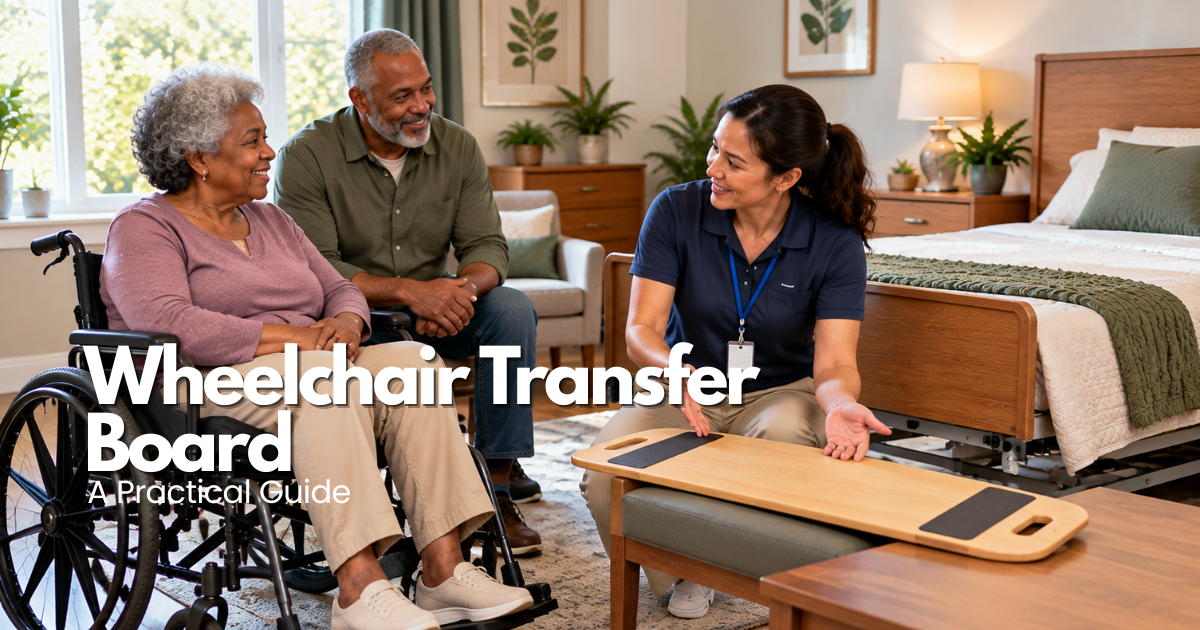
Choosing the right wheelchair transfer board involves more than comparing board length, shape, price, or advertised weight capacity. Sitting balance, arm and shoulder function, skin condition, wheelchair configuration, surface height, caregiver assistance, and training all affect whether a transfer board is suitable.
This comprehensive guide explains how wheelchair transfer boards work, the differences between straight and curved designs, essential fit and safety considerations, wheelchair-to-bed and wheelchair-to-car planning, maintenance, costs, insurance questions, and situations where mechanical lifting equipment may be more appropriate.
Safety note: A wheelchair transfer board is not appropriate for every individual or transfer. Incorrect use can result in falls, skin injuries, finger entrapment, or caregiver strain. Have a qualified occupational therapist, physical therapist, or other appropriate professional assess the person and demonstrate the exact transfer arrangement. Do not attempt an unfamiliar transfer based only on written instructions. Stop when balance, stability, comfort, or equipment condition becomes unsafe.
Quick Answer: What Should Wheelchair Transfer Board Buyers Verify First?
Before choosing a wheelchair transfer board, confirm that the person can participate safely in the type of seated transfer being considered. The board must be compatible with the person’s abilities, the wheelchair, the destination surface, and the available caregiver support.
A transfer board is generally intended to bridge a manageable gap between appropriate surfaces. It does not lift the person automatically, eliminate the need for balance, or make an unstable destination safe.
Before buying, verify:
- The person’s sitting balance and functional abilities.
- The approved transfer method and level of assistance.
- The exact wheelchair and destination surface.
- The gap and height difference between surfaces.
- The board’s dimensions, shape, and rated weight capacity.
- The condition and stability of both surfaces.
- Wheelchair components that may affect clearance.
- Risks involving skin friction and hand positioning.
- The number and training of caregivers required.
- The product’s cleaning and inspection requirements.
- Purchase or rental costs and applicable coverage.
- An alternative plan when the board cannot be used.
A suitable wheelchair transfer board should match an individualized mobility plan rather than a general product description.
What a Wheelchair Transfer Board Does
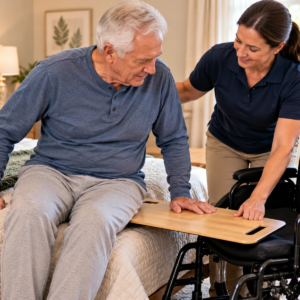
A wheelchair transfer board, also called a transfer board or sliding board, is a rigid bridging device used during certain seated transfers. It provides an additional support surface between two destinations.
Depending on the person’s abilities and the recommended technique, movement may involve controlled weight shifts and sufficient body clearance to reduce friction against the board. The board should not be understood as a device that automatically carries or lifts the user.
How a Transfer Board Supports Mobility
A transfer board can help bridge a gap that would otherwise make a seated transfer more difficult.
The person may use their arms and upper body to participate in movement, while trained caregivers provide the assistance identified in the individual care plan.
Not everyone has the balance, strength, coordination, or skin tolerance necessary for this equipment.
Who May Benefit From a Wheelchair Transfer Board?
Some wheelchair users who have appropriate sitting balance and functional arm strength may benefit from transfer board use.
The device may also be considered for certain people who require limited assistance but can participate in an assessed transfer.
Suitability should be determined through individualized evaluation rather than based on a diagnosis or wheelchair use alone.
What a Transfer Board Cannot Do
A wheelchair transfer board cannot replace a mechanical patient lift when the person requires full-body lifting assistance.
It also cannot compensate for major differences in surface height, an unstable wheelchair, poor trunk control, or insufficient trained caregiver support.
If the conditions needed for a safe seated transfer are absent, another mobility solution may be appropriate.
Wheelchair Transfer Board Versus Patient Lift Equipment
Transfer boards and patient lifts support different kinds of movement.
A wheelchair transfer board is used in certain seated lateral transfers, while a patient lift supports the person through an approved lifting mechanism and compatible sling or other support system.
When a Transfer Board May Be Considered
A transfer board may be considered when the person can maintain appropriate sitting balance, participate in the movement, and use the equipment according to professional guidance.
The destination and wheelchair must provide suitable support.
A board should not be selected simply because it appears less expensive or easier to store than a patient lift.
When a Patient Lift May Be More Appropriate
Some individuals cannot safely participate in a seated transfer because of limited trunk control, severe weakness, pain, fatigue, or other medical and functional concerns.
A qualified professional may recommend a different transfer method, including appropriately selected mechanical lifting equipment.
Do not attempt to compensate for insufficient support by pulling, carrying, or forcing a transfer.
Comparing a Transfer Board and Patient Lift
| Consideration | Wheelchair transfer board | Mechanical patient lift |
|---|---|---|
| Primary purpose | Bridge suitable surfaces for a seated transfer | Provide mechanical lifting support |
| User participation | Often requires meaningful sitting control and participation | Requirements depend on lift and care plan |
| Equipment | Board with approved dimensions and capacity | Lift, approved sling or support system, accessories |
| Space requirements | Depends on wheelchair and destination gap | Depends on lift footprint and transfer route |
| Caregiver training | Individualized transfer-board instruction | Model-specific mechanical lift instruction |
| Maintenance | Surface, edges, structure, cleaning | Mechanical components, sling, controls, power as applicable |
| Suitability | Must be assessed individually | Must be assessed individually |
Neither option should be selected or used without considering the complete care arrangement.
Professional Assessment Before Wheelchair Transfer Board Use
A professional mobility assessment is the foundation of appropriate transfer board selection.
An occupational therapist or physical therapist can evaluate how the person moves, communicates, maintains balance, and responds to the proposed transfer environment.
Sitting Balance and Trunk Control
Stable sitting is an important consideration because the person may need to maintain control while moving between surfaces.
The clinician should evaluate the person’s actual abilities, not simply whether they can remain seated in a wheelchair.
Fatigue, discomfort, medication effects, or changing health conditions may also influence the assessment.
Arm and Shoulder Function
Transfer board use may place demands on the arms, wrists, hands, and shoulders.
Someone with substantial upper-body pain, weakness, limited range of motion, or previous injury may require another approach.
A qualified professional should determine whether the expected movement is appropriate.
Skin Condition and Pressure Concerns
Skin condition is important because movement across or near the board can create friction, pressure, or shear forces.
A person with fragile skin, reduced sensation, or a history of pressure injuries may need additional precautions or different equipment.
The transfer plan should prioritize adequate body clearance and appropriate skin protection.
Caregiver Assistance Requirements
Some people may use a transfer board independently after appropriate training, while others require one or more trained helpers.
Caregiver requirements depend on the person’s abilities, the environment, and the approved technique.
A family member should not assume that an available board makes independent or one-person assistance appropriate.
Supervised Practice and Reassessment
A qualified professional should evaluate the transfer using the actual equipment and intended destination.
Training should include communication, equipment inspection, warning signs, and the conditions under which the transfer must not proceed.
Reassessment is important whenever mobility, health, equipment, or caregiver circumstances change.
Wheelchair Transfer Board Length, Width, and Shape
Wheelchair transfer boards come in different shapes and dimensions. These differences can influence the available support area, clearance around wheelchair parts, and suitability for particular destinations.
Product dimensions should be considered alongside the individual’s mobility assessment and the manufacturer’s instructions.
Straight Wheelchair Transfer Boards
Straight boards generally have an elongated shape with rounded or tapered ends.
They may be considered for certain wheelchair-to-bed or wheelchair-to-chair transfers when compatible with the environment.
The appropriate length depends on the actual gap, board design, user requirements, and professional recommendation.
Curved Transfer Boards
Curved transfer boards are designed to accommodate certain wheelchair and furniture configurations.
Their shape may help navigate around obstacles such as wheelchair wheels or fixed furniture features.
However, the curved shape alone does not guarantee compatibility with every wheelchair.
Transfer Boards With Cutouts
Some products include cutouts or specially shaped ends intended for particular seating arrangements.
These designs may be useful where ordinary straight boards cannot provide suitable clearance.
The entire configuration must be assessed, including where the board contacts the supporting surfaces.
Transfer Boards With Sliding Components
Certain transfer devices include a movable seating component or other low-friction design features.
These systems operate differently from simple rigid boards and may introduce additional inspection and maintenance needs.
Families should follow the specific manufacturer’s instructions and professional recommendations.
Wooden Versus Plastic Transfer Boards
Wooden and plastic boards may differ in weight, surface texture, cleaning requirements, flexibility, and durability.
A smooth-looking surface does not automatically mean that the board reduces harmful friction appropriately.
Choose a material and design approved for the intended use and maintain it according to the manufacturer.
Wheelchair Position and Brake Considerations
Wheelchair stability is a central part of planning a transfer board arrangement.
The wheelchair, destination furniture, and transfer board must be compatible before the person begins an approved transfer.
Wheelchair Brake Function
Wheelchair brakes and wheel locks should be evaluated as part of the professional transfer plan.
Their condition and operation may affect the stability of the arrangement.
Always follow the wheelchair manufacturer’s instructions and the transfer method taught by the qualified professional.
Armrests and Footrests
Removable or movable wheelchair components may affect the space available for a transfer board.
However, not every armrest or footrest is designed to be removed or repositioned in the same way.
The correct configuration should be demonstrated using the specific wheelchair.
Wheelchair Cushion Considerations
Seat cushions can change the person’s height and stability in relation to the destination surface.
Some cushions may also affect how the individual reaches or supports their body.
The actual cushion should be included in the assessment rather than using an empty wheelchair as the only reference.
Wheelchair Transfer Board Compatibility
A board may work with one wheelchair but not another.
Differences in seat height, wheel position, frame construction, and removable components can affect suitability.
A change of wheelchair should trigger a review of the transfer arrangement.
Bed-to-Wheelchair Transfer Board Planning
Bed-to-wheelchair transfers are a common reason for considering a wheelchair transfer board.
However, the bed, wheelchair, person, and trained caregiver must be assessed as one complete arrangement.
Bed Height and Surface Stability
Bed height and mattress characteristics may affect how the transfer board is supported.
A soft mattress, unstable edge, or large height difference can make a transfer more difficult.
The clinician should evaluate the actual bed rather than relying on generic dimensions.
Bedside Clearance
Furniture, bedside tables, cords, rugs, and other objects may restrict caregiver access.
Assessing the complete space helps determine whether the equipment can be used appropriately.
A narrow room may require environmental changes or a different transfer solution.
Protecting Skin During Bed Transfers
Repeated contact with the board or mattress edge can affect sensitive skin.
Professional training should address appropriate movement and the avoidance of excessive friction.
Stop and request reassessment when the person experiences pain, discomfort, or skin changes.
Bed-to-Wheelchair Transfer Checklist
Before relying on the arrangement, confirm that the person, board, wheelchair, bed height, surface stability, caregiver assistance, and backup plan have been professionally reviewed.
A successful transfer during one training session does not guarantee that the method remains appropriate after changes in health or equipment.
Wheelchair-to-Car Transfer Board Considerations
A wheelchair-to-car transfer board may be considered for certain people who can participate safely in a seated vehicle transfer.
Car transfers can be more complicated than transfers between household surfaces because vehicle seats, door openings, surrounding space, and parking conditions vary.
Vehicle Seat Height
The difference between wheelchair seat height and vehicle seat height can affect the suitability of a board.
A large or awkward height difference may make the arrangement inappropriate.
Have the exact vehicle and wheelchair evaluated together.
Vehicle Doorway and Access
Vehicle door shapes, seat positioning, and nearby obstacles may restrict movement.
A transfer board that works at home may not be suitable for a car.
The correct approach must be demonstrated by a qualified professional rather than improvised during an outing.
Weather, Parking, and Surface Conditions
Rain, uneven pavement, steep parking areas, and limited space can change transfer conditions.
Families should consider whether the established plan remains practical outside a controlled training environment.
When the environment is unsuitable, use the agreed alternative.
Transportation and Wheelchair Securement
A wheelchair transfer board does not replace appropriate vehicle seating, occupant restraints, or wheelchair transportation systems.
Vehicle safety requirements must be addressed separately.
Planning a Supervised Wheelchair Transfer Board Trial
A supervised trial helps establish whether the selected board matches the actual person and transfer environment.
The clinician or qualified instructor should observe both equipment suitability and the person’s ability to maintain control without unnecessary strain.
Confirm the Actual Destination
A board should be evaluated with the exact bed, chair, or other destination the person expects to use.
Changing furniture after training can affect the arrangement.
Observe Comfort and Control
The professional should determine whether the person can participate without unsafe strain, uncontrolled movement, or unnecessary friction.
Comfort and skin protection matter even when a movement can technically be completed.
Identify Stop Conditions
The care plan should describe circumstances that require the transfer to be postponed or reassessed.
These may include unexpected pain, fatigue, damaged equipment, changing balance, or an unsuitable destination.
Document the Approved Arrangement
Keep the equipment information, relevant measurements, trained caregiver requirements, professional recommendations, and emergency contacts together.
This helps ensure consistency when different caregivers provide support.
Bathroom and Commode Transfer Board Planning
Bathrooms can present additional challenges because of limited space, wet surfaces, clothing needs, and privacy requirements.
A wheelchair transfer board should be considered for bathroom use only when the entire arrangement has been assessed and approved.
Bathroom Clearance and Stability
Check whether the wheelchair and destination can remain stable within the available space.
Narrow doorways, fixtures, and restricted caregiver access may make the proposed arrangement unsuitable.
Commode Compatibility
Commode designs vary in height, frame structure, seat support, and available clearance.
Not every commode can accommodate a board.
Ask a qualified professional to evaluate the exact model.
Moisture and Surface Conditions
Water and cleaning products can affect some board surfaces or floor conditions.
Follow manufacturer instructions and do not use a wet or contaminated board in a way that compromises control.
Respecting Privacy
Bathroom transfers involve personal care and should protect the person’s dignity.
Explain assistance, respect consent, and provide appropriate privacy throughout the routine.
Wheelchair Transfer Board Skin Protection and Friction
Protecting skin is essential during transfer board use.
Friction and shear can occur when the body drags across the board or contacts wheelchair components, even if the person reaches the destination successfully.
Why Skin Shear Matters
Skin shear involves forces acting across tissue when body surfaces move in different directions.
People with reduced sensation, fragile skin, or existing skin injuries may be particularly vulnerable.
An occupational therapist can help determine the appropriate transfer technique and equipment.
Reducing Unnecessary Sliding
Clinical guidance generally emphasizes controlled movement with sufficient body clearance rather than dragging the body across a board.
The exact technique should be taught through individualized hands-on instruction.
Do not treat the word sliding board as permission to slide directly across the surface without considering skin protection.
Inspecting Skin and Comfort
A person who experiences persistent rubbing, pain, or new skin changes may need reassessment.
Caregivers should report observable problems promptly.
Do not continue a routine that repeatedly causes discomfort.
Hand Placement and Pinch Risks With a Transfer Board
Hand and finger position can influence safety during seated transfers.
The wheelchair frame, board edges, wheels, furniture, and destination surface can create areas where fingers may become trapped.
Recognizing Pinch Points
Caregivers should understand which parts of the equipment may create an entrapment hazard.
Specific hand positions must be taught by a qualified instructor.
Do not improvise support by placing hands beneath loaded equipment.
Protecting Wrists and Shoulders
A transfer board routine may involve considerable upper-body effort.
Persistent wrist, elbow, or shoulder pain is a reason to review the technique and equipment.
A clinician can help determine whether another approach is appropriate.
Avoiding Untrained Physical Assistance
A caregiver should not pull, lift, or force the person beyond their training.
Additional physical effort cannot reliably compensate for an unsuitable board or transfer environment.
Helper Roles and Communication During Transfers
Clear communication helps people understand the approved transfer plan and recognize when assistance must stop.
The person receiving care should remain involved in decisions whenever possible.
Assigning Caregiver Responsibilities
A professional care plan should identify the number of caregivers required and their responsibilities.
Family members should not assume that one helper is sufficient for every person or destination.
Respecting Consent and Preferences
Explain what assistance is planned and ask about comfort and concerns.
A person may prefer certain caregivers, times, or communication methods.
Recognizing Fatigue
Fatigue may affect balance, arm strength, concentration, and movement control.
A transfer method that worked earlier in the day may become unsuitable when the person is exhausted.
Reassessment is preferable to forcing the routine.
Comparing Transfer Surfaces and Height Differences
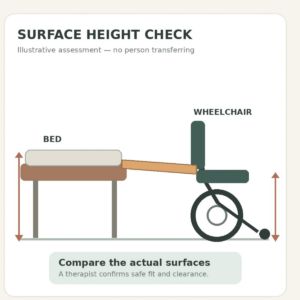
Transfer board suitability depends partly on how the two supporting surfaces relate to each other.
Large gaps, unstable furniture, soft cushions, or substantial height differences can create unacceptable risks.
Surface Height
Surface height should be evaluated using actual measurements.
The appropriate relationship between surfaces depends on professional guidance and the intended equipment.
Surface Stability
Both surfaces must be suitable for the approved transfer.
Unstable chairs, movable furniture, or unsupported mattress edges should not be assumed safe.
The Importance of the Complete Route
The transfer route includes more than the board itself.
Consider the wheelchair, furniture, nearby obstacles, caregiver position, and how the person will remain supported.
When Environmental Changes Are Necessary
A qualified professional may recommend adjusting the environment, using different furniture, or selecting another transfer method.
Do not improvise structural changes or accessories to make an unsuitable board appear usable.
Cleaning and Maintaining a Wheelchair Transfer Board
Routine inspection and cleaning are important because cracks, rough edges, moisture, or damaged surfaces may affect equipment reliability.
Follow the manufacturer’s instructions for the specific board material.
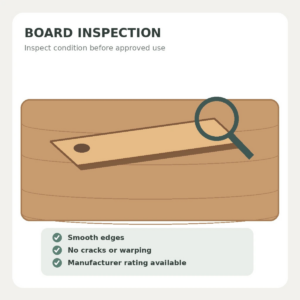
Inspecting the Board Surface
Look for visible cracking, splintering, sharp edges, warping, or unexpected changes in the surface.
Remove damaged equipment from use until the appropriate professional or manufacturer can advise.
Cleaning the Board
Wooden, plastic, and coated boards may have different cleaning requirements.
Use only approved cleaning methods and allow the board to return to the condition specified by the manufacturer before storage or use.
Checking Handles and Cutouts
Some boards contain handles, shaped edges, or additional components.
Inspect these areas according to the manufacturer’s guidance.
Maintenance Records
Keep basic information about the purchase date, manufacturer, product identification, cleaning instructions, and any observed defects.
This may help caregivers identify recurring equipment problems.
Wheelchair Transfer Board Storage and Travel
A transfer board should remain accessible without obstructing walking routes or creating hazards.
Storage and transportation arrangements should also protect the board from damage.
Choosing a Storage Location
Store the board according to the manufacturer’s recommendations.
Avoid leaving it where someone may trip over it or where the material may become damaged.
Transporting the Board
A travel routine may require carrying the board between home, rehabilitation appointments, and other suitable settings.
Check its dimensions, weight, and carrying features before purchase.
Protecting the Board
Some materials may be affected by temperature, moisture, or improper storage.
Follow the manufacturer rather than assuming every board can be stored in the same way.
Confirming Destination Compatibility
A familiar board does not guarantee a safe transfer at an unfamiliar location.
The intended destination and environment must still meet the person’s assessed needs.
Wheelchair Transfer Board Inspection Before Reuse
A transfer board should be evaluated before being used again after storage, transportation, or a significant equipment event.
This is especially important when the board has been dropped, exposed to unsuitable conditions, or used by another person.
Inspecting a Used Transfer Board
A secondhand board may have unknown wear, structural stress, or previous damage.
Do not assume that an inexpensive used board is suitable because it looks intact in photographs.
Manufacturer Labels and Capacity
Verify the board’s rated weight capacity and product identification.
Missing information may make it difficult to establish appropriate use or obtain replacement guidance.
Signs That Require Replacement
Cracks, significant warping, damaged edges, or other structural concerns may mean the board is no longer suitable.
Do not attempt unauthorized modifications or repairs.
Wheelchair Transfer Board Costs, Coverage, and Rental Questions
Transfer board costs depend on material, shape, size, manufacturer, and product features.
Some devices may be purchased through medical equipment suppliers, while rental or alternative funding arrangements may be available in certain circumstances.
Compare the Full Product Cost
Evaluate the board’s suitability before comparing price.
Include shipping, professional assessment, training, warranty terms, and replacement needs when relevant.
A lower price does not compensate for an incompatible device.
Medicare Coverage for Wheelchair Transfer Boards
Original Medicare Part B covers certain medically necessary durable medical equipment, but a specific wheelchair transfer board is not automatically covered simply because it is used with a wheelchair.
Families should ask the prescribing healthcare professional and Medicare-enrolled supplier whether the exact item qualifies under the applicable coverage policy.
When a DME item is covered and the relevant requirements are satisfied, Original Medicare generally pays according to its Part B rules, including the usual deductible and coinsurance.
Medicaid and Private Insurance
Coverage varies by Medicaid program, state, insurance plan, and medical necessity requirements.
Some programs identify transfer devices through specific equipment codes, but the presence of a billing code does not guarantee an individual claim will be paid.
Request the applicable coverage requirements in writing.
Buying Versus Renting
A temporary rehabilitation need may lead a family to investigate rental equipment or other short-term arrangements.
Availability depends on the supplier and product.
Ask about cleaning, inspection, return requirements, and the condition of rented equipment.
When a Wheelchair Transfer Board Is Not Enough
A wheelchair transfer board is not appropriate when the person cannot maintain the necessary balance, participate in the approved movement, or remain supported between the surfaces.
The professional assessment should also consider pain, skin condition, fatigue, caregiver capabilities, and the environment.
Poor Sitting Balance
A person who cannot maintain adequate sitting control may require a different transfer method.
The appropriate alternative should be determined by a qualified professional.
Significant Pain or Skin Injury
Pain or skin damage can make the planned transfer unsuitable.
Do not continue a method that causes persistent discomfort or tissue injury.
Large Gaps or Unstable Surfaces
A board should not be used to bridge arbitrary distances or compensate for unstable furniture.
An alternative environment or transfer device may be necessary.
Inadequate Caregiver Assistance
If required trained helpers are unavailable, the scheduled transfer may need to be postponed or handled through an approved alternative.
Avoid improvised carrying or untrained physical lifting.
Reviews and Wheelchair Transfer Board Product Claims
Online reviews can help identify practical questions about board shape, weight, material, and durability.
However, reviews do not establish that a board will work safely for a specific wheelchair user.
Evaluating Positive Reviews
A product may be described as lightweight, smooth, durable, or easy to store.
These observations may be helpful, but they should be compared with actual specifications and individual needs.
Evaluating Negative Reviews
Complaints about rough edges, cracking, unsuitable dimensions, or difficulty using the product may identify questions worth investigating.
Determine whether the review concerns the same model and usage conditions.
Confirming Manufacturer Specifications
Check current dimensions, capacity, material, cleaning recommendations, and warranty information.
Do not rely solely on retailer descriptions when important specifications are missing.
Backup Planning When a Wheelchair Transfer Board Cannot Be Used
Every transfer board routine should include a backup arrangement.
Unexpected fatigue, changes in health, equipment damage, or an unsuitable environment may prevent the planned transfer.
Identify Approved Alternatives
The care plan should explain whom to contact and what alternative equipment or trained assistance is available.
A backup should be established before problems occur.
Avoid Improvised Transfers
Do not substitute an unsuitable board, unstable furniture, or untrained manual lifting for the approved arrangement.
Seek qualified assistance when the usual plan cannot be followed.
Respond to Immediate Danger
Contact emergency services when there is an immediate emergency.
Technical troubleshooting or routine caregiver coordination should not delay necessary emergency assistance.
Update the Backup Plan
Review the plan when caregiver availability, equipment, housing, or the person’s abilities change.
Final Wheelchair Transfer Board Checklist
Use this checklist before selecting or continuing a transfer board routine:
-
A qualified professional has assessed transfer suitability.
-
Sitting balance and upper-body abilities have been reviewed.
-
Skin integrity and friction concerns have been considered.
-
The exact wheelchair and destination surfaces were evaluated.
-
Relevant gaps and surface heights were measured.
-
Board shape, dimensions, and capacity are appropriate.
-
Wheelchair brakes and relevant components have been assessed.
-
The person and caregivers received suitable training.
-
Required helper support is available.
-
The board has no visible structural damage.
-
Cleaning and storage instructions are understood.
-
Vehicle or bathroom transfers have been assessed separately.
-
Costs and possible coverage have been verified.
-
Stop conditions and emergency contacts are documented.
-
A realistic alternative transfer plan is available.
A wheelchair transfer board is only appropriate while the person, equipment, environment, and trained support continue to meet the approved plan.
Making a Wheelchair Transfer Board Plan Work Every Day
A practical transfer board plan should remain understandable and reliable during ordinary activities.
The household should know where the board is stored, who may provide assistance, and when professional reassessment is required.
Keep the Approved Plan Accessible
Store relevant equipment information and professional recommendations in a location authorized caregivers can access.
Document the specific destinations and circumstances covered by the plan.
Review Everyday Practicality
A routine that works during a supervised appointment may need adjustments in a small home or unfamiliar setting.
Report difficulties rather than assuming they will disappear with practice.
Keep Caregiver Responsibilities Clear
Caregivers should understand the limits of their training and what to do when assistance is unavailable.
Avoid relying on informal assumptions about who can help.
Reassessing Wheelchair Transfer Board Needs After Changes
A wheelchair transfer board may be appropriate initially but become unsuitable when the person’s circumstances change.
Reassessment is especially important after a fall, hospitalization, surgery, new pain, changes in sitting balance, or replacement of mobility equipment.
After Changes in Health or Mobility
New weakness, fatigue, pain, or reduced balance may affect transfer suitability.
Seek professional evaluation before resuming an arrangement that no longer feels safe.
After Changing the Wheelchair or Cushion
Different seat heights, frames, and cushions can affect the transfer environment.
The approved plan should be reviewed when significant equipment changes occur.
After Moving Furniture or Changing Rooms
Changes in bed height, mattress, flooring, room arrangement, or destination furniture may affect compatibility.
Repeat relevant measurements and assessments.
After Caregiver Changes
New helpers may require training before participating.
An experienced caregiver’s explanation does not necessarily replace qualified instruction.
Applied Wheelchair Transfer Board Situations
Different transfer environments present different requirements. The following examples identify situations that deserve professional review rather than providing instructions for independently performing transfers.
Wheelchair Transfer Board for Bed-to-Wheelchair Use
The professional should assess the bed, wheelchair, board, sitting balance, skin risk, and caregiver assistance.
Wheelchair Transfer Board for Car Access
Vehicle geometry, seat height, surrounding surfaces, and environmental conditions require a separate assessment.
Wheelchair Transfer Board for Bathroom Transfers
Moisture, limited clearance, commode compatibility, and privacy should be considered before use.
Wheelchair Transfer Board During First Training
The qualified instructor should evaluate equipment suitability, communication, body control, and caregiver responsibilities.
Wheelchair Transfer Board With Skin Concerns
A clinician should assess repeated friction, discomfort, pressure-related issues, or new skin changes.
Wheelchair Transfer Board Inspection After Storage
Check the equipment according to the manufacturer before returning it to an active care routine.
Wheelchair Transfer Board When Fatigue Changes
A person who is unusually tired may be unable to participate as expected.
Stop and follow the approved alternative when control becomes uncertain.
Wheelchair Transfer Board With an Obstructed Route
Obstacles and unsuitable furniture can prevent safe use.
Do not improvise around a blocked route; request appropriate reassessment.
Frequently Asked Questions About Wheelchair Transfer Boards
What Is a Wheelchair Transfer Board?
A wheelchair transfer board is a rigid device that bridges suitable surfaces during certain seated transfers.
It should be selected according to the person’s abilities and professional recommendations.
Who Can Use a Wheelchair Transfer Board?
Some people with suitable sitting balance, upper-body function, and an appropriate transfer plan may use one.
Others require trained assistance or a different transfer method.
Can a Wheelchair Transfer Board Be Used Between a Bed and Wheelchair?
Yes, in appropriate circumstances after professional assessment and training.
The bed, wheelchair, board, person, and caregivers must be compatible.
Can a Wheelchair Transfer Board Be Used for Car Transfers?
Some transfer boards are used for suitable wheelchair-to-car transfers.
However, vehicle access presents additional challenges and requires specific evaluation.
Are Curved Transfer Boards Better Than Straight Boards?
Not necessarily. Curved and straight boards accommodate different environments and wheelchair configurations.
The best shape depends on the specific transfer requirements.
Does a Wheelchair Transfer Board Need a Weight Rating?
Yes. The selected board must have an appropriate manufacturer-defined capacity.
The person and equipment must remain within all applicable specifications.
Can a Wheelchair Transfer Board Damage Skin?
Improper technique, excessive friction, or unsuitable equipment can contribute to skin injury.
Professional instruction should address skin protection and appropriate body clearance.
Can a Caregiver Help With a Transfer Board?
Yes, when the caregiver has received suitable training and the professional plan permits the assistance.
The number of helpers required depends on the individual circumstances.
Can a Wheelchair Transfer Board Replace a Patient Lift?
No. Transfer boards and mechanical lifts provide different forms of support.
A person requiring full-body lifting assistance may need a different device.
Can a Transfer Board Be Used in a Bathroom?
Sometimes, but clearance, stability, moisture, and destination compatibility must be assessed.
How Should a Wheelchair Transfer Board Be Cleaned?
Follow the manufacturer’s instructions for the exact material and finish.
Do not use cleaning methods that damage or alter the surface.
Is a Used Wheelchair Transfer Board Safe to Buy?
A used board may have wear or unknown damage.
Verify its condition, rating, and manufacturer information, and seek qualified guidance before relying on it.
Does Medicare Cover Wheelchair Transfer Boards?
Coverage is not automatic. Ask the relevant healthcare professional and Medicare-enrolled supplier whether the specific product qualifies under applicable rules.
How Often Should a Transfer Board Be Reassessed?
Reassess after significant changes in health, wheelchair configuration, furniture, skin condition, caregiver availability, or transfer performance.
What Should I Do if a Transfer Board Feels Unsafe?
Stop the planned activity and seek qualified guidance.
Do not compensate by using additional force or an improvised transfer method.
Conclusion: Choosing a Wheelchair Transfer Board With Confidence
A wheelchair transfer board can support certain seated transfers when the person has appropriate physical abilities, the board fits the environment, and the transfer method has been professionally assessed. The most important factors include sitting balance, equipment compatibility, surface height, skin protection, caregiver training, and a reliable backup plan.
Before purchasing a wheelchair transfer board, compare the exact equipment and the actual surfaces involved. An occupational therapist or physical therapist can help determine whether the selected board is appropriate and whether another solution would provide better support.
A successful wheelchair transfer board arrangement is not defined by a product’s price, shape, or advertised convenience. It is defined by suitability for the individual, careful maintenance, respectful assistance, and ongoing reassessment as circumstances change.
Official sources and verification notes
These official and independent sources were consulted for safety, coverage, access, and decision boundaries. They do not endorse a product, seller, provider, brand, price, ranking, or individual outcome. This article keeps that check specific to wheel chair transfer board.
- Evelina London — Transfer board guide — Professional guidance, brakes, positioning, and supervised use.
- UMass Memorial — Transfer board — Transfer-board mechanics and safety boundaries.
- WHO — Wheelchair reference manual — Assistive-device and transfer context.
- WHO — Transfer board guide — Positioning and emergency transfer context.
- OSHA — Safe patient handling — Risk reduction and caregiver safety.
- Medicare.gov — DME coverage — Coverage framework; exact board and plan must be confirmed.