
caregiver support and respite care | SeniorTechLife caregiver resources guide
Caring for a family member can involve meaningful relationships and rewarding experiences. However, caregiving may also require considerable time, coordination, physical effort, and emotional attention. Responsibilities such as preparing meals, arranging appointments, assisting with personal care, managing household tasks, and communicating with healthcare professionals can become difficult to balance.
For some caregivers, the greatest challenge is finding dependable assistance during ordinary daily routines. Others may struggle with limited personal time, interrupted sleep, financial pressure, or uncertainty about changing care needs.
Effective Caregiver Support and Respite Care involves more than taking an occasional break. A sustainable care plan should address the needs of both the person receiving care and the caregiver providing assistance.
Available options include family caregiving arrangements, professional in-home respite care, adult day programs, caregiver support groups, temporary residential care, counseling, and community services.
This comprehensive guide explains how Caregiver Support and Respite Care works, explores caregiver burnout and stress, compares respite care services, discusses family support groups, reviews costs and coverage, and provides practical strategies for creating an organized caregiving plan.
Safety note: Persistent exhaustion, severe stress, or difficulty safely completing essential caregiving responsibilities may require additional support from qualified healthcare or social-service professionals. Respite arrangements should match the care recipient’s actual needs, including mobility assistance, medication requirements, supervision, communication, and emergency planning. General caregiver resources do not replace individualized medical or mental health care.
Quick answer: what is caregiver support and respite care?
Caregiver Support and Respite Care includes services, resources, and temporary assistance that help caregivers manage their responsibilities while ensuring the person receiving care continues to receive appropriate support.
Caregiver support may involve education, counseling, practical help, peer groups, financial guidance, and coordination with other family members.
Respite care provides temporary caregiving coverage so the primary caregiver can attend appointments, complete personal responsibilities, rest, or spend time on other activities.
Important caregiver support options include:
- In-home respite care.
- Adult day care programs.
- Temporary residential respite.
- Family caregiver support groups.
- Online caregiver communities.
- Professional counseling.
- Caregiver education.
- Community aging services.
- Shared family caregiving schedules.
- Home care assistance.
- Transportation support.
- Meal preparation assistance.
- Backup caregiver arrangements.
- Care coordination services.
- Emergency planning.
The best Caregiver Support and Respite Care arrangement should respect the preferences and needs of both the caregiver and the person receiving assistance.
Why caregiver support and respite care matters
Caregiving responsibilities can increase gradually.
A family member may begin by providing transportation or shopping assistance and later become responsible for numerous daily activities.
Without additional support, these responsibilities may interfere with sleep, employment, relationships, and personal well-being.
Caregiver Support and Respite Care helps distribute responsibilities and provides opportunities to obtain qualified assistance when needed.
What respite care can and cannot provide
Respite care can offer temporary relief from caregiving duties.
However, services differ in staffing, training, location, supervision, and medical capabilities.
A respite provider may be qualified to help with companionship and ordinary household activities without being authorized to perform skilled nursing procedures.
Families should verify what the service includes before arranging coverage.
Understanding caregiver stress and burnout
Recognizing caregiver stress is an important part of Caregiver Support and Respite Care.
Caregiver stress can develop when responsibilities consistently exceed the caregiver’s available time, resources, or support.
Burnout is commonly used to describe a state of substantial exhaustion and reduced ability to manage ongoing responsibilities.
Common signs of caregiver burnout
Possible caregiver burnout symptoms include:
- Persistent fatigue.
- Feeling overwhelmed.
- Increased irritability.
- Difficulty concentrating.
- Changes in sleep.
- Reduced interest in enjoyable activities.
- Social withdrawal.
- Feeling emotionally exhausted.
- Difficulty keeping up with responsibilities.
- Frequent worry about caregiving tasks.
These experiences can have different causes and do not establish a diagnosis.
If symptoms persist or interfere significantly with daily functioning, professional assessment may be helpful.
Emotional stress among family caregivers
Caregivers may experience concern about a loved one’s health, uncertainty about future care, frustration with limited resources, or sadness about changes in family relationships.
Different emotions can exist alongside affection and commitment.
Support should address practical responsibilities and emotional needs without judging the caregiver.
Physical demands of caregiving
Caregiving can involve transportation, household chores, mobility-related assistance, and disrupted routines.
Unsafe lifting or transfers can create risks for both caregivers and care recipients.
Professional training or appropriate equipment may be needed for physically demanding activities.
When caregiver stress requires additional help
Consider professional assistance when exhaustion, emotional distress, or practical care demands interfere with health, relationships, work, or the ability to provide appropriate care.
A healthcare professional, counselor, or social worker can help evaluate the situation and identify suitable resources.
Compare the main types of caregiver support and respite care
Different Caregiver Support and Respite Care services address different needs.
In-home respite care for seniors
In-home respite care provides temporary assistance in the person’s usual residence.
Depending on the provider, services may include:
- Companionship.
- Meal preparation.
- Assistance with selected daily activities.
- Light household tasks.
- Support with familiar routines.
- Supervision within the provider’s service scope.
- Communication with authorized family members.
In-home arrangements may be useful when the older adult prefers familiar surroundings.
However, staffing, qualifications, minimum service hours, and costs vary.
Adult day care programs
Adult day care programs provide scheduled daytime services in a community setting.
Some programs emphasize social activities and supervision.
Others may offer additional health-related support.
Before choosing a program, verify accessibility, transportation, staff training, activities, operating hours, and suitability for the person’s needs.
Residential respite care
Some assisted living communities, memory care facilities, and other residential providers offer temporary stays.
These arrangements may provide planned caregiver coverage during travel, recovery, or other short-term needs.
Confirm the facility’s licensing, admission criteria, available services, medication procedures, and total fees.
Family and informal respite care
Relatives, friends, or trusted community members may help provide temporary caregiving coverage.
This arrangement can be practical when tasks are clearly explained and the helper is prepared.
However, complex medical or mobility needs may require qualified professional care.
Emergency respite care
Unexpected illness, family emergencies, or caregiver unavailability can create an immediate need for replacement assistance.
Emergency respite availability varies.
Families should identify possible backup providers before a disruption occurs.
Respite care for dementia caregivers
People living with dementia may require individualized communication, familiar routines, supervision, or specific environmental arrangements.
Respite care providers should understand the individual’s needs and demonstrate appropriate experience.
Not every general respite program offers dementia-specific services.
Caregiver Support and Respite Care: explore related guides
This article provides the broad educational foundation for caregiver well-being, temporary care services, and practical support.
Related topics can be explored through dedicated guides.
Caregiver burnout guides
Related topics include:
- What Is a Common Sign of Caregiver Burnout?
- Symptoms of Caregiver Burnout.
- Caregiver Burnout Definition.
- Family Caregiver Burnout.
- Elderly Caregiver Burnout.
- Spousal Caregiver Burnout.
- Caregiver Stress and Burnout.
- Caregiver Burnout Prevention.
- How to Prevent Caregiver Burnout.
- How to Recover from Caregiver Burnout.
- Therapy for Caregiver Burnout.
- Caregiver Burnout Resources.
These guides can explain stress patterns, support options, assessment, and professional care.
Respite care and adult day care guides
Related topics include:
- Respite Care: A Practical Guide.
- Adult Day Care: A Practical Guide.
These topics can provide specific details about service categories, schedules, suitability, and costs.
Caregiver support group guides
Related topics include:
- Family Caregiver Support Groups.
- Elder Caregiver Support Groups.
- Elderly Parent Caregiver Support Groups.
- Caregiver Burnout Support Groups.
- Virtual Caregiver Support Groups.
- Caregiver Support Groups Online.
- Local Caregiver Support Groups.
- Spousal Caregiver Support Groups.
- Christian Caregiver Support Groups.
- AARP Caregiver Support Groups.
- Topics for Caregiver Support Groups.
These resources can examine group formats, accessibility, privacy, and participation requirements.
Specialized caregiver support guides
Additional topics include:
- Caregiver Stress Management.
- Caregiver Stress Relief.
- Caregiver Stress Assessment Tool.
- Caregiver Burnout Quiz.
- Managing Caregiver Stress.
- How to Deal with Caregiver Burnout.
- MS Caregiver Support Groups.
Location-specific articles for cities such as New York, Los Angeles, Denver, and Las Vegas should verify actual local programs.
Publishing note: These titles represent planned related articles, not verified active links. Activate navigation links only after each resource has been published and reviewed.
Eight important decisions when choosing caregiver support and respite care
An effective Caregiver Support and Respite Care plan begins with the actual caregiving demands.
1. Identify the caregiving responsibilities
Determine which tasks currently require the most time or assistance.
Examples include personal care, meals, medication-related coordination, transportation, supervision, appointments, and household activities.
Document who currently manages each responsibility.
2. Understand the care recipient’s needs
Review mobility, communication, memory, personal care, dietary requirements, and medically directed care.
A respite provider should be capable of meeting the relevant needs.
3. Evaluate caregiver well-being
Consider whether the caregiver has adequate time for sleep, ordinary appointments, social relationships, and personal responsibilities.
Support should address the causes of ongoing strain rather than focusing only on occasional relaxation.
4. Choose the appropriate respite setting
Compare in-home respite, adult day programs, family support, and temporary residential care.
The best option depends on the care recipient’s needs, preferences, and available providers.
5. Respect privacy and consent
Discuss care arrangements openly with the person receiving assistance whenever appropriate.
Clarify what information the respite provider needs and how it will be protected.
6. Coordinate responsibilities
Identify the primary caregiver, respite provider, emergency contacts, and backup contacts.
Clearly communicate each person’s responsibilities.
7. Compare costs and available assistance
Review service fees, minimum hours, transportation costs, cancellation policies, and applicable insurance or community benefits.
Do not assume all respite services are covered.
8. Prepare a backup arrangement
A provider may cancel, become unavailable, or discover that the person’s needs exceed the service offered.
Maintain a suitable alternative contact and care procedure.
How to recognize and prevent caregiver burnout
Caregiver burnout prevention should focus on reducing unsustainable demands.
Review the total caregiving workload
List routine responsibilities and estimate which ones require assistance.
Include administrative duties such as scheduling appointments, managing household finances, and coordinating services.
These tasks can consume substantial time even when they do not involve hands-on care.
Distribute responsibilities when possible
One person does not necessarily need to coordinate every caregiving activity.
Family members may be able to share transportation, shopping, appointment scheduling, meal preparation, or paperwork.
Assign duties clearly rather than assuming someone will volunteer when needed.
Schedule reliable respite breaks
Planned respite works best when the replacement caregiver is confirmed and understands the required care.
The primary caregiver should know that appropriate coverage is in place.
Maintain personal routines
Caregivers may benefit from protecting time for sleep, meals, healthcare, friendships, hobbies, and other meaningful activities.
Rest should be supported by realistic changes to workload.
Seek professional caregiver support
Counseling, social services, caregiver education, and appropriate healthcare support may help when stress becomes persistent.
Professional assistance can complement practical respite arrangements.
Caregiver support groups: online and in-person options
Caregiver support groups can provide opportunities to share experiences, learn about resources, and connect with people facing similar responsibilities.
In-person caregiver support groups
In-person groups may operate through community centers, hospitals, nonprofit organizations, or other established services.
Consider meeting location, transportation, accessibility, facilitator qualifications, and privacy expectations.
Online caregiver support groups
Online groups may be convenient for caregivers who cannot regularly travel.
Formats vary and may include moderated video meetings, discussion communities, or structured educational sessions.
Review privacy practices and moderation.
Support groups for dementia caregivers
Dementia-focused groups may discuss communication, daily routines, changing needs, and caregiver experiences.
These groups should complement healthcare guidance rather than provide individual diagnoses or treatment instructions.
Spousal caregiver support groups
Caregiving for a spouse or partner may affect household responsibilities, shared routines, and family relationships.
Specialized groups may provide a space to discuss these particular experiences.
Faith-based caregiver support groups
Some caregivers prefer support programs connected with a faith community.
Participation should be voluntary and consistent with personal beliefs and preferences.
How to select a caregiver support group
Look for an appropriate group purpose, respectful discussion environment, accessible meeting format, clear privacy expectations, and facilitators suited to the group’s activities.
A support group should not be presented as a substitute for qualified mental health care.
Caregiver Support and Respite Care: preparing the first respite arrangement
A successful first respite arrangement requires clear information.
Document the ordinary daily routine
Include relevant information about meals, communication, mobility, rest, personal care, and preferred activities.
Avoid unnecessary personal details.
Review professional care instructions
Qualified providers should receive the information necessary to perform authorized tasks.
Medication administration and medical procedures must follow professional and legal requirements.
Prepare emergency contacts
Identify appropriate family contacts, healthcare providers, and emergency procedures.
Introduce the respite provider
When practical, allow the person receiving care to become familiar with the new caregiver before a longer arrangement.
Confirm the schedule
Record arrival times, service duration, responsibilities, and the process for unexpected changes.

Caregiver Support and Respite Care: practical comparison table
| Support option | Main purpose | What to verify | Important limitation |
|---|---|---|---|
| Family caregiver assistance | Share everyday responsibilities | Availability and training | May be inconsistent |
| In-home respite care | Temporary support at home | Staff qualifications and care tasks | Minimum hours and fees vary |
| Adult day care | Structured daytime activities and care | Hours, transportation, accessibility | Not overnight support |
| Residential respite | Temporary stay in a care setting | Licensing, services, admission criteria | May require advance booking |
| Caregiver support group | Peer connection and shared experiences | Facilitation and privacy | Not a replacement for clinical care |
| Professional counseling | Individualized emotional support | Professional qualifications | Costs and access vary |
| Caregiver education | Improve knowledge and practical skills | Relevance and source quality | Does not replace hands-on coverage |
| Community aging services | Connect families with available resources | Eligibility and location | Availability differs |
| Backup caregiver | Cover unexpected absences | Skills and response arrangements | Must be confirmed in advance |
Caregiver stress management and practical daily routines
Caregiver Support and Respite Care should include sustainable everyday routines.
Organize responsibilities into manageable categories
Separate daily essentials, scheduled appointments, household tasks, and responsibilities that can be delegated.
A simple list may help identify which tasks require personal attention.
Use caregiver scheduling tools
Shared calendars or caregiver applications can help coordinate authorized helpers.
However, a scheduled task is not proof that care was delivered.
Identify realistic break opportunities
A short respite period may be useful for one caregiver, while another may require longer scheduled coverage.
Plan according to actual responsibilities rather than a fixed ideal schedule.
Keep communication clear
Caregivers should know how to communicate schedule changes, concerns, and completed responsibilities.
Avoid maintaining several conflicting sets of instructions.
Reassess workload regularly
Responsibilities may change after hospitalization, mobility changes, or new medical needs.
Review whether the current care arrangement is still practical.
Caregiver Support and Respite Care: practical four-step planning guide
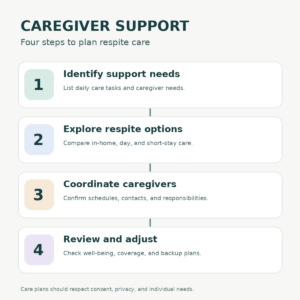
A simple planning process can help families create a more sustainable arrangement.
Step 1: Identify caregiver needs
Document the most demanding tasks and the support currently available.
Step 2: Compare respite and support options
Evaluate family assistance, professional services, adult day programs, counseling, and support groups.
Step 3: Coordinate care responsibilities
Confirm schedules, contact information, authorized tasks, and backup coverage.
Step 4: Review caregiver well-being and the care plan
Check whether the arrangement continues to meet the needs of both the caregiver and the person receiving care.
Respite care for dementia, stroke, and complex care needs
Not every respite provider is suitable for every care situation.
Dementia respite care
Some people living with dementia need individualized communication, familiar routines, assistance with activities, or appropriate supervision.
Ask providers about dementia-specific training and how they respond to changing needs.
Respite care after a stroke
A person recovering from a stroke may need specialized support with mobility, communication, personal care, or rehabilitation-related routines.
Care tasks should follow the person’s professional care plan.
Caregiving for chronic conditions
Chronic conditions may involve medications, appointments, equipment, and changing symptoms.
Clarify which tasks require qualified medical professionals.
Caregiving with mobility limitations
Transfers, lifting, and mobility assistance can present risks.
Providers should have appropriate training and access to suitable equipment.
Do not substitute improvised handling techniques for professional recommendations.
Matching the provider to the person
The most suitable respite service is one that can reliably provide the agreed level of care.
Advertising descriptions such as experienced or specialized should be verified through qualifications and actual service details.
Caregiver support and respite care costs
Respite costs vary according to location, service type, hours, staffing, and care requirements.
In-home respite costs
In-home services may charge hourly rates or require minimum visit durations.
Confirm whether personal care, transportation, weekend coverage, or additional services involve separate fees.
Adult day care costs
Adult day programs may charge daily or recurring fees.
Transportation, meals, and specialized care may affect the total cost.
Residential respite costs
Temporary residential stays may include accommodation, meals, activities, and certain care services.
Additional charges may apply.
Medicare and respite care
Original Medicare generally does not pay for routine respite solely to give a family caregiver time off. Certain respite services may be covered in qualifying hospice arrangements under applicable rules.
Other plans or programs may offer different benefits.
Medicaid and community assistance
Certain Medicaid programs and community services may support eligible respite care.
Rules vary by location and individual circumstances.
Long-term care insurance
Some policies may include respite-related benefits.
Review the exact contract, eligibility requirements, and exclusions.
Compare the complete expense
Ask for written information about service hours, transportation, deposits, cancellation fees, and other costs before choosing a provider.
How to find caregiver support and respite care services
Start with healthcare and social-service contacts
Healthcare professionals, social workers, and established aging services organizations may help families identify suitable options.
Explore community aging programs
Community organizations may provide caregiver education, referrals, support groups, and respite resources.
Availability varies by area.
Verify professional providers
Ask about licensing where applicable, training, supervision, insurance, references, and service limitations.
Review accessibility
Consider transportation, scheduling, language, physical access, and the older adult’s preferences.
Confirm availability
A service listed online may not have openings or offer the required level of care.
Contact the provider directly to verify current availability.
Protect privacy and consent in caregiver support
Caregiver Support and Respite Care should respect the dignity and choices of everyone involved.
Obtain appropriate agreement
Discuss respite care, personal assistance, and information sharing with the person receiving care whenever possible.
Share only necessary information
Providers should receive relevant instructions without unnecessary disclosure of personal information.
Protect caregiver boundaries
Family caregivers also need appropriate personal time, private relationships, and reasonable expectations.
Review access after caregiver changes
Remove outdated access to digital records, household systems, or confidential documents.
Test respite care arrangements before depending on them
Test 1: A planned short respite period
When suitable, begin with a manageable, agreed care session.
Review whether the provider understands the person’s routine.
Test 2: A caregiver handoff
Confirm essential instructions, contacts, responsibilities, and communication methods.
Test 3: An ordinary schedule change
Discuss how the service manages delays or substitutions.
Avoid making necessary care depend on unconfirmed coverage.
Test 4: A change in support needs
Determine how the provider responds if the person’s care requirements change.
Test 5: Caregiver feedback
After the arrangement, ask both the primary caregiver and the care recipient, when appropriate, about comfort, reliability, and areas for improvement.
Common caregiver support and respite care mistakes
Waiting until responsibilities become unmanageable
Exploring support options early may provide more time to compare services and prepare backup care.
Choosing respite based only on price
A lower-cost service may not meet the person’s actual care needs.
Qualifications, reliability, and appropriate service scope matter.
Assuming family members know what to do
Even familiar helpers need clear instructions and agreed responsibilities.
Treating support groups as a substitute for respite coverage
Peer support can be valuable, but it does not automatically provide hands-on caregiving assistance.
Ignoring caregiver privacy and preferences
Both the caregiver and the person receiving care should have appropriate input into the arrangement.
Failing to confirm backup coverage
A scheduled service may be canceled.
Maintain a realistic alternative.
Caregiver support and respite care maintenance plan
Initial setup
Document the chosen support arrangements, responsibilities, care instructions, emergency contacts, and service details.
Weekly review
Confirm upcoming caregiver coverage, appointments, and unresolved support needs.
Monthly reassessment
Review:
- Caregiver workload.
- Respite availability.
- Service reliability.
- Care recipient needs.
- Important contacts.
- Financial arrangements.
- Provider communication.
- Backup care.
- Privacy permissions.
After a care transition
Hospital discharge, relocation, changing mobility, or new health needs may require adjustments.
After a caregiver change
Update responsibilities, contacts, access permissions, and care instructions.
Safe everyday caregiver support and respite care
A sustainable caregiver plan should support meaningful care and realistic personal responsibilities.
Make regular assistance predictable
Consistent schedules can help caregivers plan work, household responsibilities, rest, and appointments.
Support familiar routines
Replacement caregivers should understand important personal preferences and daily activities.
Encourage respectful communication
Both family caregivers and professional helpers should communicate clearly about relevant changes.
Keep support flexible
An arrangement may need adjustment as needs evolve.
Review whether respite actually helps
Ask whether the support reduced the original caregiving burden without introducing significant new problems.

Emergency and backup planning for family caregivers
Identify backup caregivers
Choose appropriate people or services that can provide coverage if the primary caregiver becomes unavailable.
Keep essential instructions accessible
Maintain relevant care information, current contacts, and authorized procedures.
Prepare for service cancellation
Review the provider’s cancellation and replacement policies.
Know when professional help is necessary
Medical concerns, major changes in functioning, or severe caregiver distress may require qualified assistance.
Reassess after unexpected disruptions
Review what happened and adjust responsibilities, contact information, or backup arrangements.
Caregiver Support and Respite Care: final planning checklist
Before relying on a caregiver support arrangement, confirm:
- The caregiver’s responsibilities are documented.
- The care recipient’s needs are understood.
- Personal preferences are respected.
- The respite provider is appropriately qualified.
- The care setting is accessible.
- Service hours and responsibilities are confirmed.
- Medication-related tasks follow professional guidance.
- Emergency procedures are documented.
- Support group options have been considered.
- Caregiver well-being is reviewed.
- Costs and cancellation policies are understood.
- Privacy arrangements are appropriate.
- Backup coverage is available.
- Contact information is current.
- Regular reassessment is planned.
Frequently asked questions about Caregiver Support and Respite Care
What is Caregiver Support and Respite Care?
Caregiver Support and Respite Care includes practical assistance, emotional support, resources, and temporary care arrangements that help caregivers manage responsibilities while maintaining appropriate care for the person receiving assistance.
What is the difference between caregiver support and respite care?
Caregiver support is a broad category that can include education, counseling, community services, and practical help.
Respite care specifically provides temporary caregiving coverage.
What are common signs of caregiver burnout?
Possible signs include persistent exhaustion, feeling overwhelmed, changes in sleep, irritability, concentration difficulties, and reduced ability to manage daily responsibilities.
These symptoms may have multiple causes.
How can families prevent caregiver burnout?
Families can share responsibilities, arrange reliable respite coverage, consider professional support, and regularly review whether the caregiving workload is sustainable.
What types of respite care are available?
Options may include in-home respite, adult day programs, temporary residential respite, and appropriate family caregiving assistance.
Can respite care help dementia caregivers?
Yes. Suitable respite services may provide temporary coverage, but providers should understand the person’s dementia-related needs.
Are caregiver support groups helpful?
Support groups may provide peer connection, education, and information about community resources.
Their suitability depends on individual preferences.
Can caregivers find support groups online?
Yes. Some organizations offer virtual groups and other online support formats.
Check moderation, privacy, and accessibility.
Does Medicare cover respite care?
Coverage is limited and service-specific. Certain qualifying hospice arrangements may include respite benefits, while ordinary long-term caregiving relief is generally not covered by Original Medicare.
How much does respite care cost?
Costs depend on location, service type, schedule, care needs, and provider fees.
Request a complete cost explanation.
What is the best respite care for elderly adults?
The best option is one that meets the care recipient’s actual needs, provides reliable coverage, and fits the family’s schedule and resources.
Can caregiver burnout affect family relationships?
Ongoing stress and insufficient support may affect communication, emotional well-being, and relationships.
Professional support and practical workload adjustments may help.
When should a caregiver seek professional support?
Professional assistance may be appropriate when stress is persistent, daily functioning becomes difficult, or caregiving responsibilities cannot be managed safely.
How often should caregiver support plans be reviewed?
Review plans periodically and after changes in health, caregiver availability, home environment, service arrangements, or household responsibilities.
Final thoughts on Caregiver Support and Respite Care
Caregiver Support and Respite Care works best when the well-being of the caregiver and the needs of the person receiving assistance are addressed together.
An effective caregiving arrangement does not require one family member to manage every responsibility without help.
Dependable respite services, clear family coordination, appropriate professional guidance, supportive communities, and practical backup arrangements can help make caregiving more sustainable.
The strongest Caregiver Support and Respite Care plan is personalized, respectful, realistic, and regularly reviewed as family circumstances and care needs change.
Sources used for this guide
Official sources support the planning framework; they do not endorse a company, provider, organization, or product.
- Caregiving — National Institute on Aging.
- Aging in Place: Growing Older at Home — National Institute on Aging.
Build a safer plan
Return to the Caregiver Resources Resource Center for broad planning; focused child assets remain inactive until reviewed.
1 comentario en «💛 Caregiver Support, Burnout, and Respite Care»