
SeniorTechLife Mobility Service Guide
How to verify a local store, prepare for a useful showroom visit, compare written offers, and choose support that lasts beyond delivery day.
A mobility scooters store near me is worth visiting when it can help match the rider, scooter, environment, and service plan. Before making the trip, confirm that the business has a real showroom or appointment location, carries the relevant scooter class, permits test drives, identifies its authorized brands, and explains who will deliver, adjust, warranty, and repair the equipment.
Mobility scooter store near me: the quick answer
Use official manufacturer retailer locators to identify authorized sellers, then call each store before visiting. Ask which exact scooters are available to try, whether appointments are required, whether the store is accessible, how far it delivers, and whether it performs repairs for products it sells.
At the appointment, evaluate transfers, seated fit, controls, turning space, transport, charging, and the intended route. Take home an itemized quote with the exact model, configuration, battery, accessories, delivery, return terms, warranty route, and repair responsibilities. Do not buy solely because a scooter is in stock or discounted.
What this local mobility scooter store guide covers
This guide evaluates the retail provider and showroom process. It does not rank scooter models, cover short-term rental contracts, or serve as a broad directory of every provider near a reader. Use the planned guide to the best mobility scooters for seniors for cross-model selection, the planned mobility scooter guide for fundamentals, and the planned Pride mobility scooter guide for that brand’s product families.
The Excel also maps this page to aging in place services near me and stair and entryway safety for seniors. These remain inactive until the targets are published and relevant at the exact point of use.
Verify that the result is a mobility scooter store
Search results can mix physical showrooms, appointment-only warehouses, DME suppliers, repair businesses, pharmacies, online retailers, stand-up electric scooter stores, and lead-generation pages. Read the official site and call the business. Confirm the address, opening hours, accessible entrance, scooter inventory, staff availability, and whether the public can test equipment there.
A website with a local-looking page may route every inquiry to a national call center or third-party seller. That is not automatically a problem, but the buyer should know who owns the transaction, who delivers the scooter, and where future service occurs. Record the legal seller’s name and contact details from the quote or contract.
Check multiple independent signals
- The store’s official website lists a consistent address and service area.
- The manufacturer’s official locator confirms authorization when claimed.
- The telephone is answered with the business name and staff can discuss actual inventory.
- Written policies identify returns, delivery, warranty, and repair responsibility.
- State business records or required licenses are consistent with the seller’s identity.
- Reviews are considered for patterns, not treated as proof of product fit or technical competence.
Why authorized dealer status can matter
An authorized dealer relationship can provide access to current product information, warranty procedures, parts channels, and manufacturer support. Pride Mobility’s official resources direct shoppers to approved providers, and Golden Technologies’ locator identifies retailers and certain service-center designations.
Authorization is brand-specific and sometimes location-specific. A store can be authorized for one manufacturer but not another, or sell a product without being the location that performs warranty labor. Verify the exact brand and address through the manufacturer and ask the store what it handles directly.
Ask one decisive question: “If this exact scooter needs warranty diagnosis three months after delivery, who do I call, who transports it, and who pays for labor or pickup?” Get the answer in writing.
Prepare for a productive mobility scooter showroom visit
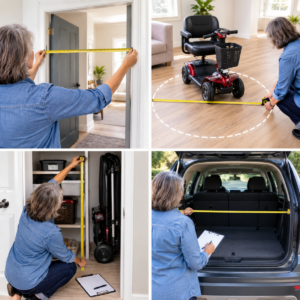
Bring the rider, the person who will help with transport or charging, and a written description of daily routes. Record the rider’s approximate height and weight, transfer method, control needs, typical walking tolerance, expected trip length, terrain, slopes, thresholds, storage, and charging location. Bring measurements, not estimates.
| Measure | Why it matters |
|---|---|
| Narrowest usable doorway | Overall scooter width is only part of the fit; approach and turning room also matter |
| Hallway and room turning area | Confirms whether the scooter can maneuver without repeated collisions |
| Thresholds and ramp slope | Must remain within the scooter and ramp limits under real conditions |
| Elevator door and interior | Confirms entry, turning, total load, and control access |
| Storage and charging area | Protects the scooter and keeps cords away from walking routes |
| Vehicle cargo opening and interior | Determines whether the folded or disassembled scooter and lift system fit |
| Heaviest safe lift for each helper | A transport scooter is not portable if no one can safely handle its components |
If the person has complex posture, pressure, transfer, vision, cognition, respiratory, neurological, or control needs, ask whether an occupational therapist, physical therapist, assistive technology professional, or other qualified clinician should assess the situation before purchase.
What a good mobility scooter store should help you test
Transfer and fit
The rider should be able to approach, use any swivel seat, sit, position the feet, reach the tiller, and stand using a repeatable method. Check seat width and depth, back support, armrest spacing, knee clearance, and visibility. A larger seat can increase overall scooter width or affect transport.
Controls and understanding
Ask staff to explain the key, throttle, direction, speed control, horn, lights, battery display, freewheel lever, charging, and any error indicators. The rider should demonstrate starting, stopping, turning, and parking—not merely watch the salesperson.
Maneuverability
Test slow turns, reversing, door approaches, and controlled stopping. If allowed, test a representative ramp, threshold, or outdoor surface within manufacturer limits. A large open showroom can hide the turning constraints of a home or hotel room.
Transport
Have the store demonstrate every step to fold, disassemble, lift, secure, and reassemble the exact scooter. Verify component weights in official specifications. If a vehicle lift or carrier is proposed, confirm the vehicle’s tongue-weight or lift capacity, hitch, scooter weight including accessories, ground clearance, visibility, and professional installation requirements.
Charging and routine care
Identify the battery chemistry, charger, connection sequence, recommended charging routine, storage temperature, battery replacement route, tire care, cleaning limits, and periodic service. Obtain the owner’s manual for the exact model before buying.
How to compare written offers from mobility scooter stores
Ask two or three stores to quote equipment that satisfies the same requirements. A useful quote names the exact model and configuration rather than a general product family. Record model number, color only after functional decisions, battery pack, charger, seat, accessories, delivery, setup, tax, financing, return terms, and warranty support.
| Offer element | Questions to resolve |
|---|---|
| Exact product | Model number, generation, battery option, seat, capacity, and included accessories |
| Availability | Floor model, new boxed inventory, special order, delivery estimate, and substitution policy |
| Condition | New, demo, open-box, refurbished, or used; mileage and warranty start |
| Delivery and setup | Assembly, home delivery, fit adjustment, instruction, packaging removal, and travel distance |
| Return or exchange | Deadline, condition, mileage, restocking, pickup fees, and nonreturnable items |
| Warranty support | Parts, labor, transport, in-home service, exclusions, and responsible company |
| Financing | Cash price, financed total, APR, fees, term, late charges, and optional products |
| Ongoing service | Diagnostic fee, pickup, response time, loaner availability, batteries, tires, and parts |
Do not let a monthly payment replace the total-cost comparison. Review the financed amount, annual percentage rate, term, fees, optional protection, and total of payments. Ask for a copy before signing and do not leave blank spaces in a contract.
Evaluate warranty, maintenance, and repair before purchase
A manufacturer warranty can cover specified parts while excluding labor, transportation, wear items, misuse, or batteries after a different period. Ask the store to separate manufacturer obligations from store promises. Get any free service, home visit, loaner, pickup, or extended protection in writing.
Ask whether the location is a service center, which brands it repairs, whether technicians use manufacturer diagnostics, how parts are ordered, and what happens if the business stops servicing the model. If repair is outsourced, identify that company and its distance from the rider.
For future mobility scooter repair-shop searches, keep the model and serial number, purchase record, warranty, manuals, service history, charger label, and photos together. This information can shorten diagnosis and prevent incorrect parts from being ordered.
Stores, DME suppliers, and Medicare are not the same thing
A retail mobility store may sell scooters without being enrolled to bill Medicare. A Medicare-enrolled DME supplier may not stock every retail scooter or allow a showroom-style comparison. If coverage may apply, use Medicare’s official supplier directory and confirm the current enrollment, participation, assignment, documentation, and service process.
Medicare explains that power-operated vehicle coverage requires conditions including a face-to-face examination and written prescription. The equipment must address a qualifying in-home mobility need under program rules. Never assume a store purchase becomes covered because a salesperson says the scooter is “medical.”
Local mobility scooter store versus online retailer
A local store can offer a test drive, individual setup, immediate questions, delivery instruction, and a nearby service relationship. An online seller can offer broader inventory, convenient comparison, or shipping to areas without a showroom. Neither channel is automatically better.
Compare the exact scooter, seller authorization, return cost, assembly, damaged-shipment process, technical support, warranty labor, replacement parts, and repair transport. If testing locally and buying elsewhere, be honest about the intended transaction and do not assume the local store will service a product it did not sell.
An online page that uses local terms is not a local store unless it clearly identifies the service location and responsibility. Ask where the scooter ships from, who performs setup, where returns go, and who repairs it in your ZIP code.
Warning signs when comparing mobility scooter stores
- The seller will not identify the exact model, condition, serial status, or legal business name.
- A “limited-time” claim is used to prevent measurements, a test drive, or a second quote.
- The store promises Medicare approval or reimbursement without the required process.
- The staff dismisses weight capacity, turning space, ramp limits, control ability, or transfer concerns.
- A product is substituted after payment without written approval.
- Return, warranty, financing, delivery, or repair terms are unavailable in writing.
- The seller requests gift cards, wire transfer, cryptocurrency, or another irreversible payment method.
- The proposed scooter has missing labels, altered serial information, unexplained damage, or a charger not verified for the battery.
Pause the transaction when a material answer changes between representatives. Keep screenshots and written communications, but rely on the final signed agreement and official manufacturer documentation for the exact product.
A practical scorecard for choosing a mobility scooter store
Score each store from zero to two on every item: zero means absent or unacceptable, one means partly resolved, and two means clear and satisfactory. Do not average away a safety-critical failure.
- Verified business identity and relevant manufacturer authorization
- Accessible location and appropriate scooters available to test
- Staff who ask about rider, environment, transport, and charging
- Complete demonstration and rider return-demonstration
- Itemized quote with exact product and configuration
- Fair written return and exchange terms
- Clear warranty labor, transport, and repair responsibility
- Parts, battery, tire, and long-term service route
- Transparent financing and total cost
- No unresolved safety, fit, or support issue
Frequently asked questions about finding a mobility scooter store near me
How can I find an authorized mobility scooter dealer?
Use the scooter manufacturer’s official dealer or retailer locator, then call the listed location. Confirm authorization for the exact brand, current address, models available, test-drive policy, and whether the location performs service.
Can I test-drive a mobility scooter in a store?
Many showrooms permit it, but inventory and appointment rules vary. Ask which exact models can be tested and whether the route includes turns, thresholds, or outdoor surfaces. Bring measurements and the intended rider.
Do mobility scooter stores repair scooters?
Some do, some outsource repairs, and some sell only. Ask which brands and models are serviced, whether warranty work is authorized, where repairs occur, what pickup costs, and how quickly common parts can be obtained.
Can a mobility scooter store bill Medicare?
Only an eligible enrolled DME supplier can bill Medicare for covered equipment under applicable rules. Verify the supplier in Medicare’s directory and confirm participation and assignment. A retail storefront or “medical device” label alone is not sufficient.
Should I buy a used scooter from a store?
A used or refurbished scooter can be considered if the store identifies its condition, inspection, battery test, mileage, serial number, parts support, warranty, return terms, and included charger. Compare the total with a supported new product.
How do I find a Pride mobility scooter repair provider near me?
Use Pride Mobility’s official dealer locator and contact the location with the exact model and serial number. Confirm that it performs service, not only sales, and ask about diagnostic, pickup, labor, parts, and warranty procedures.
Sources and verification date
Dealer, coverage, and supplier information was checked July 29, 2026. Verify the store and exact transaction again before purchase.
- Pride Mobility: Buy online / find a dealer
- Pride Mobility: How to buy a mobility scooter
- Golden Technologies: Retailer locator
- Golden Technologies: Scooter and service FAQs
- Medicare: About the DME Supplier Directory
- Medicare: DME coverage and supplier assignment
- CMS: DMEPOS accreditation organizations and purpose
Choose the store and the scooter as one support decision
Verify the business, prepare measurements, test the exact equipment, take the quote home, and resolve delivery, return, warranty, and repair responsibilities. The best store is not merely nearby; it is the provider that makes the scooter usable and supportable in the rider’s real life.