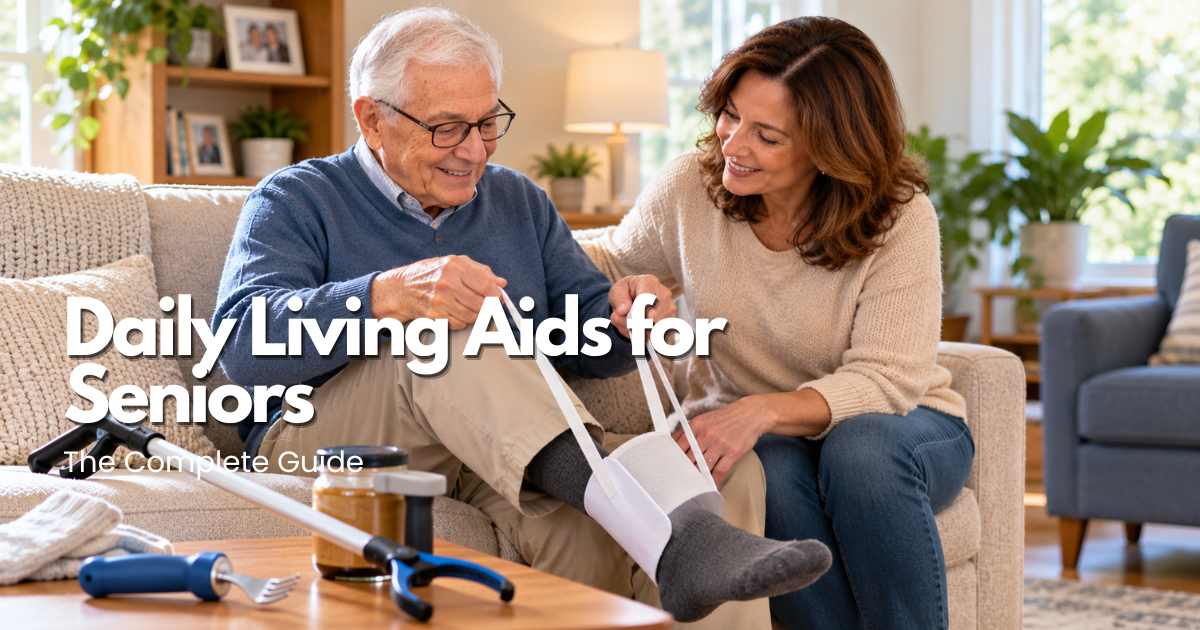
daily living aids for seniors | SeniorTechLife caregiver resources guide
For many older adults, maintaining independence means continuing daily activities such as getting dressed, preparing food, eating meals, opening containers, organizing household items, and managing personal care. Changes in hand strength, coordination, flexibility, vision, or mobility may make some of these activities more challenging.
However, choosing Daily Living Aids for Seniors requires more than purchasing products advertised as senior-friendly. The right assistive equipment should match the person’s abilities, the specific task, the surrounding environment, comfort preferences, and any professional care recommendations.
Adaptive daily living aids are available in many forms. A sock aid may support dressing, a reacher may help retrieve lightweight objects within its intended range, and adaptive utensils may provide a more manageable grip during meals.
These devices offer different advantages and limitations. A tool that works well for one person may be unsuitable for someone with different mobility, strength, coordination, or safety needs.
This comprehensive guide explains how to choose Daily Living Aids for Seniors, compare adaptive equipment, understand dressing and eating aids, evaluate grip and reach tools, improve household accessibility, coordinate caregiver assistance, review costs, and maintain equipment safely.
Safety note: Daily living aids do not replace medical care, rehabilitation, or necessary personal assistance. Tools such as reachers, dressing sticks, and adaptive utensils have specific limitations. They should not be used for unsupported lifting, transfers, or other activities beyond their intended purpose. New weakness, repeated falls, significant movement difficulties, or sudden changes in function warrant appropriate professional evaluation.
Quick answer: what are the best daily living aids for seniors?
The best Daily Living Aids for Seniors are products that address a clearly identified everyday difficulty while remaining comfortable, manageable, and safe for the intended user.
Someone who has difficulty putting on socks may benefit from a suitable sock aid.
An older adult who struggles to open certain containers may prefer an easy-grip jar opener.
A person who finds traditional forks or spoons difficult to hold may benefit from adaptive eating utensils.
A reacher may be useful for retrieving suitable lightweight objects without unnecessary bending or stretching.
Important features to consider include:
- Comfortable handles and grips.
- Appropriate tool size.
- Ease of operation.
- Suitable weight.
- Grip strength requirements.
- Dexterity and coordination needs.
- Visual accessibility.
- Compatible household surfaces.
- Product durability.
- Cleaning requirements.
- Storage convenience.
- Manufacturer safety instructions.
- Professional fitting when necessary.
- Total ownership costs.
- Caregiver assistance.
- Practical alternatives when equipment cannot be used.
The most useful Daily Living Aids for Seniors should support the person’s everyday routine rather than introduce additional complexity.
Why daily living aids for elderly adults matter
Everyday activities can involve numerous small movements that become more demanding when strength, flexibility, or coordination changes.
For example, fastening small buttons, opening a jar, holding a spoon, or reaching a shelf may become uncomfortable.
Daily Living Aids for Seniors can help adapt selected activities to the person’s abilities.
The goal is to reduce unnecessary difficulty while preserving comfort, choice, and participation.
What activities of daily living aids can support
Activities of daily living, often called ADLs, include fundamental personal care activities such as dressing, bathing, toileting, eating, and moving between positions.
Other household responsibilities, such as meal preparation and managing personal belongings, are commonly described as instrumental activities of daily living.
Adaptive equipment may support selected activities in both categories.
However, each aid should be evaluated according to the exact task it is intended to perform.
What daily living aids cannot guarantee
An adaptive tool cannot guarantee independent completion of every activity.
A reacher cannot replace safe mobility equipment.
A dressing aid cannot automatically solve significant balance or transfer difficulties.
Adaptive utensils cannot address every eating or swallowing problem.
Daily Living Aids for Seniors should form part of an individualized approach that may also include occupational therapy, home modifications, and caregiver support.
Compare the main types of daily living aids for seniors
There are several categories of Daily Living Aids for Seniors, each designed to address different everyday activities.
Dressing aids for seniors
Dressing aids may help with selected clothing tasks when reaching, gripping, or coordination becomes difficult.
Common examples include:
- Sock aids.
- Button hooks.
- Dressing sticks.
- Long-handled shoehorns.
- Zipper pulls.
- Elastic shoelaces.
- Clothing with accessible fasteners.
The most appropriate option depends on the clothing, the person’s movement abilities, and the intended use.
Sock aids for elderly adults
A sock aid is designed to help guide a sock onto the foot using a specially shaped support and attached handles or straps.
Some designs are flexible, while others are more rigid.
Important considerations include:
- Sock compatibility.
- Ease of positioning.
- Handle comfort.
- Required pulling strength.
- Seating stability.
- Product durability.
- Cleaning requirements.
A sock aid may not be appropriate if the task causes pain, instability, or movements that exceed the person’s abilities.
Button hooks and zipper aids
A button hook may help someone manipulate certain clothing buttons without relying entirely on fingertip precision.
Zipper pulls can provide a larger gripping surface.
However, the device must work with the intended clothing.
Practice with ordinary garments in a comfortable position before relying on the tool.
Dressing sticks and long-handled shoehorns
Dressing sticks may help position certain garments.
Long-handled shoehorns can make putting on suitable shoes more manageable.
They should not be used as walking supports, lifting tools, or transfer devices.
Reachers and grabber tools for seniors
Reachers are commonly used to retrieve selected lightweight objects within a comfortable and safe range.
Features may include:
- Trigger-style handles.
- Rotating gripping heads.
- Magnetic tips.
- Folding designs.
- Lightweight construction.
- Textured gripping surfaces.
However, a reacher should not be used for heavy, unstable, hot, sharp, or otherwise hazardous objects unless its manufacturer specifically permits that use.
An older adult should not stretch beyond a stable position to reach an object.
Jar openers and grip aids
Jar openers may help with certain containers that are difficult to twist open.
Options include manual grip pads, lever-style openers, and suitable electric openers.
Check:
- Container compatibility.
- Grip strength requirements.
- Stability.
- Ease of cleaning.
- Countertop placement.
- Electrical requirements when applicable.
A jar opener should reduce the difficulty of a task without creating unsafe force or unstable movement.
Adaptive eating utensils for seniors
Adaptive utensils may support people who find standard cutlery uncomfortable or difficult to control.
Options include:
- Large-handle forks.
- Built-up spoons.
- Angled utensils.
- Lightweight utensils.
- Weighted utensils.
- Compatible non-slip grips.
- Specialized eating accessories.
Different designs address different functional needs.
A weighted utensil is not automatically suitable for everyone with tremors or hand weakness.
Adaptive plates and dining accessories
Some older adults may benefit from non-slip placemats, plate guards, dishes with raised edges, or suitable easy-grip cups.
These products should match the person’s eating abilities and meal preferences.
Swallowing concerns require professional assessment rather than simply changing utensils.
Daily Living Aids for Seniors: explore related guides
This article serves as the main educational guide for Daily Living Aids for Seniors.
Detailed product comparisons and condition-specific questions can be addressed in dedicated articles.
Dressing and reaching aid guides
Related topics include:
- Sock Aid.
- Reachers.
- Jar Opener.
- Button Hook.
- Dressing Aids.
- Dressing Aid Stick.
These guides can explain specific products, usability, maintenance, and appropriate limitations.
Adaptive eating utensil guides
Related topics include:
- Adaptive Utensils for Eating.
- Adaptive Eating Aids.
- Adaptive Utensils for Adults.
- Adaptive Utensils for Seniors.
- Eating Aids for the Elderly.
- Types of Adaptive Utensils.
- Adaptive Utensils and Plate.
Individual guides can compare grip shapes, weights, handle sizes, cleaning requirements, and intended uses.
Daily living aids for specific conditions
Related topics include:
- Daily Living Aids for Arthritis.
- Daily Living Aids for Stroke Patients.
- Daily Living Aids for the Blind.
- Adaptive Utensils for Tremors.
- Eating Aids for Parkinson’s.
- Eating Aids for Arthritic Hands.
- Eating Aids for Dementia.
- Adaptive Utensils for ALS.
- Adaptive Utensils for MS.
- Adaptive Utensils for Stroke.
- Occupational Therapy Adaptive Utensils.
Condition-specific aids should be evaluated according to functional abilities rather than diagnosis alone.
Brand and shopping guides
Other related topics include:
- Bunmo Adaptive Utensils.
- Vive Adaptive Utensils.
- Weighted Adaptive Utensils.
- Adaptive Utensils Near Me.
- Adaptive Utensils Amazon.
- Special Supplies Adaptive Utensils.
These guides should verify actual product specifications and current purchasing information.
Publishing note: Related titles represent planned editorial resources, not verified active links. Activate links only after each article is published and reviewed.
Eight important decisions when choosing daily living aids for seniors
Selecting Daily Living Aids for Seniors should begin with a practical assessment of the person’s activities and abilities.
1. Identify the exact daily task
Start by determining which activity is difficult.
Examples include:
- Putting on socks.
- Fastening buttons.
- Opening containers.
- Holding eating utensils.
- Retrieving lightweight objects.
- Managing clothing.
- Preparing simple meals.
- Operating household controls.
A clearly identified task makes it easier to compare suitable equipment.
2. Evaluate strength, movement, and dexterity
Consider hand strength, joint flexibility, range of motion, grip control, and coordination.
A device advertised as easy-grip may still require more force than the user can comfortably apply.
Observe normal movement without encouraging unsafe effort.
3. Review fit and physical accessibility
Daily living aids should fit the user and the task.
Handle size, length, weight, gripping surfaces, and positioning can influence comfort.
The ideal design may differ between individuals.
4. Check ease of operation
Some adaptive devices require several steps or precise positioning.
A simpler tool may be more useful than a highly adjustable product.
Ask the person to try the aid in a safe setting.
5. Consider the surrounding environment
The same device may perform differently depending on furniture height, floor condition, table stability, or room layout.
For example, a reacher may be useful near a stable chair but inappropriate if someone must lean dangerously to operate it.
6. Protect independence and personal preferences
Daily Living Aids for Seniors should support the person’s choices.
Some individuals prefer familiar equipment, while others welcome new assistive technology.
Respect whether the person wants assistance or prefers to complete a task independently when safe.
7. Compare costs and long-term maintenance
Expenses may include:
- Product purchase.
- Replacement parts.
- Specialized accessories.
- Cleaning supplies.
- Professional assessment.
- Repairs.
- Shipping.
- Returns.
- Replacement equipment.
Consider whether the product will remain practical with continued use.
8. Establish caregiver and backup arrangements
Some tasks may still require assistance.
Identify who can provide appropriate help when needed.
Maintain an alternative plan if equipment breaks or becomes unsuitable.
Dressing aids for seniors: comfort, independence, and practical use
Dressing aids are among the most familiar Daily Living Aids for Seniors.
They can support selected clothing tasks, but should not encourage unsafe stretching or unstable positions.
Choosing a sock aid
Compare the flexibility, shape, handles, and intended sock types.
Use manufacturer instructions and seek professional guidance when significant mobility limitations are present.
Using button hooks for clothing
Button hooks may be useful when fine finger movements are difficult.
Test the device on the person’s actual clothing.
Avoid forcing a button or fabric when resistance is excessive.
Dressing sticks and reach requirements
Dressing sticks can help position certain garments.
However, users should maintain an appropriate, supported position rather than stretching beyond their comfortable range.
Long-handled shoehorns and footwear
A shoehorn may help with suitable shoes.
Footwear should still fit correctly and provide appropriate stability for the person.
When dressing aids are not enough
Pain, significant weakness, poor balance, or an inability to complete dressing safely may require an occupational therapy assessment or other assistance.
Adaptive utensils and eating aids for seniors
Eating equipment is another important category of Daily Living Aids for Seniors.
Built-up handle utensils
Built-up handles increase the gripping surface of forks, spoons, or other compatible tools.
They may help some individuals hold utensils more comfortably.
However, the best handle diameter depends on the person’s hand function.
Angled adaptive utensils
Angled utensils are designed to change the position required to bring food toward the mouth.
Their suitability depends on movement abilities, comfort, and individual guidance.
Weighted utensils for tremors
Weighted utensils may help some people with specific movement difficulties, but they may increase fatigue or be unsuitable for others.
Avoid assuming that additional weight always improves control.
Non-slip plates and dining accessories
Non-slip surfaces and raised-edge plates can support certain eating tasks.
The equipment should remain stable and easy to clean.
Consider professional eating assessments
Difficulty manipulating utensils differs from difficulty chewing or swallowing.
Swallowing problems require appropriate clinical assessment, which adaptive cutlery cannot replace.
Reachers, jar openers, and everyday household tools
Daily Living Aids for Seniors can also support selected household activities.
Choosing a reacher for seniors
A reacher should be appropriately sized and comfortable to operate.
Consider gripping strength, product capacity, and the types of objects the person normally retrieves.
Avoid dangerous reaching
Do not use a reacher to retrieve objects that require standing on unstable surfaces, leaning dangerously, or lifting beyond the device’s capacity.
Reorganizing storage may provide a safer solution.
Selecting a jar opener
Compare ease of gripping, container compatibility, countertop stability, and user comfort.
Some people may prefer a non-slip opening pad, while others may benefit from a suitable mechanical opener.
Organize frequently used household items
Placing everyday objects within comfortable reach may reduce the need for additional tools.
Adaptive equipment should complement sensible household organization.
Avoid using adaptive tools outside their purpose
A dressing stick is not a mobility aid.
A reacher is not a load-bearing support.
Kitchen aids should not be assumed suitable for every container or task.
Daily Living Aids for Seniors: practical comparison table
| Aid category | Main purpose | What to verify | Important limitation |
|---|---|---|---|
| Sock aid | Assist with putting on socks | Fit, handle comfort, sock compatibility | Does not solve all dressing difficulties |
| Button hook | Support button fastening | Button size, grip, clothing compatibility | Requires some coordination |
| Dressing stick | Position selected garments | Length, control, comfort | Not a walking or transfer aid |
| Long-handled shoehorn | Assist with shoes | Length and footwear compatibility | Does not replace suitable footwear |
| Reacher | Retrieve selected lightweight items | Grip, reach, capacity | Not for heavy or unstable loads |
| Jar opener | Open compatible containers | Grip strength and stability | May not work with every lid |
| Built-up utensil | Provide a larger eating grip | Handle fit and control | Does not address swallowing problems |
| Angled utensil | Change the required movement | Individual movement needs | Not appropriate for every person |
| Weighted utensil | Support certain eating activities | Weight, fatigue, individual suitability | May worsen comfort for some users |
| Non-slip dining aid | Reduce selected dish movement | Surface compatibility and cleaning | Cannot replace necessary assistance |
Daily Living Aids for Seniors: how to compare fit, grip, and reach
Physical fit is one of the most important factors when selecting adaptive equipment.
Match the grip to the person’s hand
Consider whether the handle is too narrow, too large, too heavy, or difficult to control.
The person should not need to strain to operate the tool.
Evaluate comfortable reach
Longer tools are not automatically better.
A longer reacher or dressing stick may be harder to control.
Choose equipment according to the task and safe working position.
Consider weight and balance
Lightweight tools may reduce handling effort.
Weighted tools may serve selected purposes but can increase fatigue.
Evaluate individual comfort rather than following a universal recommendation.
Check surfaces and stability
An opener or adaptive plate may require a stable countertop or table.
Test the complete activity rather than judging the device alone.
Seek occupational therapy guidance when needed
An occupational therapist can evaluate activities of daily living and recommend suitable tools, techniques, or environmental changes.
This may be particularly useful when physical limitations are significant.
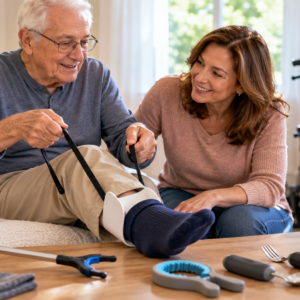
Daily Living Aids for Seniors: four-step practical selection guide
A simple process can help families choose appropriate adaptive equipment.
Step 1: Identify the everyday task
Observe the activity and determine which movement or action is difficult.
Avoid purchasing products before defining the problem.
Step 2: Compare suitable aids
Evaluate products designed for the specific task.
Review handle shape, fit, instructions, and relevant limitations.
Step 3: Test comfort and usability
Try the aid in a safe, familiar environment.
Assess comfort, control, and whether the person can use the tool without excessive effort.
Step 4: Review maintenance and support
Confirm how the equipment is cleaned, stored, replaced, and used when assistance is necessary.
Document what works and reassess when needs change.
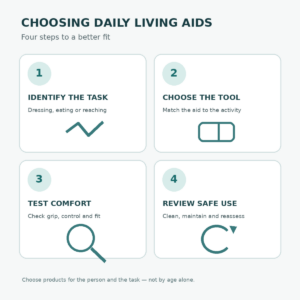
Daily living aids for arthritis, tremors, stroke, and vision changes
Adaptive Daily Living Aids may support people experiencing different functional limitations.
Daily living aids for arthritis
Arthritis may affect grip comfort, hand movement, or joint flexibility.
Some individuals may benefit from larger handles, suitable jar openers, or other equipment requiring less uncomfortable gripping.
Recommendations should match the person’s actual symptoms and abilities.
Eating aids for Parkinson’s and tremors
Tremors can make eating tasks difficult for some individuals.
Specialized utensils may provide support in selected circumstances.
However, no single utensil design works for everyone.
Professional assessment may help identify suitable options.
Daily living aids for stroke patients
After a stroke, difficulties may involve strength, coordination, sensation, vision, or movement on one side of the body.
Adaptive equipment should be selected as part of an individualized rehabilitation plan when appropriate.
Daily living aids for visually impaired seniors
People with low vision may benefit from high-contrast markings, readable controls, tactile cues, or organized storage.
A tool’s shape and visual design may affect usability.
Adaptive aids for memory-related needs
Some people experiencing cognitive changes may find familiar, simple equipment easier to use.
Introduce new tools according to the person’s ability to understand and operate them.
Complex equipment should not create confusion or additional risk.
Daily Living Aids for Seniors: setup, cleaning, and maintenance
Adaptive equipment should remain practical after the initial purchase.
First setup
Review manufacturer instructions.
Check that all components are included and the product is appropriate for the intended task.
Everyday use
Keep tools accessible and use them only for their intended purposes.
Stop using a device if it causes pain, instability, or unsafe movement.
Cleaning adaptive utensils
Follow the manufacturer’s cleaning instructions.
Some utensils may be dishwasher-compatible, while others require handwashing.
Check whether grips can trap food residue or moisture.
Maintaining dressing and reaching aids
Inspect handles, straps, joints, and gripping surfaces.
Replace equipment when components become damaged or unreliable.
Storage and organization
Keep frequently used aids in consistent, accessible locations.
Avoid storing tools where they create trip hazards.
Reassessment after changes
Changes in strength, coordination, vision, or mobility may affect equipment suitability.
Seek professional guidance when the existing tool no longer works safely.
Test daily living aids for seniors in everyday situations
Practical testing can reveal problems that product descriptions do not show.
Test 1: A familiar dressing routine
Evaluate whether a suitable dressing aid helps with the intended garment.
Use a comfortable, stable position.
Do not encourage unsafe bending or balance challenges.
Test 2: An ordinary meal
Try approved adaptive utensils with familiar foods.
Review grip comfort, control, and cleaning.
Test 3: A household reaching task
Use the reacher only for an appropriate lightweight object in a safe position.
Do not test equipment with heavy or hazardous objects.
Test 4: A caregiver demonstration
An authorized caregiver can review instructions and demonstrate appropriate use when needed.
The older adult should remain involved in decisions.
Test 5: Equipment unavailable
Discuss how the task will be managed if the aid breaks or is temporarily unavailable.
Use appropriate assistance rather than improvising unsafe equipment.
Common mistakes when buying daily living aids for seniors
Choosing equipment based only on appearance
A product may look comfortable yet require difficult movements.
Evaluate actual fit and usability.
Assuming every senior needs the same aids
Older adults have different preferences and functional abilities.
Recommendations should be individualized.
Buying a reacher that is difficult to control
A tool that is too long, heavy, or difficult to grip may be impractical.
Choose an appropriate design.
Assuming weighted utensils always improve eating
Additional weight can affect fatigue and control.
Consider the person’s specific needs.
Ignoring cleaning requirements
Adaptive equipment should be easy to maintain according to its intended use.
Using tools beyond their intended purpose
Reachers, dressing aids, and utensils should not be repurposed as mobility or lifting devices.
Overlooking professional assistance
A device may not be sufficient when significant physical or neurological limitations are present.
Occupational therapy or other qualified support may be appropriate.
Daily Living Aids for Seniors: everyday independence and caregiver support
Daily Living Aids for Seniors work best when people have opportunities to use appropriate tools during familiar activities.
Encourage comfortable participation
Allow the older adult to complete suitable tasks at a comfortable pace.
Avoid unnecessary rushing.
Keep supplies within reach
Organize important tools where they can be accessed without unsafe movements.
Respect individual preferences
Some older adults may prefer a familiar household method over a new adaptive product.
Discuss options rather than assuming one device is required.
Provide assistance when needed
Caregivers may help with setup, maintenance, or activities that remain difficult.
Assistance should support dignity and independence.
Review how equipment performs
Ask whether the product continues to make the intended activity easier.
Replace or adjust the arrangement if it becomes uncomfortable.
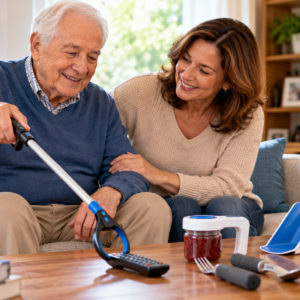
Daily living aid costs, accessibility services, and professional guidance
Compare complete product costs
A low-cost tool may work well for a simple task.
More specialized equipment may involve higher prices or additional accessories.
Compare features and usefulness rather than assuming higher cost means better results.
Understand possible insurance coverage
Coverage for adaptive equipment depends on the insurance plan, device classification, medical need, and applicable rules.
Many ordinary household convenience aids are not automatically covered.
Verify the exact product and benefits.
Ask about occupational therapy
Occupational therapists can evaluate daily activities and help identify equipment or adaptations suited to individual needs.
Compare purchasing and return terms
Check product dimensions, warranty, cleaning instructions, shipping charges, return eligibility, and available replacement parts.
Consider household changes before purchasing
Sometimes reorganizing storage, selecting easier clothing, or using more accessible furniture can reduce the need for additional equipment.
Emergency and backup planning for daily living aids
Daily Living Aids for Seniors should be part of a realistic household support plan.
Maintain an alternative for essential tasks
If an aid becomes damaged, the user should have an appropriate way to complete the task with assistance when necessary.
Avoid improvising unsafe repairs
Do not use damaged handles, broken straps, or makeshift attachments when product safety is uncertain.
Keep important communication accessible
A phone or suitable communication method should be available when the person requires help.
Reassess after injury or significant changes
A fall, new weakness, or major change in physical functioning may require updated professional recommendations.
Document caregiver responsibilities
Identify who checks equipment, replaces worn components, and arranges appropriate help.
Daily Living Aids for Seniors: final selection checklist
Before purchasing or relying on adaptive equipment, confirm:
- The tool addresses a clearly identified task.
- The person wants to use it.
- Grip and handle size are comfortable.
- Weight and reach are manageable.
- The equipment matches the household environment.
- Instructions are understandable.
- Manufacturer limitations are known.
- The product has been tested safely.
- Cleaning requirements are practical.
- Storage is accessible.
- Replacement parts are available if needed.
- Caregiver responsibilities are clear.
- Costs and return conditions are understood.
- Professional assessment has been considered.
- A suitable backup arrangement exists.
Frequently asked questions about Daily Living Aids for Seniors
What are Daily Living Aids for Seniors?
Daily Living Aids for Seniors are adaptive products that help older adults perform selected everyday activities, including dressing, eating, reaching, gripping, and managing household tasks.
What are the most useful daily living aids for elderly adults?
Useful tools may include sock aids, button hooks, reachers, jar openers, adaptive utensils, and other equipment suited to individual needs.
The best choice depends on the specific task.
Can daily living aids help seniors remain independent?
Appropriate aids may make selected activities easier and reduce unnecessary effort.
However, they do not guarantee independence or replace necessary support.
What are the best dressing aids for seniors?
Common dressing aids include sock aids, dressing sticks, button hooks, and long-handled shoehorns.
Suitability depends on comfort, movement abilities, and clothing.
Are reachers safe for older adults?
A suitable reacher may help retrieve certain lightweight objects.
It should not be used for unsafe loads, unstable reaching, or activities beyond its intended purpose.
What are adaptive utensils for seniors?
Adaptive utensils are eating tools designed with features such as larger handles, specialized angles, or different weights to support selected gripping and movement needs.
Are weighted utensils good for seniors with tremors?
Weighted utensils may help some individuals but may be uncomfortable or unsuitable for others.
Professional evaluation can help determine appropriate options.
Can daily living aids help with arthritis?
Certain grip aids, dressing tools, and adaptive utensils may make selected tasks more comfortable for some people with arthritis.
The appropriate aid depends on symptoms and abilities.
How can daily living aids help after a stroke?
Adaptive tools may support selected activities during rehabilitation.
Equipment should match individualized clinical guidance and functional needs.
What is the difference between a dressing stick and a reacher?
A dressing stick is generally intended to help position certain clothing items.
A reacher is designed to retrieve suitable objects within its rated capabilities.
Neither is a walking or transfer aid.
Does Medicare cover daily living aids for seniors?
Coverage depends on the type of equipment, medical circumstances, and applicable Medicare rules.
Many ordinary daily living convenience products are not routinely covered.
Verify specific benefits before purchasing.
When should families consider occupational therapy?
Occupational therapy may be useful when dressing, eating, reaching, or other everyday activities become difficult or unsafe.
How often should adaptive equipment be reviewed?
Inspect equipment according to manufacturer instructions.
Reassess its suitability after damage, changes in strength or movement, discomfort, or changes in daily routines.
Final thoughts on Daily Living Aids for Seniors
Daily Living Aids for Seniors can support comfortable everyday routines by making certain dressing, eating, reaching, gripping, and household tasks more accessible.
The best adaptive equipment does not need to be the most expensive or complicated product.
A suitable sock aid, easy-grip jar opener, properly selected reacher, or comfortable adaptive utensil may provide practical support when matched to the person and activity.
The strongest Daily Living Aids for Seniors plan combines individualized equipment selection, safe use, accessible household organization, respectful caregiver assistance, appropriate maintenance, and professional guidance when needed.
Sources used for this guide
Official sources support the planning framework; they do not endorse a company, provider, organization, or product.
- Caregiving — National Institute on Aging.
- Aging in Place: Growing Older at Home — National Institute on Aging.
- Unique Considerations in the Home — U.S. Food and Drug Administration.
Build a safer plan
General education only; seek qualified professional, clinical, legal, or emergency help when appropriate.