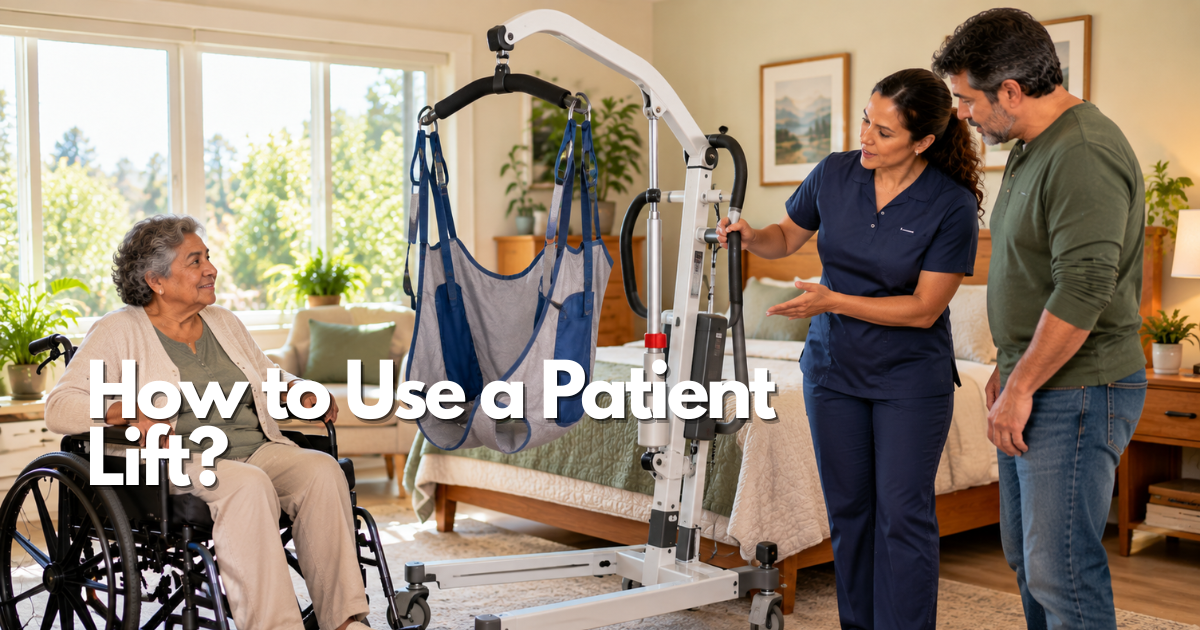
Understanding how to use a patient lift safely involves more than learning to operate its controls. Caregivers must recognize sling compatibility, equipment limitations, room clearance, weight capacity, communication needs, and the warning signs that require a transfer to stop. A lift that is suitable for one person or environment may be inappropriate for another.
This comprehensive guide explains how to use a patient lift as part of a professionally approved care plan. It covers full-body and sit-to-stand devices, sling selection, inspections, caregiver training, room preparation, battery care, maintenance, emergency arrangements, and Medicare coverage.
Important safety note: Patient lifting equipment can cause serious injuries when used incorrectly. This guide supports equipment evaluation and caregiver preparation but is not a substitute for hands-on training or the manufacturer’s operating instructions. A qualified healthcare professional should establish the transfer plan and teach caregivers using the exact lift and sling. Never attempt an unfamiliar transfer based only on written instructions or photographs.
Quick Answer: How to Use a Patient Lift Safely
The safest way to approach how to use a patient lift is to begin with professional assessment, compatible equipment, trained caregivers, and a clear transfer plan. Before routine use, the person and caregiver should understand the lift’s purpose, the required sling, the destination, and the procedure to follow if something goes wrong.
There is no single operating method for every patient lift. A manual hydraulic floor lift, electric full-body lift, sit-to-stand device, and ceiling lift can have substantially different requirements.
A practical preparation checklist includes:
- Confirm that a qualified professional has assessed the person’s transfer needs.
- Identify the exact patient lift model and approved purpose.
- Verify the equipment’s weight capacity and required accessories.
- Use only an approved sling with the correct size and attachment system.
- Inspect the lift and sling according to manufacturer instructions.
- Check that the intended environment has adequate clearance.
- Confirm that the required trained caregivers are available.
- Understand the specific brake, base, and control requirements.
- Explain the planned assistance and respect the person’s consent.
- Establish a clear communication and stop procedure.
- Understand the equipment’s emergency and backup arrangements.
- Reassess the transfer plan whenever needs or equipment change.
Knowing how to use a patient lift responsibly means recognizing the limits of the equipment and knowing when additional professional assistance is necessary.

What a Patient Lift Does
A patient lift is an assistive device intended to support certain movements between approved surfaces when a person requires mechanical transfer assistance. Depending on the model, the device may use a sling, supported seat, powered lifting mechanism, or manual hydraulic system.
Patient lifts are used in home care, rehabilitation, hospitals, and long-term care facilities. However, a lift is not a substitute for clinical assessment, caregiver training, or appropriate supervision.
How Patient Lifts Support Assisted Transfers
A full-body patient lift uses a manufacturer-approved support system to help caregivers manage certain transfers without relying on improvised manual lifting.
The person’s position, support needs, and destination must be considered together. Caregivers should not assume that the same equipment is suitable for every bed, wheelchair, commode, or chair.
What a Patient Lift Cannot Do
A patient lift cannot independently determine whether someone is medically ready to move.
It also cannot eliminate every risk related to positioning, equipment failure, skin pressure, unstable surfaces, or caregiver error.
Patient lifts are not intended to function as ordinary transport wheelchairs, stair lifts, or general-purpose lifting devices unless the manufacturer specifically authorizes the intended use.
Why the Exact Model Matters
Different manufacturers use different lifting mechanisms, spreader bars, slings, attachment systems, and control procedures.
Learning how to use a patient lift therefore requires instruction for the actual equipment rather than relying on experience with a similar-looking device.
Full-Body Patient Lift Versus Sit-to-Stand Lift
One of the first decisions in understanding how to use a patient lift is identifying which type of equipment matches the person’s abilities.
A full-body lift and a sit-to-stand device are not interchangeable. Each is designed for different levels of participation and support.
Full-Body Patient Lifts
Full-body lifts provide support through an approved sling or comparable lifting arrangement.
They may be considered when a person cannot safely participate in a transfer requiring greater physical effort.
The correct sling and support configuration depend on the person’s medical and functional needs.
Sit-to-Stand Patient Lifts
Sit-to-stand devices support certain transitions involving people who can participate in the movement to the extent required by the equipment and care plan.
These devices may not be appropriate for someone who cannot meet the necessary weight-bearing, balance, or participation requirements.
A clinician should determine whether this type of lift is suitable.
Electric and Hydraulic Patient Lifts
Electric lifts use a powered mechanism, often with a rechargeable battery. Hydraulic lifts rely on manually operated controls to provide mechanical lifting assistance.
Both require qualified instruction and regular maintenance.
The most appropriate choice depends on caregiver abilities, available power, equipment specifications, and the person’s assessed needs.
Ceiling Lifts and Mobile Floor Lifts
Ceiling-mounted systems generally operate along installed overhead tracks, while mobile floor lifts have wheeled bases.
Their requirements for installation, room access, equipment inspection, and permitted transfer routes differ.
A professional should assess the complete environment before either system is selected.
Professional Assessment Before Learning How to Use a Patient Lift
A professional mobility assessment identifies the person’s physical abilities, support requirements, and environmental needs.
This assessment should occur before caregivers independently rely on a patient lift.
Assessing Mobility and Participation
A clinician may evaluate strength, posture, movement restrictions, balance, fatigue, and the person’s ability to participate in care.
These findings help determine whether the proposed lifting method is appropriate.
The presence of a wheelchair or an older age does not automatically establish which patient lift should be used.
Reviewing Pain and Skin Condition
Existing pain, skin sensitivity, recent surgery, and pressure-related concerns can affect sling selection and positioning.
An incorrect support arrangement may create discomfort even when the lift operates mechanically.
Professional assessment should identify relevant precautions.
Considering Communication and Cognitive Needs
The person may require additional time, reassurance, accessible communication, or another form of support to understand the planned movement.
Caregivers should know how to recognize discomfort and communicate consistently.
Assessing Caregiver Capabilities
The physical abilities and training of available caregivers matter as much as equipment design.
The care plan should specify how many trained people are required and which responsibilities each person has.
A powered lift does not automatically make a one-person transfer appropriate.
How to Use a Patient Lift With the Correct Sling
Sling selection is a critical part of safe patient lift use.
The FDA advises that a sling must be compatible with the specific lift and appropriate for the person. No single sling is suitable for every patient lift.
Understanding Sling Compatibility
Different slings use different attachment systems, support configurations, and materials.
A sling that appears to attach to a lift may still be incompatible.
Always verify the approved combination through manufacturer documentation and the qualified care team.
Choosing the Appropriate Sling Size
Sling size should reflect the person’s body dimensions, posture, support requirements, and the manufacturer’s specifications.
A sling that is too large or too small may provide inappropriate support.
Sizing should not be selected using clothing size alone.
Sling Attachment Systems
Patient lifts may use loops, clips, or other manufacturer-specific attachment arrangements.
Attachment configurations should only be used as approved for the exact lift and sling.
Caregivers must receive direct training on the model’s requirements.
Inspecting Sling Material
Slings can develop worn fabric, damaged stitching, stretched straps, or defective attachments.
Inspect the sling according to the manufacturer’s instructions before use.
Damaged components should be removed from service and replaced with approved equipment.
Patient Lift Inspection Before Every Transfer
A pre-use inspection helps identify equipment problems before someone depends on the lift.
The manufacturer’s instructions should provide the exact inspection requirements for the selected device.
Checking the Lift Structure
Look for visible damage, missing parts, abnormal movement, or other concerns affecting the frame and lifting assembly.
A device showing unexplained structural defects should not be used until appropriately evaluated.
Inspecting the Spreader Bar and Attachments
The spreader bar and related attachment components must be compatible and in suitable condition.
Check for damage, malfunction, or incomplete components according to the model’s instructions.
Wheels, Casters, and Base Condition
For mobile lifts, inspect the wheels and base for visible problems that could affect movement or stability.
Caster and brake procedures vary between manufacturers and must follow the approved transfer plan.
Battery and Controls
For powered models, verify battery readiness and relevant control indicators using the approved checks.
Unresponsive controls, unusual sounds, or warning indicators should be addressed before routine use.
When Equipment Must Be Removed From Service
Stop using the lift when there is visible damage, unexpected movement, an unresolved mechanical problem, or uncertainty about sling compatibility.
Contact the supplier or qualified technician rather than attempting an improvised repair.
Caregiver Training and Supervised Return Demonstration
Training is essential when learning how to use a patient lift.
A caregiver should understand not only the equipment’s functions but also the individual’s approved transfer plan and the conditions that make assistance unsafe.
Learning From a Qualified Professional
Instruction should be provided by an appropriately qualified professional familiar with the selected equipment and care needs.
Training should address the exact lift, compatible sling, environment, communication procedures, inspections, and emergency arrangements.
Why Watching Videos Is Not Enough
Videos may introduce terminology and help caregivers recognize equipment components.
However, they cannot assess the person’s mobility needs or verify that an individual can operate the equipment safely.
Direct supervised practice remains important.
Return Demonstration and Competency
A return demonstration allows the caregiver to show the instructor what has been learned.
The qualified professional can identify problems and determine whether additional instruction is necessary.
A completed demonstration should reflect the actual care situation, not an unrelated model or hypothetical transfer.
Training Every Regular Caregiver
Every person responsible for operating or assisting with the lift should receive suitable instruction.
A previously trained relative cannot automatically transfer that competence to another helper through informal explanations.
Communication, Consent, and Patient Comfort
Good communication is part of understanding how to use a patient lift responsibly.
The person receiving assistance should know what is planned and have an appropriate opportunity to express concerns.
Explain the Planned Assistance
Describe the purpose of the transfer in language the person understands.
Allow time for questions and consider hearing, visual, language, or cognitive needs.
Agree on Communication Signals
The care team should establish a clear way to communicate discomfort, uncertainty, or a request to stop.
These signals should be understood by the person and caregivers before the activity begins.
Maintain Privacy and Dignity
Patient transfers may involve personal care and unfamiliar physical support.
Protect the person’s privacy and avoid unnecessary exposure or rushed interactions.
Stop When the Person Is Uncomfortable
Unexpected pain, distress, skin discomfort, or difficulty maintaining the approved support arrangement requires attention.
Caregivers should pause and seek appropriate assistance rather than pressuring someone to continue.

Room Clearance and Floor Surfaces for Patient Lifts
A patient lift must fit the complete environment where it will be used.
Doorway width alone cannot establish that equipment will work beside a bed, approach a wheelchair, or maneuver within a bathroom.
Bed and Furniture Clearance
Beds differ in frame design, height, and the amount of usable space around them.
The lifting equipment, destination furniture, and required caregivers should be assessed together.
Doorways and Turning Space
Measure the complete route between intended locations, including doorways, corners, and areas requiring turns.
A lift may pass through a doorway but remain unsuitable for the destination.
Flooring and Thresholds
Carpets, uneven flooring, raised thresholds, and other obstacles may affect mobile lift movement.
The exact manufacturer’s requirements should determine permitted surfaces.
Do not force equipment across an unsuitable route.
Keeping the Environment Clear
Cords, rugs, furniture, and unnecessary objects can interfere with caregivers and wheeled equipment.
A professional home assessment can help identify environmental changes that support an approved care arrangement.
Patient Lift Brakes, Wheels, and Base Width
Mobile patient lifts have manufacturer-specific base, wheel, and brake arrangements.
These components must be understood before the equipment is used.
Base Configuration
Some mobile lifts have adjustable bases intended for particular positioning and stability requirements.
The correct configuration must follow the exact manufacturer’s instructions and professional training.
Wheel and Brake Operation
Braking instructions may differ depending on the model and activity.
Do not assume that a procedure used with a wheelchair or another patient lift applies to the current device.
Inspecting Wheels
Wheels should be checked for visible damage, obstruction, or unusual resistance according to the maintenance schedule.
A mechanical problem should be resolved before using the lift again.
Avoiding Unapproved Modifications
Do not alter wheels, base components, or brakes to make equipment fit an unsuitable environment.
A different lift or care arrangement may be necessary.
Battery Care and Emergency Lowering
Powered patient lifts require dependable battery and electrical systems.
Families should understand the model’s charging requirements and emergency features before the equipment becomes part of routine care.
Battery Readiness
Battery life varies by model, condition, and usage.
Check the manufacturer’s indicators and charging instructions rather than assuming a particular number of transfers remains available.
Approved Charging Equipment
Use the manufacturer-approved charger and follow its instructions.
Keep electrical cords away from walking routes and environmental hazards.
Emergency Lowering Features
Some powered lifts include model-specific emergency lowering mechanisms.
Caregivers should receive direct training from a qualified professional on the actual device.
Do not improvise an emergency release or attempt an unfamiliar procedure.
Responding to Power Failure
A discharged battery or control failure may interrupt planned assistance.
Follow the documented equipment-failure procedure and arrange suitable trained support.
Bathroom and Commode Transfers
Bathroom transfers can be more complicated than bedroom transfers because of limited space, wet surfaces, clothing requirements, and privacy concerns.
A patient lift suitable for a bedroom may not be appropriate for every bathroom.
Bathroom Accessibility
Assess the doorway, flooring, maneuvering area, fixtures, and caregiver access.
A narrow bathroom may require another care arrangement or appropriate accessibility changes.
Commode Compatibility
Commodes and shower chairs have different designs and clearance requirements.
The selected destination must be evaluated with the exact lift and person’s needs.
Moisture and Slip Concerns
Wet floors and unsuitable surfaces can affect stability and caregiver movement.
The care plan should account for bathroom conditions rather than assuming they are equivalent to those in a dry bedroom.
Privacy and Communication
Toileting support should maintain dignity and appropriate consent.
The person should be informed and involved whenever possible.
Bed-to-Chair and Chair-to-Bed Transfer Planning
Patient lifts may support certain transfers between a bed and wheelchair or chair when professionally approved.
The correct method depends on the person, destination, sling, lifting device, and trained caregiver arrangement.
Evaluating Both Transfer Directions
Moving from a bed to a wheelchair may create different positioning and access requirements than the reverse arrangement.
Both situations should be included in the professional assessment.
Checking Destination Compatibility
Wheelchairs and chairs vary in seat height, frame design, armrests, footrests, and structural support.
These characteristics can influence whether the approved lift arrangement is practical.
Recognizing Changes in the Person’s Abilities
Fatigue, pain, illness, and changes in posture may alter transfer suitability.
A previously successful arrangement should not be continued automatically when circumstances change.
Documenting the Approved Plan
Keep the relevant model, sling, destinations, required caregivers, and professional instructions together.
This information should be available to authorized helpers.
Cleaning and Infection Prevention
Patient lift maintenance includes appropriate cleaning of contact surfaces and compatible slings.
Cleaning procedures differ by manufacturer, material, and care environment.
Cleaning the Lift Frame
Follow the manufacturer’s directions for cleaning permitted surfaces.
Avoid exposing electrical components to inappropriate moisture.
Sling Cleaning
Slings may require specific laundering, drying, or disinfection procedures.
Do not assume that all sling materials tolerate the same cleaning products or temperatures.
Checking Equipment After Cleaning
Inspect relevant components and follow the manufacturer’s instructions before returning the equipment to use.
Cleaning should not conceal damage or substitute for maintenance.
Shared Equipment Considerations
Equipment used by multiple people may require additional cleaning and infection prevention policies.
Care settings should follow applicable professional and organizational procedures.
Patient Lift Maintenance and Service
Knowing how to use a patient lift also means understanding the equipment’s ongoing maintenance responsibilities.
A device that is damaged, incorrectly serviced, or unavailable when needed cannot reliably support the care plan.
Routine Inspection Schedule
Follow the manufacturer-defined inspection and maintenance schedule.
Some components may require professional service rather than routine caregiver checks.
Mechanical and Electrical Problems
Unexpected noises, abnormal movement, damaged controls, or hydraulic or electrical defects require appropriate evaluation.
Do not perform unapproved modifications or repairs.
Maintaining Service Documentation
Keep a dated record of inspections, repairs, replacement components, and service-provider contacts.
A clear maintenance history can help caregivers identify unresolved problems.
Replacement Parts and Slings
Use components approved for the exact model.
A substitute part that appears similar may not be appropriate.

Medicare Coverage and Patient Lift Documentation
Medicare Part B may cover certain patient lifts as durable medical equipment when the applicable eligibility and medical necessity criteria are met.
However, not every lifting product, accessory, or additional feature is automatically covered.
When Medicare May Cover a Patient Lift
Medicare’s patient-lift coverage policy includes specific requirements relating to the person’s need for transfers and the consequences of not having a lift.
Coverage depends on the exact equipment category and the applicable medical documentation.
A patient lift being recommended or available for purchase does not establish Medicare eligibility by itself.
Medicare Part B Cost Sharing
For qualifying durable medical equipment under Original Medicare, beneficiaries generally pay 20% of the Medicare-approved amount after meeting the Part B deductible, provided the applicable requirements and supplier arrangements are satisfied.
The actual cost can vary.
Prescriptions and Supplier Requirements
The healthcare professional and Medicare-enrolled equipment supplier should explain the necessary order, documentation, and coverage conditions.
Families should obtain information for the exact device rather than relying on general equipment descriptions.
Medicare Advantage and Other Plans
Medicare Advantage plans may have separate network, authorization, and cost-sharing requirements.
Medicaid and private insurance may also apply different rules.
Home Modification Costs
Medicare generally does not pay for structural home remodeling simply because a patient lift is required.
Distinguish equipment coverage from household accessibility expenses.
Preventing Caregiver Injuries During Lift-Assisted Care
Patient lifts are part of safe patient handling programs because manual lifting can place considerable strain on caregivers.
However, equipment alone cannot remove every injury risk.
Avoid Untrained Manual Lifting
When the lift cannot be used, caregivers should follow the approved alternative arrangement.
They should not attempt to carry or manually lift a person beyond their training or physical capabilities.
Recognize Caregiver Fatigue
Fatigue may affect attention, communication, and the ability to identify problems.
Care plans should include realistic staffing and rest.
Request Additional Assistance
If the approved transfer requires more helpers than are available, arrange qualified support.
Do not assume that a lift’s controls make every transfer suitable for one person.
Reassess the Environment
Awkward space, clutter, unsuitable flooring, and incompatible furniture may create additional strain.
Environmental problems should be addressed through an appropriate assessment.
Falls, Skin Concerns, and Changes in Physical Ability
A person’s transfer needs may change after an illness, fall, hospitalization, or significant change in mobility.
An arrangement that previously worked may require reassessment.
New Pain or Discomfort
Unexpected pain during planned assistance may indicate an issue with the person’s condition, sling fit, or support arrangement.
Stop and seek professional guidance.
Skin Changes
Redness, pressure-related concerns, or skin injuries can affect sling suitability and comfort.
The healthcare team should assess relevant changes.
Reduced Strength or Postural Control
Changes in physical function may require a different lift, sling, caregiver arrangement, or clinical plan.
Do not continue using outdated instructions when the person’s needs have materially changed.
After Hospitalization
Discharge instructions may include new movement precautions, equipment needs, or assistance requirements.
Confirm the current plan before returning to routine lift use.
Buying, Renting, or Using a Secondhand Patient Lift
Families may obtain patient lifts through purchases, rental suppliers, insurance arrangements, or equipment assistance programs.
The selected equipment must be appropriate and properly maintained regardless of how it is acquired.
Purchasing New Equipment
Confirm the exact model, warranty, approved sling, delivery arrangements, caregiver training, and maintenance support.
Renting Equipment
Ask whether the supplier provides professional setup, appropriate cleaning, service, replacement equipment, and rental cancellation conditions.
Evaluating Used Patient Lifts
Used equipment may have unknown wear or incomplete service records.
A qualified equipment professional should inspect its condition, compatible accessories, and manufacturer support before use.
Comparing Total Costs
Consider delivery, slings, batteries, training, maintenance, and replacement parts.
A lower purchase price may not represent the best value when service or compatibility is uncertain.
Backup Planning When a Patient Lift Fails
Every care arrangement involving lifting equipment needs a realistic alternative when the normal device cannot be used.
A backup should be established before an equipment problem occurs.
Equipment Malfunction
Stop using the device when it behaves unexpectedly or shows concerning damage.
Follow the approved emergency plan and contact qualified support.
Unavailable Caregivers
When the required trained helpers are unavailable, the household should arrange an authorized alternative.
Do not improvise an unsafe transfer.
Blocked or Unsuitable Routes
Furniture changes, unexpected obstacles, or damaged flooring may prevent the intended lift arrangement.
The care team should reassess the environment before continuing.
Immediate Emergency Situations
Contact emergency services when there is immediate danger.
Routine troubleshooting should not delay urgent assistance.
Final How to Use a Patient Lift Checklist
Before routine lift-assisted care, confirm:
-
A qualified professional has assessed the person and transfer needs.
-
The exact lift model is appropriate for the intended task.
-
Lift and sling capacities have been verified.
-
Sling type, size, and attachments are manufacturer-approved.
-
Caregivers have received suitable hands-on training.
-
The required number of trained caregivers is available.
-
Equipment inspection requirements are understood.
-
The transfer environment has adequate clearance.
-
Wheel, brake, and base instructions are known.
-
Battery or hydraulic requirements are understood.
-
Communication and consent procedures are established.
-
The person can communicate discomfort or ask to stop.
-
Emergency procedures have been covered in training.
-
Maintenance and supplier contacts are accessible.
-
Equipment costs and insurance coverage have been reviewed.
-
An appropriate backup transfer plan exists.
-
The care plan includes regular reassessment.
A checklist supports consistent preparation, but it does not replace supervised competency or manufacturer-specific instructions.
Research Findings That Matter When Learning How to Use a Patient Lift
Several evidence-based principles should guide families evaluating patient lifting equipment.
These principles help distinguish reliable care planning from product claims or assumptions about equipment.
Sling Compatibility Is Essential
FDA guidance emphasizes the need for manufacturer-approved sling compatibility.
An incorrect sling or attachment arrangement can create serious risks.
Training Must Be Equipment-Specific
OSHA identifies training, equipment selection, and care planning as central parts of safer patient handling.
Generic familiarity does not guarantee competence with a new device.
Coverage and Safety Are Different Questions
Medicare approval does not independently establish that a lift is suitable for an individual home.
Coverage, professional assessment, equipment compatibility, and caregiver training must be considered separately.
Practical Situations When Learning How to Use a Patient Lift
The following examples identify circumstances that should be evaluated by the responsible healthcare professional or equipment supplier.
They are not independent operating instructions.
During an Initial Home Assessment
The care team reviews the person’s support needs, available equipment, destinations, and caregiver arrangement.
During a Medical Equipment Supplier Visit
Ask the supplier to identify the exact model, approved slings, inspection requirements, and available training.
During Room Measurements
Confirm the complete route, including bed clearance, doorways, destination furniture, and caregiver access.
During a Supervised Training Session
A qualified professional evaluates whether caregivers understand the equipment and approved care plan.
During Sling Inspection
Identify wear, damage, or compatibility concerns using the manufacturer’s inspection criteria.
During Caregiver Handoff
Ensure that replacement caregivers receive the current instructions and appropriate training.
During Equipment Repairs
Take damaged equipment out of service until it has been appropriately evaluated and cleared for use.
During a Medicare Inquiry
Confirm the exact patient lift, applicable coverage criteria, documentation, supplier, and potential out-of-pocket costs.
During a Change in Health
New pain, weakness, skin changes, or mobility limitations should lead to professional reassessment.
During an Emergency
Use the established emergency plan and obtain qualified assistance instead of improvising an unfamiliar transfer.
Frequently Asked Questions About How to Use a Patient Lift
How Do You Use a Patient Lift Safely?
Safe use requires the correct lift, manufacturer-approved sling, appropriate caregiver training, pre-use inspection, clear communication, and an individualized transfer plan.
The exact operating procedure depends on the model and the person’s needs.
Can One Caregiver Use a Patient Lift Alone?
Not necessarily. The required number of helpers depends on professional assessment, manufacturer instructions, the person, and the care setting.
What Is the Difference Between a Full-Body Lift and a Sit-to-Stand Lift?
Full-body lifts and sit-to-stand devices provide different types of support.
Sit-to-stand equipment generally requires specific participation abilities, while full-body lifts are intended for different support needs.
Can Any Sling Be Used With a Patient Lift?
No. The sling must be compatible with the exact lift and suitable for the person’s body dimensions and support needs.
What Should Be Checked Before Using a Patient Lift?
Follow the manufacturer’s pre-use inspection instructions, including relevant structural parts, slings, attachments, wheels, controls, and power components.
Can a Patient Lift Be Used at Home?
Many models are designed for home care, but suitability depends on adequate space, appropriate equipment, trained caregivers, and an individualized plan.
Does a Patient Lift Work on Carpet?
Compatibility depends on the specific model, floor conditions, and approved route.
Have the environment professionally assessed.
How Do You Use a Patient Lift in a Bathroom?
Bathroom transfers require specific assessment because space, moisture, destination equipment, and privacy needs differ from bedroom conditions.
Only trained caregivers should follow the model-specific approved plan.
What Happens if an Electric Patient Lift Loses Power?
Follow the exact manufacturer’s emergency instructions and the established backup plan.
Caregivers should learn emergency features through qualified training before routine use.
Does Medicare Cover Patient Lifts?
Certain patient lifts may be covered as durable medical equipment when Medicare’s medical necessity and documentation requirements are met.
Coverage of a particular model is not automatic.
Can a Patient Lift Prevent Caregiver Injuries?
Appropriate lifting equipment may help reduce certain manual-handling risks, but training, suitable equipment, and good care planning remain essential.
Are Used Patient Lifts Safe?
Used equipment should be professionally assessed for condition, service history, approved accessories, and manufacturer support.
How Often Should a Patient Lift Be Inspected?
Follow the manufacturer’s pre-use and maintenance instructions.
Stop using equipment when damage or malfunction is suspected.
What Should Happen if a Transfer Feels Unsafe?
Stop the activity, protect the person according to the approved care plan, and seek appropriate trained assistance.
Do not use additional force or improvise a different method.
Can a Patient Lift Replace a Caregiver?
No. A patient lift is assistive equipment and does not replace trained human assistance or professional care planning.
Conclusion: How to Use a Patient Lift With Confidence
Learning how to use a patient lift safely begins with understanding the individual, the equipment, and the environment. A suitable lifting system should be compatible with the person’s mobility needs, approved sling, destination surfaces, and available caregivers.
The most important elements are professional assessment, model-specific training, pre-use inspections, reliable communication, appropriate maintenance, and a clearly documented emergency plan. Families should also understand insurance requirements and the ongoing responsibilities associated with equipment ownership.
A practical approach to how to use a patient lift combines suitable technology with qualified guidance, respectful assistance, and regular reassessment. These measures help caregivers make informed decisions while supporting comfort, dignity, and appropriate safety.
Neutral how to use a patient lift decision table
| Decision area | What can go wrong | Evidence to verify |
|---|---|---|
| Person or rider | Wrong fit, control, posture, or participation assumption | Measurements and supervised assessment |
| Environment or route | Clearance, surface, slope, parking, or transfer failure | Complete route test and measurements |
| Provider or seller | Missing service, repair, documentation, or return support | Written terms and named contact |
| Fallback | Delay, malfunction, fatigue, weather, or coverage denial | Backup route and escalation plan |
Official sources and limitations
These sources were consulted for the how to use a patient lift research map. They establish general U.S. safety, access, equipment, or coverage boundaries; they do not endorse a product, converter, seller, provider, ranking, or individual outcome.
- OSHA — Safe patient handling — Training, hazard assessment, and equipment-selection principles.
- OSHA — Safe patient handling equipment — Selection, maintenance, availability, and cleaning context.
- CMS — Patient lifts policy article — Medicare documentation and coverage boundaries.
- CMS — Patient lifts compliance tips — Current documentation and denial-risk context.
- Medicare.gov — DME coverage — General DME framework.
- ADA — Medical care and mobility — Access and dignity context; not a transfer authorization.