Choosing a patient lift for home use requires more than comparing lifting capacity, price, or whether a model is advertised as portable. The person’s mobility, physical support needs, compatible sling, home layout, destination furniture, and caregiver capabilities all influence the decision. A lift that meets its advertised specifications may still be unsuitable for a particular bedroom or bathroom.
This comprehensive guide explains how to choose a patient lift for home use, compare electric and manual models, evaluate doorways and flooring, understand sling compatibility, and prepare caregivers for appropriate equipment use. It also covers maintenance, emergency planning, rental options, Medicare coverage, and situations when home lifting arrangements require reassessment.
Safety note: Patient lifts can cause serious injuries if equipment is incompatible, damaged, or operated by untrained caregivers. Never attempt an unfamiliar transfer based only on an online article or video. Have a qualified healthcare professional assess the person and demonstrate the approved procedure with the exact lift and sling. Stop if equipment behaves unexpectedly, the person experiences pain or distress, or the approved transfer cannot be performed safely.
Quick Answer: How to Choose a Patient Lift for Home Use
The right patient lift for home use should match the person’s mobility and support requirements, fit the intended household spaces, and be manageable for the trained caregivers who will operate it. Selection should begin with a professional assessment rather than a product listing.
A full-body lift may be appropriate for someone requiring extensive transfer support, while a sit-to-stand device has different participation requirements. Electric and hydraulic floor lifts also differ in operation and maintenance.
Before choosing a patient lift for home use, verify:
- The person’s assessed mobility and transfer needs.
- The type of lifting equipment recommended by a qualified professional.
- The exact model and manufacturer-defined weight capacity.
- Sling size, support requirements, and attachment compatibility.
- Bed, wheelchair, chair, and bathroom accessibility.
- Doorway widths, turning areas, and flooring conditions.
- The number of trained caregivers required.
- Battery or hydraulic operating requirements.
- Inspection, cleaning, and maintenance responsibilities.
- The equipment supplier’s delivery, training, and support services.
- Total purchasing or rental costs.
- Medicare or other insurance eligibility.
- A safe backup plan if the lift cannot be used.
An appropriate home patient lift arrangement considers the complete care routine, including the person, equipment, environment, available assistance, and response to unexpected problems.
What Is a Patient Lift for Home Use?
A patient lift for home use is mechanical equipment intended to assist with certain transfers when a person cannot safely move between surfaces using ordinary mobility methods.
Depending on the design, a home patient lift may support the person through a manufacturer-approved sling, lifting seat, or other specified support system. Most floor lifts have a wheeled base, frame, lifting arm, and either a powered or hydraulic mechanism.
What Does a Home Patient Lift Do?
A patient lift helps caregivers manage certain transfers identified in the individual’s care plan. Common destinations may include a bed, wheelchair, suitable chair, or approved commode.
The exact device and transfer technique depend on the person’s abilities and the manufacturer’s requirements. A lift cannot determine whether a transfer is medically appropriate or whether the destination is suitable.
Who May Need a Patient Lift at Home?
Some people living with significant mobility limitations require mechanical assistance for transfers.
The need may arise following an illness, surgery, injury, or change in physical function, but the appropriate equipment cannot be determined from a diagnosis alone.
An occupational therapist, physical therapist, or other qualified professional should assess the person’s actual transfer requirements.
What a Home Patient Lift Cannot Replace
A patient lift does not replace trained caregivers, professional assessment, emergency assistance, or a suitable mobility plan.
It is not automatically an alternative to a transport wheelchair, stair lift, or vehicle access system.
The approved uses must be confirmed for the exact model.
Types of Patient Lifts for Home Use
Patient lift for home use options include full-body floor lifts, powered lifts, manual hydraulic models, sit-to-stand devices, and certain ceiling-mounted systems.
These categories support different movements and require different levels of participation from the person being assisted.
Full-Body Patient Lifts
Full-body lifts use an approved support system, commonly a sling, to assist with transfers.
They may be considered when the person’s mobility or strength makes other transfer methods unsuitable.
The correct sling, body support, and equipment configuration must be determined through professional assessment.
Sit-to-Stand Patient Lifts
Sit-to-stand devices support certain transitions for individuals who can participate in the manner required by the equipment.
They are not interchangeable with full-body lifts and may be unsuitable for someone unable to meet the necessary weight-bearing or balance requirements.
A qualified clinician should determine whether this category is appropriate.
Electric Patient Lift for Home Use
An electric patient lift uses a powered lifting mechanism, usually operated through model-specific controls.
It may reduce certain manual operating demands compared with a hydraulic lift, but it requires attention to batteries, charging, electrical components, and emergency procedures.
Powered operation does not automatically make a lift appropriate for one-person use.
Manual Hydraulic Patient Lifts
A manual hydraulic lift uses a manually operated pumping mechanism.
It generally avoids the need for a rechargeable lifting motor, but caregivers must be capable of operating the mechanism according to their training.
Hydraulic components still require inspection and maintenance.
Ceiling-Mounted Patient Lifts
Ceiling lifts use an overhead track system installed in an approved building structure.
They may be worth considering when a floor lift cannot maneuver adequately, but installation requires professional evaluation.
Track coverage, structural requirements, maintenance, and total costs vary.
Comparing Patient Lift for Home Use Options
Different lifting systems should be compared according to actual care needs rather than general advertising claims.
| Lift type | Main characteristic | Important consideration |
|---|---|---|
| Electric floor lift | Powered lifting with a wheeled base | Battery, controls, caregiver training, and room clearance |
| Manual hydraulic lift | Manually powered hydraulic mechanism | Caregiver operating ability and hydraulic maintenance |
| Full-body lift | Supports specific transfers with a compatible sling | Individual assessment and approved sling configuration |
| Sit-to-stand lift | Supports certain assisted standing transitions | Requires appropriate participation and physical abilities |
| Ceiling lift | Uses an installed overhead track | Structural suitability, installation, and track coverage |
No patient lift for home use is universally best. The correct selection depends on the person, the environment, and the trained assistance available.
Start With the Home Transfer Task
Before comparing equipment, identify the specific transfers that need support.
A household may require assistance moving between a bed and wheelchair, while another needs access to a commode or a suitable reclining chair.
Identify Starting and Destination Surfaces
List the bed, wheelchair, chair, or other locations involved in the usual routine.
Each destination should be assessed for suitability with the exact lift.
Do not assume that a lift approved for bedroom use will also work in a bathroom.
Understand the Person’s Participation
Some individuals can communicate, adjust posture, or participate in certain movements, while others require more extensive support.
The care plan should reflect these abilities without making assumptions based on age.
Review Caregiver Availability
The number of caregivers required depends on the person, equipment instructions, environment, and professional assessment.
The plan must remain practical on weekdays, weekends, and overnight when assistance is needed.
Professional Assessment Before Bringing a Patient Lift Home
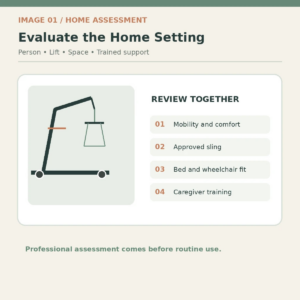
A patient lift for home use should be selected after a qualified professional evaluates the person and the intended environment.
An assessment helps identify whether the equipment, sling, and available caregivers can support the planned activities.
Mobility, Strength, and Body Positioning
The professional may assess strength, trunk control, posture, endurance, movement restrictions, and physical assistance requirements.
These factors influence the lifting arrangement and appropriate support equipment.
Pain and Skin Integrity
Pain, skin sensitivity, pressure concerns, and recent medical procedures may affect sling suitability.
The assessment should consider comfort and appropriate positioning, not just weight capacity.
Communication and Cognitive Needs
A person may need clear explanations, extra time, or communication adaptations to express preferences and discomfort.
Caregivers should understand how to recognize distress and when to stop.
Trialing Equipment in the Home
A supervised assessment in the actual home can identify obstacles that are not apparent in a showroom.
Verify the exact bed, wheelchair, destination furniture, floor surfaces, and caregiver arrangement before routine use.
Full-Body Lift, Standing Aid, or Transfer Chair?
These devices serve different purposes and should not be treated as interchangeable.
A full-body lift may provide extensive mechanical support, while a sit-to-stand aid typically requires more participation. Transfer chairs may also have specific mobility or transport limitations.
Matching Equipment to Functional Abilities
A clinician should determine which movements the person can perform safely and what additional support is needed.
Equipment selection should not be based solely on convenience or price.
Understanding Transfer Chair Limitations
Some products marketed as transfer chairs support specific forms of movement or transport.
Their approved functions, weight limits, and accessibility requirements vary.
A transfer chair cannot automatically replace an appropriately selected patient lift.
Knowing When a Different Device Is Necessary
Changing balance, significant weakness, pain, or difficulty controlling posture may make a previously suitable device inappropriate.
Professional reassessment is more appropriate than improvising another transfer technique.
Patient Lift for Home Use: Doorways and Turning Space
Home accessibility is one of the most important factors in selecting a patient lift for home use.
A device that can lift the required weight may still be unusable in a narrow bedroom, hallway, or bathroom.
Measure Doorway Widths
Record the usable width of relevant doorways.
Compare these measurements with the exact equipment specifications, including its approved base configurations.
Consider the space immediately beyond the doorway.
Evaluate Turning Areas
A floor lift needs room to approach destinations and maneuver according to the approved procedure.
Measure the actual route, not just the widest open space.
A device may pass through a doorway but lack room to turn.
Review Bedside Accessibility
Beds differ in frame design, height, under-bed clearance, and surrounding furniture.
Evaluate the exact bed and lift together.
Assess Bathroom Access Separately
Bathrooms often present restricted space, wet surfaces, and different destination equipment.
A lift suitable for a bedroom may be inappropriate for a small bathroom.
Flooring, Rugs, and Thresholds
Floor surfaces can influence the movement and control of a wheeled home patient lift.
Carpeting, raised thresholds, loose rugs, clutter, and uneven flooring should be reviewed before equipment is used.
Carpet and Rolling Resistance
Some flooring may make a loaded lift harder to maneuver.
Check the manufacturer’s permitted conditions and obtain professional assessment of the actual route.
Raised Thresholds
Door thresholds and transitions may interfere with wheel movement.
Do not force a loaded lift across an unsuitable transition.
Loose Rugs and Household Obstacles
Rugs, cords, toys, pets, and furniture may obstruct caregivers or equipment.
The household should maintain an appropriate route based on the approved transfer plan.
Bed-to-Chair and Bathroom Transfer Planning
A patient lift for home use may be part of a care plan involving different transfer destinations.
Each destination requires an appropriate assessment because bed, wheelchair, chair, and commode arrangements are not identical.
Bed-to-Wheelchair Transfers
The bed and wheelchair must be compatible with the chosen lifting system.
Seat height, bed design, wheelchair armrests, footrests, and caregiver access may influence suitability.
Chair-to-Bed Transfers
The reverse transfer may involve different environmental and positioning requirements.
Both directions should be evaluated through supervised training.
Bathroom and Toileting Arrangements
Bathroom transfers introduce concerns involving privacy, clothing, moisture, and limited clearance.
A suitable bathroom plan should be established with qualified assistance.
Avoiding Improvised Transfers
If the lift cannot reach the destination safely, stop and use the approved alternative.
Do not compensate for restricted space by forcing the lift or manually carrying the person beyond caregiver training.
Sling Selection for a Patient Lift for Home Use
Sling compatibility is essential because the sling supports the person during an approved lift-assisted transfer.
The FDA warns that no sling is suitable for every patient lift. The exact sling must be compatible with the manufacturer-approved equipment and suitable for the individual.
Choose the Correct Sling Type
Different sling designs provide different forms of body support.
Some may be intended for specific care tasks or positioning requirements.
The selection should come from professional assessment.
Confirm Sling Size
Sling sizing depends on the person’s dimensions and the manufacturer’s specifications.
A person’s clothing size cannot reliably determine the appropriate sling.
Verify Attachment Compatibility
Slings may have loops, clips, or other approved attachment systems.
Do not combine components simply because they appear to connect.
Inspect the Sling
Check the fabric, stitching, straps, and attachment points according to manufacturer instructions.
Remove damaged slings from service.

Electric Versus Manual Patient Lifts for the Home
Both electric and manual hydraulic patient lifts may be appropriate for home care when the required conditions are met.
The best option depends partly on the caregivers’ ability to operate the equipment and maintain it reliably.
Powered Controls and Charging
An electric lift uses a powered lifting mechanism.
Caregivers need to understand the controls, charging routine, battery indicators, and relevant emergency functions.
Manual Hydraulic Operation
A hydraulic model requires operation of a manual lifting mechanism.
The physical demands should be evaluated with the actual caregivers.
Comparing Long-Term Responsibilities
Powered equipment involves electrical and battery maintenance, while hydraulic equipment involves different mechanical service needs.
Both require inspection and approved components.
Choosing Based on the Actual Home
A smaller or less expensive model is not automatically more practical.
Compare dimensions, compatibility, operating requirements, and the support available from the supplier.
Training Every Home Caregiver
Caregiver training is a central part of using a patient lift for home use responsibly.
Every regular caregiver should understand the exact equipment and the person’s approved transfer plan.
Qualified Hands-On Instruction
A qualified professional should demonstrate the lift and its approved accessories in the relevant environment.
Training should cover equipment limitations, inspection, communication, emergency procedures, and conditions requiring the transfer to stop.
Supervised Return Demonstration
A return demonstration allows the caregiver to show that the equipment and care plan are understood.
Watching another person or a general online video is not equivalent to demonstrated competence.
Training Replacement Caregivers
New helpers should receive appropriate instruction before taking responsibility.
Do not assume a relative or professional caregiver is familiar with the exact model.
Refresher Training
Training should be reviewed after significant changes in the person’s condition, equipment, or household routine.
Battery, Charger, and Emergency Planning
A powered patient lift for home use requires a dependable power arrangement.
Battery failure or unresponsive controls may interrupt essential care if no backup has been prepared.
Establish a Charging Routine
Follow the manufacturer’s charging requirements and use only approved accessories.
Keep power cords away from walking routes.
Understand Low-Battery Warnings
Caregivers should recognize the device’s warning indicators.
Do not rely on equipment when an unresolved power problem affects its normal operation.
Emergency Lowering Procedures
Some powered lifts have model-specific emergency lowering features.
These must be covered in hands-on training for the exact equipment.
Do not improvise an unfamiliar emergency procedure.
Prepare an Alternative Care Arrangement
Identify trained assistance or approved alternative equipment for situations when the lift is unavailable.
Contact emergency services when immediate danger exists.
Patient Lift Storage and Daily Readiness
A patient lift needs an appropriate storage location that remains accessible without blocking household movement.
The sling, manual, service contacts, and charging equipment should also have designated locations.
Choose an Accessible Storage Area
Avoid blocking exits, hallways, or essential routes.
Follow manufacturer recommendations for environmental conditions.
Keep the Sling Protected
Store approved slings where they will remain clean, dry, and protected from damage.
Review manufacturer instructions for laundering and storage.
Maintain Clear Responsibilities
Assign responsibility for checks, cleaning, charging, and contacting the equipment supplier.
A household routine is more reliable when tasks are not left to assumption.
Pain, Skin, Dignity, and Consent
Mechanical lifting involves personal care, so comfort and dignity must remain central.
The person’s preferences, skin condition, and ability to communicate should influence the care plan.
Recognize Pain or Discomfort
Unexpected pain, pinching, pressure, or distress requires attention.
Stop and seek appropriate professional guidance when the usual arrangement becomes uncomfortable.
Protect Privacy
Explain the planned assistance and provide an appropriate private environment.
Avoid unnecessary exposure or rushed care.
Respect Personal Preferences
Ask about preferred caregivers, communication methods, and concerns.
A person should participate in decisions to the extent appropriate to their abilities.
Cleaning and Shared Home Equipment
Patient lifts and slings require cleaning according to their manufacturer’s instructions.
Material and electrical differences mean that one cleaning method is not appropriate for every component.
Cleaning Lift Surfaces
Use suitable cleaning products and avoid inappropriate moisture exposure.
Check equipment condition after cleaning.
Sling Cleaning
Slings may require specific washing and drying methods.
Do not reuse a damaged or improperly maintained sling.
Shared Equipment
Equipment used by multiple individuals may require additional infection prevention procedures.
Follow the relevant professional care policies.
Renting or Buying a Patient Lift for Home Use
The choice between renting and purchasing depends on expected use, available budget, service support, and insurance arrangements.
A temporary recovery period may create different financial needs than long-term home care.
Buying a New Home Patient Lift
Confirm the model, compatible sling, manufacturer warranty, delivery, setup, and training services.
Ask whether replacement parts and professional support are available.
Renting a Patient Lift
Check rental duration, monthly charges, delivery, servicing, cleaning, equipment replacement, and return requirements.
Request written terms.
Purchasing Used Equipment
Secondhand patient lifts may have unknown wear, missing manuals, or incompatible accessories.
Have the device inspected by a qualified equipment professional and verify manufacturer support before use.
Comparing Total Cost
Include accessories, training, delivery, maintenance, repairs, batteries, and rental obligations.
A lower initial price does not guarantee better long-term value.

Medicare Coverage for Patient Lifts at Home
Original Medicare Part B may cover certain patient lifts as durable medical equipment when the applicable medical necessity, equipment, ordering, and supplier requirements are met.
However, Medicare coverage does not automatically extend to every device marketed as a home patient lift.
When a Patient Lift May Qualify
The Medicare patient-lift coverage policy includes specific criteria involving required transfers between the bed and a chair, wheelchair, or commode.
The applicable policy also addresses the consequences of not having a lift, including bed confinement.
Eligibility should be established through the patient’s healthcare professional and the enrolled supplier.
Medicare Part B Costs
For covered durable medical equipment under Original Medicare, beneficiaries generally pay 20% of the Medicare-approved amount after meeting the Part B deductible, when applicable supplier requirements are satisfied.
The actual cost depends on the equipment and coverage arrangement.
Documentation Requirements
Ask the ordering clinician and Medicare-enrolled supplier which medical records, orders, and authorizations apply.
Request information about the exact lift model and billing category.
Medicare Advantage and Other Insurance
Medicare Advantage, Medicaid, and private insurance may have different eligibility and cost-sharing rules.
Contact the appropriate plan before committing to expenses.
Home Modification Costs
Original Medicare generally does not cover structural remodeling needed to accommodate a patient lift.
Installation and accessibility expenses should be considered separately from equipment benefits.
Patient Lift Repairs and Service Response
A patient lift for home use needs dependable technical support.
Mechanical wear, battery problems, worn slings, or damaged controls can interrupt an established care arrangement.
Recognizing Equipment Problems
Unusual movement, visible damage, unexpected sounds, and unresponsive controls should be reported.
Do not use questionable equipment until it has been appropriately evaluated.
Contacting the Supplier
Keep the manufacturer, model, supplier, warranty details, and service contact information accessible.
Record the problem and any professional repair.
Avoiding Unapproved Repairs
Do not substitute unknown parts or make structural, hydraulic, or electrical modifications.
Repairs should follow manufacturer requirements.
When a Home Patient Lift Is No Longer Appropriate
A previously suitable patient lift may become inappropriate when the person’s health, mobility, or household circumstances change.
Regular reassessment helps identify whether equipment or caregiver arrangements need updating.
Changes in Mobility or Strength
New weakness, reduced balance, or different positioning needs may affect the lift and sling selection.
Seek an updated professional assessment.
New Pain or Skin Concerns
Discomfort or skin changes may indicate that the existing support arrangement needs review.
Do not continue a routine that repeatedly causes pain.
Changes in the Home
New furniture, different flooring, a changed bedroom, or altered doorway access may affect equipment suitability.
Reassess the actual route.
Caregiver Availability Changes
An approved transfer plan may become impractical when trained helpers are no longer available.
Arrange suitable support before relying on an alternative.
Household Communication and Daily Readiness
A patient lift for home use is easier to manage when responsibilities and important information are shared consistently.
Caregivers need access to the current care plan, equipment instructions, service records, and emergency contacts.
Maintain a Caregiver Handoff Record
Include the current equipment model, approved sling, assigned caregiver responsibilities, and any reported problems.
Keep private health information secure.
Document Equipment Checks
Record completed maintenance and outstanding issues.
A simple checklist can help identify when service is needed.
Review the Backup Plan
Confirm that alternative caregivers and service contacts remain available.
A backup plan should be realistic rather than merely written down.
Questions to Ask a Home Medical Equipment Supplier
Before buying or renting a patient lift for home use, ask:
- Is the exact model appropriate for the person’s assessed transfer needs?
- What is the approved lifting capacity?
- Which slings and attachments are compatible?
- Is a professional home assessment available?
- What doorway and turning clearances are required?
- Can the equipment reach the intended bed and chair?
- Which floor surfaces are permitted?
- How many trained caregivers are required?
- Are delivery, assembly, and training included?
- What battery or hydraulic maintenance is required?
- How are emergency features demonstrated?
- What is the warranty and repair process?
- Is replacement equipment available during service delays?
- What are the full purchase or rental costs?
- Is the exact model eligible for insurance coverage?
- What happens if the equipment is unsuitable after delivery?
Request written answers to important questions.
Final Patient Lift for Home Use Checklist
Before relying on a home patient lift, verify:
-
A qualified professional has assessed the person.
-
The exact lift type and model are appropriate.
-
Weight capacity and approved accessories are verified.
-
Sling compatibility and size are confirmed.
-
The bed and intended destination surfaces are suitable.
-
Doorways, flooring, and turning space have been evaluated.
-
The required number of trained caregivers is available.
-
Caregivers have completed appropriate supervised training.
-
Equipment inspection responsibilities are assigned.
-
Charging or hydraulic requirements are understood.
-
Emergency procedures are documented and taught.
-
Cleaning and maintenance instructions are available.
-
Manufacturer and supplier support contacts are accessible.
-
All purchasing or rental costs are understood.
-
Medicare or other coverage has been verified.
-
Privacy, comfort, and consent are respected.
-
A safe backup arrangement exists.
-
A reassessment schedule has been established.
The checklist supports planning but does not replace individualized clinical assessment or model-specific training.
Practical Home Patient Lift Situations
The following situations identify common questions to review with qualified professionals. They do not provide instructions for independently performing transfers.
Patient Lift for Home Use During a Bedroom-to-Chair Transfer
Assess the person, bed, chair, compatible sling, available space, and trained caregiver requirements.
The same lift may need a separate assessment for other destinations.
Patient Lift for Home Use in a Narrow Bathroom
Measure the room and consider whether the equipment can maneuver without compromising caregiver access.
A different approved care arrangement may be necessary.
Patient Lift for Home Use During First Delivery
Confirm the exact model, approved accessories, setup, training, instructions, and service contacts.
Do not begin routine use before unresolved issues are addressed.
Patient Lift for Home Use During Sling Fitting
A qualified professional should confirm the sling’s compatibility, size, and suitability for the person.
Patient Lift for Home Use With a Low Battery
Follow the model’s documented power and backup procedures.
Do not improvise an emergency method.
Patient Lift for Home Use During Caregiver Changes
Replacement caregivers should receive the current care plan and appropriate equipment-specific training.
Patient Lift for Home Use During a Repair
Take questionable equipment out of service and use the established backup plan.
Patient Lift for Home Use After a Change in Health
New pain, weakness, skin problems, or changes in mobility may require reassessment before the established routine continues.
Frequently Asked Questions About Patient Lifts for Home Use
What Is the Best Patient Lift for Home Use?
There is no universal best model. The appropriate lift depends on the person’s mobility, support needs, home layout, sling compatibility, caregiver training, and budget.
Can a Patient Lift Fit in a Small Home?
Sometimes. The exact model must be evaluated against doorway widths, turning space, bedroom layout, bathroom access, and flooring.
A compact label does not guarantee suitability.
How Do Caregivers Use a Patient Lift at Home?
Caregivers should follow the exact manufacturer instructions and an individualized plan taught by a qualified professional.
The approved procedure depends on the lift, sling, person, destination, and available helpers.
Can One Caregiver Use a Patient Lift Alone?
Not automatically. Staffing requirements depend on the equipment, person, environment, manufacturer instructions, and clinical assessment.
Is an Electric Patient Lift Better Than a Hydraulic Lift?
Neither is universally better.
Powered models reduce some manual operating demands but require battery management, while hydraulic models involve different physical and maintenance responsibilities.
Can Every Sling Work With Every Patient Lift?
No. Sling and attachment compatibility must be verified for the exact equipment.
Can a Home Patient Lift Be Used on Carpet?
Only when the exact manufacturer’s instructions and professional assessment support the intended flooring.
Can a Patient Lift Be Used in a Bathroom?
Some models may be appropriate in specific bathroom arrangements.
Room clearance, destination compatibility, moisture, and caregiver access require assessment.
Does Medicare Cover a Patient Lift for Home Use?
Certain medically necessary patient lifts may qualify for Medicare Part B durable medical equipment coverage.
The exact criteria, documentation, and supplier arrangements must be verified.
Can I Rent a Patient Lift for Home Use?
Some medical equipment suppliers offer rentals.
Confirm delivery, training, maintenance, replacement equipment, and return conditions.
Are Used Patient Lifts Safe?
Used equipment requires professional evaluation of its condition, service history, approved accessories, and manufacturer support.
How Often Should a Patient Lift Be Inspected?
Follow the exact manufacturer’s pre-use inspection and maintenance requirements.
Do not use equipment with unresolved damage or malfunction.
What Happens if a Patient Lift Stops Working?
Follow the approved equipment-failure and emergency procedures, seek trained assistance, and contact the supplier when appropriate.
Do not improvise a manual transfer.
When Should a Home Patient Lift Be Reassessed?
Reassess after significant changes in mobility, health, pain, skin condition, caregiver availability, equipment, or the home environment.
Conclusion: Choosing a Patient Lift for Home Use With Confidence
A patient lift for home use can provide appropriate mechanical assistance for certain transfers when the equipment matches the person’s needs and trained caregivers are available. A successful arrangement depends on the complete care environment, not just the lift’s advertised features.
Before choosing a patient lift for home use, obtain professional assessment, verify sling compatibility, evaluate the actual home layout, and confirm caregiver training. Maintenance, emergency procedures, supplier support, costs, and insurance requirements should also be considered.
The strongest home patient lift plan combines suitable equipment with respectful assistance, clear responsibilities, regular reassessment, and a dependable backup. These steps help families make informed decisions while supporting comfort, dignity, and appropriate safety.
Neutral patient lift for home decision table
| Decision area | What can go wrong | Evidence to verify |
|---|---|---|
| Person or rider | Wrong fit, control, posture, or participation assumption | Measurements and supervised assessment |
| Environment or route | Clearance, surface, slope, parking, or transfer failure | Complete route test and measurements |
| Provider or seller | Missing service, repair, documentation, or return support | Written terms and named contact |
| Fallback | Delay, malfunction, fatigue, weather, or coverage denial | Backup route and escalation plan |
Official sources and limitations
These sources were consulted for the patient lift for home research map. They establish general U.S. safety, access, equipment, or coverage boundaries; they do not endorse a product, converter, seller, provider, ranking, or individual outcome.
- CMS — Patient Lifts compliance tips — Patient-lift coverage documentation and transfer conditions.
- CMS — Patient Lifts policy article — Coverage and documentation boundary for patient lifts.
- Medicare.gov — DME coverage — General DME supplier and cost framework.
- OSHA — Safe patient handling — Safe-handling and injury-prevention context.
- OSHA — Hospital patient handling — Patient-handling program context.
- ADA — Medical care and mobility — Mobility access context for care settings.