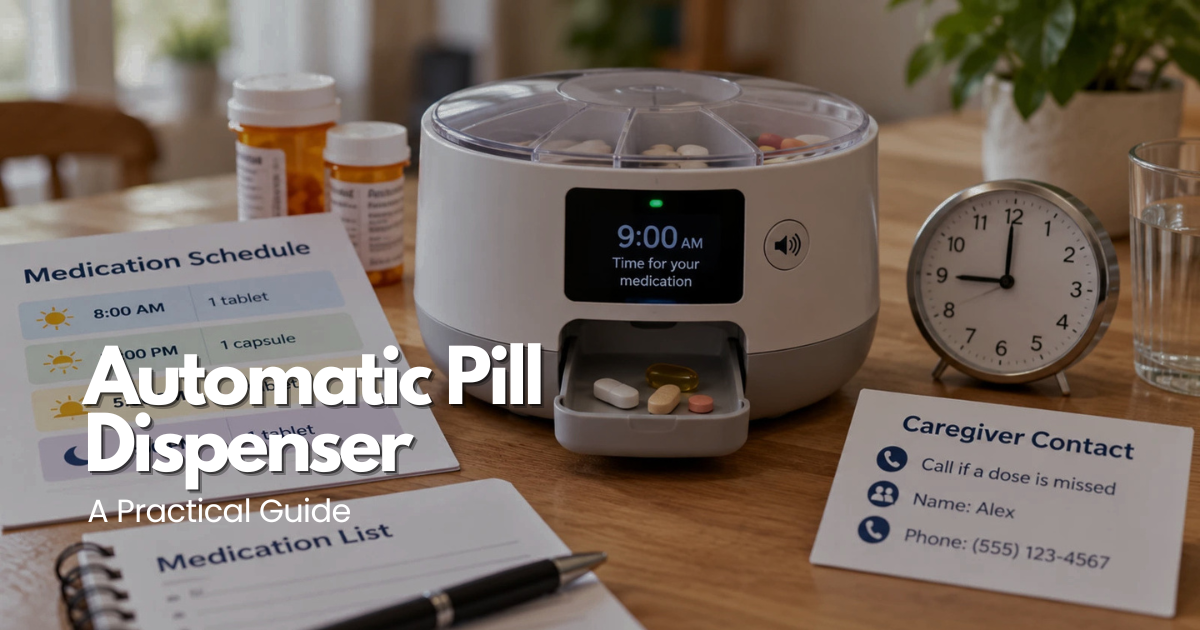
A reliable automatic pill dispenser should match the person’s medication schedule, physical abilities, and level of independence. Some models use rotating compartments, while others offer locked storage, voice reminders, connected applications, or caregiver monitoring. The appropriate choice depends on medication compatibility, accurate loading, accessible controls, maintenance requirements, and professional guidance.
This comprehensive guide explains how automatic pill dispensers work, which features matter most, how to compare different designs, and what to consider before introducing one into a medication routine. It also covers caregiver responsibilities, safe setup, missed doses, prescription changes, ongoing costs, troubleshooting, and alternatives when automated dispensing is not appropriate.
Safety note: An automatic pill dispenser cannot prescribe medication, confirm that a dose was swallowed, or determine whether a missed dose should be taken later. Never change doses, crush or split medications, combine prescriptions, or transfer medicines into a dispenser without confirming compatibility with a pharmacist or prescribing clinician. Seek urgent medical assistance if a serious medication error or concerning symptoms occur.
Quick Answer: What Is an Automatic Pill Dispenser?
An automatic pill dispenser is an electronic medication organizer that stores prepared doses and makes them available according to a programmed schedule. Depending on the model, the device may rotate a tray, unlock a compartment, release a dose into a collection area, or generate an alert when medication is due.
Automatic pill dispensers for seniors are often considered when traditional pill organizers and phone reminders no longer provide enough structure. Some devices keep future doses inaccessible between scheduled dispensing times, while connected models may notify designated caregivers about missed collection events.
However, a dispenser does not independently verify the medication inside each compartment. It also cannot determine whether the person’s prescription has changed or whether the medication has actually been taken.
Before choosing a device, consider:
- Whether the medication schedule is stable and predictable.
- Which medicines can be safely stored in the dispenser.
- How many scheduled releases are needed each day.
- Whether the person can hear and understand reminders.
- Whether the collection area is easy to reach and operate.
- Who will load and verify the medications.
- Whether locking mechanisms or caregiver notifications are necessary.
- What happens during a power outage or connection failure.
- How missed doses and equipment malfunctions are handled.
- What equipment, subscription, replacement, and service costs apply.
The most useful automatic pill dispenser is one that supports a verified medication routine without creating additional confusion or unsafe dependence on automation.
How Does an Automatic Pill Dispenser Work?
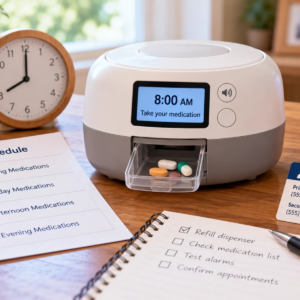
An automatic pill dispenser generally combines medication storage, electronic scheduling, alerts, and a controlled release mechanism. The person or authorized caregiver prepares the medication according to verified instructions, while the device follows the programmed dispensing schedule.
The exact process depends on the model. Some devices simply uncover the appropriate compartment at a scheduled time, while others physically deliver the prepared tablets or capsules into a collection area.
Timed Medication Compartments
Many automatic pill dispensers use internal trays containing separate compartments for scheduled doses. A programmable mechanism moves the appropriate compartment into position when the selected time arrives.
Tray capacity varies, and the number of days a device can hold depends on how many medication events occur each day.
A dispenser advertised as having 28 compartments does not necessarily provide 28 days of medication storage. A person taking medication four times daily may use those compartments much faster.
Automatic Pill Release and Locked Storage
Certain devices use locking mechanisms to prevent access to future compartments before their scheduled release.
This feature may help reduce some forms of accidental repeated access, but it cannot eliminate medication errors. Incorrect loading, changes in prescriptions, unauthorized overrides, and medication stored outside the device remain important considerations.
Families should understand exactly which parts are locked and how an authorized person can respond when the schedule changes.
Audible Alarms and Medication Reminders
Automatic medication dispensers may use sounds, flashing lights, spoken notifications, or combinations of these features to announce a scheduled release.
The most suitable alert depends on the person’s hearing, vision, cognitive abilities, and everyday environment.
A reminder must be noticeable and understandable during ordinary activities. An alarm that cannot be heard from the bedroom or understood during a busy morning may not provide useful support.
Caregiver Notifications and Monitoring
Some smart automatic pill dispensers connect to a phone application or monitoring service and send notifications when a scheduled event is not completed.
The meaning of a notification depends on what the device actually detects. It may indicate that a compartment opened, a dose was released, or medication was collected.
A notification generally cannot confirm that the user swallowed the correct medication. Families should verify the precise monitoring function before relying on it.
Who May Benefit From an Automatic Pill Dispenser?
An automatic pill dispenser for elderly adults may be useful when the person follows a consistent medication schedule but finds it difficult to manage several daily reminders or organize multiple prescriptions.
The decision should be based on functional needs rather than age alone. Some older adults manage complex schedules independently, while younger individuals with mobility, memory, or organizational difficulties may also benefit from automated support.
Seniors Managing Multiple Prescriptions
People with several medications may find it difficult to remember different times or distinguish one scheduled dose from another.
An automatic pill dispenser may simplify access to prepared medication when a pharmacist confirms that the medicines can be stored together in the device.
However, complicated regimens, as-needed medications, or frequently changing instructions may require additional oversight.
Older Adults With Mild Memory Difficulties
Some individuals with mild memory changes may respond well to predictable alarms and a consistent location for medication.
The important question is whether the person understands the reminder, recognizes what action is expected, and can request help when something goes wrong.
More significant cognitive difficulties may require direct supervision or a different medication management arrangement.
People With Limited Dexterity or Grip Strength
Difficulty opening prescription bottles may make ordinary medication packaging frustrating.
Certain automated designs may reduce the need to handle several containers each day. However, small buttons, removable trays, lids, or narrow collection openings can create new difficulties.
Evaluate the complete routine with the intended user rather than assuming that automation automatically improves accessibility.
Family Caregivers Managing Medication Routines
Caregivers may appreciate a centralized schedule, programmed reminders, or remote notifications when supporting someone who lives independently.
Nevertheless, assigning an automatic dispenser does not remove the need for prescription verification, refill planning, and communication.
Someone must remain responsible for loading medications accurately and responding to problems.
When an Automatic Dispenser May Not Be Suitable
A device may be unsuitable when medication instructions change frequently, the person cannot reliably respond to alerts, or medicines require storage conditions the device cannot maintain.
Significant swallowing difficulties, complicated clinical instructions, or an inability to recognize a medication error also warrant professional evaluation.
In these circumstances, a pharmacist or healthcare professional may recommend another medication management approach.
Types of Automatic Pill Dispensers for Seniors
Automatic pill dispensers are available in several designs. Each offers a different combination of storage, accessibility, monitoring, and maintenance responsibilities.
Understanding these differences helps families compare products based on practical needs rather than marketing descriptions.
Rotating Automatic Pill Dispensers
Rotating dispensers typically contain a circular tray with separate medication compartments.
At scheduled times, the mechanism positions the appropriate compartment near an opening and activates a reminder.
These models can be useful for predictable medication schedules, but the user must still understand how to collect the released dose.
Locked Automatic Medication Dispensers
Locked models restrict access to medication outside permitted times.
This may be helpful when repeated access to medication containers is a concern, but the benefit depends on correct loading and reliable programming.
Families should verify the manufacturer’s emergency-access procedures and restrictions before choosing a locked design.
Smart Automatic Pill Dispensers
A smart automatic pill dispenser may connect to Wi-Fi, cellular service, Bluetooth, or a smartphone application.
Connected features can include remote status information, caregiver notifications, schedule management, or certain service options.
Before purchasing, identify which functions require a paid subscription and what happens when internet access becomes unavailable.
Automatic Pill Dispensers With Voice Reminders
Some models provide spoken reminders instead of relying solely on beeps or lights.
Voice prompts may be useful for certain users, but they must remain understandable and appropriate for the person’s hearing and language needs.
Test the actual sound level and message clarity before relying on the feature.
Automatic Pill Dispensers With Remote Caregiver Access
Remote-access systems may allow an authorized caregiver to review schedules, monitor selected events, or receive notifications.
Permissions vary by device and provider. Not every system allows remote programming or confirmation of dose collection.
Review privacy policies, access controls, and the limits of available notifications.
How to Choose the Best Automatic Pill Dispenser
Choosing the best automatic pill dispenser begins with identifying the problems the device is expected to solve.
A household that primarily needs audible reminders may not benefit from an expensive connected subscription. Another household may require a locked design because independent access to future doses is a concern.
Medication Capacity and Scheduling
Check the number of medication compartments, scheduled releases per day, and maximum pills permitted per compartment.
Consider whether the schedule includes different morning, afternoon, evening, or nighttime doses.
A large storage capacity is useful only when it matches the actual regimen and the caregiver’s ability to verify the contents.
Locking and Controlled Access
Ask whether the device prevents access to future doses and how it handles late or missed collection events.
The system should have a documented procedure for authorized access and prescription changes.
Do not assume that locking automatically makes a device suitable for someone with advanced cognitive impairment.
Alerts and Accessibility Features
Review alarm volume, visual indicators, screen readability, button size, and ease of collecting medication.
Accessibility should be tested with the person who will use the device, ideally in the intended location.
Consider ordinary environmental noise, lighting, furniture placement, and mobility limitations.
Battery Backup and Connectivity
Find out whether the device uses replaceable batteries, rechargeable power, or continuous electrical service.
Confirm how local alarms and dispensing operate during internet interruptions or power failures.
A connected caregiver application may stop providing remote information even when local dispensing remains operational.
Privacy and Caregiver Monitoring
Connected devices may collect medication schedules, personal information, contact details, and dispensing history.
Review the manufacturer’s privacy practices and ensure that the user understands which information is shared.
Caregiver monitoring should be proportional to the person’s needs and authorized preferences.
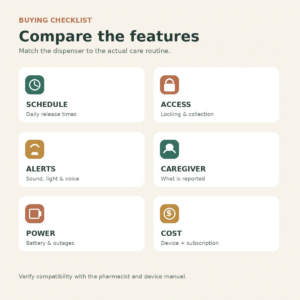
Automatic Pill Dispenser Comparison Checklist
| Feature | Why it matters | What to verify |
|---|---|---|
| Compartment capacity | Determines available scheduled doses | Number of compartments and daily releases |
| Medication compatibility | Protects appropriate storage | Pharmacist approval for each medicine |
| Locking mechanism | Controls access to stored doses | What remains locked and how authorized access works |
| Alert system | Helps the user recognize scheduled medication times | Volume, lights, voice options, and usability |
| Caregiver notifications | Supports selected follow-up activities | What event is detected and who receives the alert |
| Battery backup | Addresses interruptions | Battery life and behavior during outages |
| Ease of loading | Affects caregiver responsibilities | Tray design, labeling, and verification |
| Subscription requirements | Changes ownership costs | Included features, recurring charges, and cancellation |
| Customer support | Helps resolve technical problems | Service availability and replacement policy |
A good purchasing decision considers the whole medication routine, not simply the number of advertised features.
Medication Compatibility: What Can Go Into an Automatic Pill Dispenser?
Not every medication can safely be removed from its original packaging or stored in a dispenser.
Some products have special requirements involving moisture, temperature, light, handling, timing, or protective packaging.
Confirm Medication Storage With a Pharmacist
Before transferring medications, review each product with a pharmacist.
Ask whether it can be stored outside its original container and whether sharing a compartment with other medicines is appropriate.
A dispenser manufacturer’s claim that its device accommodates tablets and capsules does not establish compatibility with every prescription.
Tablets, Capsules, and Other Medication Forms
Many dispensers are designed primarily for certain solid oral medicines.
Liquids, powders, refrigerated products, dissolving formulations, and medications requiring special packaging may not be compatible with ordinary pill compartments.
Never modify a medication’s physical form to make it fit the device without professional authorization.
Medications Taken as Needed
As-needed medications do not always follow a predictable daily schedule.
A rigid automatic dispenser may be unsuitable for these medicines unless the device and prescribed instructions support the intended arrangement.
Ask the prescriber or pharmacist how these medications should be managed separately.
Keep Original Prescription Information Available
Even when medication is transferred into an approved dispenser, retain original labeled containers and current written instructions.
These records are essential when prescriptions change, a question arises, or the device malfunctions.
The dispenser cannot replace pharmacy labeling or clinical judgment.
Setting Up an Automatic Pill Dispenser Safely
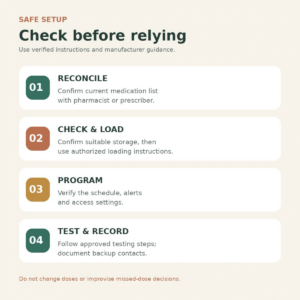
Initial setup is one of the most important parts of using an automatic pill dispenser.
Medication information, compartment organization, programming, and notification settings must all be correct before the device becomes part of a daily routine.
Step 1: Verify the Current Medication List
Gather current pharmacy labels and written instructions.
Review medication names, prescribed amounts, timing, and relevant administration directions with the pharmacist or prescriber when necessary.
Resolve discrepancies before attempting to load the device.
Step 2: Confirm Which Medicines Are Compatible
Ask a pharmacist whether each medication may be stored in the selected dispenser.
Keep medicines requiring different storage arrangements in their approved packaging.
Do not assume that every medication can be included because there is unused compartment space.
Step 3: Prepare a Suitable Loading Area
Choose a clean, dry, well-lit surface and keep the manufacturer’s manual available.
Ensure that the person responsible for loading the device understands the approved medication schedule.
Avoid interruptions or mixing containers when preparing the compartments.
Step 4: Load According to the Verified Schedule
Follow the exact device instructions and the medication plan approved by the appropriate healthcare professional.
The responsible caregiver should verify that each compartment matches the corresponding scheduled medication event.
When the regimen is complex, ask whether a second-person check or pharmacy-prepared alternative would be more appropriate.
Step 5: Program the Dispensing Times
Set the schedule according to verified medication instructions.
Review time format, morning and evening settings, alarm behavior, and any locking or notification options.
Do not adjust prescribed timing for convenience without appropriate professional guidance.
Step 6: Test the Device Using an Approved Method
Follow the manufacturer’s test procedure to verify alarms, access controls, and dispensing behavior without risking an unintended medication release.
If connected caregiver alerts are enabled, confirm that the intended recipient receives the test information.
Do not rely on the system until identified technical problems have been resolved.
Step 7: Document the Refill and Backup Plan
Record who is responsible for refilling the dispenser and who can respond to device problems.
Keep the pharmacist’s contact information, current medication list, manufacturer support details, and appropriate backup instructions accessible.
A device should never become the only available source of medication information.
Daily Use of an Automatic Pill Dispenser
An automatic pill dispenser works best when it becomes part of an understandable and consistent routine.
Position the device where the person can reach it comfortably without climbing, bending excessively, or navigating unnecessary obstacles.
Choose an Accessible Location
Place the dispenser on a stable surface with appropriate lighting.
Consider whether the person uses a walker, wheelchair, or other mobility equipment and whether the collection area can be reached safely.
Store medications away from children, unauthorized users, and pets according to the manufacturer’s requirements.
Respond to Scheduled Alerts
The person should understand the device’s notification and collection process.
If the alert is not heard or recognized consistently, reassess the alarm settings and suitability of the device.
Do not assume that an automated reminder will work without initial practice.
Confirm the Difference Between Collection and Taking a Dose
Removing medication from a dispenser does not prove that the person took it.
Some devices report that medication was made available or that a compartment opened.
Caregivers should understand this distinction before interpreting notifications as evidence of adherence.
Keep a Consistent Refill Routine
Refilling responsibilities should be assigned to someone who understands the verified medication schedule and the manufacturer’s instructions.
Maintain a clear record of the refill date and any relevant prescription changes.
A delayed or incorrect refill may disrupt the entire medication routine.
What to Do if an Automatic Pill Dispenser Misses a Dose
A missed alarm, an unopened compartment, and an uncertain medication history are different situations.
The response should begin by determining what is known without guessing whether medication was taken.
Check the Actual Situation
Review the device information and the current medication plan.
Do not assume that the medication was missed simply because a caregiver notification arrived.
Likewise, a recorded collection event does not confirm that the correct dose was swallowed.
Do Not Automatically Take an Extra Dose
Missed-dose instructions vary significantly between medications.
Never double the next dose or release additional medication simply to compensate for an earlier alert.
Contact a pharmacist or prescriber when the appropriate next step is unclear.
Contact the Appropriate Professional
The device manufacturer can explain technical behavior, but medication decisions belong to qualified healthcare professionals.
If a possible overdose, serious reaction, or dangerous medication error occurs, seek urgent medical assistance.
Record and Review the Problem
Document what happened, when it happened, and which contacts or actions were involved.
Determine whether the problem relates to programming, device access, medication instructions, or caregiver communication.
Use the findings to improve the system rather than blaming the person using it.
Automatic Pill Dispenser Power, Connectivity, and Technical Problems
Automatic pill dispensers depend on mechanical and electronic components that may occasionally require troubleshooting.
Families should understand the specific device’s behavior during battery failure, interrupted internet access, incorrect settings, or a blocked mechanism.
Power Outages and Battery Failure
Check whether the selected dispenser offers battery backup and what functions remain available during an outage.
Some devices may continue local operation while connected notifications become unavailable.
Keep the manufacturer’s documented backup procedure accessible.
Lost Internet or Cellular Connection
Connected dispensers may require Wi-Fi or cellular service for remote notifications.
If the network fails, determine whether the local dispensing schedule continues.
Do not interpret the absence of a caregiver notification as proof that the medication was collected successfully.
Jammed or Incorrect Compartments
A malfunction may prevent the intended dose from becoming available.
Do not force the mechanism or improvise access to medication.
Follow approved troubleshooting instructions, contact the manufacturer when necessary, and consult a pharmacist or prescriber about any uncertain medication event.
Outdated Schedules
A dispenser programmed using old prescription information may continue releasing medication according to that schedule.
Prescription changes should trigger a documented review before the next refill or scheduled use.
Never assume the device updates automatically when a prescriber changes instructions.
Automatic Pill Dispenser Maintenance and Cleaning
Routine maintenance supports reliable device operation.
Dust, spills, worn components, depleted batteries, and improper cleaning can affect the dispenser’s performance over time.
Follow Manufacturer Cleaning Instructions
Clean the exterior and approved removable components according to the device manual.
Avoid exposing electronic parts or medication compartments to moisture beyond the manufacturer’s permitted cleaning method.
Before loading medication again, confirm that relevant surfaces meet the manufacturer’s requirements.
Inspect Compartments and Mechanisms
Check for visible damage, residue, misalignment, or parts that no longer move correctly.
Stop relying on a device that behaves unexpectedly until the problem has been resolved.
Review Alarm and Power Settings
Periodically verify that reminders remain audible, visible, and correctly scheduled.
Check the battery or power status and confirm that the intended caregiver notifications are functioning.
Maintain Service Records
Keep the purchase information, model details, support contacts, warranty, and maintenance instructions together.
A brief log of recurring technical issues can help identify when repair or replacement is appropriate.
Automatic Pill Dispenser Costs and Subscription Considerations
The price of an automatic pill dispenser depends on the design, storage capacity, locking mechanism, monitoring options, and support services.
A device with remote notifications may have higher ongoing expenses than a basic timed dispenser.
Equipment Purchase Price
Compare the complete equipment cost rather than relying on advertised introductory prices.
Ask whether the package includes trays, charging accessories, batteries, and other necessary components.
Monthly Monitoring and Connected Services
Certain smart dispensers charge recurring fees for caregiver applications, cellular connections, or monitoring features.
Find out what remains functional if the subscription is canceled or the connected service becomes unavailable.
Replacement Parts and Maintenance
Additional trays, replacement accessories, batteries, and technical support may affect the total cost of ownership.
Before purchasing, check how long replacement parts are expected to remain available.
Insurance and Medicare Considerations
Original Medicare does not generally provide a blanket benefit covering all consumer automatic pill dispensers.
Coverage, if any, depends on the particular equipment, applicable medical necessity rules, and the person’s insurance arrangements.
Ask the insurer or benefits administrator whether the exact device and supplier are eligible rather than assuming reimbursement.
Comparing Long-Term Value
A less expensive dispenser may be appropriate for a stable routine that does not require remote features.
A connected system may justify additional cost for another household if caregivers can use its information reliably.
Value depends on usability, compatibility, support, and the complete ongoing expense.
Privacy and Caregiver Support With Automatic Pill Dispensers
Connected dispensers may collect information about schedules, dispensing events, device status, and selected caregiver contacts.
Families should understand what information is transmitted and who can access it.
Respect Medication Privacy
Medication details can reveal sensitive health information.
Use available privacy controls and share information only with people authorized to participate in the routine.
Discuss Caregiver Notifications
Explain what alerts the caregiver may receive and what actions are expected afterward.
A person who lives independently may prefer limited notifications instead of continuous monitoring.
Choose Clear Responsibilities
Assign responsibility for refills, schedule updates, equipment maintenance, and technical support.
A system without clear ownership may fail even when the technology functions correctly.
Establish a Backup Contact
Select someone who can help when the primary caregiver is unavailable.
The backup person should understand their role and know how to obtain appropriate professional guidance.
Alternatives to Automatic Pill Dispensers
Not every medication routine requires an automatic dispenser.
Simpler tools or professional services may be more appropriate, depending on the person’s abilities and the complexity of the regimen.
Traditional Weekly Pill Organizers
A weekly pill organizer may be useful for certain stable medication schedules.
However, compatibility with the medication and the person’s ability to fill or use it correctly must still be considered.
Medication Reminder Applications
Smartphone applications can provide scheduling alerts and tracking features.
These tools may be appropriate when the person can identify the correct medication and manage the physical supply independently.
An app notification cannot confirm that medication was swallowed.
Pharmacy-Prepared Medication Packaging
Some pharmacies offer prepared medication packaging that organizes suitable prescriptions according to scheduled times.
Ask whether this service is available and compatible with the medication regimen.
Caregiver-Assisted Medication Routines
In some households, direct assistance or professional supervision may be more appropriate than automated dispensing.
The correct arrangement depends on clinical needs, legal responsibilities, available caregivers, and the person’s preferences.
Questions to Ask Before Buying an Automatic Pill Dispenser
Before purchasing, ask the manufacturer, retailer, pharmacist, or relevant professional:
- Does the device match the current medication schedule?
- Which medicines can safely be stored inside it?
- How many doses and scheduled releases can it accommodate?
- Can the user understand and respond to the reminders?
- How easy is it to access released medication?
- Who will load and verify the compartments?
- What does the locking feature actually control?
- What information do caregiver notifications report?
- Does remote monitoring require a subscription?
- What happens if electricity or connectivity fails?
- Can the schedule be updated after prescription changes?
- What is the documented missed-dose procedure?
- What maintenance and replacement parts are required?
- What are the warranty and cancellation terms?
- Is another medication management arrangement more appropriate?
Keep important answers in writing, particularly when they involve device compatibility, professional instructions, or ongoing expenses.
Common Automatic Pill Dispenser Mistakes
Choosing a Device Based Only on Capacity
A dispenser that holds many compartments may look convenient but may not match the person’s medication schedule.
Compare actual daily releases, pill sizes, and refill responsibilities.
Loading Medications Without Pharmacy Verification
Not all medicines can be transferred safely into a dispenser.
Verify storage compatibility and current instructions before loading.
Treating Collection as Proof of Medication Use
A sensor may detect that a compartment opened, but it generally cannot confirm swallowing.
Caregiver monitoring should reflect the device’s documented limitations.
Ignoring Accessibility Needs
Small controls, quiet alarms, difficult lids, and poorly positioned devices can undermine convenience.
Test the complete routine with the actual user.
Failing to Update Prescription Changes
Outdated schedules may create serious medication management problems.
Reconcile the device whenever a prescription changes.
Depending Entirely on Automation
No dispenser eliminates the need for accurate records, professional guidance, and human support.
Keep a practical backup arrangement available.
Final Automatic Pill Dispenser Checklist
Before relying on an automatic pill dispenser, confirm that the following conditions are met:
-
The medication list is accurate and current.
-
A pharmacist has confirmed storage compatibility.
-
The device matches the required dispensing schedule.
-
The person can operate the controls and collect medication.
-
The alert is noticeable and understandable.
-
Loading and refill responsibilities are clearly assigned.
-
Caregiver notifications are configured appropriately.
-
The household understands the limits of monitoring.
-
Prescription changes trigger a schedule review.
-
Battery, power, and connectivity requirements are understood.
-
Manufacturer testing and maintenance procedures are followed.
-
Missed-dose instructions come from appropriate professionals.
-
Current pharmacy and device-support contacts are available.
-
A backup medication management plan is established.
A dispenser should become part of regular care only after its setup, accessibility, and backup arrangements have been appropriately reviewed.
Frequently Asked Questions About Automatic Pill Dispensers
What Is an Automatic Pill Dispenser Used For?
An automatic pill dispenser organizes prepared medication doses and makes them available according to a programmed schedule. Some models also provide reminders, locked storage, and caregiver notifications.
Are Automatic Pill Dispensers Safe for Seniors?
They may be appropriate for certain older adults when the medication regimen is compatible, the device is loaded correctly, and the user can operate it safely.
Pharmacist review and appropriate caregiver support remain important.
Can an Automatic Pill Dispenser Prevent Medication Errors?
A suitable device may reduce certain organizational mistakes, but it cannot prevent every error.
Incorrect loading, outdated prescriptions, missed alerts, and medication stored outside the device can still create problems.
Do Automatic Pill Dispensers Work Without Wi-Fi?
Some dispensers operate through local alarms and programming without continuous internet access.
Connected features may require Wi-Fi, cellular service, or another supported connection. Verify the exact model’s requirements.
Can an Automatic Pill Dispenser Notify a Caregiver?
Some connected models send notifications when specified dispensing events occur or remain incomplete.
However, these alerts do not necessarily confirm that medication was taken.
Can Every Medication Go Into an Automatic Pill Dispenser?
No. Some medicines require original packaging, special storage, or different handling.
Ask a pharmacist to confirm compatibility before transferring any medication.
What Happens if a Dose Is Missed?
Follow the medicine-specific instructions from the pharmacist or prescriber.
Do not automatically double the next dose or release an extra portion from the device.
How Often Should an Automatic Pill Dispenser Be Refilled?
Refill frequency depends on the number of compartments, daily medication events, the approved medication plan, and the manufacturer’s instructions.
The person responsible should document refill dates and verify the schedule.
Can Someone With Dementia Use an Automatic Pill Dispenser?
Some people with mild cognitive difficulties may benefit from structured reminders.
More significant cognitive changes may require direct supervision or another arrangement. Suitability should be evaluated individually.
How Much Does an Automatic Pill Dispenser Cost?
Costs vary by model, features, and subscription arrangements.
Compare equipment expenses, monitoring charges, replacement parts, and long-term service requirements before purchasing.
Does Medicare Cover Automatic Pill Dispensers?
There is no general Original Medicare benefit that automatically covers every consumer automatic pill dispenser.
Any possible coverage should be verified for the specific equipment, supplier, and insurance arrangement.
Can an Automatic Pill Dispenser Replace a Caregiver?
No. An automatic dispenser may support an established medication routine, but it cannot replace accurate prescription management, professional guidance, or direct assistance when required.
Conclusion: Choosing a Reliable Automatic Pill Dispenser
An automatic pill dispenser can support medication organization by making prepared doses available at scheduled times and providing reminders that fit everyday routines. For some older adults, locked compartments, accessible alerts, and caregiver notifications may add structure to a complicated medication schedule.
However, automation is only useful when the entire process remains accurate and understandable. Medication compatibility, correct loading, prescription updates, refill responsibilities, reliable operation, and appropriate human assistance all determine whether the device is a practical choice.
Before purchasing an automatic pill dispenser, begin with the person’s actual medication needs and obtain professional guidance about storage and use. By combining suitable technology with a verified medication plan, routine testing, and dependable backup arrangements, families can develop a more organized and sustainable approach to medication management.
Official sources used
- National Institute on Aging: Taking Medicines Safely as You Age
- MedlinePlus: Keeping Your Medicines Organized
- National Institute on Aging: Tips for Living Alone With Early-Stage Dementia
- U.S. Food and Drug Administration: Use Medicines Wisely
- FDA: Remote Medication Management System Guidance
This educational guide is for general information in the United States. It is not individualized medical advice, a diagnosis, a product endorsement, or a guarantee of medication adherence. Consult a qualified clinician or pharmacist for decisions about a specific medicine or person.Confirm the exact local policy.