
Choosing Ashley Manor Memory Care involves more than comparing photographs, amenities, or online ratings. Families need to understand how residents are assessed, what assistance is available throughout the day and night, how medications and health changes are managed, and what happens when a person’s needs increase. Staffing arrangements, licensing, financial agreements, and communication practices can vary between locations.
This comprehensive guide explains Ashley Manor Memory Care services, community locations, personalized care planning, costs, family visits, resident safety, and questions to ask before admission. It also provides a practical checklist for comparing memory care options and preparing for a successful transition.
Important note: Ashley Manor Memory Care offers specialized residential support, but no memory care community can guarantee particular health outcomes or prevent every emergency. Confirm current licensing, staffing, services, pricing, admission requirements, and care limitations directly with the specific community. This guide provides general information and does not replace medical, legal, or financial advice.
Quick Answer: What Is Ashley Manor Memory Care?
Ashley Manor Memory Care is a provider of residential memory care services, with communities listed in Idaho. The organization describes its approach as specialized support for individuals experiencing Alzheimer’s disease, dementia, and related cognitive conditions.
Ashley Manor promotes smaller residential settings, caregiver assistance, individualized care routines, and opportunities for meaningful daily engagement. These features may appeal to families seeking an alternative to larger senior living communities.
However, the appropriate choice depends on whether a specific location can meet the prospective resident’s needs.
Before selecting Ashley Manor Memory Care, families should:
- Verify the exact community name, address, and license.
- Request an individualized resident assessment.
- Ask about caregiver staffing during all shifts.
- Confirm dementia-specific staff training.
- Review medication and healthcare coordination procedures.
- Observe activities, dining, and ordinary resident interactions.
- Understand wandering precautions and emergency response.
- Request current monthly pricing and additional charges.
- Read the complete admission agreement.
- Discuss family visits, communication, and resident rights.
- Confirm how care plans change as needs increase.
- Ask what circumstances could require transfer to another setting.
The most important question is whether the individual community offers a realistic, respectful plan for the person’s current and anticipated care needs.
Ashley Manor Memory Care Locations and Community Overview
Ashley Manor Memory Care operates residential memory care communities in Idaho, including facilities identified in Boise, Caldwell, Eagle, Nampa, Pocatello, and other communities.
Its official website provides individual facility pages, contact information, and general descriptions of the organization’s approach to memory care.
Because facilities operate in different locations and may have distinct licensing or service arrangements, families should verify information directly with the specific property.
Ashley Manor Memory Care Contact Information
Provider: Ashley Manor Memory Care
Corporate contact location: 4334 N. Bright Angel Avenue, Meridian, Idaho 83646
Main telephone: 1-888-376-7298
Official website: https://ashleymanormemorycare.com/
These corporate details should not be confused with the street address or direct contact number of an individual residential community.
Ashley Manor Memory Care in Boise, Idaho
Ashley Manor has several communities identified in Boise, including locations associated with Cloverdale Road, Elgin Way, and other residential neighborhoods.
For example, its official community pages identify the Cloverdale facility at 3749 North Cloverdale Road and the Elgin facility at 3961 North Elgin Way.
Families should confirm whether a particular location is currently accepting residents, which services it provides, and whether it can accommodate the prospective resident’s needs.
Other Ashley Manor Memory Care Communities
Additional Idaho communities are identified in locations such as Caldwell, Chubbuck, Eagle, Jerome, Kimberly, Middleton, Nampa, Pocatello, and Twin Falls.
Each location should be evaluated separately for room availability, admission requirements, staff coverage, services, and pricing.
A positive experience at one Ashley Manor community does not automatically establish the conditions at another.
What Makes a Smaller Memory Care Residence Different?
Smaller residential memory care settings may provide a familiar household atmosphere, shared living areas, and opportunities for more individualized routines.
However, the size of a community alone does not determine care quality.
Families should evaluate caregiver availability, staff training, supervision, resident engagement, clinical coordination, and the ability to meet changing needs.
Ashley Manor Memory Care Services and Personalized Care
Ashley Manor Memory Care describes its approach as specialized support for people living with memory impairment.
A personalized care plan should reflect the individual’s physical abilities, communication needs, familiar routines, preferences, and medical circumstances.
The provider’s general descriptions offer a starting point, but the exact services must be confirmed through an individual assessment.
Individualized Memory Care Assessments
Before admission, ask Ashley Manor how it evaluates prospective residents.
The assessment should consider mobility, personal care, nutrition, communication, medication needs, cognition, sleep patterns, medical history, and supervision requirements.
Families should also provide information about familiar routines, preferred activities, important relationships, and situations that cause discomfort.
Ask who develops the care plan, how the resident participates, and how frequently the plan is reassessed.
Assistance With Activities of Daily Living
Residents may need varying levels of support with dressing, bathing, grooming, toileting, meals, and mobility.
Some individuals require occasional reminders, while others need more frequent personal assistance.
Ask which services community caregivers provide directly, which are included in the monthly fee, and whether any tasks require outside professionals.
Care should support the resident’s participation whenever appropriate instead of automatically taking over activities the person can manage.
Dementia-Specific Caregiver Training
Caregivers supporting individuals with dementia need communication skills, awareness of cognitive changes, and appropriate responses to distress or confusion.
Ask about Ashley Manor’s current employee training requirements, supervision, continuing education, and procedures for introducing new staff to individual care plans.
Families should also ask how staff share important resident information between shifts.
A general statement about trained caregivers should be supported by a clear explanation of how that training is used in daily practice.
Personalized Routines and Resident Preferences
Residents may have longstanding preferences about waking, meals, clothing, music, visitors, and daily activities.
A useful care plan should incorporate these preferences whenever possible.
Families can provide a concise personal history to help caregivers understand what makes the resident comfortable.
Daily Life and Activities at Ashley Manor Memory Care
Daily activities can influence comfort, social connection, and quality of life for people living with dementia.
Ashley Manor describes memory care environments with opportunities for engagement, dining, and familiar residential routines.
However, activities should be evaluated according to what residents actually experience rather than relying exclusively on promotional descriptions.
Memory Care Activities and Social Engagement
A suitable activity program may include familiar music, conversation, gentle movement, arts and crafts, reminiscence, or other meaningful experiences.
Not every resident enjoys large group activities.
Some individuals may prefer quiet conversations, simple household tasks, outdoor time, or individual engagement.
During an Ashley Manor Memory Care visit, request the current activity calendar and ask how programs are adapted for different cognitive and physical abilities.
Dining and Nutritional Support
Meals are an important part of everyday residential care.
Ask how menus are planned, whether resident preferences are considered, and what assistance is available for individuals who have difficulty eating independently.
Changes in appetite, chewing, swallowing, or nutritional needs may require healthcare assessment.
Do not assume that standard dining services automatically include every specialized diet or level of assistance.
Comfortable Rooms and Common Areas
Familiar surroundings may help some people adjust to a new residential environment.
Ask whether residents may bring personal photographs, bedding, meaningful decorations, and other permitted belongings.
Review room dimensions, shared spaces, bathroom accessibility, lighting, and available storage.
A comfortable environment should also provide appropriate privacy and safe movement.
Outdoor Areas and Supervised Activities
Access to outdoor spaces may contribute to daily enjoyment when it is appropriate for the resident.
Families should ask whether the community has secure outdoor areas, how access is supervised, and what accommodations exist for mobility limitations.
The presence of a garden does not establish that every resident can use it independently.
Preparing for an Ashley Manor Memory Care Tour
A tour allows families to compare the provider’s descriptions with the actual environment and daily routines.
Before visiting, make a list of the prospective resident’s essential needs and personal preferences.
These may include medication support, mobility assistance, nighttime supervision, favorite activities, communication requirements, and dietary considerations.

Important Questions to Ask During an Ashley Manor Memory Care Tour
A community tour should cover everyday care, staffing, emergency procedures, medications, activities, family communication, and financial responsibilities.
Observe ordinary staff-resident interactions whenever possible.
Staffing and Overnight Supervision
Ask how many caregivers are present during daytime, evening, overnight, and weekend shifts.
Find out how staffing changes when residents need additional assistance.
Clarify who supervises caregivers and whether licensed nurses are physically present or available through another arrangement.
The community should explain how residents receive help at night and during unexpected situations.
Medication Management and Clinical Coordination
Ask who receives prescriptions, communicates with pharmacies, documents medication administration, and contacts prescribers when questions arise.
Find out how medication changes following hospitalization are verified.
Clarify which services are provided directly and which require outside healthcare professionals.
Medication-related responsibilities should be documented in the resident’s care arrangement.
Wandering Precautions and Security
Some people living with dementia experience disorientation or difficulty navigating unfamiliar environments.
Ask how exits are managed, how residents are supervised, and what procedures apply if someone cannot be located.
Security features should be considered alongside respectful mobility, independence, and individualized care.
No secured environment guarantees that every safety incident can be prevented.
Falls and Mobility Support
Discuss the resident’s walking ability, falls history, mobility equipment, and transfer needs.
Ask how staff assess changes in mobility and whether occupational or physical therapy services are coordinated when appropriate.
The care plan should specify the assistance available and any limitations.
Family Visits and Communication
Find out how relatives can visit, contact staff, receive updates, and participate in care planning.
Ask whether there is a primary contact person and an after-hours communication procedure.
Families should understand how urgent concerns differ from ordinary updates.
Ashley Manor Memory Care Costs and Pricing
Ashley Manor Memory Care pricing varies by community, accommodation, individual needs, and contract terms.
Public listings and advertised estimates may not reflect the current cost of a particular room or care plan.
Families should request a detailed written quote from the specific Ashley Manor location.
What May Be Included in Monthly Memory Care Fees?
A residential memory care fee may include accommodation, meals, certain personal care services, housekeeping, activities, and supervision.
However, families must verify exactly what their agreement includes.
Medication services, additional personal assistance, supplies, transportation, and outside clinical care may have separate arrangements.
Care Levels and Additional Charges
Some communities adjust charges when a resident requires more assistance.
Ask whether Ashley Manor uses care levels or another assessment-based pricing system.
Find out how changes are evaluated, when families receive notice, and whether additional services create recurring charges.
The written agreement should explain these policies clearly.
Deposits, Refunds, and Rate Changes
Before paying a deposit, review community fees, refund rules, billing dates, cancellation conditions, and the process for future price increases.
Ask what happens if the resident is hospitalized or temporarily absent.
Request clarification of any provision that could affect the household’s long-term budget.
Does Medicare Pay for Ashley Manor Memory Care?
Original Medicare generally does not cover long-term custodial care or room and board in assisted living and residential memory care.
Eligible medical services may be covered separately when applicable Medicare requirements are met.
Medicaid, long-term care insurance, veterans benefits, and other programs have different eligibility and payment rules.
Families should verify benefits directly with the relevant organization before assuming that Ashley Manor Memory Care expenses will be reimbursed.
Ashley Manor Memory Care Reviews and Family Experiences
Online reviews may provide useful perspectives about staff communication, meals, activities, cleanliness, and the residential environment.
However, an individual review reflects a particular person’s experience at a specific time.
The most useful approach is to identify questions raised by reviews and verify current practices directly.
How to Interpret Positive Reviews
Positive reviews may describe helpful caregivers, a welcoming atmosphere, or a resident’s comfortable adjustment.
These observations can be valuable but do not guarantee that every resident will have the same experience.
Ask whether the people, policies, and services mentioned remain in place.
How to Evaluate Critical Reviews
Negative reviews may identify concerns involving communication, staffing, costs, or care planning.
Look for specific details, dates, and patterns rather than relying exclusively on star ratings.
Ask the community how it currently handles the relevant issue.
Licensing and Inspection Information
State licensing and inspection records provide another source of information.
Families should verify the exact legal facility name and address because similar community names can create confusion.
Review the most recent available records and ask about corrective actions when applicable.
Licensing records, family reviews, and personal observations provide different perspectives and should be considered together.
Ashley Manor Memory Care Safety and Healthcare Planning
Resident safety requires ongoing attention to health changes, medications, mobility, nutrition, supervision, and communication.
A memory care setting may include specialized environmental features, but these cannot replace individualized assessment and appropriate staffing.
Individualized Safety Plans
Ask how Ashley Manor evaluates fall risks, wandering concerns, communication difficulties, and other important needs.
A resident’s plan should include reasonable precautions without unnecessarily limiting daily activities.
Families can help by describing previous incidents, known triggers, and calming routines.
Responding to Changes in Health
Changes in appetite, sleep, mobility, behavior, communication, or physical comfort may require clinical evaluation.
Ask how caregivers identify concerns, document observations, and notify the appropriate healthcare professionals.
The community should also explain when emergency services are contacted.
Emergency and Evacuation Procedures
Ask how the community handles fire alarms, power outages, severe weather, missing residents, and emergency transportation.
Find out how families receive urgent updates and whether the facility has a documented emergency plan.
Verify that residents with mobility or cognitive limitations are considered in emergency arrangements.
Coordinating Outside Healthcare
Some residents may require services from physicians, nurses, therapists, pharmacies, or other external providers.
Ask who coordinates appointments, transportation, referrals, and important medical information.
Clarify which responsibilities belong to Ashley Manor staff and which remain with the family.
Family Communication and Personalized Memory Care Plans
Communication is essential when residents have difficulty describing their needs or remembering recent events.
Families should understand how Ashley Manor documents and communicates care changes.
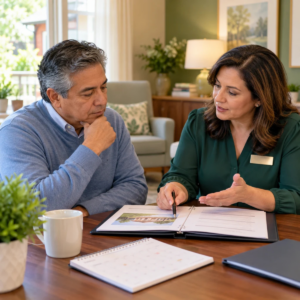
Preparing a Personal History Profile
A concise personal profile can help caregivers understand the resident’s preferences.
Include familiar routines, favorite music, food preferences, meaningful relationships, preferred forms of address, communication needs, and activities the person enjoys.
Practical information should be easy for staff to use during ordinary caregiving shifts.
Scheduling Care Conferences
Ask when formal care-plan reviews occur and how families can request an earlier meeting.
Discuss sleep, meals, activities, personal care, mobility, medications, relationships, and unresolved concerns.
A productive meeting should end with clear responsibilities and a follow-up date.
Communicating Between Staff Shifts
Caregiver changes should not cause important information to disappear.
Ask how updates are documented, who reviews the current plan, and how new employees learn resident preferences.
Consistent communication is particularly important after hospitalization or a significant change in health.
Respecting Privacy and Consent
Families should understand who may receive confidential health information and how authorized representatives are documented.
Residents should be involved in decisions to the extent appropriate to their abilities and preferences.
A dementia diagnosis does not automatically eliminate personal rights or meaningful choice.
Moving Into Ashley Manor Memory Care
Moving into memory care can be a significant adjustment for both the resident and family.
Preparation should focus on familiar routines, essential documentation, personal belongings, and clear communication.
Before Move-In Day
Confirm admission approval, the care plan, contract, room arrangements, medication information, and emergency contacts.
Ask which documents and personal items must be provided before arrival.
Clarify transportation and who will introduce the resident to the care team.
Creating a Familiar Living Space
Personal belongings may help a new room feel more recognizable.
Ask whether the resident may bring photographs, preferred bedding, familiar artwork, or meaningful objects.
Avoid overcrowding the room or bringing prohibited items.
Family Visits During the Transition
Some individuals may enjoy frequent family visits, while others may benefit from a more predictable schedule.
Discuss the person’s reactions with staff and adjust plans according to their needs.
A difficult first visit does not necessarily establish that the community is unsuitable.
Reviewing the First Month
Arrange an early care-plan review after admission.
Discuss eating, sleeping, mobility, communication, activities, emotional comfort, and family updates.
If a concern continues, request a specific adjustment and an agreed follow-up.
Resident Rights and Personal Independence
People living with dementia continue to have preferences, relationships, and rights.
Families should ask how Ashley Manor supports appropriate choices in everyday life.
Clothing, Meals, and Daily Activities
Residents may have preferences about clothing, meals, bathing, bedtime, visitors, and activities.
Caregivers should consider these preferences whenever practical.
Safety requirements may place reasonable limits on some choices, but those limits should be explained respectfully.
Privacy and Dignity
Personal care should preserve privacy and respect.
Ask how staff respond when a resident declines assistance, feels uncomfortable, or needs additional time.
Care arrangements should not rely unnecessarily on pressure or restrictions.
Addressing Concerns
Ask for the community’s formal complaint and grievance procedures.
Identify the contact for routine questions, urgent concerns, billing issues, and unresolved care problems.
Document important interactions and request written follow-up when appropriate.
For serious concerns involving abuse, neglect, exploitation, or safety, families may contact the appropriate state authority.
Ashley Manor Memory Care Versus Other Care Options
Ashley Manor Memory Care is one possible residential care option for individuals living with dementia.
Other arrangements may include care at home, adult day services, respite care, assisted living, or skilled nursing.
The appropriate choice depends on individual care requirements, family resources, professional recommendations, and available services.
Memory Care Versus Aging in Place
Remaining at home may be appropriate when adequate assistance, supervision, and environmental support are available.
However, increasing care needs or limited caregiver availability may make the home arrangement difficult to sustain.
Compare the actual home support plan with the services available at the specific Ashley Manor location.
Memory Care Versus General Assisted Living
Memory care generally provides a more specialized environment for individuals experiencing cognitive changes.
General assisted living may support personal care and everyday activities without offering the same dementia-specific programs or supervision arrangements.
Ask each provider exactly which needs it can accommodate.
When Another Level of Care May Be Necessary
Some residents develop medical or functional requirements that exceed the services available in residential memory care.
Ask Ashley Manor about its admission limitations, reassessment process, and transfer procedures.
Families should understand these possibilities before moving in.
Final Ashley Manor Memory Care Checklist
Use this checklist when comparing individual Ashley Manor communities.
-
Confirm the community name, address, license, and contact information.
-
Request an individualized resident assessment.
-
Verify caregiver staffing and dementia-specific training.
-
Discuss overnight support and changing care needs.
-
Review medication and healthcare coordination.
-
Observe ordinary staff-resident communication.
-
Request a current dining and activity schedule.
-
Evaluate bedroom, bathroom, and common-area accessibility.
-
Discuss wandering precautions and emergency procedures.
-
Request a complete written cost estimate.
-
Review deposits, additional fees, refunds, and rate changes.
-
Understand family visits and communication policies.
-
Verify current licensing and inspection information.
-
Review resident rights and grievance procedures.
-
Prepare the move-in plan and personal belongings.
-
Schedule the first care-plan review.
The most useful information comes from comparing the written care agreement with the prospective resident’s actual needs.
Visiting an Ashley Manor Memory Care Community
A meaningful visit should provide more than a look at a model room or common area.
Families should observe the physical environment, ask about resident routines, and speak with the appropriate care representative.

Observe Everyday Resident Life
Ask to see common areas, dining spaces, and activity settings.
Consider whether residents have opportunities for engagement, privacy, rest, and appropriate movement.
A polished entrance cannot replace observation of ordinary care.
Review Accessibility and Comfort
Look at lighting, flooring, seating, bathrooms, and walking routes.
If the prospective resident uses mobility equipment, ask whether the available space supports its use.
Evaluate the environment from the resident’s perspective rather than focusing only on appearance.
Ask About Weekend and Nighttime Routines
Staffing, activities, and family communication may operate differently outside ordinary business hours.
Ask which caregivers are present overnight and how urgent problems are handled.
These details may be especially important for residents who require frequent assistance.
Document Important Answers
Keep a record of tour dates, representatives, written information, costs, and unresolved questions.
Compare the answers with the admission agreement.
If important statements are unclear or inconsistent, request clarification before signing.
Frequently Asked Questions About Ashley Manor Memory Care
What Is Ashley Manor Memory Care?
Ashley Manor Memory Care is a provider of specialized residential care for people living with Alzheimer’s disease, dementia, and related memory conditions. Its official website identifies communities in Idaho.
Where Are Ashley Manor Memory Care Locations?
Ashley Manor Memory Care identifies communities in several Idaho cities, including Boise, Caldwell, Eagle, Nampa, and Pocatello.
Verify the exact community’s current address, services, and license before visiting.
Does Ashley Manor Offer Personalized Memory Care?
Ashley Manor describes individualized approaches to memory care.
Families should confirm how the specific community assesses residents, develops care plans, and updates support when needs change.
How Much Does Ashley Manor Memory Care Cost?
Pricing varies by community, accommodations, and care requirements.
Request a current written estimate that separates the base rate, included services, additional charges, deposits, and future increases.
Does Medicare Cover Ashley Manor Memory Care?
Original Medicare generally does not pay for residential memory care room and board or long-term custodial assistance.
Eligible medical services may have separate coverage rules, and other programs may offer different benefits.
How Can Families Schedule an Ashley Manor Tour?
Families can use the provider’s official website or contact its main office at 1-888-376-7298 to obtain information about the relevant community.
Confirm current visiting arrangements directly.
What Activities Are Offered at Ashley Manor Memory Care?
Ashley Manor describes opportunities for resident engagement and meaningful activities.
Ask the individual community for its current activity calendar and how programs are adapted to residents’ needs.
Is Ashley Manor Memory Care Suitable for Everyone With Dementia?
No single community is appropriate for every individual with dementia.
Suitability depends on medical conditions, mobility, supervision needs, communication, personal preferences, and the services available at the specific location.
How Should Families Interpret Ashley Manor Reviews?
Use reviews to identify questions about staff, activities, communication, costs, and the environment.
Compare these observations with current licensing information, direct visits, and written policies.
What Happens if a Resident’s Condition Changes?
Ask the community how it reassesses needs, updates care plans, communicates with families, and determines whether additional services or a different care setting may be required.
Can Family Members Participate in Care Planning?
Families should ask about current care conferences, authorized communication, and participation in care-plan reviews.
The resident’s preferences and applicable privacy requirements should remain part of the process.
What Should Families Bring to an Ashley Manor Assessment?
Prepare relevant medical information, medication lists, mobility needs, daily routines, communication preferences, and questions about services.
The community should explain exactly which documentation it needs.
Conclusion: Is Ashley Manor Memory Care the Right Choice?
Ashley Manor Memory Care offers specialized residential care options for individuals living with Alzheimer’s disease, dementia, and related cognitive changes. Its smaller, home-like approach may appeal to families looking for a setting that emphasizes familiar routines, personal comfort, and individualized support.
However, the right decision depends on the specific community’s ability to meet the prospective resident’s needs. Families should verify staffing, services, licensing, safety arrangements, care planning, costs, and resident rights before making a commitment.
The strongest Ashley Manor Memory Care evaluation combines an individualized assessment, direct visits, written information, and respectful participation from the person receiving care. With careful preparation and regular follow-up, families can make a more informed decision about long-term memory care.
Official sources and verification for Ashley Manor Memory Care
- Ashley Manor: community overview and location finder — used for provider and location context.
- Ashley Manor: Resident Life — used for the provider’s public descriptions of daily-life features.
- Alzheimer’s Association: Long-term care — used for evaluation questions about staffing, family involvement, environment, and programs.
- Alzheimer’s Association: Choosing care providers — used for needs assessment and provider-screening questions.