
Choosing a sliding transfer board requires more than comparing length, material, shape, or price. The person’s sitting balance, arm function, skin condition, wheelchair configuration, caregiver assistance, and destination surface all affect whether the equipment is appropriate. A board that works well in one environment may not be suitable for another.
This comprehensive sliding transfer board guide explains how transfer boards work, the differences between common designs, how to evaluate dimensions and surface height, and why professional instruction is essential. It also covers skin protection, wheelchair compatibility, caregiver responsibilities, maintenance, Medicare considerations, and practical alternatives.
Safety note: A sliding transfer board is not a patient lift and cannot safely replace mechanical lifting equipment when full-body assistance is necessary. Incorrect transfer techniques may result in falls, skin injuries, or caregiver strain. Obtain an individualized assessment and hands-on training from a qualified occupational therapist or physical therapist before using a transfer board.
Quick Answer: How to Evaluate a Sliding Transfer Board
A sliding transfer board should be selected only after determining whether the person can participate safely in the intended seated transfer. The equipment must match the wheelchair, destination surface, physical abilities, and available trained assistance.
A suitable transfer board creates a stable bridge between approved surfaces. It does not automatically move the person or eliminate the physical effort and coordination required for transferring.
Before choosing a sliding transfer board, verify:
- The person’s sitting balance and upper-body function.
- Professional approval for the intended transfer method.
- Board length, width, shape, and weight capacity.
- The gap between wheelchair and destination.
- Relative height and stability of both surfaces.
- Wheelchair brakes, armrests, footrests, and cushion configuration.
- Skin protection and friction concerns.
- Appropriate hand placement and communication.
- The number of trained caregivers required.
- Manufacturer inspection and cleaning requirements.
- Coverage, equipment costs, and replacement options.
- An approved alternative when the board cannot be used.
The most suitable sliding transfer board is the one that meets the individual’s assessed needs and can be used consistently within an appropriate care plan.
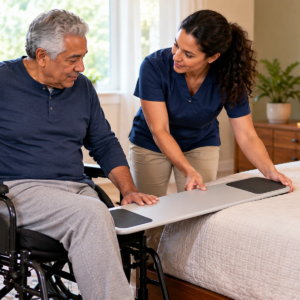
What a Sliding Transfer Board Does
A sliding transfer board, also called a transfer board or slide board, is a rigid device that creates a bridging surface between two suitable destinations.
It is commonly considered for certain wheelchair-to-bed, wheelchair-to-chair, or wheelchair-to-vehicle transfers. However, the person’s functional abilities and the environment must support the approved technique.
How a Sliding Transfer Board Supports Movement
A transfer board can bridge a gap between surfaces, allowing someone with appropriate mobility and training to participate in a seated transfer.
Some people can perform approved transfers independently, while others require trained caregiver assistance.
The board does not provide powered lifting or automatically support the person’s full weight throughout the movement.
Sliding Transfer Board Versus Patient Lift
A sliding transfer board and a mechanical patient lift are designed for different mobility needs.
Transfer boards generally require sufficient sitting balance and the ability to participate in a controlled movement. Mechanical lifts provide another form of support for individuals whose assessed needs make board transfers unsuitable.
A qualified professional should determine which equipment meets the person’s requirements.
Why Sliding Does Not Mean Dragging
Although the equipment is commonly called a sliding transfer board, dragging the body directly across its surface may create friction and shear.
Clinical guidance often emphasizes maintaining appropriate body clearance during transfer movements to protect the skin.
The correct technique should be taught in person rather than inferred from the equipment’s name.
Professional Assessment Before Sliding Transfer Board Use
A sliding transfer board should be selected after an individualized mobility assessment.
Occupational therapists and physical therapists can evaluate physical abilities, equipment compatibility, the intended transfer environment, and the support needed from caregivers.
Sitting Balance and Trunk Control
Sitting balance is an important factor because the person must remain appropriately supported throughout the movement.
Someone who cannot maintain sufficient sitting control may need another transfer method.
Balance should be evaluated under realistic conditions, including the influence of fatigue and changes in health.
Arm, Wrist, and Shoulder Function
Sliding transfer board use may place physical demands on the upper body.
The clinician should consider strength, range of motion, pain, joint limitations, and the person’s ability to participate.
Existing shoulder or wrist difficulties may affect whether the recommended technique is suitable.
Skin Integrity and Sensation
People with fragile skin, reduced sensation, or a history of pressure injuries may require additional precautions.
Excessive friction or poor body clearance can contribute to skin damage.
Professional assessment should identify how to reduce these risks.
Cognitive and Communication Needs
The person should understand the planned activity and have an appropriate way to communicate discomfort or uncertainty.
Caregivers should recognize when confusion, fear, or fatigue makes the existing plan unsuitable.
Supervised Transfer Training
A qualified instructor should assess the actual transfer arrangement and provide hands-on education.
Training should cover the specific board, wheelchair, destination, caregiver responsibilities, and warning signs.
A general video cannot confirm that the technique is appropriate for an individual.
Sliding Transfer Board Length and Width
Board dimensions influence the support area available between the wheelchair and destination.
A board that is too short, narrow, flexible, or poorly matched to the environment may not provide suitable support.
Choosing an Appropriate Length
The correct sliding transfer board length depends on the distance between approved surfaces and the manufacturer’s specifications.
Longer boards may be useful in certain configurations, but greater length does not automatically make a product safer.
Measure the actual environment and obtain professional recommendations.
Choosing a Suitable Width
Board width affects the available surface area and compatibility with seating arrangements.
The appropriate size depends on the user’s needs, equipment design, and intended transfer.
An unsuitable width may create discomfort or interfere with furniture.
Weight Capacity and Structural Design
Every sliding transfer board should have a manufacturer-defined weight capacity.
Verify that the intended use falls within all applicable limits.
Do not rely on appearance alone to judge structural strength.
Straight and Curved Transfer Boards
Straight boards provide a simple bridging shape, while curved models may accommodate certain wheelchair components or furniture arrangements.
A curved design is not automatically preferable for every user.
Choose according to the actual environment and professional guidance.
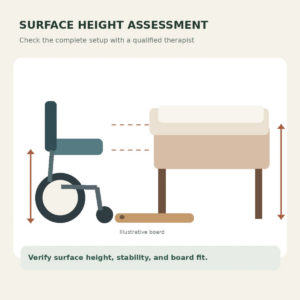
Surface Height and Level: An Important Sliding Transfer Board Consideration
The relative height of two surfaces can influence the physical demands and risks of a transfer.
Large differences in height may make a planned movement more difficult or unsuitable.
Wheelchair Seat Height
Wheelchair height can vary with frame design, seat cushion, wheels, and individual adjustments.
A measurement taken without the usual cushion may not reflect actual conditions.
The complete wheelchair configuration should be assessed.
Bed and Mattress Height
Beds vary in height, mattress firmness, and edge support.
A soft mattress may behave differently from a firm therapy surface.
A clinician should evaluate the actual bed before approving the arrangement.
Stable Destination Surfaces
The destination must provide appropriate support.
Unstable chairs, movable furniture, or unsuitable mattress edges cannot be made safe simply by adding a transfer board.
Avoiding Improvised Height Adjustments
Do not use unstable cushions, makeshift platforms, or unsupported furniture to compensate for an unfavorable height difference.
Ask a qualified professional whether environmental adjustments or a different transfer method are necessary.
Wheelchair Brakes and Footrests
Wheelchair configuration is a central part of sliding transfer board planning.
Wheel locks, armrests, footrests, cushions, and wheelchair frame geometry can all affect the transfer environment.
Wheelchair Stability
The wheelchair should be evaluated for stability under the approved care plan.
Brake and wheel-lock procedures must follow the specific wheelchair manufacturer’s instructions and professional training.
Armrest Clearance
Some wheelchair armrests are removable or adjustable, but not every model uses the same design.
The correct configuration should be demonstrated using the actual wheelchair.
Footrests and Leg Supports
Footrests may restrict access or create obstacles in certain arrangements.
Their permitted positioning depends on the wheelchair and transfer plan.
Caregivers should not force components or make unapproved adjustments.
Reassessment After Changing Wheelchairs
A new wheelchair may differ in seat height, frame design, or cushion configuration.
A transfer method that worked with the previous wheelchair should be reassessed before being adopted with replacement equipment.
Skin and Clothing Protection With a Sliding Transfer Board
Protecting skin is essential when using a sliding transfer board.
Friction and shear may occur when the body drags against the board or nearby wheelchair components.
Understanding Friction and Shear
Friction occurs when surfaces resist movement against one another. Shear can affect the skin and underlying tissues when forces act in different directions.
These concerns are particularly relevant when someone has reduced sensation or vulnerable skin.
Avoiding Direct Skin Dragging
Clinical transfer guidance emphasizes appropriate body clearance rather than simply sliding the body across the board.
The specific movement technique must come from individualized professional instruction.
Clothing and protective materials may be relevant, but they do not replace proper assessment.
Recognizing Discomfort
Pain, pinching, new redness, or other skin concerns should lead to a pause and appropriate evaluation.
Do not continue a routine that repeatedly causes discomfort.
Keeping Skin Protection in the Care Plan
Skin condition can change with illness, mobility, medication, and other circumstances.
The transfer plan should be reviewed when the person’s comfort or skin health changes.
Hand Placement and Communication During Transfers
Hand placement and communication influence control during assisted seated transfers.
A qualified instructor should demonstrate how the individual and caregiver can participate without unnecessary strain.
Protecting Hands and Fingers
Board edges, wheelchair wheels, armrests, and furniture may create potential pinch points.
Avoid placing hands beneath loaded equipment or in positions that have not been approved during training.
Communication and Stop Signals
The person and caregiver should understand how to communicate during the approved movement.
An agreed stop signal can help identify discomfort, uncertainty, or a loss of control.
Respecting Consent
Explain the planned assistance and invite participation whenever possible.
The person’s privacy, preferences, and comfort should remain part of the decision.
Caregiver Body Mechanics and Injury Prevention
Caregivers may experience strain when assisting with transfers that exceed their training or physical capabilities.
A sliding transfer board should not be treated as permission to pull, lift, or support a person’s weight through improvised movements.
Avoiding Excessive Physical Effort
A caregiver who cannot perform the approved assistance comfortably should request reassessment.
Additional force cannot reliably compensate for unsuitable equipment or insufficient staffing.
Understanding Caregiver Positions
The appropriate caregiver arrangement depends on the person, destination, and trained technique.
There is no universal position or number of helpers suitable for every sliding transfer board user.
Managing Fatigue
Fatigue can affect concentration and physical control.
A task that was manageable during training may become inappropriate when either the caregiver or the individual is unusually tired.
Knowing When to Request Help
A qualified professional should review repeated difficulties, pain, loss of balance, or concerns about caregiver strain.
A different transfer method may provide better support.
Bed-to-Wheelchair Sliding Transfer Board Planning
Bed-to-wheelchair transfers are a common reason for considering a sliding transfer board.
However, both surfaces must be suitable, and the individual must have the physical abilities required by the approved technique.
Evaluating the Bed
The clinician should assess mattress support, bed height, frame design, and available clearance.
The bed used at home may behave differently from a rehabilitation bed.
Evaluating the Wheelchair
Wheelchair dimensions, cushion, brakes, and removable components should be included in the assessment.
A transfer should not be attempted using an unfamiliar configuration without appropriate review.
Preparing the Surrounding Area
Clutter, rugs, cords, and furniture may restrict the necessary space.
Environmental changes should be evaluated before adopting the routine.
Reviewing Transfer Comfort
The person’s comfort and skin condition should be monitored during supervised assessment.
Pain or uncontrolled movement is a reason to stop and obtain professional guidance.
Toilet and Commode Transfers
Bathroom transfers introduce additional challenges involving space, clothing, moisture, and privacy.
A sliding transfer board that works in a bedroom may not be appropriate for a toilet, shower commode, or bathroom chair.
Bathroom Space
Bathrooms may have narrow doorways and limited caregiver access.
The wheelchair, destination, and available space should be measured as one arrangement.
Commode Compatibility
Commodes vary in seat height, frame design, and available support surfaces.
Not every commode can accommodate a transfer board.
Wet Surfaces
Moisture can affect surfaces and equipment condition.
Follow manufacturer guidance and do not use a board in an environment that compromises control.
Personal Privacy
Bathroom care requires particular attention to dignity and consent.
Discuss an appropriate plan with the individual and qualified care team.
Sliding Transfer Board Use With Vehicles and Narrow Spaces
Vehicle transfers can be more complex than transfers between two household surfaces.
Car seats, door openings, parking conditions, and changes in elevation may affect whether the board is appropriate.
Vehicle Seat Height
The wheelchair and vehicle seat may be at different heights.
A professional should assess whether the difference is compatible with the proposed equipment and the person’s abilities.
Door Opening and Parking Space
Vehicle doors and surrounding parking areas may restrict the available transfer space.
A safe arrangement in one vehicle should not be assumed suitable for another.
Outdoor Surface Conditions
Rain, slopes, uneven pavement, and restricted parking space may create additional difficulties.
The family should know when to use an approved alternative.
Transportation Safety
A sliding transfer board does not replace vehicle restraints, suitable seating, or wheelchair transportation equipment.
These requirements must be evaluated separately.
Sliding Transfer Board Materials and Designs
Sliding transfer boards are available in wood, plastic, composite materials, and specialized designs.
The choice should depend on compatibility, structural specifications, comfort, and the manufacturer’s requirements.
Wooden Transfer Boards
Wooden boards often have smooth surfaces and rounded or tapered edges.
Their weight, finish, dimensions, and cleaning instructions vary.
Inspect for cracks, splinters, or other signs of damage.
Plastic Transfer Boards
Plastic designs may be lightweight and have different surface characteristics.
Not all plastic boards have the same rigidity or rated capacity.
Review the manufacturer’s specifications.
Curved Sliding Transfer Boards
Curved designs may accommodate certain wheelchair wheels, armrests, or furniture arrangements.
Their suitability should be verified for the actual destinations.
Boards With Moving Seats
Some transfer devices include a moving seating surface.
These products differ from ordinary fixed boards and may require specific operating instructions, inspections, and additional maintenance.
A qualified professional should determine whether the design is appropriate.
Cleaning and Inspecting a Sliding Transfer Board
Regular inspection helps identify damage that could affect equipment suitability.
Cleaning requirements depend on the specific materials, surface finish, and manufacturer’s instructions.
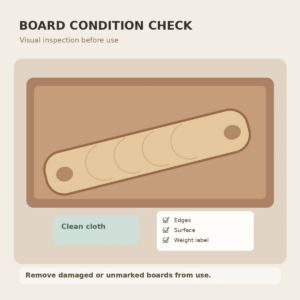
Checking the Board Surface
Look for visible cracks, sharp edges, splinters, warping, or damaged coatings.
A board with unresolved structural damage should not remain in use.
Cleaning Appropriate Materials
Use only cleaning methods recommended for the product.
Avoid chemicals or abrasive methods that could damage the surface.
Storage and Transport
Store the board where it will not obstruct walking routes or become damaged.
Protect it from unsuitable moisture, temperature, or other conditions identified by the manufacturer.
Maintaining Inspection Records
Keep a simple record of product identification, observed defects, and relevant service or replacement decisions.
This can be helpful when multiple caregivers share responsibility.
Training Every Caregiver
The person using a sliding transfer board and anyone assisting should receive appropriate instruction.
A demonstration intended for one caregiver does not establish that every other helper can safely provide the same assistance.
Initial Professional Training
Training should involve the specific equipment, person, wheelchair, and destination.
The instructor should identify risks and the circumstances that require a different approach.
Return Demonstration
A return demonstration allows the caregiver to show a qualified professional what has been learned.
This provides an opportunity to identify misunderstandings before routine use.
New Family or Professional Helpers
New helpers should receive appropriate training before taking responsibility for transfers.
Informal observation alone may not be sufficient.
Refresher Training
Seek updated guidance after changes in equipment, mobility, skin condition, or caregiver responsibilities.
Sliding Transfer Board Costs and Medicare Coverage
Sliding transfer board costs vary according to dimensions, material, design, and manufacturer.
However, price should not determine the purchase before suitability has been established.
Comparing Product Prices
Compare products with similar specifications and intended uses.
Check rated capacity, dimensions, warranty terms, and cleaning requirements.
The cheapest available board is not necessarily suitable for the person’s needs.
Does Medicare Cover a Sliding Transfer Board?
Medicare Part B covers certain medically necessary durable medical equipment, but coverage of an individual sliding transfer board must be verified under the applicable rules.
A product marketed as medical equipment is not automatically covered.
Ask the prescribing healthcare professional and Medicare-enrolled supplier whether the exact product qualifies.
Medicare Cost Sharing
For qualifying durable medical equipment under Original Medicare, the Part B deductible and coinsurance may apply.
Medicare generally pays its portion of the approved amount when all applicable requirements are met and the supplier accepts assignment.
These general rules do not confirm coverage for a specific transfer board.
Medicaid and Other Insurance
Medicaid and private insurance coverage depend on the applicable program, benefit rules, documentation, and supplier requirements.
Request written confirmation before expecting reimbursement.
Falls and Changing Physical Ability
A sliding transfer board arrangement should be reassessed when the person’s health, strength, balance, or mobility changes.
A previously successful transfer does not guarantee that the same technique remains appropriate.
After a Fall
A fall may affect comfort, confidence, balance, or movement.
Seek appropriate medical assessment and professional transfer reassessment when needed.
Changes in Strength or Balance
New weakness, fatigue, or difficulty maintaining sitting control may make the existing technique unsuitable.
Do not attempt to compensate through additional caregiver force.
Changes in Skin Condition
New discomfort, skin irritation, or reduced sensation may require adjustments or another transfer method.
After Hospitalization or Surgery
New movement restrictions or medical precautions may affect equipment suitability.
Obtain appropriate clearance before continuing a previously established routine.
Used and Borrowed Transfer Boards
A used sliding transfer board may appear economical, but its condition and specifications must be verified.
Unknown wear, damage, previous modifications, or missing instructions may create difficulties.
Inspecting Used Equipment
Review the board for cracks, warping, rough edges, and other visible defects.
Seek qualified guidance when structural condition is uncertain.
Confirming Capacity
Verify manufacturer identification and rated weight capacity.
An unmarked board may be difficult to evaluate accurately.
Cleaning Before Reuse
Follow appropriate manufacturer cleaning requirements.
Do not assume that all materials tolerate the same disinfectants.
Assessing Individual Compatibility
A board previously used successfully by another person may not match a new user’s mobility needs.
Professional evaluation remains important.
When a Mechanical Patient Lift May Be More Appropriate
A sliding transfer board is not designed to provide full-body lifting support.
Some people require a mechanical lift or another method because their physical abilities or care needs make seated transfers unsuitable.
Limited Sitting Balance
A person who cannot maintain adequate seated control may need a different transfer arrangement.
Significant Upper-Body Limitations
Severe shoulder pain, weakness, or other restrictions may make transfer board participation inappropriate.
Skin and Pressure Concerns
Existing skin injuries or high risk of friction-related damage may require alternative equipment.
Complex Transfer Environments
Large gaps, unstable surfaces, or restricted space can prevent safe board use.
A therapist can assess whether a lift or another solution is more appropriate.
Building a Sliding Transfer Board Backup Plan
Caregiving routines should include an alternative when the usual transfer method is unavailable.
This is important when the board becomes damaged, the person is fatigued, or trained assistance cannot be provided.
Identify an Approved Alternative
A professional care plan should specify what to do when the sliding transfer board cannot be used.
An alternative may involve different approved equipment or qualified assistance.
Keep Important Contacts Available
Store the therapist, equipment supplier, healthcare team, and emergency contacts in an accessible location.
Avoid Improvised Transfers
Do not substitute untrained lifting, unsuitable furniture, or unfamiliar equipment for the approved arrangement.
Reassess the Plan
Update the backup after changes in the person’s health, wheelchair, home, or caregiver availability.
Final Sliding Transfer Board Checklist
Before selecting or using a sliding transfer board, verify:
-
A qualified professional has assessed the person’s transfer needs.
-
Sitting balance and upper-body abilities are appropriate.
-
Skin protection and friction risks have been considered.
-
Board length, width, shape, and capacity are suitable.
-
Wheelchair and destination surfaces have been evaluated.
-
Surface heights and gaps have been measured.
-
Wheelchair configuration is compatible.
-
Trained caregiver assistance is available when required.
-
Communication and stop signals are understood.
-
The board has no visible structural damage.
-
Manufacturer cleaning instructions are available.
-
Bathroom and vehicle transfers have been separately assessed.
-
Costs and potential insurance coverage are understood.
-
An approved backup plan exists.
-
A reassessment date has been established.
The right sliding transfer board is one that remains appropriate for the individual’s mobility, environment, and support arrangements.
Research Findings That Matter When Choosing a Sliding Transfer Board
When evaluating a sliding transfer board, product features should be considered alongside clinical and practical needs.
Three considerations deserve particular attention: protecting skin from friction, confirming that the board supports the approved transfer, and understanding the limits of insurance coverage.
Skin Protection Is Essential
An apparently successful movement can still create skin stress.
Guidance from rehabilitation organizations emphasizes techniques that avoid unnecessary dragging and protect vulnerable areas.
The Equipment Must Match the Person
A product’s weight rating or advertised design cannot establish that it is appropriate for an individual.
The person, wheelchair, destination, and caregivers must be assessed together.
Insurance Coverage Requires Verification
A product listing cannot guarantee Medicare or private insurance payment.
Confirm requirements with the relevant healthcare professional, supplier, and insurer before purchasing.
Practical Situations for Sliding Transfer Board Planning
Different environments may require different equipment or transfer approaches.
These examples identify questions for assessment rather than providing independent instructions for performing transfers.
Sliding Transfer Board During an Initial Assessment
The therapist evaluates sitting balance, arm function, skin concerns, wheelchair configuration, and intended destinations.
Sliding Transfer Board During a Supplier Visit
Families can compare board dimensions, material, capacity, manufacturer instructions, and service support.
Sliding Transfer Board in a Home Bedroom
The bed, wheelchair, available space, and furniture should be assessed as a complete arrangement.
Sliding Transfer Board During Supervised Training
The qualified instructor determines whether the person and caregivers can use the approved method appropriately.
Sliding Transfer Board During a Caregiver Handoff
New caregivers should receive the current plan and suitable training.
Sliding Transfer Board for Vehicle Access
The vehicle and wheelchair should be evaluated together, including height and available access.
Sliding Transfer Board After Equipment Damage
A damaged board should be removed from use until an appropriate replacement or alternative has been established.
Sliding Transfer Board During Insurance Review
Confirm the specific device, medical necessity requirements, supplier status, and expected costs.
Frequently Asked Questions About Sliding Transfer Boards
What Is a Sliding Transfer Board?
A sliding transfer board is a rigid assistive device that bridges suitable surfaces during certain seated transfers.
Who Can Use a Sliding Transfer Board?
Some people with sufficient sitting balance, appropriate upper-body function, and professional training may use a transfer board independently or with assistance.
Can One Caregiver Use a Transfer Board?
The number of caregivers depends on the person’s abilities, equipment, environment, and approved care plan.
Do not assume one-person assistance is appropriate.
Can a Sliding Transfer Board Be Used Between a Bed and Wheelchair?
Yes, in suitable circumstances following professional assessment and instruction.
The actual bed, wheelchair, board, and individual must be compatible.
Can a Sliding Transfer Board Be Used in a Car?
Some transfer boards may support specific wheelchair-to-vehicle transfers.
However, vehicle geometry and environmental factors require separate assessment.
Should a Person Slide Directly Across a Transfer Board?
Not necessarily. Direct dragging may create friction and shear.
Clinical guidance often recommends techniques that maintain appropriate body clearance, depending on individual assessment.
Are Curved Transfer Boards Better?
A curved design may be appropriate for certain furniture or wheelchair configurations.
No single shape is best for every user.
What Materials Are Sliding Transfer Boards Made From?
Common materials include wood, plastic, and composite materials.
The exact design and specifications vary.
Can a Sliding Transfer Board Cause Skin Problems?
Incorrect use may cause friction, shear, pinching, or skin injury.
Professional instruction and appropriate equipment selection are important.
Does Medicare Cover a Sliding Transfer Board?
Coverage is not automatic.
Ask the healthcare professional and Medicare-enrolled supplier whether the specific product qualifies under applicable benefit rules.
Can I Buy a Used Sliding Transfer Board?
Used equipment should be evaluated for condition, manufacturer information, capacity, and compatibility.
Do not rely only on seller descriptions.
How Should a Sliding Transfer Board Be Cleaned?
Follow the manufacturer’s instructions for the specific board material and finish.
Can a Sliding Transfer Board Replace a Patient Lift?
No. A transfer board and a mechanical patient lift support different mobility needs.
What If the Transfer Board Feels Unsafe?
Stop the activity and seek professional guidance.
Do not force the movement or use an improvised alternative.
Conclusion: Choosing a Sliding Transfer Board With Confidence
A sliding transfer board can support selected seated transfers when the person’s functional abilities, equipment, and environment have been professionally assessed. Board dimensions, wheelchair compatibility, surface height, skin protection, and caregiver training all contribute to the decision.
Before purchasing a sliding transfer board, obtain an individualized assessment and verify that the intended transfer can be performed with appropriate assistance. Compare the exact product specifications, maintenance requirements, and potential costs rather than relying only on advertising claims.
The most effective sliding transfer board plan combines suitable equipment, practical training, respect for the person’s comfort and independence, regular inspection, and a reliable backup. These considerations help families make informed decisions while supporting appropriate mobility care.
Neutral sliding transfer board decision table
| Decision area | What can go wrong | Evidence to verify |
|---|---|---|
| Person or rider | Wrong fit, control, posture, or participation assumption | Measurements and supervised assessment |
| Environment or route | Clearance, surface, slope, parking, or transfer failure | Complete route test and measurements |
| Provider or seller | Missing service, repair, documentation, or return support | Written terms and named contact |
| Fallback | Delay, malfunction, fatigue, weather, or coverage denial | Backup route and escalation plan |
Official sources and limitations
These sources were consulted for the sliding transfer board research map. They establish general U.S. safety, access, equipment, or coverage boundaries; they do not endorse a product, converter, seller, provider, ranking, or individual outcome.
- OSHA — Safe patient handling — Hazard assessment, equipment selection, training, and patient dignity.
- MedlinePlus — Mobility aids — Professional assessment and mobility-aid context.
- Medicare.gov — DME coverage — General DME coverage boundary.
- ADA — Medical care and mobility — Access and dignity context.
- CDC — Older adult falls — Fall-prevention context.
- NIOSH — Home healthcare workers — Caregiver handling-risk context.