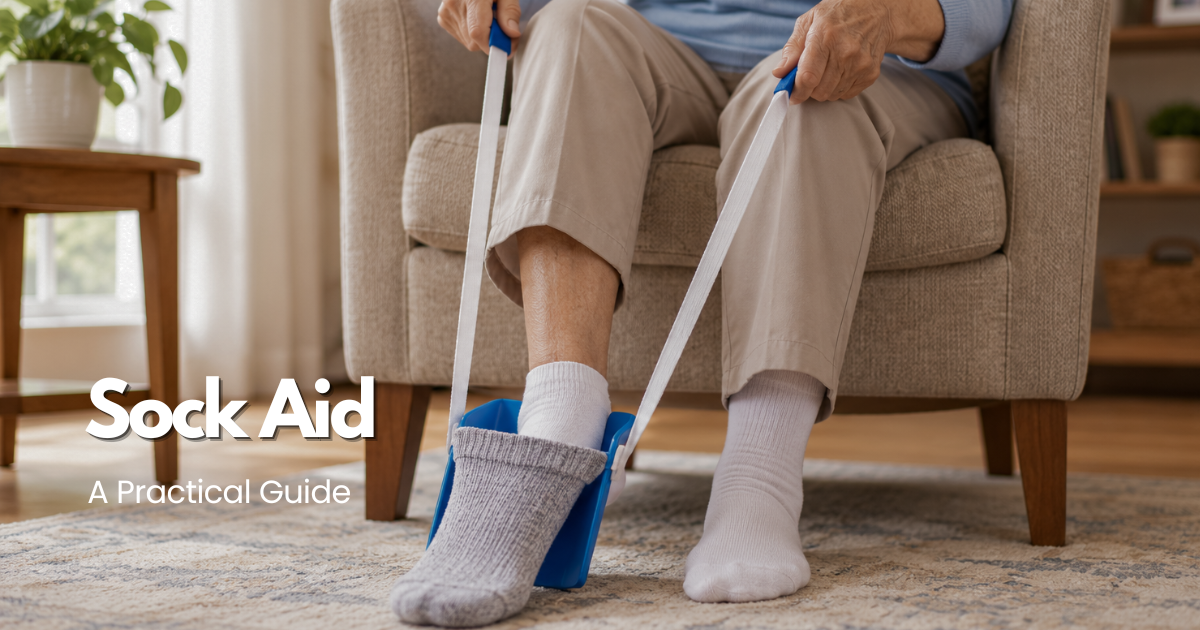
A sock aid helps a person put on an ordinary sock while seated, with less bending and reaching toward the feet. The right setup can support daily independence after a change in flexibility, balance, reach, or hand strength, but the device must fit the person, the sock, and the safety plan.
Quick answer: how does a sock aid work?
A sock aid holds a sock open while the user lowers it to the floor with straps, cords, or handles. The user slides a foot into the opening, then pulls the handles so the aid moves away while the sock travels up the foot and heel. This changes the task from bending toward the toes to controlling a tool from a seated position. A flexible cradle, a rigid shell, and a fabric sleeve may each use a slightly different loading motion, so the printed instructions for the particular device matter.
Use the aid from a stable chair with both feet supported or positioned predictably. Clear the floor, keep the handles within reach, and pull gradually. A sock aid is not a balance device, a treatment for foot swelling, or proof that a person can safely dress without help. Stop for pain, dizziness, shortness of breath, a sudden change in sensation, or any need to stand and catch balance.
For a first trial, use a clean, familiar, ordinary sock rather than a tight compression garment. If a surgery, injury, stroke, neurologic condition, severe arthritis, wound, or new weakness has changed dressing ability, ask the treating clinician or occupational therapist to review the method. An assistive device can make dressing easier, but it should be part of a realistic routine.
What a sock aid helps with when dressing is difficult
Putting on a sock combines several movements: bringing the leg forward, reaching to the foot, opening the sock, guiding the toes, clearing the heel, and smoothing the fabric. A sock aid primarily reduces the need to bend and reach. It may also reduce the amount of force needed to pull a sock past the heel when the garment is loose enough for the device.
That benefit is different from improving strength or balance. A person may be able to use a sock aid while seated yet still be unsafe walking across the room barefoot. The device also cannot correct a sock that is too small, twisted, bunched, or incompatible with its cradle. Consider the whole routine: where the person sits, how the feet get to the floor, how the aid is stored, and what happens if the sock does not land correctly.
Limited bending, hip movement, or back comfort
Reduced hip motion, a temporary bending restriction, or back discomfort can make a conventional toe-touching method impractical. A long strap or handle may let the user keep the trunk more upright. The important test is not whether the handle is long in isolation; it is whether the user can place, guide, and retrieve it without leaning past the chair’s support or twisting.
Hand arthritis, weak grip, or one-handed dressing
Some people can reach the foot but cannot stretch a sock around it or pull the heel into place. A sock aid can move the work to larger handles, but loading the sock may still require two hands. Look for a method that permits pauses and does not require a forceful pinch. A caregiver can load the aid while the user performs the controlled pull, if that division preserves comfort and consent.
Balance, sensation, and fatigue limits
Seated dressing may reduce one source of risk, but the user still needs enough trunk control to remain upright. Reduced sensation in the feet can make a fold or pressure point harder to notice. Fatigue can also change technique near the end of the task. Plan a rest, keep the chair close to a stable surface, and have help available during early practice if the person’s therapist recommends it.
Which sock aid design fits the daily task?
“Sock aid” describes a family of dressing aids rather than one universal shape. Flexible plastic or fabric cradles can collapse or flex as the foot enters. Rigid or semi-rigid shells hold a more definite opening. Some aids have two long cords; others have wide loop handles, foam grips, or extended handles. The useful design is the one the person can load and control with the socks used at home.
| Dressing challenge | Feature to examine | Trial question | Limit to remember |
|---|---|---|---|
| Limited bending | Strap or handle length | Can the user reach the control while sitting upright? | Length does not correct poor sitting balance. |
| Reduced hand strength | Grip diameter and texture | Can the user hold and release without pain? | A grip that feels large may still be hard to control. |
| Thicker everyday socks | Opening and cradle flexibility | Does the sock load without tearing or rolling? | Compatibility varies by sock and device. |
| Small or slippery socks | Fabric retention while loading | Does the sock stay in place through the first pull? | Yanking can make the aid slip or twist. |
| Foot pain or swelling | Clinical guidance and fit | Has the cause and safe garment choice been reviewed? | A dressing tool does not treat the cause. |
| Compression hosiery | Garment-specific donning aid | Has the prescriber or therapist approved this method? | An ordinary sock aid may not be suitable. |
Do not choose by a product photograph alone. Check the device’s dimensions, material, care instructions, handle shape, and stated sock compatibility. If buying online, treat “easy” or “universal” as marketing language until the actual fit and motion are confirmed. A local occupational therapy evaluation or medical-supply fitting can be more useful than a long list of features when the person has complex limitations.
How to use a sock aid step by step
The following sequence describes a common cradle-style sock aid. It is a practical starting point, not a substitute for the manufacturer’s directions or an individualized therapy session. Practice first with an ordinary sock while seated.
Set up the chair, floor, sock, and handles
Choose a sturdy chair that does not roll or swivel. Sit far enough back that the seat supports the pelvis and thighs, with the back close to a wall or other stable location when appropriate. Put the sock aid, sock, and handles where they can be reached without leaning forward suddenly. Remove a loose rug, pet toy, clothing, or other trip hazard from the floor. If a walker or cane is used, park it so it is accessible after dressing without creating a snag.
Check the sock before loading. Find the toe and heel, open the cuff, and note whether the fabric has a front or back. A twisted sock is harder to correct after it leaves the aid. If the sock is damp, damaged, or unusually tight, choose another garment for practice.
Load the sock without overstretching it
Place the sock over the top of the cradle according to the device directions. In a common design, the toe goes toward the end of the aid and the heel sits over the curved portion. Pull the cuff over the rim until it is secure but not stretched to its limit. Keep the seam and heel aligned as far as the design allows. If the sock slips off during loading, stop and reposition it; do not compensate with a faster pull.
Lower the aid and guide the foot forward
Hold the straps or handles and lower the aid to the floor. Keep the path between chair and aid clear. Extend one leg only as far as comfortable, then guide the toes into the opening. The foot should enter in line with the device rather than from the side. If the knee or hip cannot move into that position, do not force it. A therapist may suggest a different seat height, leg position, or aid.
Pull slowly until the sock clears the heel
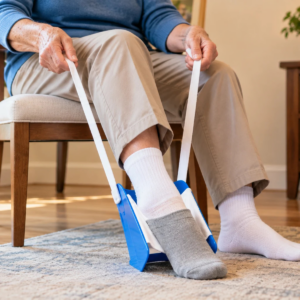
Pull the handles evenly and gradually. The sock should move with the aid as the foot advances. Pause if the fabric catches at the toes, ankle, or heel. Small adjustments are safer than a strong tug. Once the aid is free, inspect the toe, heel, ankle, and cuff. Smooth a fold only from a safe seated position; do not stand on one foot to fix a sock.
Repeat with the other foot and store the aid
Repeat only if the first side was comfortable and controlled. When finished, place the aid in a consistent, dry location where it will not become a floor hazard. Coil or shorten loose cords as the instructions allow. If a caregiver loads the device for the next use, label the routine clearly and check that the sock has not been left stretched on a way that could deform it.
How to troubleshoot a sock aid that slips, catches, or twists
A failed attempt is information about the setup. It does not mean the user should pull harder. First return the aid to the floor, keep the person seated, and identify where the motion stopped.
When the sock will not stay on the aid
Check that the cuff is pulled over the correct part of the cradle and that the heel is facing the device’s heel curve. Some socks are too short, too smooth, or too small for a particular aid. Try a slightly more generous ordinary sock before changing several variables at once. If the user has to pinch the cuff with painful fingers, ask whether someone else can load it or whether another design is needed.
When the foot stops at the opening
The opening may be misaligned, the sock may be folded inward, or the foot may be approaching at an angle. Reposition the leg from the chair rather than pushing the toes against the plastic. A high seat, a footrest, or a different cradle angle may help, but those changes should be tested carefully. Stop if the hip, knee, ankle, or wound becomes painful.
When the heel will not clear
Heel resistance often means the sock is too tight, the heel is not aligned, or the pull is not even. Release tension, remove the aid if possible, and inspect the garment. A sock aid cannot reliably apply a garment that is beyond the user’s available force or motion. For repeated difficulty, an occupational therapist can assess the garment, device, and technique together.
When the sock is on but bunched
Do not leave a thick ridge under the heel or across a toe, especially when sensation is reduced. Correct it while seated if the person can do so safely. If correction always requires bending, standing, or a second unsafe maneuver, the routine needs help or a different method. A well-fitted sock should feel comfortable and should not leave a new mark that persists.
When a sock aid is not the right solution
A sock aid may be unsuitable when the user cannot maintain a stable seated position, cannot control the handles, cannot lift or guide the foot, or cannot understand the sequence safely. It may also be the wrong tool when the problem is not ordinary socks but a medical garment, a painful swollen foot, a wound, or a new change in movement.
Compression socks need a separate plan
Compression stockings vary in pressure, length, fabric, and application method. A regular sock aid should not be assumed to work for them. Ask the prescriber, nurse, therapist, or pharmacist how the garment should be put on, whether a specific donning aid is approved, and when it should be worn. Do not change compression level, stop a prescribed garment, or force it over painful skin based only on a general dressing guide.
Foot wounds, numbness, or sudden swelling
A new wound, color change, marked swelling, unusual warmth, or sudden loss of sensation deserves clinical attention rather than a new gadget. People with diabetes, neuropathy, circulation problems, fragile skin, or prior foot ulcers may need a deliberate skin-check routine. A fold that another person would notice may not be felt by the wearer.
Recovery after surgery or injury
Postoperative restrictions differ. Some people are told not to bend beyond a certain angle, cross the legs, bear weight, or move a joint in a particular way. A sock aid may be prescribed as part of the dressing plan, but the safe method depends on the operation and phase of recovery. Follow the discharge instructions and ask the rehabilitation team to demonstrate the exact motion.
Safety checks for sock-aid dressing and fall prevention
The safest sock-aid routine makes it unnecessary to rush. Dress while seated, keep the floor clear, and leave enough time to fix a problem without standing. CDC fall-prevention materials emphasize removing trip hazards, improving lighting, reviewing individual fall risks with a health professional, and using supportive footwear. Those principles apply around dressing even though a sock aid itself is not a fall-prevention program.
Make the dressing area predictable
Use adequate lighting and keep the chair, aid, socks, footwear, and mobility device in known positions. Avoid dressing beside a bathtub, on a slippery bathroom floor, or at the edge of a bed unless that location has been assessed as safe. If shoes are part of the next step, put them within reach but not where the user must bend or twist to retrieve them.
Choose footwear after the sock is secure
A sock aid does not make loose socks, loose slippers, or poorly fitted shoes safe for walking. Check that the sock is smooth and that the shoe fits. CDC guidance recommends properly fitted, sturdy footwear with traction and support for older adults. If the person needs a shoehorn or reacher as well, practice the full sequence so the second tool does not undo the safe seated position.
Know when caregiver supervision is needed
Supervision can mean observing the first few attempts, loading the sock, or staying nearby while the person learns. It should not automatically mean taking over every step. Ask the user what help is wanted, agree on a short cue such as “pause,” and preserve privacy during dressing. Increase help when fatigue, illness, medication effects, vision changes, or confusion makes the usual routine less reliable.
Caregiver coaching for a repeatable sock-aid routine
Caregivers can make the device more useful by setting up the environment and documenting what works. Start with the person’s own socks and normal chair, not a demonstration that uses a different garment. Let the user describe where the movement becomes difficult. Then change one thing at a time: the seat position, the loading method, the handle location, or the sock.
Teach one motion at a time
Explain the sequence in short steps: load, lower, place the foot, pull slowly, inspect, and stop if it catches. Demonstrate without rushing. Have the user repeat the part they can control. Avoid pulling the aid from the other side of the room or giving several corrections simultaneously, because overload can reduce attention to balance.
Record the successful sock and setup
Write down which socks fit, how the heel was positioned, where the aid is stored, and what help is needed. A simple note can prevent repeated trial and error after a hospitalization or caregiver shift change. Recheck the method if the person’s footwear, swelling, strength, cognition, or chair changes.
Protect autonomy and dignity
Needing help with socks does not mean the person should lose control of the whole dressing routine. Offer choices, ask before touching a foot or leg, and allow extra time. If the user prefers a different aid or wants help only with loading, incorporate that preference when it is safe. Independence can mean directing the task, not necessarily doing every movement alone.
Cleaning, storage, and replacement of a sock aid
Follow the device’s care directions because materials differ. In general, keep the aid clean and dry, inspect straps and handles, and avoid storing it where it can be stepped on. A cracked shell, sharp edge, frayed cord, loose handle, or warped cradle can change the motion and injure skin or cause the sock to release unexpectedly.
Inspect the aid before regular use
Run a hand over accessible edges only when the device is clean and safe to handle. Check that attachment points are secure and that both handles respond evenly. Replace a damaged part if the manufacturer provides one, or stop using the device if the repair is uncertain. Do not tape over an edge that can still contact the foot unless a qualified professional confirms the repair.
Keep the storage location off the walking path
Store the aid in a drawer, basket, or wall location that the user can reach without climbing or bending unsafely. Keep cords contained. If several aids are used, label them by task. A tool that is hard to find may be left on the floor, creating a hazard before it helps with dressing.
Alternatives and companion dressing aids
Some people need a different solution, not a more complicated sock aid. A long-handled shoehorn may help with shoes, a dressing stick may move clothing, and a reacher may retrieve a dropped item. These tools address different tasks. A caregiver or therapist can map the complete dressing sequence and identify the one movement that creates the greatest barrier.
When hands-on help is safer
Hands-on assistance may be the safest option when the person cannot sit securely, has a painful or protected limb, becomes confused by the sequence, or repeatedly loses balance. Assistance should be planned rather than improvised: use safe body mechanics, explain each step, and follow any transfer or weight-bearing instructions. If the caregiver is experiencing pain or strain, ask for training.
When a professional assessment adds value
An occupational therapist can assess dressing, seating, reach, grip, cognition, and device fit in relation to the person’s daily life. A physical therapist may address balance or mobility concerns. A podiatrist or medical clinician can evaluate foot pain, wounds, swelling, sensation, and footwear needs. The right referral depends on the problem; a sock aid should not be used to postpone assessment of a new symptom.
Practical sock-aid checklist before relying on the routine
Use this checklist after practice and again whenever the routine changes:
- The chair is stable, the user can stay seated upright, and both feet can be guided without force.
- The floor and walking path are clear, well lit, and free of loose cords or rugs.
- The sock is ordinary, clean, intact, and compatible with the aid.
- The heel and toe can be aligned, and the sock stays on the cradle during a slow pull.
- The user can stop, release the handles, and ask for help without standing suddenly.
- The finished sock is smooth and comfortable, with no concerning pressure, mark, or fold.
- The aid has no crack, sharp edge, frayed cord, loose handle, or other defect.
- A backup plan exists for fatigue, a failed attempt, a missing aid, or a day when help is needed.
If any item fails, do not treat that as a challenge to push through. Change the setup, use help, or ask a clinician or therapist to review the task.
Frequently asked questions about sock aids
What is a sock aid used for?
A sock aid is used to help put on a sock while seated, especially when bending, reaching, gripping, or lifting the foot is difficult. It is most predictable with ordinary socks that fit the cradle. It does not automatically work for compression hosiery or replace an assessment of a new foot problem.
Can a sock aid help someone with arthritis?
It may reduce bending and the force needed at the foot, but loading the sock can still challenge painful hands. Choose a grip and loading method the person can control. If the motion causes joint pain or the person cannot release the handle, ask an occupational therapist about alternatives.
How do you use a sock aid without falling?
Use it while seated in a stable chair, on a clear floor, with the handles within reach. Pull slowly and do not stand on one foot to fix the sock. Keep supportive footwear and the mobility device available for the next step. Stop when balance or symptoms change.
Can a regular sock aid be used for compression socks?
Do not assume so. Compression garments differ from ordinary socks and may require a specific donning aid or technique. Follow the prescriber’s or therapist’s instructions, and ask whether the particular device is appropriate for the garment and the person’s condition.
What if the sock aid keeps slipping?
Check the heel direction, cuff placement, sock size, and the device’s compatibility. Try a familiar ordinary sock and a slower pull. If the aid still slips or the user must yank it, stop and seek a fitting or different design rather than adding force.
Does a sock aid work with swollen feet?
It may not, and the swelling itself may need evaluation. A tool can change how a sock is applied but cannot determine why the foot is swollen or whether a garment is safe. Ask a clinician before changing compression, footwear, or a prescribed dressing routine.
Can a caregiver load the sock aid for someone else?
Yes, if the person wants that help and the device instructions allow it. The user may still control the foot placement and pull, or the caregiver may provide more assistance. Agree on a pause cue and inspect the final sock for folds or pressure.
How should a sock aid be stored?
Keep it clean, dry, and off the walking path. Contain long straps or cords, and store it where the user or caregiver can reach it without climbing or unsafe bending. Inspect the cradle, edges, attachment points, and handles before regular use.
Final sock aid readiness check
A sock aid is ready to become part of the routine when the person can use the actual sock and chair safely, repeat the motion without pain or rushing, recognize when the sock has caught, and get help without standing unsafely. If those conditions are not present, the next step is not stronger pulling. It is a better fit, a different aid, caregiver support, or professional guidance. The goal is a comfortable, repeatable dressing task that supports independence without hiding a new medical or fall-related problem.
It is also worth checking the routine at the time of day when it will actually be used. A person who succeeds during a rested afternoon practice may struggle first thing in the morning, after bathing, or when pain medication is wearing off. Practice the same chair position, sock type, lighting, and footwear transition that will be used on an ordinary day. If the person becomes tired halfway through, the plan can include one sock at a time, a rest, and a later second attempt.
Keep a backup that does not depend on a difficult maneuver. That might be a caregiver who can load the aid, a pair of looser ordinary socks, or permission to postpone the task until assistance is available. The backup is not a failure of independence; it is part of making independence sustainable. Reassess after a fall, hospitalization, medication change, new vision problem, or meaningful change in strength or sensation.
Sources used for sock-aid safety and assistive-device guidance
- MedlinePlus: Assistive Devices — used for the general role of assistive devices in dressing and daily activities; it does not endorse a particular sock aid.
- Cambridgeshire and Peterborough NHS: Using a sock aid — used to cross-check the common load, foot placement, and gradual-pull sequence; the article keeps the device-specific instruction caveat.
- CDC: Preventing Falls and Hip Fractures — used for home-safety, lighting, hazard-removal, and clinician-discussion guidance; it is not a sock-aid product source.
- CDC STEADI: Feet and Footwear for Older Adults — used for properly fitted, supportive footwear and foot-risk context.