
elder care planning | SeniorTechLife caregiver resources guide
For many families, caring for an older adult involves several connected responsibilities. Medical appointments must be scheduled, medication information must remain accurate, household activities need coordination, and caregivers must understand who is responsible for each task.
Without a clear plan, important details may become scattered across messages, notebooks, calendars, medical documents, and different family members.
Effective Care Planning and Coordination provides a structured way to organize this information while respecting the older adult’s independence, privacy, and personal preferences.
A practical elder care plan may include daily routines, caregiver schedules, current medication lists, healthcare contacts, transportation arrangements, emergency information, and instructions for temporary caregiver replacements.
However, creating a care plan involves more than downloading a template. The information must reflect the person’s actual needs, current professional guidance, available support, and changing circumstances.
This comprehensive guide explains how Care Planning and Coordination works, how to create a daily care plan for elderly adults, organize medication information, coordinate caregivers, protect sensitive records, prepare for emergencies, and maintain an effective family care system.
Safety note: A family care plan is an organizational tool, not a replacement for medical assessment, licensed professional services, or emergency assistance. Medication instructions, medical procedures, complex mobility support, and changes in clinical care should follow guidance from qualified healthcare professionals.
Quick answer: how does care planning and coordination help families?
The main goal of Care Planning and Coordination is to ensure that everyone involved understands the older adult’s needs, preferences, important information, and assigned responsibilities.
A useful care plan answers several questions:
- What assistance does the person need?
- Which activities can they manage independently?
- Who provides everyday care?
- Who coordinates healthcare appointments?
- Where is the current medication list?
- How are care instructions communicated?
- What happens when a caregiver is unavailable?
- Who can access sensitive information?
- What emergency contacts are necessary?
- When should the care plan be reviewed?
The strongest Care Planning and Coordination approach is understandable, regularly maintained, and appropriate for the person receiving care.
Why elder care planning matters
An older adult may receive support from relatives, friends, professional caregivers, healthcare providers, and community organizations.
Each person may handle different responsibilities.
Without coordination, appointments may be missed, instructions may become outdated, or family members may assume someone else is responsible for a task.
Elder care planning helps make responsibilities visible and reduces unnecessary confusion.
What a care plan for elderly adults should include
A comprehensive plan may contain:
- Personal preferences.
- Current support needs.
- Daily routines.
- Healthcare contacts.
- Current medication information.
- Appointment schedules.
- Mobility and accessibility considerations.
- Meal arrangements.
- Caregiver responsibilities.
- Emergency procedures.
- Authorized information sharing.
- Backup caregiving arrangements.
- Follow-up and review dates.
The level of detail should reflect the person’s actual care needs.
What care planning cannot guarantee
A written plan cannot guarantee that every appointment will occur, every caregiver will be available, or every emergency will be prevented.
Care Planning and Coordination works best when instructions are accurate, responsibilities are confirmed, and backup arrangements are practical.
Understanding the main types of care planning and coordination
Different care arrangements require different levels of planning.
Family care planning
Family care planning organizes assistance provided by relatives and other trusted individuals.
It may include transportation, shopping, companionship, household tasks, and appointment coordination.
A shared schedule can help clarify responsibilities.
Professional home care coordination
Professional home care services may provide selected personal care, household assistance, or other authorized support.
Families should verify the provider’s qualifications, service responsibilities, working hours, and communication procedures.
Clinical responsibilities must remain within the provider’s authorized scope.
Healthcare care coordination
Healthcare coordination involves communication between the patient and appropriate professionals.
It may help organize referrals, appointments, treatment information, follow-up instructions, and transitions between healthcare settings.
A family caregiver can assist when appropriately authorized.
Daily care planning for elderly adults
A daily care plan for elderly adults describes important routines and support needs.
It may include meals, personal care, activities, appointments, mobility-related assistance, and rest.
Daily plans should remain flexible enough to accommodate changes in comfort, preferences, and health.
Long-term elder care planning
Long-term planning considers how support requirements might change.
Families may review home accessibility, caregiver availability, community services, finances, and potential transitions to other care settings.
Emergency and transition planning
Emergency planning addresses situations such as caregiver absence, hospitalization, evacuation, or interruption of essential services.
The plan should identify appropriate contacts, accessible information, and verified backup procedures.
Care Planning and Coordination: explore related guides
This article is the broad starting point for Care Planning and Coordination.
Specialized templates, formats, and planning tools are covered by narrower guides.
Medication list templates
Related topics include:
- Current Medication List Template.
- Medication List Template.
- Free Medication List Template.
- Medication List Template Word.
- Printable Medication List Template.
- Free Medication List Template Word.
- Excel Medication List Template.
- PDF Printable Medication List Template.
- Free Printable Medication List Template.
- Personal Medication List Template.
- Medication List Template PDF.
- Medication List Template for Patients.
- Patient Medication List Template.
- Google Sheets Medication List Template.
These guides can explain different formats, documentation practices, accessibility, and updating medication records.
Weekly caregiver schedules
Related topics include:
- Weekly Caregiver Schedule.
- Free Printable Weekly Caregiver Schedule Template.
These resources can provide practical approaches for assigning family caregiving responsibilities and maintaining backup coverage.
Elder care plan templates
Related topics include:
- Daily Care Plan for Elderly Template.
- Example Care Plan Template for Elderly.
- Sample Care Plan Template for Elderly.
These guides can explain how to document routines, responsibilities, care instructions, and periodic reviews.
Specialized care planning topics
Additional subjects include elder abuse care planning, professional nursing assessments, and jurisdiction-specific care arrangements.
Potential mistreatment or neglect requires an appropriate safeguarding response, rather than relying only on a general household planning template.
Publishing note: These are planned related resources, not verified active links. Navigation links should only be activated after each guide is published and reviewed.
Eight important decisions in care planning and coordination
The effectiveness of Care Planning and Coordination depends on how well the plan matches the person, caregivers, and environment.
1. Identify the older adult’s priorities
Begin with the person’s preferences and everyday activities.
Ask which routines they want to continue and where assistance is welcome.
The plan should support remaining abilities rather than assuming that all responsibilities must be transferred to caregivers.
2. Assess daily support needs
Review relevant activities such as dressing, meal preparation, transportation, household organization, mobility, and communication.
Complex medical or functional concerns may require qualified professional assessment.
3. Assign caregiver responsibilities
Identify who manages appointments, transportation, meals, communication, and other agreed tasks.
Avoid assigning the same responsibility to multiple people without clear coordination.
4. Establish accurate healthcare information
Maintain verified medication records, appropriate healthcare contacts, and current professional instructions.
Do not use old schedules or caregiver assumptions to change medical care.
5. Choose accessible planning tools
Some families prefer printed records.
Others use shared calendars, spreadsheets, or approved caregiver applications.
Choose tools that authorized participants can understand and maintain.
6. Protect consent and confidentiality
Discuss which caregivers may access information.
Use appropriate permissions and protect medical and financial records.
7. Evaluate time, costs, and support
Consider caregiver availability, professional services, transportation, equipment, and administrative workload.
The plan should be sustainable rather than dependent on unrealistic commitments.
8. Prepare reliable backups
Identify who will respond when an assigned caregiver becomes unavailable.
Record practical alternatives for transportation, communication, and essential care.
How to create a daily care plan for elderly adults
A daily care plan organizes ordinary activities into manageable responsibilities.
Start with familiar routines
Document the person’s normal schedule, including preferred waking times, meals, appointments, activities, and rest.
Avoid introducing unnecessary changes simply to make a chart look consistent.
Identify where assistance is needed
For each activity, clarify whether the person manages it independently, prefers occasional help, or requires an authorized caregiver.
Keep instructions specific
Instead of writing «help with mornings,» specify the agreed activity and responsible caregiver.
Clinical instructions should come from the healthcare team.
Record personal preferences
Include useful details about communication, favorite activities, meal preferences, and accessibility.
Avoid collecting information that is unnecessary for the care task.
Make the plan easy to understand
Use readable text, logical sections, clear dates, and familiar terminology.
A simple plan that caregivers consistently follow is often more useful than a complicated document.
Organizing caregiver roles and responsibilities
Care Planning and Coordination becomes more reliable when responsibilities are clearly assigned.
Identify the primary care coordinator
A family may designate one person to maintain the shared plan and confirm that important updates are communicated.
This person does not need to perform every caregiving activity.
Create a weekly caregiver schedule
A weekly schedule may document:
- Caregiver names.
- Days and agreed hours.
- Assigned responsibilities.
- Appointments.
- Transportation.
- Backup coverage.
- Relevant contact information.
Review the schedule with everyone involved.
Confirm task acceptance
Adding a person’s name to a calendar does not guarantee they agreed to provide care.
Confirm arrangements directly.
Document caregiver handoffs
When one caregiver replaces another, communicate relevant changes and outstanding responsibilities.
Use a consistent, appropriately secure method.
Reassess workload
If caregiving responsibilities become difficult to maintain, consider additional family assistance, appropriate professional services, or respite care.

Care Planning and Coordination: practical comparison table
| Planning tool | Main purpose | What to verify | Important limitation |
|---|---|---|---|
| Printed care plan | Document essential routines | Accuracy and accessibility | Can become outdated |
| Weekly caregiver schedule | Organize responsibilities | Confirmed availability | Assigned tasks may be missed |
| Medication list | Record verified medication information | Professional instructions and review date | Not a prescribing document |
| Shared digital calendar | Coordinate appointments | Permissions and notifications | May require internet or device access |
| Caregiver application | Organize selected care tasks | Security, compatibility, costs | Features vary |
| Emergency contact sheet | Provide important contacts | Current information | Does not guarantee availability |
| Appointment tracker | Record healthcare visits | Follow-up instructions | Requires regular updates |
| Daily care notes | Communicate relevant changes | Accuracy and privacy | Not a substitute for clinical records |
| Professional care plan | Guide authorized clinical care | Professional qualifications | Requires appropriate review |
Medication list templates and prescription coordination
Medication information is an important part of Care Planning and Coordination.
Maintain a current medication list
A medication list may include medication names, strengths, professional instructions, pharmacy information, and a review date.
It should reflect the current treatment plan.
Include relevant nonprescription products
Over-the-counter medications and supplements may be relevant to professional medication reviews.
Share appropriate information with the pharmacist or healthcare team.
Review changes after appointments
Medication instructions may change after hospital discharge, specialist visits, or other healthcare transitions.
If records conflict, seek clarification from the pharmacist or prescriber.
Compare medication list formats
A printed medication list may be convenient for appointments.
A spreadsheet or digital format may be easier to update.
Choose the format that supports accurate and authorized information sharing.
Avoid independent medication changes
Neither a caregiver checklist nor an app should be used to change medication doses or schedules without appropriate professional guidance.
Coordinating healthcare appointments and follow-up
Appointments can involve transportation, preparation, medical information, and follow-up tasks.
Maintain one current appointment calendar
Record confirmed dates, locations or virtual appointment details, and appropriate contact information.
Assign transportation responsibilities
Verify who will accompany or transport the older adult when assistance is needed.
Prepare appointment questions
With the person’s agreement, caregivers may help organize questions and observations for the healthcare professional.
Document verified follow-up instructions
After the appointment, record relevant tasks and assign appropriate responsibilities.
Avoid interpreting clinical instructions without professional clarification.
Coordinate specialists and primary care
Different healthcare professionals may provide information about related conditions.
Families should share relevant updates through appropriate authorized channels.
Privacy, consent, and safeguarding in elder care planning
Care Planning and Coordination should respect personal rights and protect sensitive information.
Include the older adult in decisions
The person receiving care should participate in decisions according to their preferences and decision-making abilities.
Age alone does not determine whether someone can make personal decisions.
Limit access to personal records
Use appropriate permissions for medical, financial, and household information.
Not every caregiver requires full access.
Protect printed and digital records
Store sensitive documents securely.
Avoid sharing passwords through unprotected notes or messaging systems.
Recognize possible neglect or mistreatment
Care coordinators should take concerns about unsafe care, coercion, neglect, or financial exploitation seriously.
Appropriate safeguarding professionals or local protective services may need to become involved.
Understand legal decision-making authority
Healthcare proxies, powers of attorney, and other legal arrangements vary by jurisdiction.
Seek qualified legal advice when authority or consent requirements are unclear.
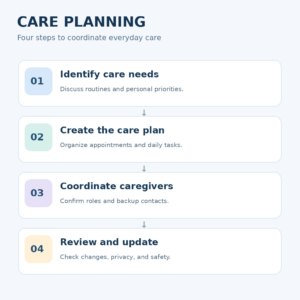
Care Planning and Coordination: practical four-step guide
A simple workflow can make care planning easier to maintain.
Step 1: Identify needs and priorities
Discuss the older adult’s routines, preferences, functional abilities, and necessary assistance.
Step 2: Organize the care plan
Record relevant daily activities, verified healthcare information, contacts, and appointments.
Step 3: Assign and confirm responsibilities
Identify caregivers for each task and establish appropriate backup coverage.
Step 4: Review and update
Evaluate how the plan works and revise it after important changes.

Organizing care during hospital discharge and transitions
Transitions between healthcare settings can introduce new responsibilities.
Review discharge instructions
Before leaving a healthcare facility, ensure that the patient or authorized caregiver understands relevant instructions and follow-up arrangements.
Confirm the updated medication list
Discharge records may differ from earlier information.
Ask the healthcare team to resolve discrepancies.
Verify needed equipment and services
If the person requires new mobility equipment, therapy, nursing care, or personal assistance, clarify the appropriate arrangements.
Update the home care schedule
Additional responsibilities may be needed temporarily after discharge.
Ensure caregivers understand what has changed.
Arrange appropriate follow-up
Keep contact information and scheduled appointments accessible.
Seek professional clarification when important instructions are missing.
Testing care plans and caregiver handoffs
A written plan should be practical under ordinary conditions.
Test 1: An ordinary day
Review whether the schedule reflects the person’s real activities and the assistance actually provided.
Test 2: An appointment change
Confirm that the responsible caregiver receives the updated information.
Test 3: A caregiver handoff
Have the incoming authorized caregiver review important instructions and identify any unanswered questions.
Test 4: An unavailable caregiver
Discuss how backup coverage will be arranged.
Do not deliberately leave essential care uncovered during testing.
Test 5: A change in health needs
After a meaningful change in health or functioning, obtain appropriate guidance and reassess the plan.
Common care planning and coordination mistakes
Using an outdated care plan
An old medication list, caregiver schedule, or contact sheet can cause confusion.
Keep essential information current.
Assigning responsibilities without confirmation
A calendar entry is not proof that a caregiver is available.
Confirm responsibilities.
Creating too many conflicting records
Different documents may contain inconsistent instructions.
Establish a clear process for identifying current information.
Ignoring personal preferences
A care plan should reflect the older adult’s routines and choices rather than serving only administrative convenience.
Overlooking privacy
Sharing every detail with every helper may expose unnecessary sensitive information.
Treating a template as a clinical care plan
General planning templates are not substitutes for individualized professional assessments or authorized nursing care plans.
Forgetting backups
A plan may fail when the primary caregiver, transportation, or communication system is unavailable.
Maintaining a reliable elder care plan
Effective Care Planning and Coordination requires regular maintenance.
Initial setup
Document the primary coordinator, relevant caregiver roles, current information, and authorized access.
Daily observations
Record relevant changes that caregivers need to communicate.
Avoid unnecessary duplication or speculation.
Weekly schedule review
Confirm upcoming appointments, care coverage, and unresolved tasks.
Monthly care plan review
Check:
- Current caregiver assignments.
- Important contacts.
- Appointment information.
- Verified medication records.
- Home accessibility needs.
- Care services.
- Privacy permissions.
- Backup coverage.
- Review dates.
After a hospital visit
Confirm new care instructions and update appropriate records.
After changing caregivers
Reassign responsibilities and remove outdated information access.
After moving or changing routines
Reassess the plan for the new environment and available support.
Safe everyday coordination for older adults
A good care plan should improve communication without unnecessarily limiting independence.
Keep routines familiar
Use the person’s preferred schedule as the starting point.
Encourage participation
Allow the older adult to make or contribute to decisions whenever appropriate.
Use understandable instructions
Keep notes clear and relevant.
Avoid complex abbreviations that caregivers may interpret differently.
Communicate changes promptly
Important changes should reach the responsible people through an agreed method.
Respect caregiver boundaries
Reliable care should not depend indefinitely on unrealistic expectations of one family member.
Emergency and backup planning for elderly care
Care Planning and Coordination should include clear procedures for unexpected situations.
Maintain emergency contact information
Keep current contacts for authorized relatives, healthcare providers, and appropriate emergency services.
Establish backup caregiver coverage
Identify who can provide suitable assistance when the primary caregiver is unavailable.
Prepare for power or internet interruptions
Keep necessary information accessible independently of a single app or connected device.
Coordinate essential equipment needs
Medical and mobility equipment may require specific instructions or professional support.
Do not improvise repairs or substitute unsuitable equipment.
Review changing care needs
New illness, falls, changes in functioning, or caregiver transitions may require prompt updates to the care plan.
Care Planning and Coordination: final checklist
Before relying on a family care plan, confirm:
- The older adult’s preferences are documented.
- Current support needs are understood.
- Daily routines are manageable.
- Caregiver responsibilities are clearly assigned.
- Backup caregivers are identified.
- Appointments are organized.
- Medication information is current and verified.
- Healthcare contacts are accurate.
- Transportation arrangements are confirmed.
- Appropriate professional instructions are available.
- Privacy permissions are understood.
- Emergency procedures are accessible.
- Important records can be recovered.
- Caregivers know how to communicate changes.
- The plan has a review date.
Frequently asked questions about Care Planning and Coordination
What is Care Planning and Coordination?
Care Planning and Coordination is the process of organizing everyday care needs, appointments, responsibilities, relevant records, and communication between the person receiving care and authorized helpers.
Why is elder care planning important?
Elder care planning helps clarify responsibilities and reduces confusion when multiple caregivers or healthcare professionals are involved.
What should a daily care plan for elderly adults include?
A daily plan may include preferred routines, personal care assistance, meals, activities, appointments, caregiver responsibilities, and relevant professional instructions.
Can families use a free care plan template?
Yes. A general template can help organize information.
However, it should be adapted to the person’s needs and should not replace clinical guidance.
What is a weekly caregiver schedule?
A weekly caregiver schedule records who provides agreed assistance, when they are available, and what responsibilities they have accepted.
How should families organize medication lists?
Use a current record reflecting verified instructions from healthcare professionals.
Update it after prescription changes and resolve discrepancies with a pharmacist or prescriber.
Are caregiver apps useful for care coordination?
Some applications can help organize calendars, tasks, and communication.
Suitability depends on usability, security, cost, and available backup methods.
How can families prevent missed appointments?
Maintain one current appointment calendar, assign transportation and attendance responsibilities, and confirm changes directly.
What happens when a family caregiver is unavailable?
Use a prearranged backup caregiver or suitable professional service.
Essential care should not depend on an unconfirmed replacement.
Can care planning help prevent caregiver burnout?
Clear responsibilities, realistic workload distribution, and suitable respite arrangements may help make caregiving more sustainable.
Should an older adult participate in care planning?
Yes, according to their wishes and decision-making abilities.
Care plans should respect personal choice and applicable consent requirements.
Is a care plan template the same as a nursing care plan?
No. A general family care template organizes practical responsibilities, while a nursing care plan involves professional clinical assessment and care planning.
When should Care Planning and Coordination be reviewed?
Review the plan periodically and after hospital discharge, changes in health, a fall, relocation, caregiver changes, or significant changes in daily routines.
Final thoughts on Care Planning and Coordination
Care Planning and Coordination works best when accurate information, clear responsibilities, respectful communication, professional guidance, and dependable backup arrangements are considered together.
A successful elder care plan does not need to involve expensive software or complicated documentation.
A current medication list, organized appointment calendar, manageable daily routines, confirmed caregiver schedule, and reliable communication process can provide meaningful support.
The strongest Care Planning and Coordination approach is personalized, accessible, regularly reviewed, and designed to preserve the older adult’s independence while helping caregivers work together.
Sources used for this guide
Official sources support the planning framework; they do not endorse a company, provider, organization, or product.
- Caregiving — National Institute on Aging.
- Aging in Place: Growing Older at Home — National Institute on Aging.
- Unique Considerations in the Home — U.S. Food and Drug Administration.
Build a safer plan
General education only; seek qualified professional, clinical, legal, or emergency help when appropriate.